Have you ever noticed that a puddle on the playground seems to disappear after a sunny day? It can feel like a mystery at first. But scientists do not solve mysteries by guessing. They look closely, gather clues, and use those clues to explain what happened. Those clues are called evidence. Learning how to use evidence is one of the most important things scientists and engineers do.
When we construct an explanation, we build an idea about why something happens and support it with facts we can observe. In science, this means we use what we see, hear, measure, or record to explain the natural world. In engineering, people also use evidence, but they often use it to improve a design or solve a problem.
A strong explanation is not just an opinion. It is not the same as saying, "I think so." A strong explanation tells what happened and why we know. For example, if a plant by the window grows taller than a plant in a dark corner, we should not just say, "The window plant is lucky." We should look for evidence and explain what the evidence shows.
In science, evidence is information that helps us answer a question. Evidence can come from careful watching, measuring, comparing, and testing. If you watch a caterpillar every day and draw what changes, your drawings are evidence. If you measure a bean plant and write the height each week, those measurements are evidence too.
Observation is something you notice using your senses or tools. A pattern is something that happens again and again in a similar way. An explanation is a reasoned answer that tells why something happens, based on evidence.
Observations can be simple. You may notice that ice left on a table becomes water. You may hear that a bell sounds softer from far away. You may feel that dark pavement gets warmer than grass in sunlight. Each observation gives a piece of the puzzle.
Sometimes scientists use tools to make observations even better. A ruler helps measure length. A thermometer helps measure temperature. A balance helps measure mass. These tools help make evidence more exact. Instead of saying a plant is "bigger," a scientist might say it grew from \(6\,\textrm{cm}\) to \(10\,\textrm{cm}\). Exact evidence helps make a stronger explanation.
Evidence can come from many places, as [Figure 1] shows with notes, drawings, and measurements collected over time. A scientist may watch an object, take pictures, record numbers, or compare results from different days. Even a simple notebook can become full of valuable evidence.
For young scientists, evidence often comes from repeated observations. If you look at the sky at the same time every afternoon for a week, you may notice changes in clouds, sunlight, or wind. If you test how far different paper airplanes fly, each flight gives you evidence. One observation can help, but many observations are better because they show whether the same thing keeps happening.
Evidence can also come from someone else's careful work. Scientists often read reports, look at charts, or study data that other scientists have collected. What matters is that the information is careful, clear, and related to the question being asked.
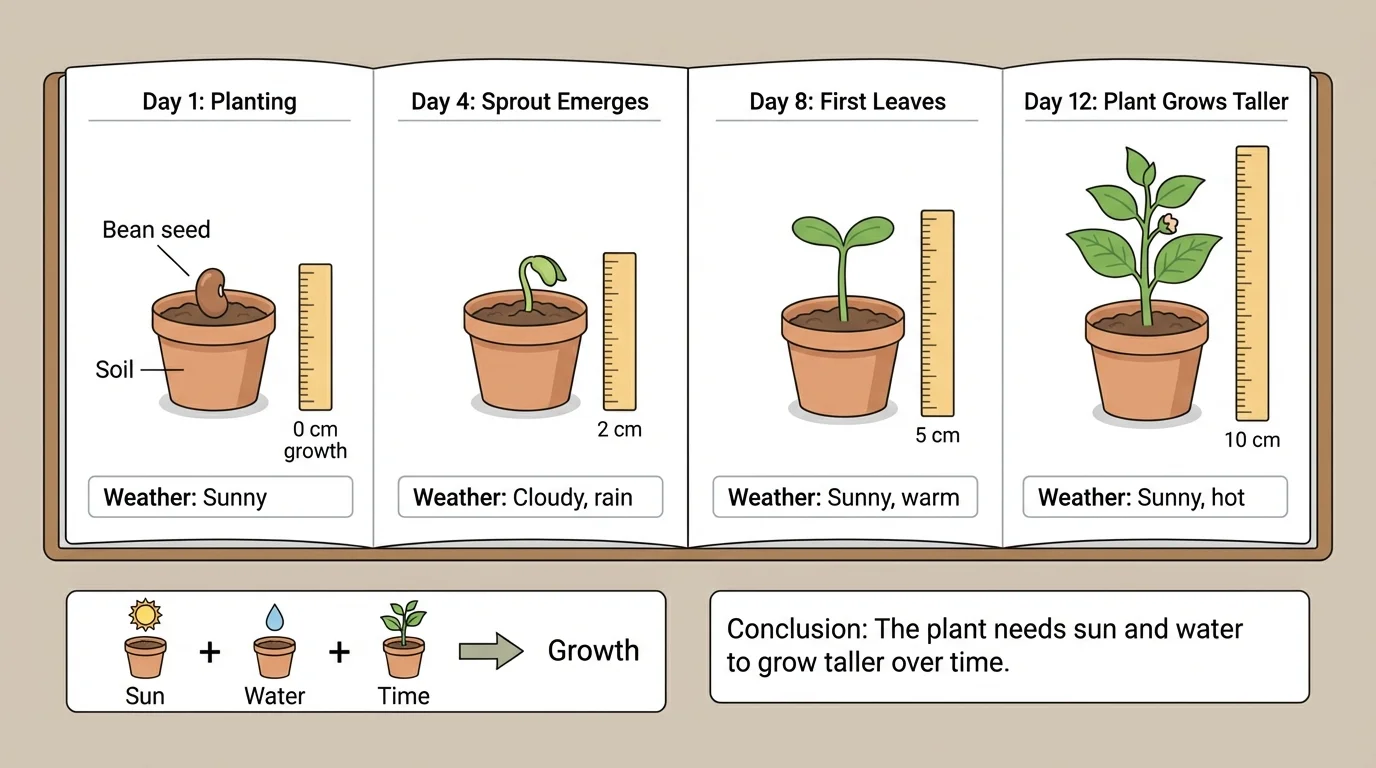
If a student wants to know why one plant grows faster than another, the student might collect these kinds of evidence: how much water each plant gets, how much sunlight each plant gets, the height of each plant every few days, and the color of the leaves. Each piece helps the explanation become more complete.
Scientists often trust repeated results more than single results. If the same pattern appears again and again, the explanation becomes stronger.
That is why careful records matter. A scientist does not want to depend only on memory. Writing things down helps us check our ideas later and see whether our explanation really matches the evidence.
A pattern helps us notice repeated changes, as [Figure 2] illustrates with two plants that grow differently in sunlight and shade. Patterns help scientists move from "I saw this once" to "This seems to happen regularly."
Suppose a class grows two bean plants. One plant is placed in sunlight. The other is kept in a darker place. Every two days, students measure both plants. After many days, they may notice a pattern: the sunny plant is taller and greener, while the darker plant grows more slowly and looks pale. That repeating difference is important evidence.
Patterns can show change over time, differences between groups, or things that happen together. If shadows are short near midday and long in the morning and late afternoon, that is a pattern. If metal playground slides feel hotter than plastic seats under the same sunlight, that is also a pattern. Scientists ask, "What does this repeating pattern tell us?"
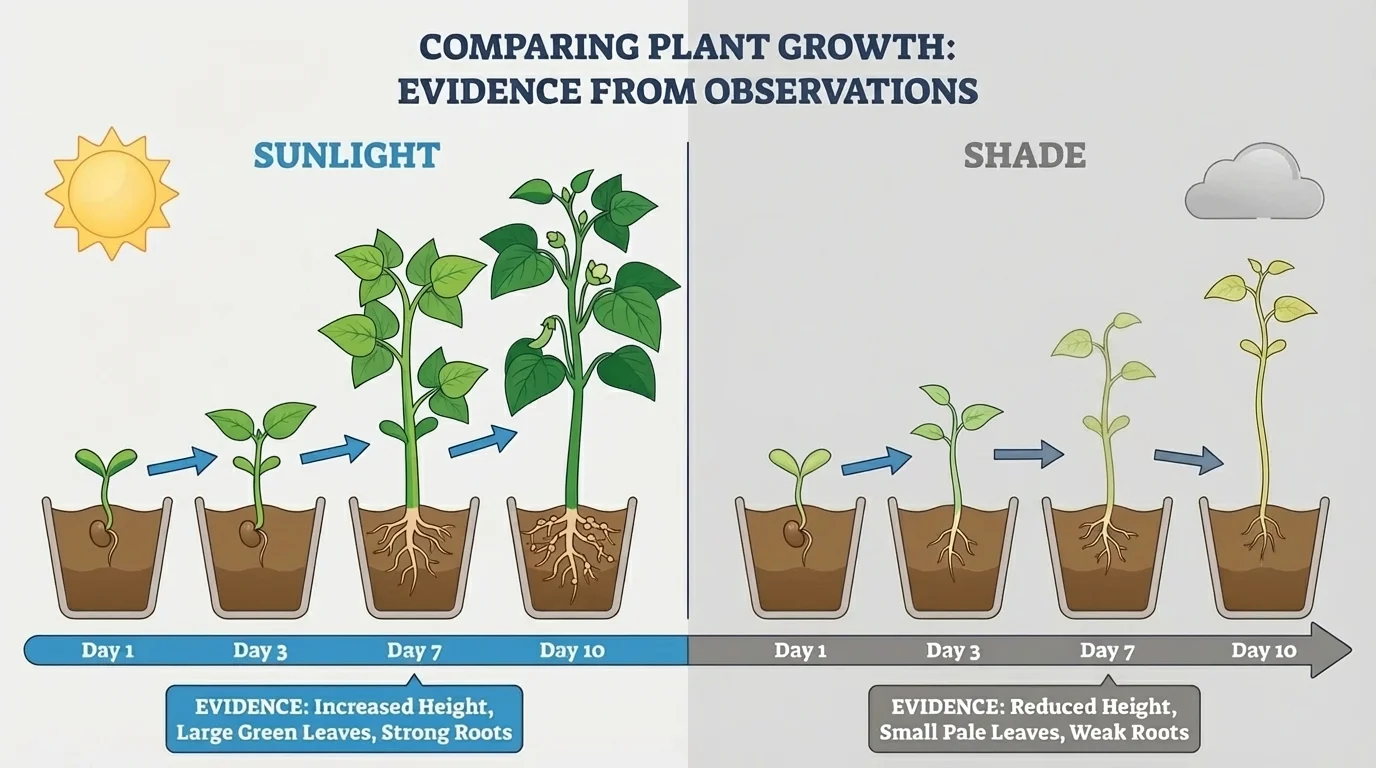
Patterns do not answer every question by themselves, but they point us in the right direction. Seeing the same result again and again suggests that something important is happening. Later, when we explain plant growth or shadow changes, we can return to that pattern and use it as support for our reasoning.
Now comes the big step: using evidence to explain. An explanation usually answers a question like "Why did this happen?" or "What caused this change?" To build a good explanation, we connect our evidence to a reasonable idea.
For example, let us say students ask, "Why did the plant near the window grow taller?" Their evidence shows that the window plant received more sunlight, stayed greener, and grew more each week. A good explanation would be: the plant near the window grew taller because plants need light to make food and grow, and this plant got more light than the one in the darker place.
How an explanation is built
A useful explanation has three parts: a question, evidence related to the question, and reasoning that connects the evidence to the answer. The evidence tells what was observed. The reasoning tells why those observations support the explanation.
Notice that the explanation does not just repeat the evidence. It goes one step further. It says what the evidence means. If you only say, "The plant by the window was \(4\,\textrm{cm}\) taller," that is evidence. If you add, "This supports the idea that more sunlight helped the plant grow," that becomes part of an explanation.
Scientists also compare different explanations. If one explanation matches the evidence better than another, it is stronger. If the evidence does not fit, the explanation may need to change.
Not every explanation is equally strong. A strong explanation uses more than one piece of evidence. It matches the observations clearly. It does not ignore important facts. And it is based on a fair test when possible.
A fair test means changing one thing at a time and keeping other things the same. If students test whether sunlight helps plants grow, they should use the same kind of plant, the same amount of water, similar soil, and similar pots. Then sunlight is the main difference. This makes the evidence more trustworthy.
If too many things change at once, the explanation becomes weaker. Imagine one plant gets more sunlight, more water, and a larger pot. Then if it grows taller, we do not know which change mattered most. Scientists try to keep tests fair so their explanations are based on clear evidence.
Example: Explaining why a puddle gets smaller
Question: Why did a puddle on the pavement get smaller during the day?
Step 1: Gather evidence.
Students observe that the puddle is larger in the morning and smaller in the afternoon. They notice the day is sunny and warm. They also notice that a puddle in the shade stays longer.
Step 2: Look for patterns.
On several sunny days, puddles in sunny places disappear faster than puddles in shady places.
Step 3: Construct the explanation.
The puddle gets smaller because water evaporates faster in warm sunlight. The repeated pattern of sunny puddles drying faster supports this explanation.
When scientists are careful with fair tests, their explanations are easier to trust. That does not mean they are always perfect. It means the explanation is supported by the best evidence they have.
Science and engineering are connected, but they are not exactly the same. In science, we often ask, "Why does this happen?" In engineering, we often ask, "How can we solve this problem?" The difference is clear in [Figure 3], which shows students both explaining a weak bridge and redesigning it to hold more weight.
If a paper bridge bends when books are placed on it, science helps us explain why it bends. Maybe the paper is flat and not stiff enough. Maybe the weight is too great. Engineering uses that evidence to design a better bridge. Students might fold the paper into shapes that make it stronger, test it again, and use the new evidence to improve the design.
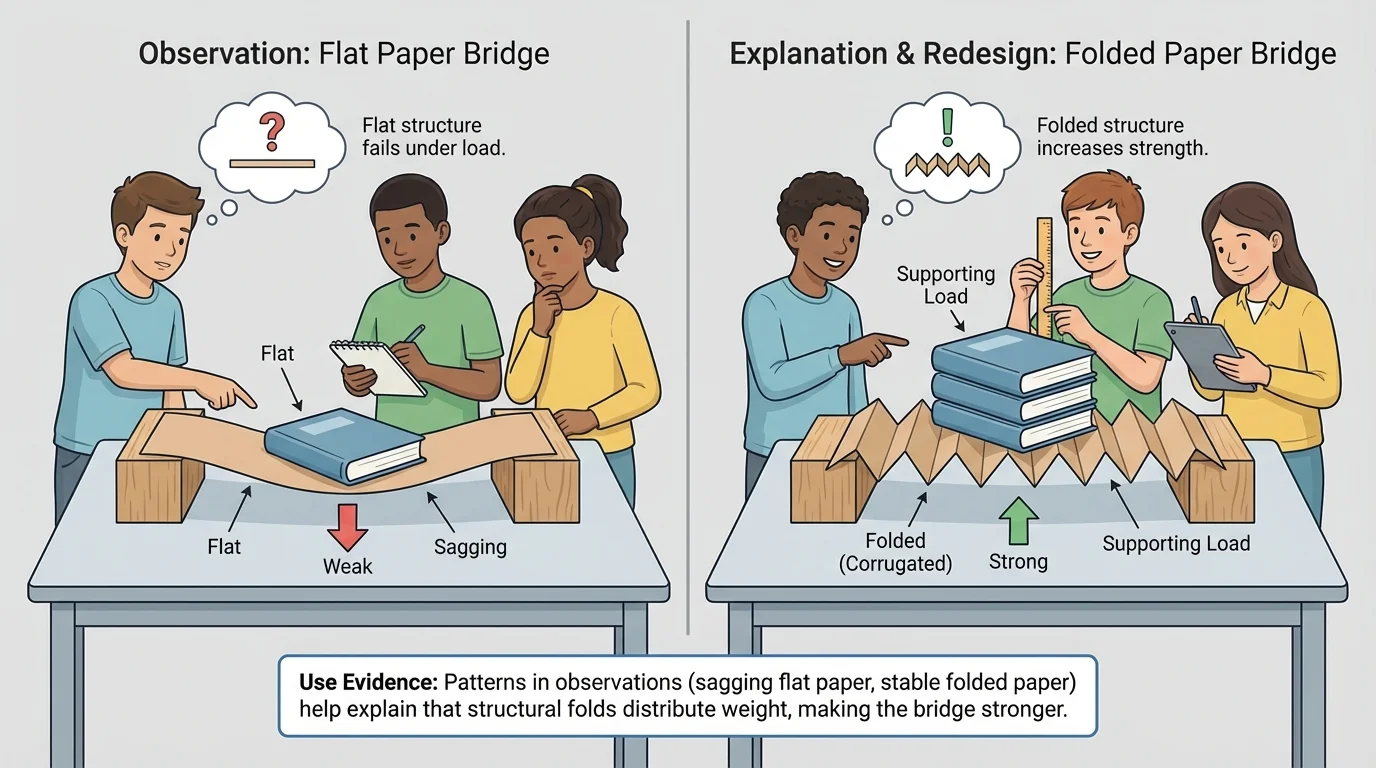
So in science, we construct explanations. In engineering, we also use evidence, but we often design solutions. The two ideas work together. First we understand what is happening. Then we use that understanding to make something better.
Later, when students compare weak and strong bridges, they can use the same thinking: observe carefully, test fairly, and use results to support a design choice.
People use evidence every day, even outside a science classroom. A doctor listens to symptoms, checks temperature, and may order tests before explaining why a person feels sick. A meteorologist studies clouds, wind, and temperature to explain and predict weather. A builder tests materials to decide which design is safest.
Here are a few simple science examples:
Example 1: A class notices that metal spoons in hot soup warm up quickly. Their evidence is that the metal spoon feels hotter sooner than a wooden spoon. Their explanation is that metal transfers heat more quickly than wood.
Example 2: Students observe that shadows move across the playground during the day. Their evidence is the changing position and length of the shadows. Their explanation is that the Sun appears to move across the sky, which changes where shadows fall.
Example 3: A team builds two paper helicopters. One falls slowly, and one falls quickly. Their evidence includes the sizes of the blades and how long each takes to fall. Their explanation may be that wider blades create more air resistance, slowing the fall.
Remember that evidence must connect to the question. Interesting facts that do not help answer the question are not useful support for an explanation.
These examples show that evidence can come from everyday life. The important part is thinking carefully: What did we observe? What pattern did we find? What explanation fits best?
One common mistake is confusing an opinion with evidence. Saying "I like this idea better" is not scientific evidence. Another mistake is using only one observation. One small clue may help, but more clues usually make the explanation stronger.
A third mistake is ignoring evidence that does not fit. Suppose you think plants only need water, but your notes show that well-watered plants in darkness still grow poorly. That evidence matters. Good scientists pay attention to all the evidence, not just the parts they like.
Another mistake is making explanations that are too big for the evidence. If you see one bird eating one kind of seed, you cannot explain all bird feeding behavior everywhere. Scientists try to make explanations that match what the evidence really supports.
"Good explanations grow from good evidence."
This idea reminds us to be careful thinkers. We do not need to know everything at once. We just need to observe carefully, think honestly, and use evidence well.
Scientific explanations are not frozen forever. New evidence can make an explanation stronger, weaker, or different. That is not a problem. It is one of the strengths of science.
Suppose students first think one plant grew poorly because it got too little water. Later they check their notes from [Figure 1] and see that both plants got the same amount of water. Then they notice the darker location. Now they have better evidence that light, not water, was the main difference. Their explanation changes because the evidence changed.
Example: Revising an explanation
Question: Why did one ice cube melt faster?
Step 1: First idea.
A student thinks the ice cube melted faster because it was smaller.
Step 2: New evidence.
The student measures both ice cubes and finds they are the same size. One was on a metal tray, and one was on a foam tray.
Step 3: Better explanation.
The ice cube on the metal tray melted faster because metal transfers heat better than foam. The new evidence supports a new explanation.
Changing an explanation when new evidence appears is a smart scientific habit. It shows that the scientist is listening to the evidence instead of holding onto a guess.
When you use evidence to construct an explanation, you are thinking like a scientist. When you use evidence to improve a design, you are thinking like an engineer. Both ways of thinking help people understand the world and solve real problems.
