Why do puppies from the same litter look alike, yet not exactly the same? Why might you have your mother's curly hair but your father's smile? Living things carry clues from their families, but their surroundings matter too. The food they eat, the amount of sunlight they get, and the things they learn can all make a difference. Scientists study these patterns to understand why organisms look and act the way they do.
A trait is a characteristic of a living thing. Traits can be things you see easily, like eye color, fur color, leaf shape, or the length of a dog's tail. Traits can also be things that are harder to see, like how fast a plant grows or whether a bird sings a certain song.
People, animals, and plants all have traits. A sunflower may have tall stems and bright yellow petals. A rabbit may have long ears and soft fur. A person may have dimples, straight hair, or freckles. Traits help us notice similarities and differences among living things.
Some traits are present when an organism begins life. A kitten may be born with gray fur. A baby plant may sprout with a certain leaf shape. These are often traits that come from parents. Other characteristics develop later because of what happens during life.
Inherited traits are characteristics that are passed from parents to offspring. Environment means everything around a living thing, such as food, water, sunlight, temperature, and other living things. A learned behavior is something an organism learns from experience or practice, rather than being born knowing it.
When scientists talk about traits, they ask careful questions. Did this characteristic come mostly from the parents? Did it change because of the environment? Or did both inheritance and environment work together? These questions help us understand life more clearly.
Many traits are passed from parents to offspring. In families, children may look like one parent, the other parent, or both, as [Figure 1] shows. A child may have a parent's brown eyes, another parent's hair color, or a mix of family features. In animals, a calf may have coat colors similar to its parents. In plants, seeds from a tomato plant grow into tomato plants, not into bean plants or oak trees.
This passing of traits from parents to offspring is called inheritance. It helps explain why young organisms are the same kind of organism as their parents. Cats have kittens, oak trees grow from acorns made by oak trees, and ducks hatch ducklings.
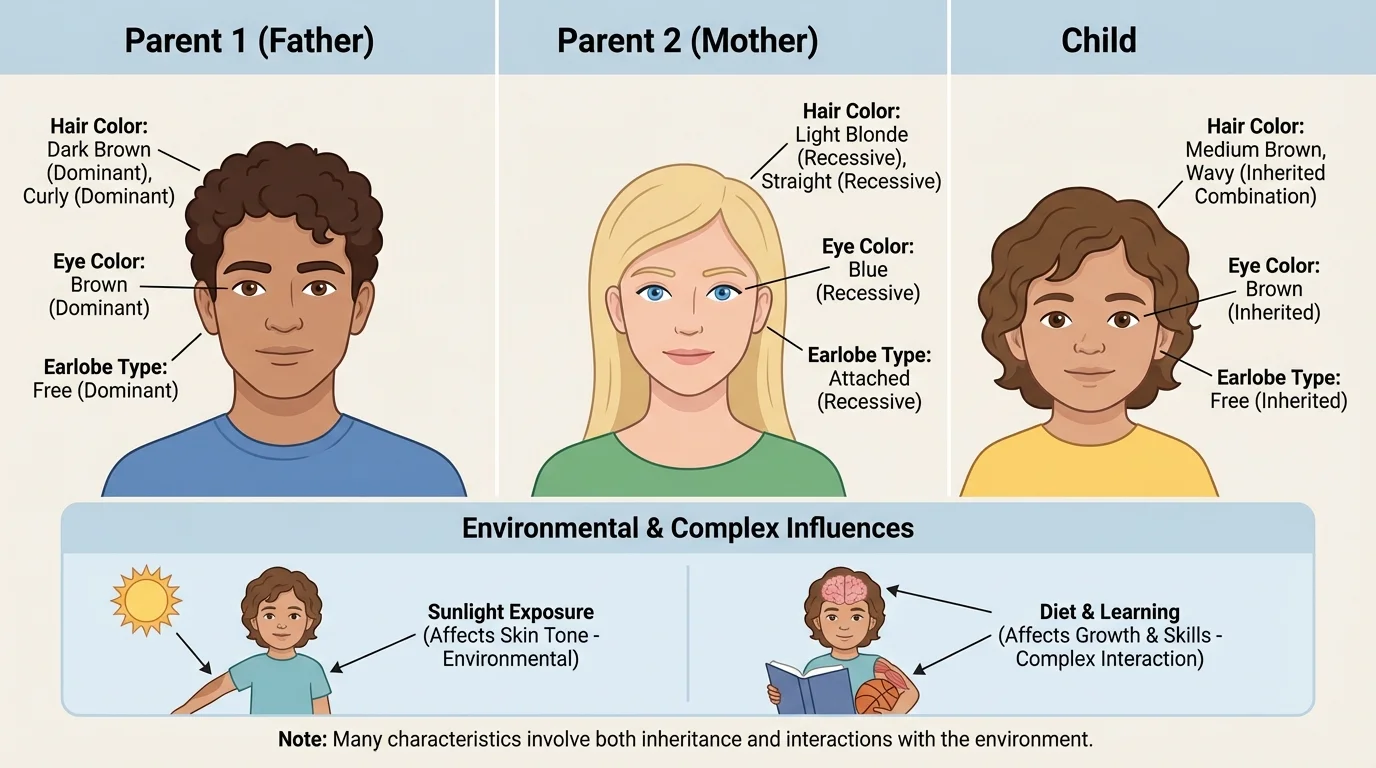
Even though offspring are similar to their parents, they are not exact copies. Brothers and sisters in the same family can have different hair textures, heights, or face shapes. Puppies from one litter may have slightly different markings. This is one reason living things of the same kind can still look different from one another.
Inside living things are instructions that help guide traits. Students at this grade do not need all the tiny details, but it is helpful to know that organisms receive biological information from their parents. That information helps shape features such as flower color, feather pattern, or whether a person has naturally curly or straight hair.
Some baby animals can do amazing things very early in life. A foal can often stand and walk soon after it is born because many of those body traits and instincts are part of its inherited biology.
Inheritance does not mean every trait matches perfectly. A child may have the same eye color as a parent but a different nose shape. A young plant may have leaves like its parent plant but grow to a different size depending on its surroundings. Later, when we look at traits shaped by both inheritance and environment, the family pattern in [Figure 1] remains useful because it reminds us that inherited starting points come from parents.
Some characteristics result from a living thing's environment. Environment includes the conditions and experiences around an organism. A plant with the same genetic information can grow tall and healthy in good sunlight and water, or small and weak in poor conditions.
[Figure 2] Think about two bean plants from the same packet of seeds. If one plant gets enough water, rich soil, and sunlight, it may grow strong green leaves. If the other plant gets too little water or too little light, it may grow more slowly and look pale. The seeds came from the same kind of plant, but the environment changed how well each plant grew.
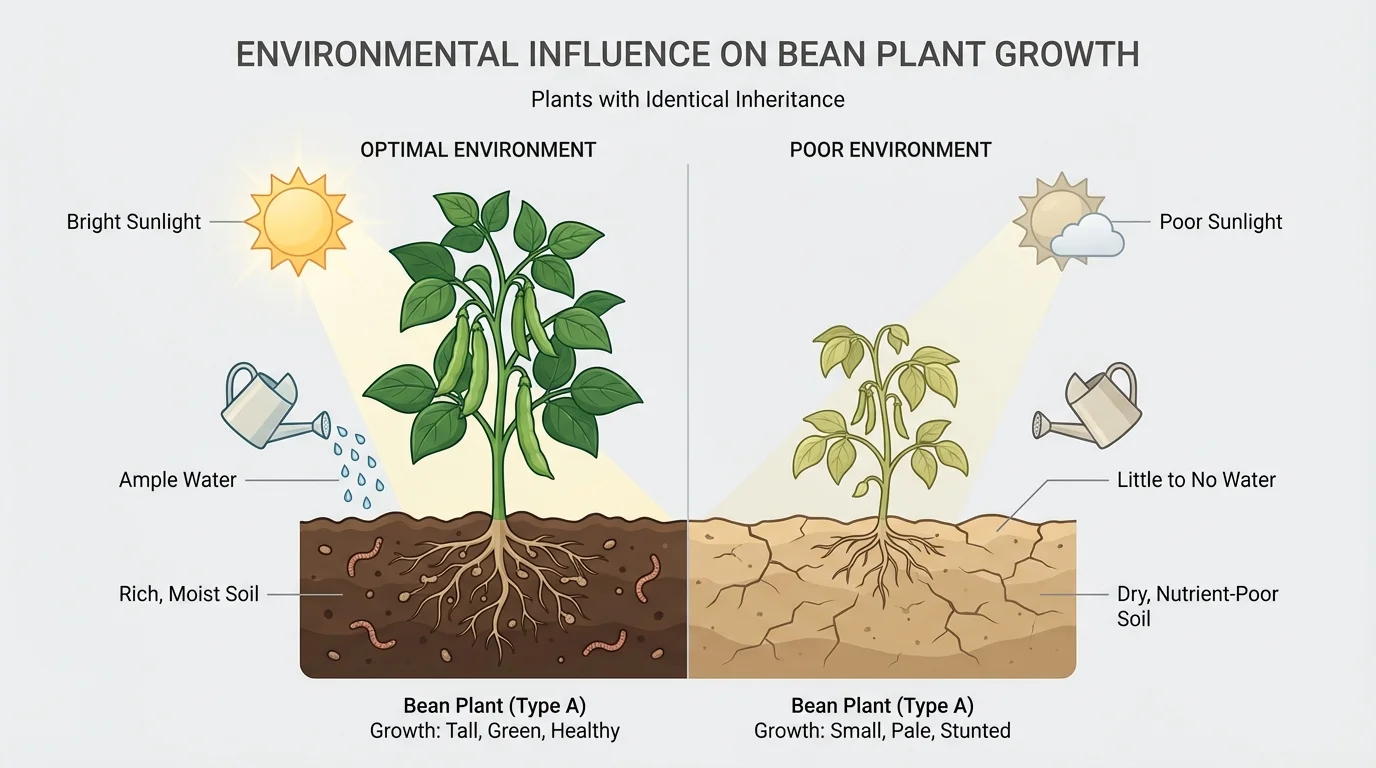
Animals are affected by environment too. A puppy that eats healthy food and gets care is more likely to grow well. A wild rabbit living where food is scarce may not grow as well as one living where food is easy to find. In people, exercise can make muscles stronger, and sunlight can darken skin temporarily into a tan.
Some changes are clearly not inherited. A scar from falling off a bike does not get passed to future children. Pierced ears are not inherited either. These are changes that happen during life, not traits passed from parents.
Example: same kind of plant, different results
Step 1: Start with two plants of the same kind.
They have similar inherited instructions because they come from the same type of seed.
Step 2: Change the environment.
Plant A gets enough water and sunlight. Plant B gets too little water.
Step 3: Observe the difference.
Plant A grows taller and greener. Plant B grows less and may wilt.
The difference in growth happens mostly because of the environment, not because Plant B is a different species.
Environment can also affect behavior. A pet dog that is trained may sit when told. Another dog of the same breed may not do that if it was never trained. The dog's inherited traits help make it what it is, but experiences change what it does.
Some characteristics are not physical body traits at all. They are behaviors. A baby bird may have an inherited ability to make sounds, but some birds learn special songs by listening to older birds. A child is not born knowing how to read, ride a bike, or tie shoes. These are learned behaviors and skills.
A behavior is something an organism does. Some behaviors are inherited, such as a spider spinning a web or a baby sea turtle moving toward the ocean soon after hatching. Other behaviors are learned, such as a dog learning tricks or a child learning to swim.
This means scientists must be careful. If they see a bird singing a certain way, they ask: was that song inherited, learned, or both? If they see a person who is very skilled at soccer, they know practice matters a lot. The ability to move and grow comes from the body, but skill improves with learning and experience.
Inherited traits and learned behaviors are not the same thing. Inherited traits are passed from parents, like eye color or fur pattern. Learned behaviors come from practice, teaching, or experience, like speaking a language or performing a dance. Some actions may include both: a bird may inherit the ability to sing but learn the exact pattern of its song.
Learning can change what an organism can do, but it does not usually change the inherited information passed to offspring. If a parent learns to play the piano, the child is not born knowing piano. The child can learn too, but the skill itself is not directly inherited.
Many real-life characteristics are shaped by both inheritance and environment. This combination is one of the most important ideas in heredity. Human height is a good example. A child may inherit the genetic potential to be tall from family members, but healthy food, sleep, exercise, and general health also affect growth, as [Figure 3] shows.
Strength is another example. Your body has inherited features such as bone structure and muscle type, but exercise and practice can make you stronger. A child may inherit a natural singing voice, but lessons and practice help the voice improve. A plant may inherit the ability to produce red flowers, but poor growing conditions can keep the plant from growing well.
Fur thickness in animals can also connect inheritance and environment. A husky inherits traits for thick fur, but the season and weather affect how the coat looks across the year. A tree inherits the kind of leaves it can grow, but the amount of water and sunlight affects how full and healthy those leaves become.
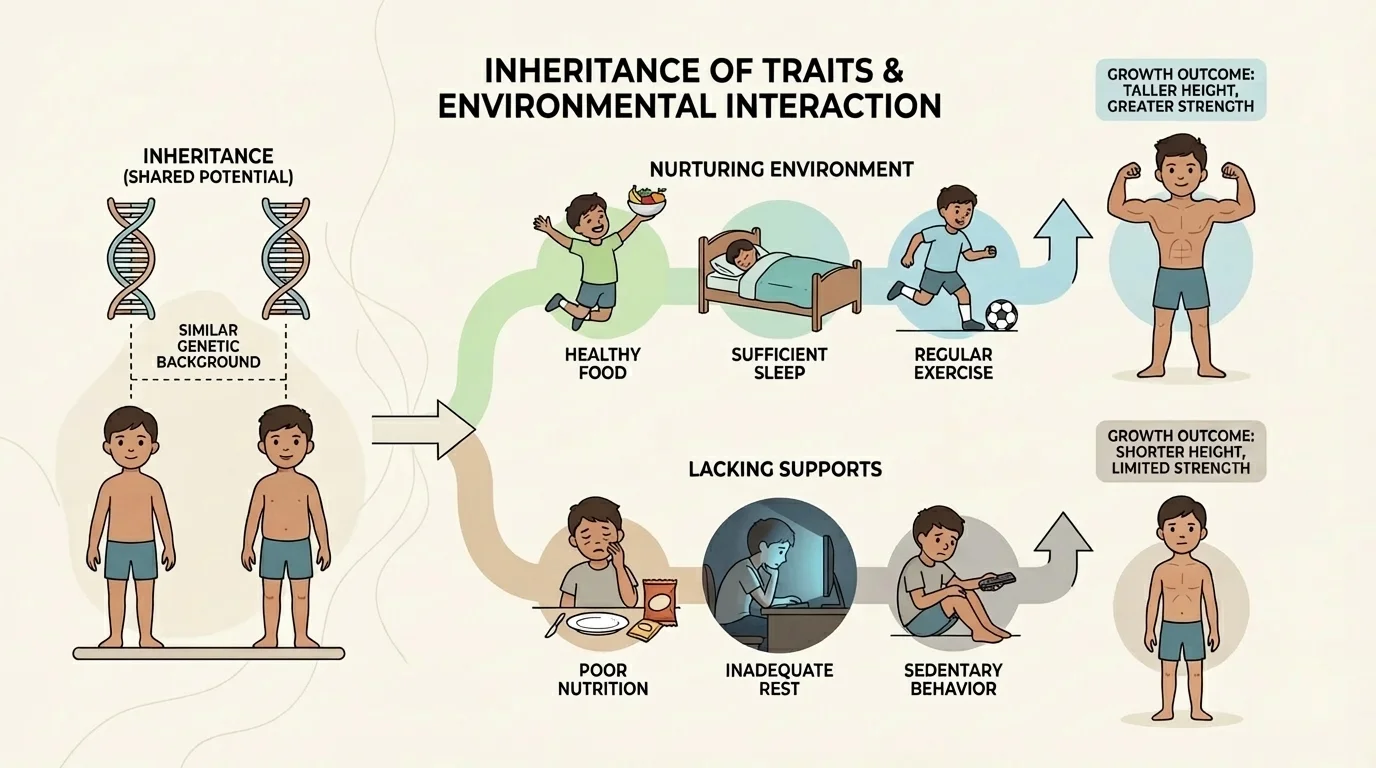
This is why scientists often avoid saying that a trait comes from only one cause. Instead, they look at how inheritance provides a starting plan and how the environment influences the final result. When we compare growth differences later, [Figure 3] helps us remember that both family background and life conditions matter.
The word variation means differences among individuals of the same kind. Variation can happen because offspring inherit different combinations of traits, because they live in different environments, or both. Variation is normal in nature. It is why not all oak leaves look exactly alike and not all kittens in one litter have identical markings.
If you look around a classroom, you may notice that some students have different eye colors, different hair textures, and different heights. These are examples of variation in humans. If you visit a garden, you may see flowers of the same kind that differ a little in size or color shade. Variation appears all through the living world.
Variation does not mean one organism is better than another. It simply means living things are not all identical. These differences can help organisms live in different places and conditions. For example, some plants may grow better in dry places, while others do well where it is wetter.
Scientists compare traits carefully to understand patterns. They may ask which traits are inherited, which are changed by surroundings, and which are influenced by both. This kind of observation helps in biology, farming, medicine, and caring for animals.
| Characteristic | Mostly inherited | Mostly environmental | Both inheritance and environment |
|---|---|---|---|
| Eye color in humans | Yes | No | Sometimes small appearance changes from light, but mostly inherited |
| Scar on skin | No | Yes | No |
| Plant growth | Partly | Partly | Yes |
| Ability to ride a bike | No | Yes | Body growth helps, but the skill is learned |
| Height | Partly | Partly | Yes |
Table 1. Examples of characteristics grouped by whether they are mainly inherited, mainly environmental, or influenced by both.
The examples in Table 1 show that science often involves sorting and comparing. Some traits fit clearly into one group, while others belong in the middle because life is complicated. That is why careful observation is important.
Farmers and gardeners use these ideas every day. They choose seeds from plants with helpful inherited traits, such as sweet fruit or strong stems. But they also know those plants still need water, sunlight, nutrients, and protection from pests. Good inheritance alone is not enough if the environment is poor.
People who care for pets think about both kinds of causes too. A dog may inherit a certain coat type or body size, but its health depends on food, exercise, shelter, and veterinary care. A horse may inherit speed, but training matters greatly in racing and work.
Identical twins begin with extremely similar inherited information, but they can still develop differences over time because they have different experiences, diets, habits, and environments.
Doctors and health experts also study traits influenced by both inheritance and environment. A person may inherit a tendency toward certain body conditions, but healthy habits such as exercise, sleep, and nutritious food can still make an important difference.
These ideas also help people protect nature. If a type of plant is moved to a place where the soil, water, or temperature is wrong, it may not grow well even if its inherited traits are strong. To care for living things, we must understand both what they inherit and what they need from their surroundings.
When scientists study heredity, they observe, compare, and ask questions. They may compare parents and offspring, notice differences among siblings, or grow the same kind of plant under different conditions. They look for evidence before deciding whether a trait is inherited, environmental, or both.
You can think like a scientist too. If you notice that a kitten has the same fur pattern as its mother, that suggests inheritance. If you notice that a plant near a sunny window grows better than the same kind in a dark corner, that suggests the environment matters. If you notice that height and strength depend on both family traits and healthy living, then you are combining both ideas correctly.
Understanding heredity helps us make sense of the living world. It explains why family members resemble one another, why living things can change with their surroundings, and why no two individuals are exactly the same. The world of traits is full of patterns, and learning to spot them is part of doing science.
