Why are two plants of the same kind sometimes different sizes, even when they started as the same kind of seed? That is the kind of question scientists love. Instead of guessing, they look closely, collect clues, and build an explanation from what they notice. When we use evidence, we make our ideas stronger and more believable.
A scientist does not just say, "I think this happened," and stop there. A scientist asks, "What did I observe? What pattern do I notice? What facts support my idea?" Evidence can come from watching carefully, measuring, comparing, and recording what happens over time.
An observation is something you notice with your senses or with tools. You might observe that one plant has taller stems than another plant. You might observe that a dog has thick fur in winter. A pattern is something that happens again and again. If many plants in sunlight grow taller than plants in shade, that repeated result is a pattern.
Evidence is information that helps support an explanation. Evidence can include observations, measurements, and patterns.
Explanation is a science idea that tells why or how something happens.
Solution is a way to solve a problem by using what we have learned.
Good explanations are based on real information. If we say, "This plant is shorter because it received less sunlight," we should have observations to support that idea. Maybe we noticed that the shorter plant was under a tree, while the taller plant was in full sun all day.
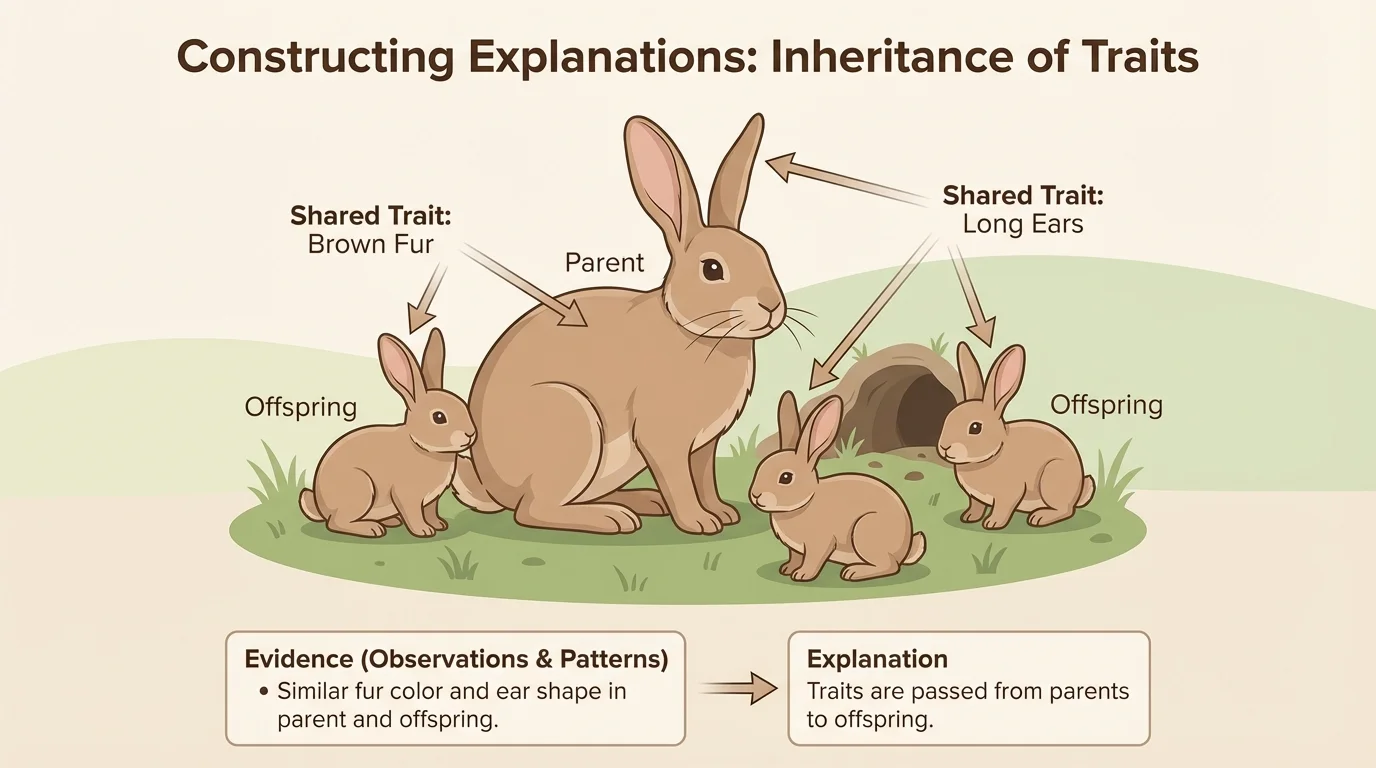
Living things have traits, which are features such as eye color, fur color, leaf shape, height, or the shape of a bird's beak. Many traits are passed from parents to offspring. As [Figure 1] shows, offspring often share traits with their parents, such as ear shape or fur color. A kitten may have fur color similar to its parents. A young sunflower will grow into the same kind of plant as its parent plant.
This passing of traits from parents to offspring is called inheritance. Inheritance helps explain why children may look a little like their parents and why baby animals often resemble the adults of their species. A calf does not grow into a chicken, and an acorn does not grow into a rose bush. Inherited traits help living things stay the same kind of organism as their parents.
But inherited traits are not the whole story. Two organisms can inherit similar traits and still end up looking a bit different. That is because the environment can also influence traits.
Think about brothers and sisters. They may have similar hair color or face shape because of inheritance, but they may not be the same height. One child may spend more time outdoors playing sports and become stronger. Another may spend less time in the sun, so their skin may look lighter. These differences help us see that traits can be affected by both inheritance and environment.
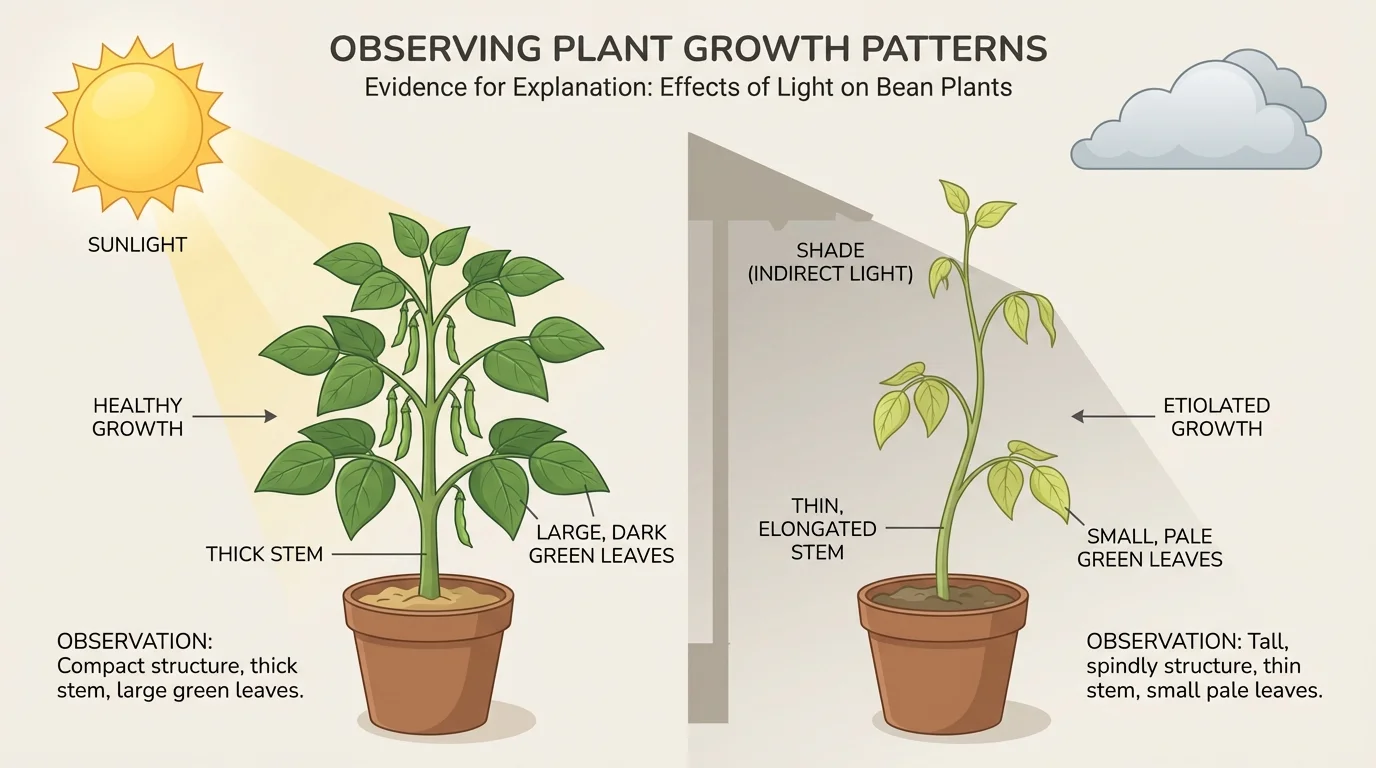
Plants give us especially clear examples. Two bean plants can come from the same kind of seed, but they may not grow exactly alike. If one gets more water, richer soil, and more sunlight, it may grow taller and greener than the other plant. The type of plant is inherited, but some of its traits can change because of conditions around it.
This idea is very important in life science: traits can be influenced by the environment. The environment includes everything around an organism, such as sunlight, water, temperature, food, space, and shelter. These things do not usually change what kind of organism it is, but they can affect how certain traits develop.
For plants, the environment can make a big difference. As [Figure 2] shows, a plant grown in bright sunlight may have stronger stems and larger leaves than the same kind of plant grown in deep shade. A plant with enough water may stand tall, while a plant without enough water may wilt. These observations help us explain why plants of the same kind can look different.
Animals are also affected by the environment. A dog that gets nutritious food and exercise may grow strong muscles. A polar fox living in a cold place grows thick fur that helps it stay warm. People can be affected too. If a child practices running every week, their leg muscles may become stronger. That stronger muscle growth is influenced by the environment and by actions in that environment.
It is important to be careful here. Environment affects some traits more than others. A rabbit's species comes from its parents. A maple tree still grows from a maple seed. But how tall, healthy, or strong an organism becomes can be influenced by what happens around it. Looking closely at evidence helps us decide which changes come from inheritance and which are affected by the environment.
How scientists separate causes
Scientists often compare organisms that are the same kind but are living in different conditions. If the same kind of plant grows differently in sun and shade, that comparison gives evidence that sunlight affects growth. When one condition changes and a trait changes too, scientists look for a connection.
Sometimes the environment causes helpful changes. Sometimes it causes problems. For example, if a plant does not get enough water, its leaves may droop. That does not mean it became a different kind of plant. It means its environment affected the way it grew and looked.
Scientists build explanations like detectives solving a mystery. They begin with clues from observations, then compare examples, find patterns, and finally build an explanation. This process helps them avoid guessing.
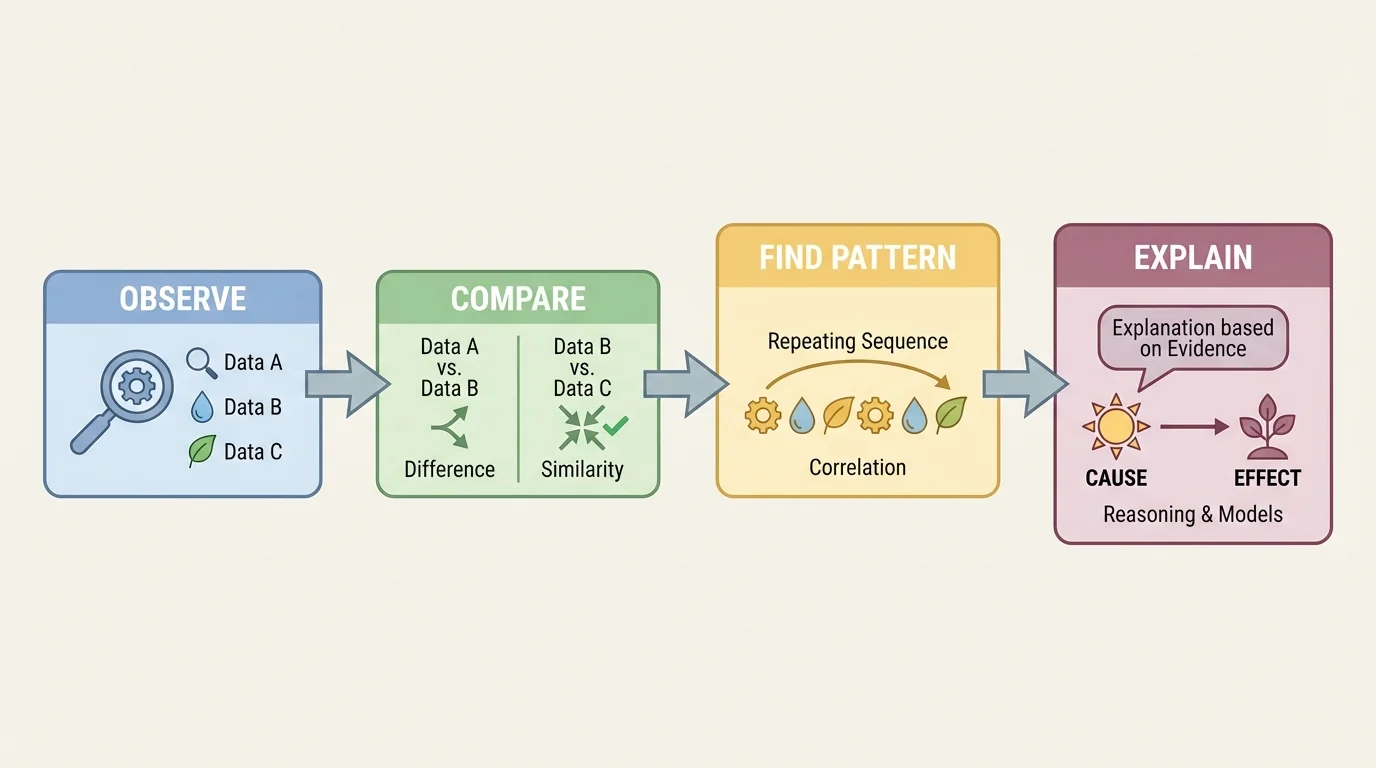
Here are three useful tools for building explanations. As [Figure 3] illustrates, scientists first observe carefully. Second, they compare what is the same and what is different. Third, they look for patterns over time or across several examples. If one plant is short, that may be interesting. If many shaded plants are short while many sunny plants are tall, that pattern is stronger evidence.
Suppose students in a school garden notice that tomato plants near the fence are shorter than tomato plants in the middle of the garden. They investigate. They observe that the fence casts shade for part of the day. They also notice the shorter plants have fewer flowers. Because several plants near the shade show the same pattern, the students can explain that less sunlight likely influenced the plants' growth.
Another example comes from animals. Imagine that several birds at a feeder are the same species, but some are larger than others. If the larger birds are older and have had more time to grow, age may explain the difference. If birds in one area have more food available and are healthier, food supply may be part of the explanation. Evidence helps us choose the explanation that fits the observations best.
Case study: Explaining plant growth with evidence
Students grow two groups of radish plants. Both groups are the same kind of plant. One group gets sunlight for most of the day. The other group gets much less sunlight.
Step 1: Observe the plants
The sunny plants are taller and have broader leaves. The shaded plants are shorter and paler.
Step 2: Look for a pattern
Most plants in the sunny group grow better than most plants in the shaded group.
Step 3: Build the explanation
The students explain that sunlight influences the growth traits of the radish plants.
This explanation is stronger because it uses observations and a repeated pattern.
Notice that the explanation does not say sunlight changed radishes into a different plant. The explanation says sunlight influenced how the radishes grew. That is an important science idea.
Once we understand a problem, we can use evidence to design a solution. If plants in a hot garden are weak because the soil dries quickly, a solution might be to give them water more often or provide shade during the hottest part of the day.
Designing a solution means making a plan to solve a problem. In science, we use evidence to choose the best plan. If we know a certain plant grows poorly in dry soil, we can design a solution such as adding mulch to keep water in the ground. If young animals need shelter from cold weather, people can build safer spaces for them.
Imagine a class garden where lettuce plants keep wilting. As [Figure 4] shows, students observe that the garden gets very strong afternoon sun and the soil dries out fast. They explain that the environment is affecting the lettuce. Then they design a solution: water earlier in the day, add a shade cover, and check soil moisture often.
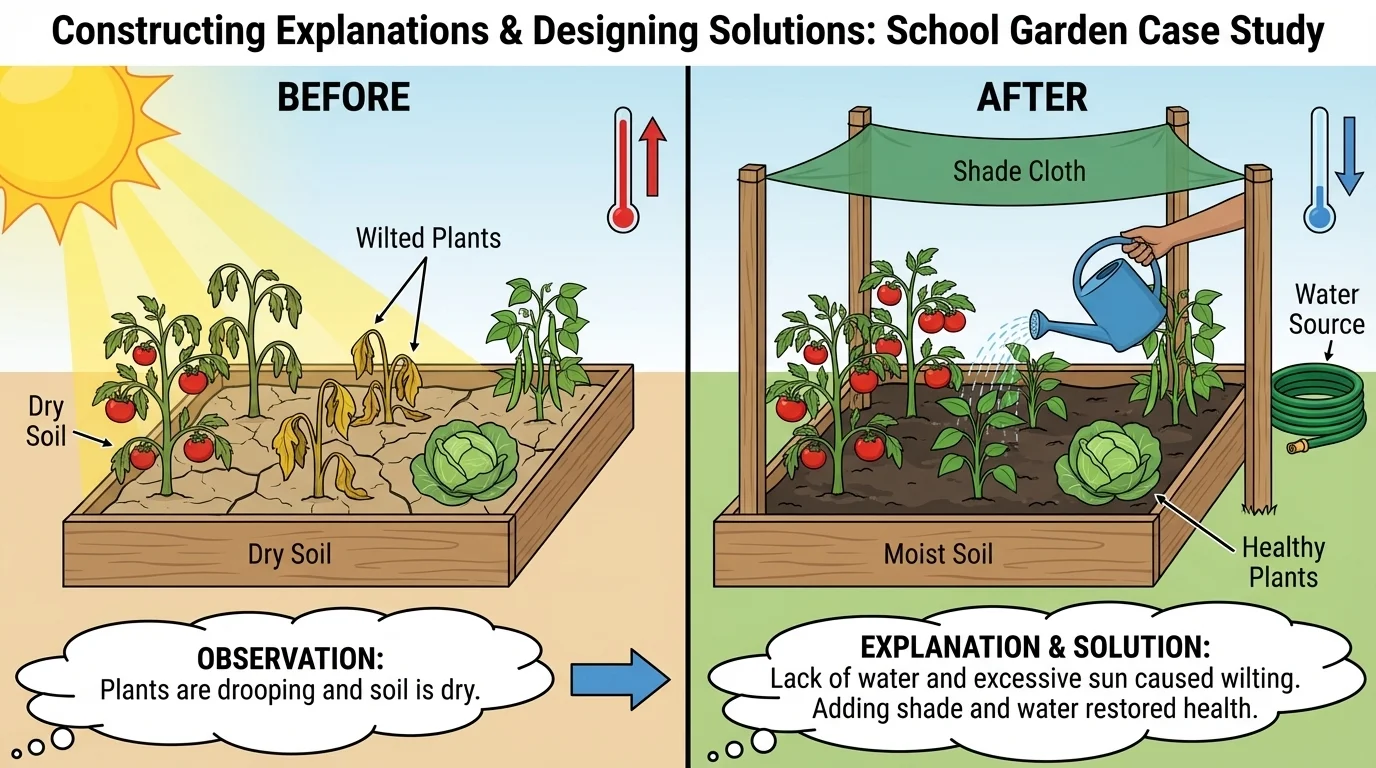
After trying the solution, the students can observe again. Are the leaves less droopy? Are the plants greener? Are more plants surviving? Scientists and engineers often test solutions this way. They use evidence before, during, and after making changes.
This same thinking can help animals too. If a birdhouse is placed where rain enters easily, young birds may not stay dry. Observations may show wet nesting material after storms. A better design would place the opening away from the strongest wind and rain. The solution comes from evidence, not from random guessing.
Some plants can look very different depending on where they grow. The same kind of hydrangea plant can produce flowers with different colors based partly on conditions in the soil.
That means explanations and solutions work together. First we ask, "Why is this happening?" Then we ask, "What can we do about it?" The better the evidence, the better the solution is likely to be.
Farmers use evidence all the time. If corn in one part of a field is shorter, the farmer might compare soil, sunlight, and water in that area. If the pattern shows that dry soil is the problem, the farmer can change the watering plan. The explanation leads to a solution.
Pet owners also use evidence. If a dog is gaining too much weight, the owner may observe how much it eats and how often it exercises. The environment, including diet and activity, can influence the dog's body. A veterinarian may suggest a solution based on those observations.
Zookeepers pay attention to animal habitats. If an animal seems less active, zookeepers may study temperature, shelter, and space. They use evidence to make the habitat safer and healthier. Just as the plant comparison in [Figure 2] shows that conditions matter, habitats for animals must match what those animals need.
| Organism | Trait observed | Environmental factor | Possible explanation |
|---|---|---|---|
| Bean plant | Taller stem | More sunlight | Sunlight helped the plant grow more |
| Dog | Stronger muscles | Exercise | Activity influenced muscle growth |
| Lettuce | Droopy leaves | Too little water | Dry conditions affected the leaves |
| Bird chicks | Safer nest | Better shelter | Nest design protected them from rain |
Table 1. Examples of traits influenced by environmental conditions and the explanations they support.
A strong explanation uses facts that match what was observed. It does not depend only on a personal opinion. Saying, "I like this idea" is not evidence. Saying, "Plants in shade were shorter in three different garden beds" gives evidence.
Strong explanations also connect clearly to the pattern. If a student says, "The plant is short because it is lonely," that is not supported by observations. But if the student says, "The plant is short because it got less sunlight," and can point to repeated observations, the explanation is much stronger. The evidence process in [Figure 3] helps us remember this order: observe, compare, find a pattern, explain.
You already know that living things need resources such as water, air, food, and space. These needs are part of the environment, and they can affect how well an organism grows and survives.
Scientists sometimes change one condition and keep others the same so they can test an explanation more fairly. For example, if they want to know whether sunlight affects plant height, they may give two groups of plants the same amount of water and soil but different amounts of light. Then they compare the results.
Even young scientists can think this way. You can ask: What did I notice? What changed? What stayed the same? What pattern do I see? What explanation fits the evidence best? These questions help turn simple observations into real scientific thinking.
Understanding traits, inheritance, and environmental influence helps us make sense of the living world. It also helps us care for plants and animals wisely. When we use evidence, our explanations become clearer, and our solutions become smarter.
