Two students can look at the same experiment and still give different answers. One might say, "The plant grew taller because it had more sunlight." Another might say, "It grew taller because it got more water." How do scientists decide which idea is stronger? They do not vote on which answer sounds nicest. They look for evidence. In science, good thinking means listening carefully, checking facts, and using what can be observed and tested.
When you talk about a classmate's science idea, you are not trying to "win" an argument in a mean way. You are learning how to think like a scientist. Scientists often share ideas, ask questions, and point out where evidence is strong or weak. This is called engaging in argument from evidence. It means using facts from tests, observations, and the world around us to explain why an idea makes sense or why it needs to be improved.
Critique means to carefully evaluate an idea by looking at what is strong and what needs work. Evidence is information that helps show whether a claim is likely to be true. A claim is a statement or answer someone says is correct. Argument from evidence means using evidence and reasons to support or question a scientific claim.
In science, people can disagree politely. The most important question is not "Who said it?" The important question is "What evidence supports it?" That makes science powerful. It helps people learn more about both the natural world, such as plants, animals, weather, rocks, water, and light, and the designed world, such as bridges, tools, containers, toys, and machines made by people.
A scientific explanation tells why something happens in nature. For example, a student might explain that a puddle disappeared because the water evaporated into the air. Another student may say the sun "soaked it up." These ideas are not equally strong just because both were spoken out loud. A stronger explanation matches observations and science knowledge.
A solution is different. A solution is a way to solve a problem, often by designing or improving something. For example, if a lunch bag keeps breaking, a student may suggest adding thicker handles. That suggestion should also be critiqued with evidence. Did the thicker handles actually hold more weight? Was the test fair? Did the bag last longer?
Scientists and engineers both use evidence, but they may ask slightly different questions. Scientists often ask, "What is happening, and why?" Engineers often ask, "What design works best, and why?" In both cases, evidence helps us choose ideas carefully.
Evidence can come from things you notice with your senses, things you measure, and things you record, as [Figure 1] shows. If you watch a seedling bend toward a window, that observation matters. If you measure its height each day and write the numbers in a chart, that also matters. Evidence is stronger when it is careful, clear, and connected to the claim you are talking about.
Some evidence comes from the natural world. You may observe clouds, compare leaf colors, watch shadows move, or notice that ice melts faster in the sun than in the shade. Some evidence comes from the designed world. You may test which paper bridge holds the most pennies, which paper airplane flies farthest, or which cup keeps water warm the longest.
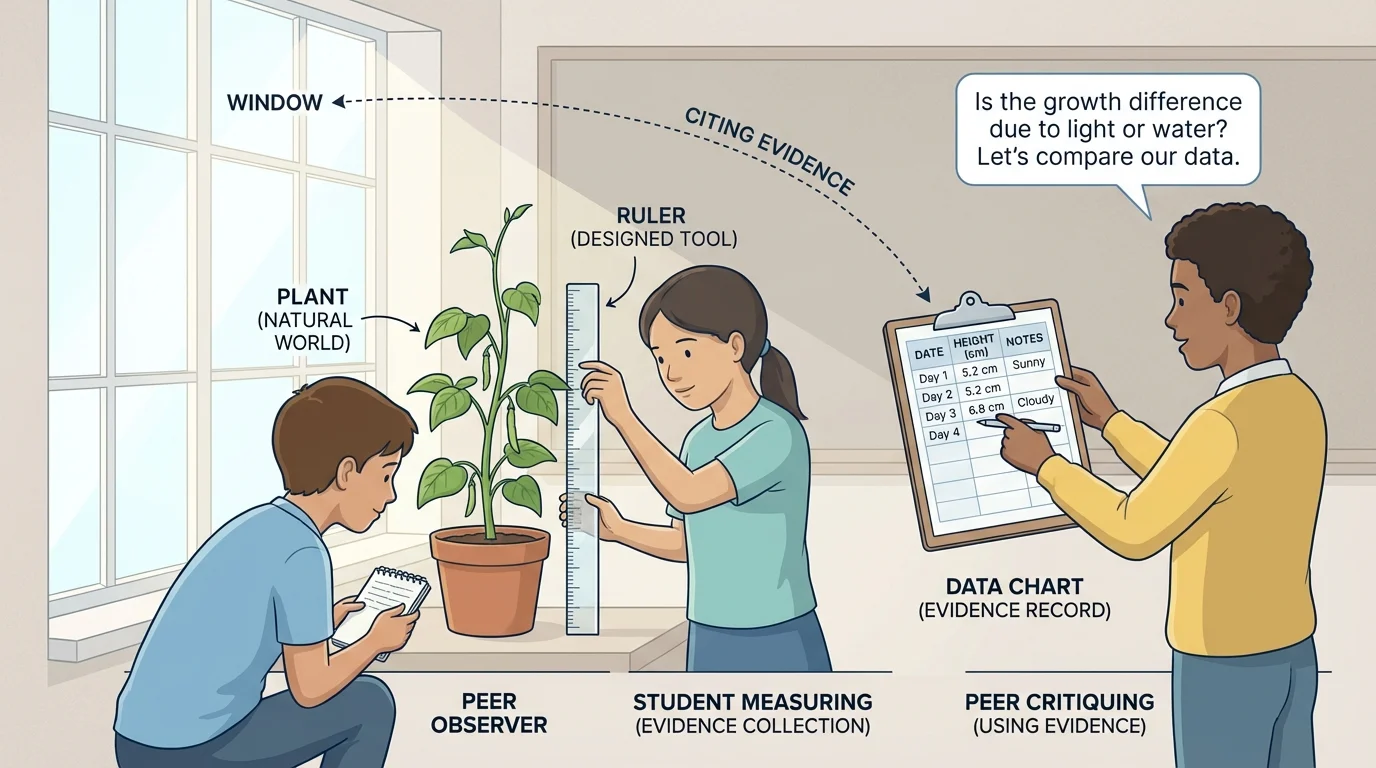
Evidence is not the same as a guess. If a student says, "I think the red airplane flies best because red is my favorite color," that is a preference, not evidence. But if the student says, "The red airplane flew farther in three trials, and each distance was measured," that is evidence-based reasoning.
Evidence is also stronger when it is specific. Saying "It worked better" is weak. Saying "It held 12 pennies while the other bridge held 7 pennies" is much stronger. Numbers, repeated observations, and notes from fair tests help make a critique more accurate.
Scientists sometimes change their minds when new evidence appears. That is not a mistake in science. It is one of science's strengths.
When you critique a peer's idea, ask yourself: What did we see? What did we measure? What happened each time we tested it? These questions help you focus on evidence instead of opinions.
[Figure 2] It is important to know whether your classmate is giving an explanation or proposing a solution. If the question is about the natural world, such as why a rock feels warmer in the sun, you are critiquing an explanation. If the question is about the designed world, such as how to make a shoe cover that keeps feet dry, you are critiquing a solution.
An explanation answers a "why" or "how" question about nature. A solution answers a "how can we fix or improve this problem?" question. Both need evidence, but the evidence may look different. For an explanation, you may need observations and science ideas. For a solution, you may need test results showing how well the design works.
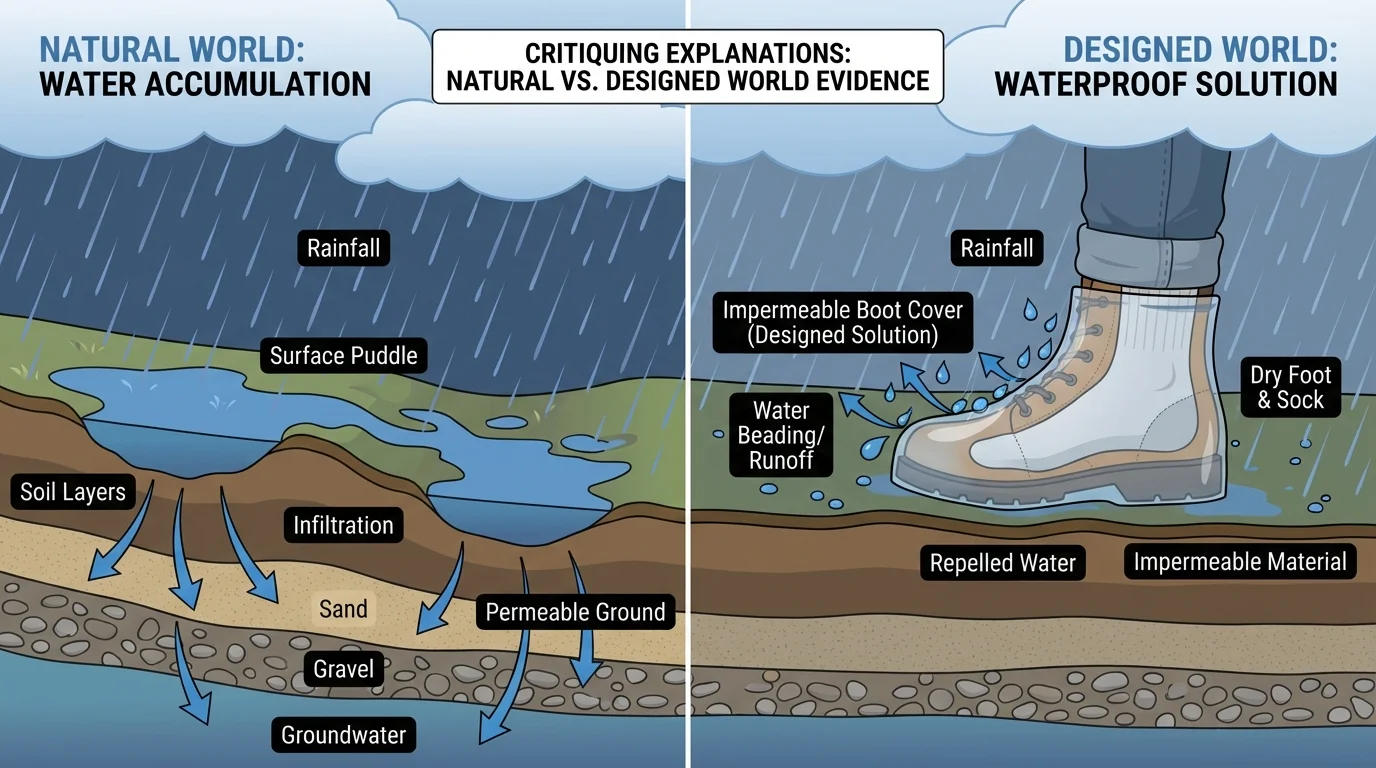
For example, a student says, "The sidewalk dried because the wind pushed the water away." Another student says, "The sidewalk dried because the water changed into vapor." To critique these ideas, you think about what is known about evaporation. The stronger explanation matches what water does when it warms and changes state.
Now think about a designed problem. A student says, "Our paper boat is best because it looks neat." Another says, "Our paper boat is best because it held 15 marbles before sinking." The second claim is stronger because it uses test evidence. The beauty of a design may matter sometimes, but if the problem is to hold weight, then evidence about weight matters most.
A good critique is respectful. It talks about the idea, not the person. Instead of saying, "You are wrong," you can say, "I disagree with that claim because our measurements showed something different." This kind of speaking keeps the discussion safe and thoughtful.
You can use helpful sentence starters. Try: "I agree with your claim because ..." "I disagree because the evidence shows ..." "Can you explain how your evidence supports your idea?" "I think your solution could be improved by ..." These sentence frames help you stay focused on science.
Good scientific critique uses three parts: a claim, evidence, and reasoning. The claim is the idea being discussed. The evidence is what was observed or measured. The reasoning explains how the evidence connects to the claim. Without reasoning, evidence may just be a list of facts. Without evidence, a claim is only an opinion.
Being kind does not mean agreeing with everything. It means being honest and fair. You can point out a problem in an idea while still showing respect. Real scientists do this all the time because it helps everyone learn more.
The natural world gives us many chances to critique explanations. Suppose a class observes that one patch of snow melts faster than another. A student claims it is because the faster-melting patch is closer to dark pavement. Another claims it is because snow just "felt like melting there." The first claim is stronger if observations show the dark pavement gets warmer in sunlight.
Here is another example: students notice that a plant near a window leans sideways. A peer says the plant is trying to "hide" from the classroom. Another says the plant is growing toward light. The second explanation is stronger because plants respond to light, and the plant's bending can be observed over time, just as we saw with careful measuring in [Figure 1].
Example: Critiquing a plant-growth explanation
A student says, "My bean plant grew taller because I sang to it." Another student says, "It grew taller because it got more light."
Step 1: Look at the evidence.
The plant by the window grew taller than the plant in the darker corner, and both got the same water.
Step 2: Check what connects to the claim.
Light affects how plants grow. Singing may be interesting, but there is no evidence here that singing changed the height.
Step 3: State the critique clearly.
"I think the light explanation is stronger because both plants had the same water, but only the one with more light grew taller."
Evidence from nature can include weather notes, temperature readings, shadow lengths, animal behavior, and changes in materials. The key is to connect the evidence directly to the idea being critiqued.
In the designed world, you often critique which design works best. A class may build paper bridges. One student says a flat bridge is best because it is easy to make. Another says a folded bridge is best because it held more pennies. If the goal is strength, the stronger critique uses the penny test results.
Engineers usually care about how well a design meets the goal. If the task is to keep water clean, then evidence should show which filter removed the most dirt. If the task is to make a fast toy car, then evidence should show which car moved farthest or fastest on the same ramp.
The comparison in [Figure 2] helps us remember that a natural explanation and a design solution are not judged in exactly the same way. A natural explanation must match what happens in nature. A design solution must solve the problem well.
| Type of idea | Main question | Helpful evidence |
|---|---|---|
| Explanation about nature | Why did it happen? | Observations, measurements, patterns, science knowledge |
| Solution for a design problem | How well did it work? | Test results, repeated trials, comparisons with other designs |
Table 1. This table compares evidence used for scientific explanations and design solutions.
Not all reasons are equally strong. "I like it better" is a weak reason in science. "It happened three times in a row" is stronger. "It happened three times in a row, and we measured the results carefully" is even stronger.
A strong critique uses evidence that is relevant. If students are testing which towel absorbs more water, then color does not matter unless there is evidence that color changes absorbency. A reason should match the question. That is why scientists stay focused on the problem they are trying to solve.
You already know that observing means noticing carefully and measuring means using tools like rulers, timers, scales, or thermometers. Those skills are the foundation for good evidence.
Sometimes a classmate may use one example to make a big claim. Be careful. One trial may not be enough. If a paper helicopter falls slowly one time, that does not prove it is always the best design. More trials help us trust the evidence more.
A fair test changes only one thing at a time so the results are easier to trust, as [Figure 3] shows. If you change paper type, wing size, and throwing force all at once when testing airplanes, you cannot tell which change mattered most.
When critiquing a peer's explanation or solution, ask whether the test was fair. Were the same tools used each time? Were the materials the same except for one part? Were the directions followed the same way? Did the group do enough trials?
Suppose one student says, "My airplane flew farther because it had wide wings." But in that test, the student also used a bigger sheet of paper and threw harder. That evidence is weak because the test was not fair. We cannot know whether the wings were the true cause.
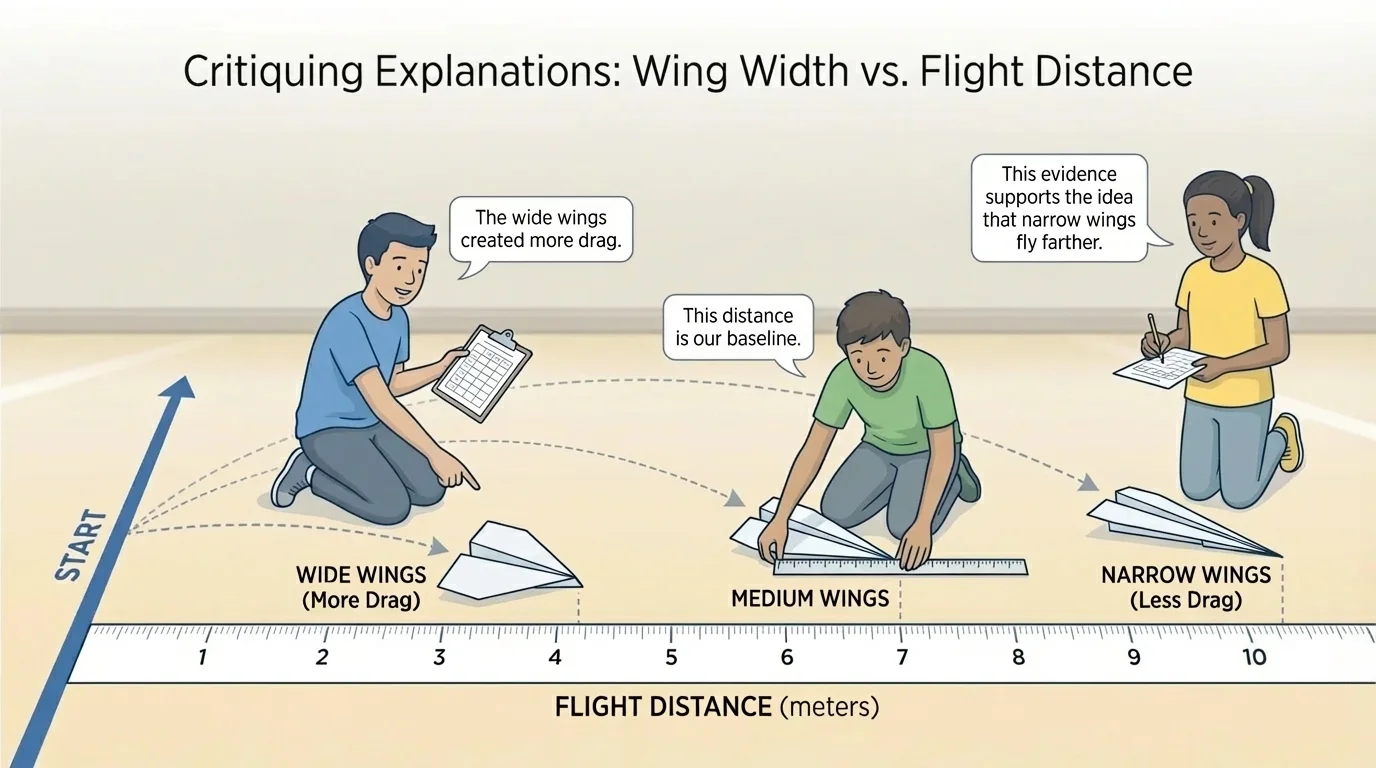
Fair tests are important in both science and engineering. In nature studies, they help us compare causes. In design studies, they help us compare solutions. The airplane trial makes it easier to judge which wing design really affects distance because only one feature changes.
Example: Critiquing a paper-airplane claim
A student says, "This airplane is best because it flew the farthest."
Step 1: Check the goal.
If the goal is distance, then flight distance is important evidence.
Step 2: Check fairness.
Ask whether all airplanes were made from the same paper and thrown in the same way.
Step 3: Check repeated trials.
If one plane flew far once but not again, the claim may be weak. Repeated trials give stronger support.
Step 4: Respond clearly.
"Your claim may be correct, but we need to compare all planes in a fair test with several throws."
Another part of fairness is accurate recording. If one group rounds numbers carelessly or forgets to write all results, it becomes harder to critique the claim. Good notes help everyone discuss ideas more honestly.
Sometimes the best answer is, "We need more evidence." That is a strong scientific response, not a weak one. If two plant groups grew almost the same amount, or two bridge designs held nearly the same number of pennies, the class may need more trials or more careful measurement.
A scientist does not need to pretend to know everything. If the evidence is mixed, it is fine to say the claim is not fully supported yet. A peer may also revise an idea after hearing a critique. That is part of learning. Good ideas get stronger when people test them and improve them.
"Science is a way of thinking much more than it is a body of knowledge."
— Carl Sagan
Revising a claim is not losing. It means the person is paying attention to evidence. In science class, changing your mind for a good reason is a smart choice.
When you critique, be clear and calm. You can say, "I agree with your explanation because the shadow got shorter as the Sun got higher." Or, "I disagree with your solution because your container leaked in two out of three trials." This kind of speaking shows both evidence and reasoning.
It also helps to ask questions. "What did you measure?" "How many times did you test it?" "Did you change more than one thing?" "How does your evidence connect to your claim?" Questions help ideas become clearer.
Listening is part of critiquing too. You should be ready to hear another person's evidence and think about it honestly. If their evidence is stronger, you may decide to change your own idea. That is what thoughtful scientists do.
People use evidence-based critique every day. Doctors compare evidence before choosing treatments. Engineers test designs before building bridges or playgrounds. Meteorologists study evidence from clouds, wind, and temperature to explain weather. Even when families choose a reusable water bottle, they may compare which one leaks less or keeps water cool longer.
In school, this skill helps you in group projects and experiments. Outside school, it helps you make wise choices. Instead of believing something just because someone says it loudly, you learn to ask, "What is the evidence?" That question is one of the most powerful tools in science.
Whether you are studying butterflies in a garden, comparing soils for plant growth, or testing a new paper tower, your goal is the same: look closely, think carefully, and support your ideas with evidence from the natural and designed world.
