A detective does not solve a mystery by guessing, and scientists do not either. When scientists explain why a seed sprouts, why metal rusts, or why one ramp makes a toy car go farther, they look for evidence. That evidence helps us move from "I think" to "I can explain why."
In science, an explanation is not just any answer. It is an answer built from what people actually observe, measure, and compare. In engineering, people also use evidence, but they often use it to decide which design works best and how to improve it. Scientists explain how the world works. Engineers design solutions to problems. Both need strong evidence.
Evidence is information that supports an idea or explanation. It can come from observations, measurements, tests, and patterns in data.
Explanation is a clear answer that tells what happened and why, based on evidence.
Claim is a statement or answer to a question.
Suppose someone says, "This plant grew better because I sang to it." That is a claim. But where is the proof? Did the person measure the plant? Did they compare it with another plant? Did they keep water and sunlight the same? Without evidence, the explanation is weak.
To use evidence means to build your explanation from facts you collected, not from a guess, opinion, or hope. Sometimes the evidence comes from what you see, hear, smell, or feel. Sometimes it comes from measuring carefully. Sometimes it comes from noticing a pattern over time.
Scientists often start with a question such as, "Why did the ice melt faster on one plate?" Then they gather information. They might observe that one plate sat in sunlight and another stayed in shade. They might measure the time each ice cube took to melt. After that, they use the evidence to explain what happened.
A strong explanation usually answers two things: what happened and why it happened. For example, "The ice cube in sunlight melted first because the sunlight warmed it more quickly." That explanation is stronger if it includes evidence such as, "The ice cube in sunlight melted in \(6\) minutes, while the one in shade melted in \(11\) minutes."
Scientists collect more than one kind of evidence, as [Figure 1] shows. Some evidence comes from careful looking, some from numbers, and some from patterns that appear after data are compared. Using different kinds of evidence can make an explanation stronger.
An observation is something you notice using your senses or tools. For example, you may observe that a leaf is yellow, the sky is cloudy, or a magnet pulls a paper clip. Observations often describe qualities such as color, shape, texture, sound, or smell. These are sometimes called qualitative observations because they describe what something is like.
A measurement is evidence written with numbers. If a plant is \(12 \textrm{ cm}\) tall, or water has a temperature of \(18^{\circ}\textrm{C}\), those are measurements. Measurements are often called quantitative data because they use numbers. Numbers help us compare things more exactly.
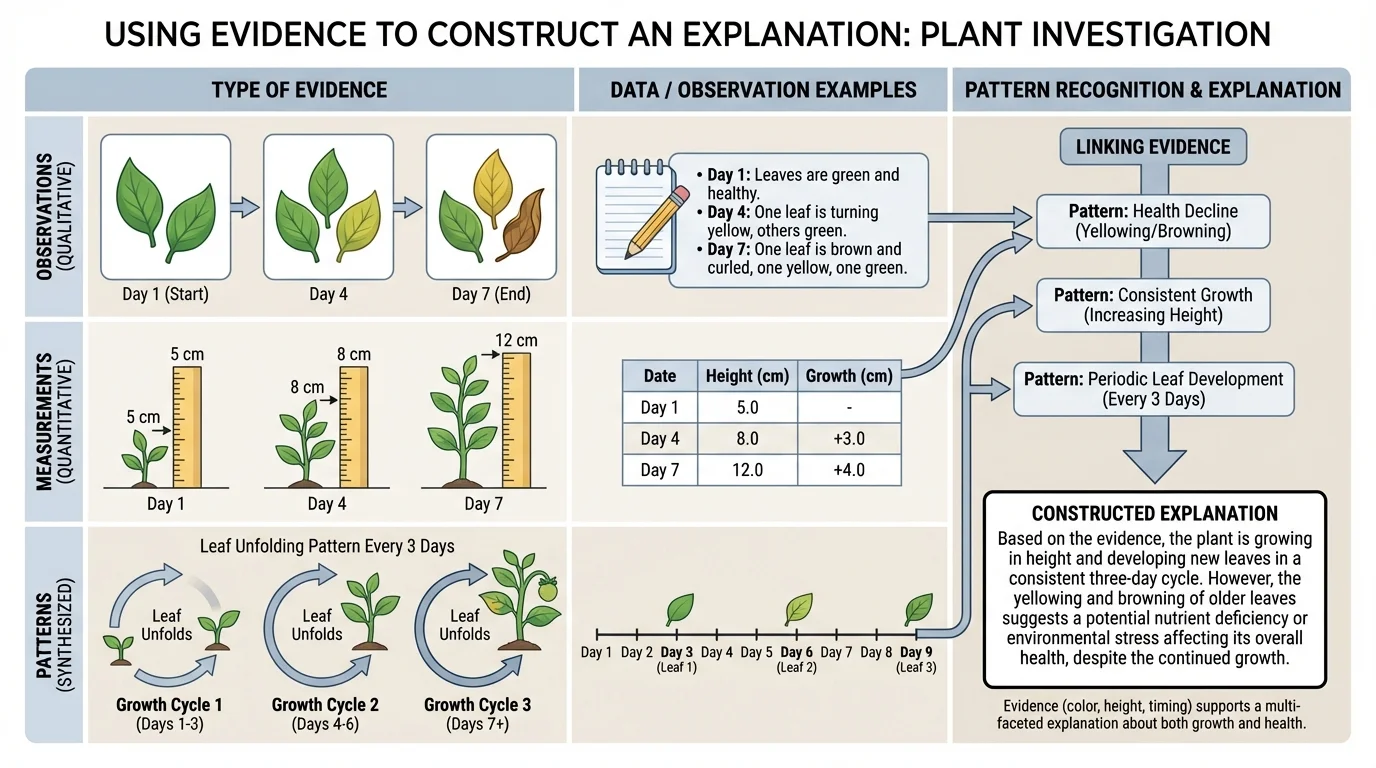
A pattern is something that repeats or shows a trend. If seeds near a window grow taller than seeds far from the window again and again, that repeated result is a pattern. Patterns matter because they help scientists see connections. One result can be an accident, but a pattern suggests there may be a real reason.
For example, imagine testing three paper towels to see which absorbs the most water. You might observe that one feels thicker. You might measure how much water each towel holds: towel A holds \(20 \textrm{ mL}\), towel B holds \(35 \textrm{ mL}\), and towel C holds \(28 \textrm{ mL}\). Then you might notice a pattern: the thicker towel absorbed the most. That pattern helps build an explanation.
| Type of evidence | What it tells you | Example |
|---|---|---|
| Observation | What you notice | The soil looks dry. |
| Measurement | Exact quantity or value | The plant is \(14 \textrm{ cm}\) tall. |
| Pattern | A repeated trend or relationship | Plants with more light grow taller in each trial. |
Table 1. Three common types of evidence used to support explanations.
Scientists often build explanations in three connected parts. First comes the question. Then comes the claim, which answers the question. Last comes the evidence that supports the claim, along with reasoning that connects the evidence to the explanation.
Reasoning means explaining how the evidence supports the claim. For example, if a student says, "The black paper got hotter because black colors absorb more sunlight," the measurements alone are not enough. The student should connect the numbers to the science idea. That connection is reasoning.
How an explanation is built
A strong scientific explanation often includes a claim, evidence, and reasoning. The claim answers the question. The evidence gives the facts, such as measurements or observations. The reasoning explains why those facts support the claim.
Here is the difference between a weak explanation and a strong one. A weak explanation says, "The car on the taller ramp went farther because it was better." A strong explanation says, "The car on the taller ramp went farther because it started higher and rolled faster. In the test, the car on the \(30 \textrm{ cm}\) ramp traveled \(180 \textrm{ cm}\), but the car on the \(10 \textrm{ cm}\) ramp traveled only \(95 \textrm{ cm}\)."
The strong explanation includes what was measured and how the measurements support the claim. It does not just tell the result. It explains the result.
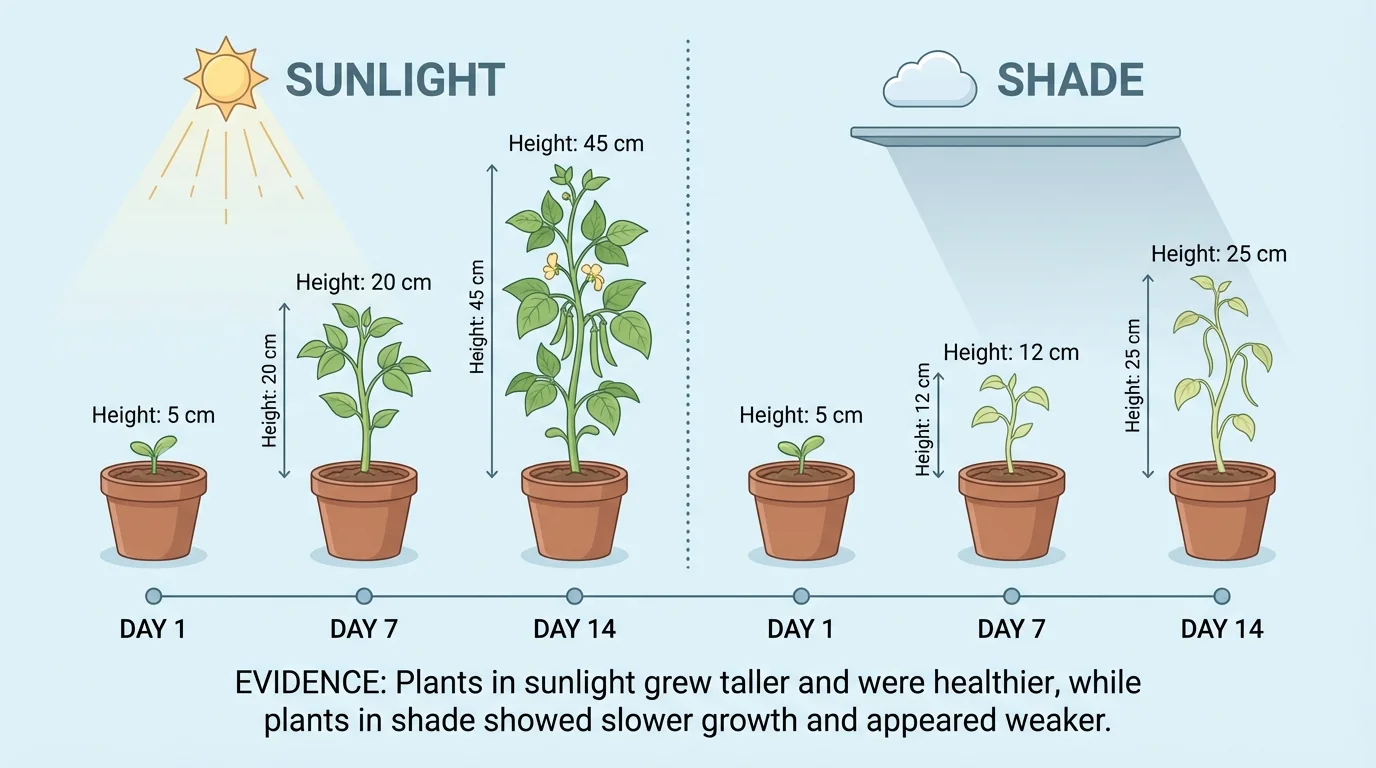
[Figure 2] Plant investigations are a good way to practice constructing explanations from evidence. Suppose two identical bean plants were grown for \(14\) days. Plant A was placed near a sunny window. Plant B was placed in a darker corner. Both got the same amount of water each day: \(50 \textrm{ mL}\).
At the end of the test, Plant A measured \(18 \textrm{ cm}\), and Plant B measured \(9 \textrm{ cm}\). Students also observed that Plant A had darker green leaves, while Plant B looked pale and thin. These observations and measurements give more than one kind of evidence.
Using evidence to explain plant growth
Step 1: State the claim.
Plant A grew taller because it received more sunlight.
Step 2: Add evidence.
After \(14\) days, Plant A was \(18 \textrm{ cm}\) tall and Plant B was \(9 \textrm{ cm}\) tall. Both plants got the same amount of water, \(50 \textrm{ mL}\) each day.
Step 3: Add reasoning.
Because the amount of water stayed the same, sunlight is the main difference between the plants. Plants use sunlight to make food, so the plant with more sunlight grew more.
This explanation is strong because it uses measured data and observations, not just a guess.
If a student only said, "Plant A is taller because it is healthier," that would not be enough. Why is it healthier? What evidence supports that idea? A good explanation must point back to the test results.
The plant example also reminds us that one piece of evidence is often not enough. Height measurements help, but leaf color and equal watering make the explanation much stronger. This mix of evidence helps show why sunlight is the best explanation.
Sometimes one measurement does not tell the whole story. Scientists look for repeated results. If the same result happens again and again, the explanation becomes stronger.
Suppose a class tests how far a toy car rolls down ramps of different heights. They try each ramp three times. Their distances might look like this:
| Ramp height | Trial 1 | Trial 2 | Trial 3 |
|---|---|---|---|
| \(10 \textrm{ cm}\) | \(92 \textrm{ cm}\) | \(95 \textrm{ cm}\) | \(94 \textrm{ cm}\) |
| \(20 \textrm{ cm}\) | \(130 \textrm{ cm}\) | \(128 \textrm{ cm}\) | \(132 \textrm{ cm}\) |
| \(30 \textrm{ cm}\) | \(178 \textrm{ cm}\) | \(181 \textrm{ cm}\) | \(179 \textrm{ cm}\) |
Table 2. Ramp test results from three trials at each height.
A pattern appears: as ramp height increases, the car travels farther. Because the class repeated the test, they can be more confident in their explanation. The results are not exactly the same every time, but they are close. In real science, tiny differences often happen, and that is normal.
Weather forecasters use patterns too. They do not predict rain from one cloud alone. They study repeated measurements of temperature, air pressure, wind, and clouds to build explanations and make forecasts.
Patterns can help explain many things: why shadows change, why some objects float, or why mold grows faster in warm places. The key is that the explanation must come from what the data show, not from what someone wants the answer to be.
Not all evidence is equally strong. Evidence is stronger when the test is fair and the data are collected carefully. A fair test changes only one variable at a time while keeping other important things the same.
In the plant experiment, if one plant got more water, a bigger pot, and more sunlight, then we would not know which factor caused the extra growth. But if both plants had the same soil, the same water, and the same kind of pot, then sunlight would be the main difference. That makes the evidence clearer.
Scientists also repeat tests. If a student measures once and gets a strange result, that one result might be an error. Repeating helps check whether the result happens again. Careful tools matter too. A ruler gives a better plant height measurement than a guess. A thermometer gives a better temperature reading than saying "it feels warm."
Measurements compare a quantity to a unit. Length might be measured in centimeters, liquid in milliliters, and temperature in degrees Celsius. Clear units make evidence more useful because other people can understand and compare the results.
Sometimes evidence can be weak because of mistakes. Maybe someone reads the ruler wrong. Maybe they forget to record one trial. Maybe they change two variables at once. Good scientists try to avoid these problems by being organized, careful, and honest.
One exciting part of science is that explanations can change when new evidence appears. Changing an explanation does not mean science is broken. It means science is working.
Long ago, people had many wrong ideas about disease because they did not have enough evidence. As better tools were invented, scientists gathered stronger evidence about germs and how diseases spread. Their explanations improved because the evidence improved.
This is true in classroom science too. A student may first think that a heavier object always falls faster. After testing objects of similar shape, they may find that both hit the ground at almost the same time. New evidence can lead to a better explanation.
"Science is a way of thinking much more than it is a body of knowledge."
— Carl Sagan
Good scientists are willing to revise their explanations. They ask, "What does the evidence show now?" That habit makes explanations stronger and more accurate.
[Figure 3] Engineers also use evidence, but they often use it to decide which solution works best. If an engineer builds three bridge designs from paper, the best design is not the one that looks coolest. It is the one that solves the problem most effectively based on test results.
Suppose students create three paper bridges and test how many blocks each bridge can hold before bending. Design A holds \(8\) blocks, Design B holds \(12\) blocks, and Design C holds \(10\) blocks. The evidence suggests that Design B is the strongest of the three.
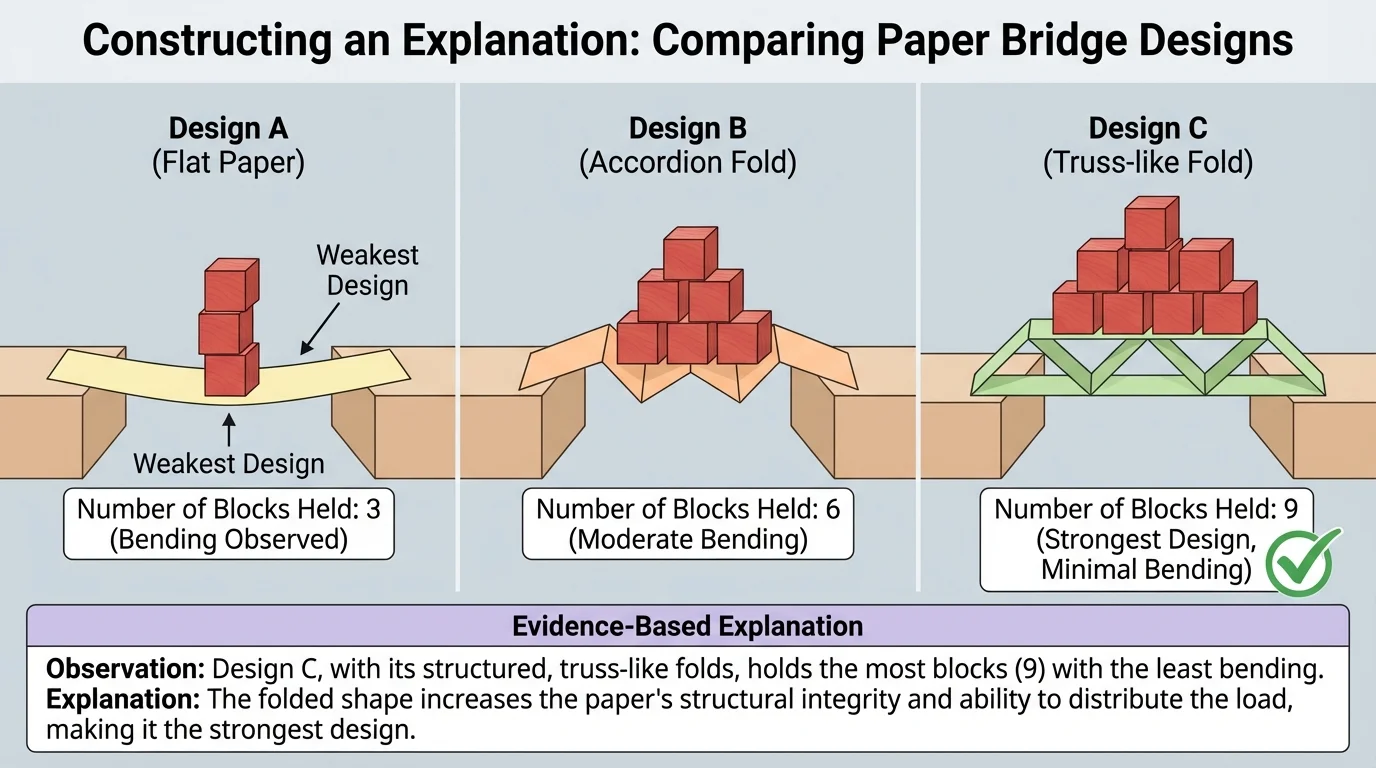
But engineers do more than choose a winner. They ask why one design worked better. Was it folded into stronger shapes? Did it spread the weight more evenly? Evidence from testing helps them improve the next design. Later in the process, they may compare new versions and gather more evidence again.
Engineering example: choosing the best bridge
Step 1: Define the problem.
The bridge must hold as many blocks as possible.
Step 2: Test each design.
Design A holds \(8\) blocks, Design B holds \(12\) blocks, and Design C holds \(10\) blocks.
Step 3: Explain the result using evidence.
Design B is the best choice because it held the most blocks. The test results are the evidence supporting that explanation.
Engineers can then improve the design and test again.
Notice that engineering explanations are closely tied to solving problems. Scientists may explain why ice melts faster in sunlight. Engineers may use evidence to design a cooler lunch box that keeps ice from melting quickly. Both rely on careful tests and strong evidence.
This comparison also shows why numbers are useful in engineering. Without measurements, it would be hard to know which design truly works better.
Using evidence is not only for laboratories. People use it every day. A basketball player notices that shots are more accurate with a higher arc. A cook sees that cookies bake more evenly on the middle rack. A doctor uses temperature, test results, and symptoms to explain what might be making a patient sick.
At school, if a class wants to know which playground surface keeps water longest after rain, students can observe puddles, measure drying times, and compare patterns. If they want to design a better paper airplane, they can test different wing shapes and use flight distance as evidence.
Real-world explanations are stronger when they include exact details. Saying "the medicine helped" is weaker than saying "the patient's fever dropped from \(39^{\circ}\textrm{C}\) to \(37.5^{\circ}\textrm{C}\) after treatment." Saying "the new bottle is better" is weaker than saying "the new bottle kept water cold for \(6\) hours, while the old bottle kept it cold for \(3\) hours."
Science and engineering work together
Science helps explain natural events by using evidence. Engineering uses evidence to design, test, and improve solutions. In both fields, strong ideas are supported by observations, measurements, and patterns.
Whenever you ask, "How do we know?" you are thinking like a scientist or engineer. The answer should lead back to evidence. That is what makes an explanation trustworthy.
