A single rainstorm can move soil, feed plants, fill streams, and even change the air around us. That may sound like one small weather event, but it actually connects several parts of Earth at the same time. Scientists study these connections by making models. A model helps us see patterns, explain what is happening, and understand a scientific principle more clearly.
A model is a drawing, diagram, physical object, or idea that represents something in the real world. Scientists use models when the real thing is too big, too small, too dangerous, or too complicated to study all at once. A globe is a model of Earth. A weather map is a model of air conditions across a region. A food web is a model of feeding relationships in an ecosystem.
When scientists develop a model, they do not try to copy every tiny detail. Instead, they choose the most important parts and show how those parts are connected. This helps them describe a scientific principle, which is a big idea about how nature works. One important scientific principle in Earth science is that Earth's systems interact. A change in one system can cause changes in another.
Scientific principle is a big science idea that helps explain how the natural world works.
Model is a simplified representation of an object, system, or process that helps people understand it.
For students your age, a model is often easiest to understand as a picture with labels and arrows. The labels name the parts. The arrows show movement, action, or cause and effect. If rain falls from clouds to the ground, an arrow can show that movement. If roots hold soil in place, an arrow can show that relationship too.
Earth can be divided into four major systems, and scientists often draw them together in one scene, as [Figure 1] shows, because they are always affecting one another. Learning these systems makes it easier to build a model and explain what is happening in nature.
The geosphere is the solid part of Earth. It includes rocks, soil, sand, mountains, and landforms. The hydrosphere includes Earth's water, such as oceans, lakes, rivers, groundwater, and ice. The atmosphere is the layer of gases around Earth. It includes the air we breathe and the clouds where weather forms. The biosphere includes all living things, such as plants, animals, fungi, and tiny organisms.
These systems are not separate boxes in real life. A tree grows in soil from the geosphere, takes in water from the hydrosphere, and exchanges gases with the atmosphere. Because the tree is alive, it is also part of the biosphere. One object or event can connect multiple systems at the same time.
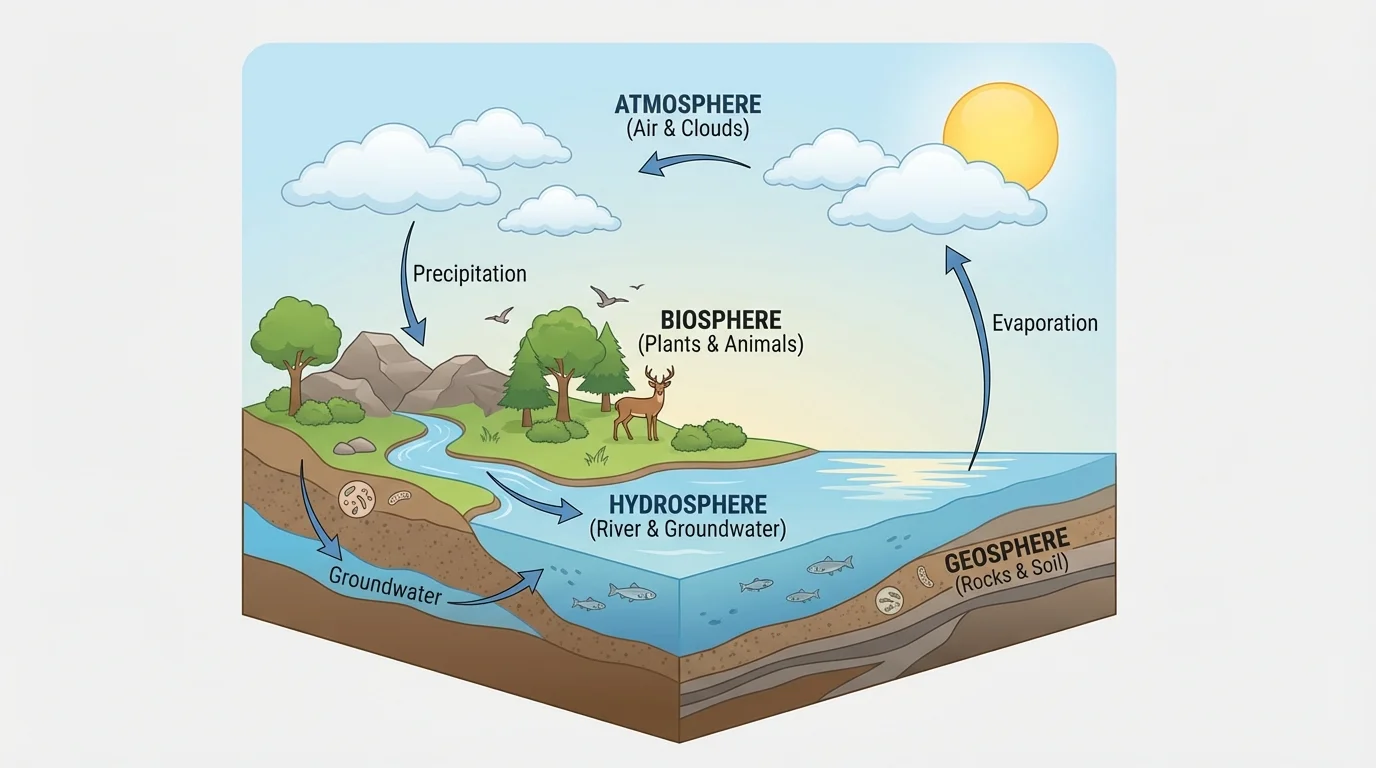
Earth as an interacting system
Earth works like a giant set of connected parts. Water, air, land, and living things constantly affect one another. When scientists say systems interact, they mean that a change in one part can lead to changes in other parts.
You can think of Earth's systems like players on a sports team. Each player has a special job, but the team works only because the players interact. If one player moves, others must respond. In the same way, if rainfall increases, streams may rise, soil may erode, and plants may either grow better or become damaged.
Interactions happen everywhere. Rain falls from the atmosphere to the geosphere and hydrosphere. Flowing water can wear away rock and soil in the geosphere. Plants in the biosphere slow that erosion by holding soil with their roots. Animals depend on water and air, so changes in the hydrosphere or atmosphere can affect where they live.
These interactions often follow cause and effect. A cause is something that happens first. An effect is what happens because of that cause. For example, heavy rain can be the cause, and muddy runoff entering a stream can be the effect. But that effect can become a new cause if the muddy water affects fish and plants.
Some interactions are quick, like a storm causing flooding in a single day. Others are slow, like wind and water wearing down a mountain over many years. Models can show both fast changes and slow changes, even when people cannot watch the whole process directly.
Roots can make a huge difference in erosion. In places with many plants, the soil is often held together more strongly than in places where the ground is bare.
Scientists also look for movement of matter in models. Matter is the "stuff" that makes up things. Water, soil, air, ash, and living material all move through Earth's systems. A useful model often shows where matter starts, where it moves, and where it ends up.
To develop a model, start with one clear example from nature. Choose an event or place where different systems interact. Good examples include a rainstorm on a hill, waves hitting a beach, a river flowing through a valley, or a volcano erupting.
Next, decide which parts need to be in the model. If you are modeling a rainy hillside, you might include clouds, rain, soil, rocks, plants, a stream, and arrows showing water movement. You should not add every pebble, insect, and blade of grass. A model is stronger when it is clear and focused.
How to build a simple Earth-system model
Step 1: Pick one real example.
Choose an event such as rain falling on a planted hillside.
Step 2: Name the systems involved.
Atmosphere: clouds and rain. Geosphere: soil and rock. Hydrosphere: water in the stream and soil. Biosphere: plants.
Step 3: Add arrows to show interactions.
Show rain moving downward, water soaking into soil, runoff moving into a stream, and roots holding soil.
Step 4: State the scientific principle.
Earth's systems interact, and a change in one system can change the others.
A strong model includes labels, arrows, and a short explanation. The explanation should answer this question: What science idea does this example help us understand? In this topic, the big idea is not just that it rained. The bigger scientific principle is that Earth's systems are connected.
A rainy hillside is an excellent example because it clearly shows all four systems working together through clouds, water, soil, and living plants in one connected scene. This kind of model helps us describe what happens during and after a storm.
[Figure 2] In the atmosphere, clouds form and release rain. In the hydrosphere, water falls, soaks into the ground, collects in puddles, and flows downhill. In the geosphere, the soil and rocks can be moved by water. In the biosphere, plants use water to grow, and their roots help hold the soil in place.
If the hillside has many plants, less soil may wash away because roots help anchor the ground. If the hillside has few plants, more soil may be carried downhill by running water. So the amount of plant life can change what happens to the land and water.
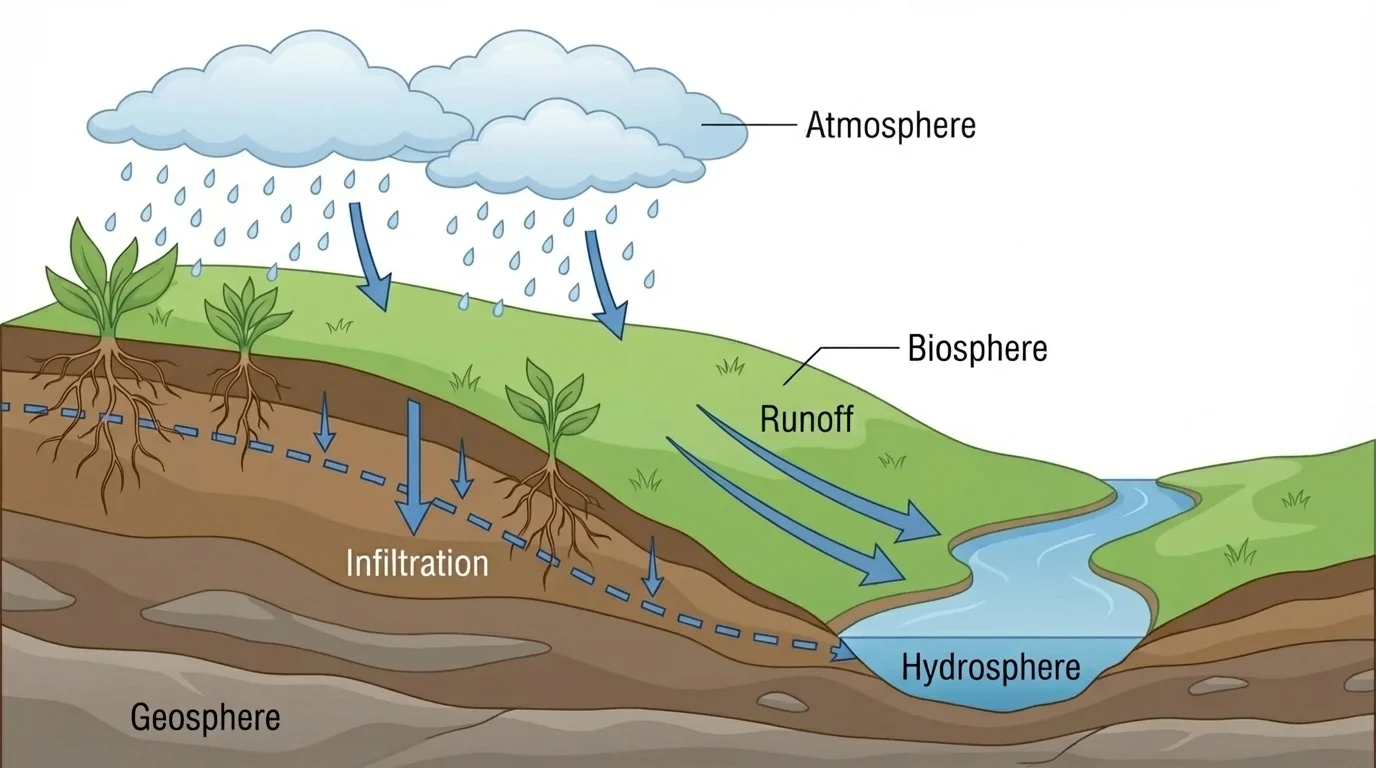
This model can also show two different paths for water. Some water soaks into the soil. Some water runs across the surface. Scientists sometimes compare these paths because each one leads to different effects. Water that soaks in can help plants and refill groundwater. Water that runs quickly over the surface may cause erosion or carry soil into streams.
Notice how one event leads to many results. Rain from the atmosphere affects the hydrosphere by adding water. That water affects the geosphere by moving soil. The biosphere affects the geosphere because roots reduce erosion. Then the condition of the geosphere affects the hydrosphere again, because loose soil can muddy the stream. The model is useful because it makes these chains of cause and effect easier to see.
The principle shown by the hillside model
The hillside model shows that Earth's systems do not act alone. Water, land, air, and living things influence one another. A single change, such as heavy rain, can spread through several systems.
Later, if you compare a bare hillside with a planted hillside, you can use the same model to explain why the outcomes differ. As in [Figure 2], the roots are a key connection between the biosphere and the geosphere. This is one reason planting vegetation can help reduce erosion in some places.
When you read a model, look for the arrows and ask what each one means. Does it show movement, such as rain falling or water flowing? Does it show influence, such as roots holding soil? Good models do not just name parts; they show relationships.
You should also ask what would happen if one part changed. What if there were more rain? What if the plants were removed? What if the soil were loose and sandy instead of packed and clay-like? A model becomes powerful when it helps you predict how changes in one system may affect the others.
Scientists often revise models after learning new information. That does not mean the old model was useless. It means science becomes stronger when explanations improve. A first model may show rainfall and runoff. A revised model might add groundwater, stronger roots, steeper slopes, or human actions such as cutting down plants.
Earlier science learning about weather, landforms, habitats, and the water cycle connects directly to this topic. Those ideas help explain why Earth's systems interact instead of acting separately.
A model can be simple and still be scientific. It does not need to be fancy. What matters most is whether it clearly shows the important parts and the scientific principle behind them.
A volcanic eruption is another strong example of interacting Earth systems. This example is more dramatic than a rainstorm, but it follows the same principle: systems interact.
[Figure 3] In the geosphere, melted rock rises and erupts as lava and ash. In the atmosphere, ash and gases spread through the air. In the hydrosphere, lava may heat water, and melted snow or ice can form rushing flows of muddy water. In the biosphere, plants and animals may be harmed, forced to move, or later return as the land changes.
This model shows that the same scientific principle works in many situations. You do not need to memorize one picture and stop there. Instead, you learn the big idea and apply it to different examples.
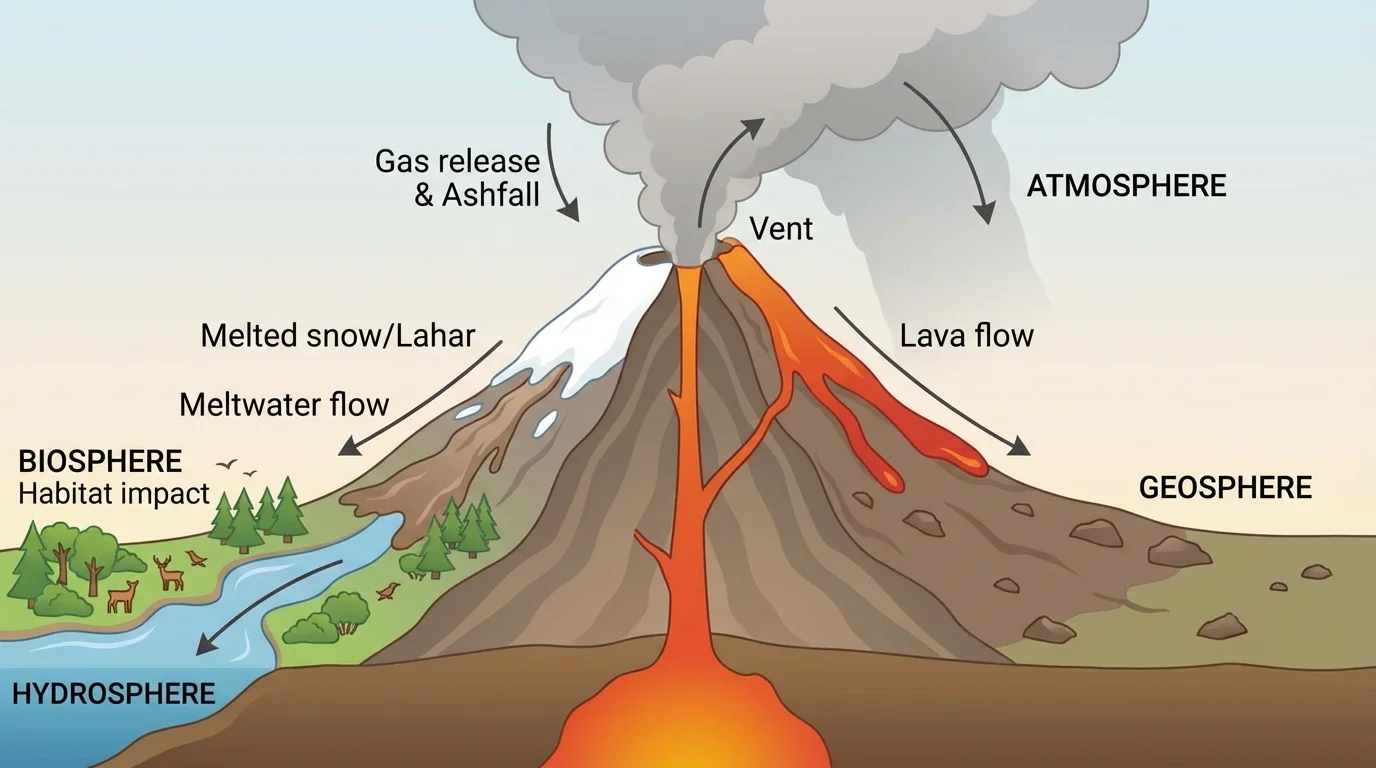
Volcanoes can even create new land over time. Later, living things may grow on that land, linking the geosphere and biosphere again. This reminds us that interactions can be destructive, helpful, or both, depending on the time scale and the place.
Case study: comparing two examples
Step 1: Identify the shared principle.
Both the rainy hillside and the volcanic eruption show that Earth's systems interact.
Step 2: Compare the systems involved.
Both examples include the geosphere, hydrosphere, atmosphere, and biosphere, but the specific interactions are different.
Step 3: Explain what the model helps us see.
The model makes it easier to track how one change spreads through multiple systems.
When you think back to the hillside model, the same kind of connected thinking applies here. Just as we saw in [Figure 2], one change can spread through several systems in sequence. The details differ, but the principle stays the same.
Every model is helpful, but every model also has limits. A drawing may show rain, roots, and runoff, but it may leave out wind, tiny organisms in the soil, or differences in rock type. That is normal. Models are meant to simplify reality so we can focus on the most important ideas.
A strong model is accurate enough to explain the science idea, but simple enough to understand. If a model is too crowded, it becomes confusing. If it is too simple, it may leave out an important interaction. Scientists try to balance these two needs.
This is why models are often revised. If a class first makes a model of rainfall and erosion, the next version might include how people affect the land by building roads, removing plants, or creating drains. Human actions can connect to Earth's systems too.
Earth system models are not only classroom tools. People use them in real life to solve problems. Weather scientists model storms to predict rain, wind, and flooding. Farmers think about soil, water, air, and plant growth when deciding what to plant and when to water. Engineers use models to reduce erosion near roads and buildings.
Park managers and conservation workers also use models. If a riverbank is wearing away, they may study how flowing water, soil, plants, and rainfall interact. Then they can decide whether planting more vegetation might help stabilize the bank.
In places near volcanoes, scientists model where ash may travel and where mudflows may move. The volcanic interaction shown earlier in [Figure 3] helps explain why warnings and maps are so important. A model can help protect people, animals, land, and water.
Some of the computer models used by scientists are incredibly complex, but they still follow the same basic idea as a classroom model: show important parts, show interactions, and help explain or predict what may happen.
Even a school garden can become a place for model thinking. If one area gets more sun, another holds more water, and another has different soil, students can observe how the biosphere responds to differences in the geosphere, hydrosphere, and atmosphere.
A strong scientific model is clear, labeled, and focused on the main idea. It includes the important systems and shows how they interact. It uses arrows or other symbols to make cause and effect visible. It connects the example to a larger scientific principle instead of stopping at surface details.
If you are looking at a model and can answer these questions, the model is probably strong: What parts are included? Which Earth systems do they belong to? What changes are happening? How does one change affect another? What scientific principle does the example demonstrate?
The most important thing to remember is this: a model is not just a picture. It is a tool for thinking. It helps scientists and students explain how Earth works as a connected system.
