One website says a food is "the healthiest snack ever." A video says the same food is unhealthy. A book gives different facts again. Which source should you trust? This happens all the time, and it is why strong readers do more than just find information. They gather information from several places, evaluate it carefully, and then communicate what they learned in a clear, fair way.
When you research a topic, you are acting a little like a detective. You look for clues, check whether they are reliable, compare what different people say, and decide what makes sense. This skill matters in science, social studies, health, and everyday life. If you want to know whether a storm is coming, whether an animal is endangered, or whether a new school rule is helpful, you need good information from good sources.
Source is a place where information comes from, such as a book, article, website, interview, chart, or video. Credibility means how trustworthy a source is. Bias is a one-sided point of view that may affect how information is presented. Evidence is the facts, observations, data, examples, or expert support used to back up a claim.
A smart researcher does not just collect facts. A smart researcher asks questions: Who made this? Why was it made? How do they know? Is the information recent enough? Do other sources agree? Those questions help you move from simply reading information to truly understanding it.
A single source can be helpful, but it can also be incomplete, outdated, or wrong. Even honest writers sometimes leave out details. That is why using several sources gives you a better picture. If three trustworthy sources say similar things, your confidence in the information grows. If the sources disagree, that tells you to investigate more carefully.
Suppose you are researching whether bees are important to plants. One source may explain pollination, another may show data about food crops, and a third may discuss what happens when bee numbers drop. No single source tells the whole story. Together, they help you understand the topic more fully.
Using more than one source also helps you separate strong claims from weak ones. A claim is stronger when it is supported by evidence in multiple places. If only one publication makes a big claim and others do not support it, that is a sign to be cautious.
An appropriate source is one that fits your question and gives useful information at the right level. Different source types can help in different ways, as [Figure 1] shows. A science question may need a science book, a museum website, or a report from a trusted organization. A question about local history may also use interviews, newspapers, and town records.
Common source types include books, magazines, news articles, educational websites, videos, interviews, maps, charts, and photographs. Each kind has strengths and limits. Books can give deep background. News articles can give recent information. Interviews can provide personal experiences. Videos can help explain a process you can see.
Not every source is appropriate for every task. If your question is "How does recycling work?" a joke website or an advertisement is probably not the best source. If your question is "What do students think about recycling bins at school?" then a student survey could be useful. Good researchers match the source to the question they are trying to answer.
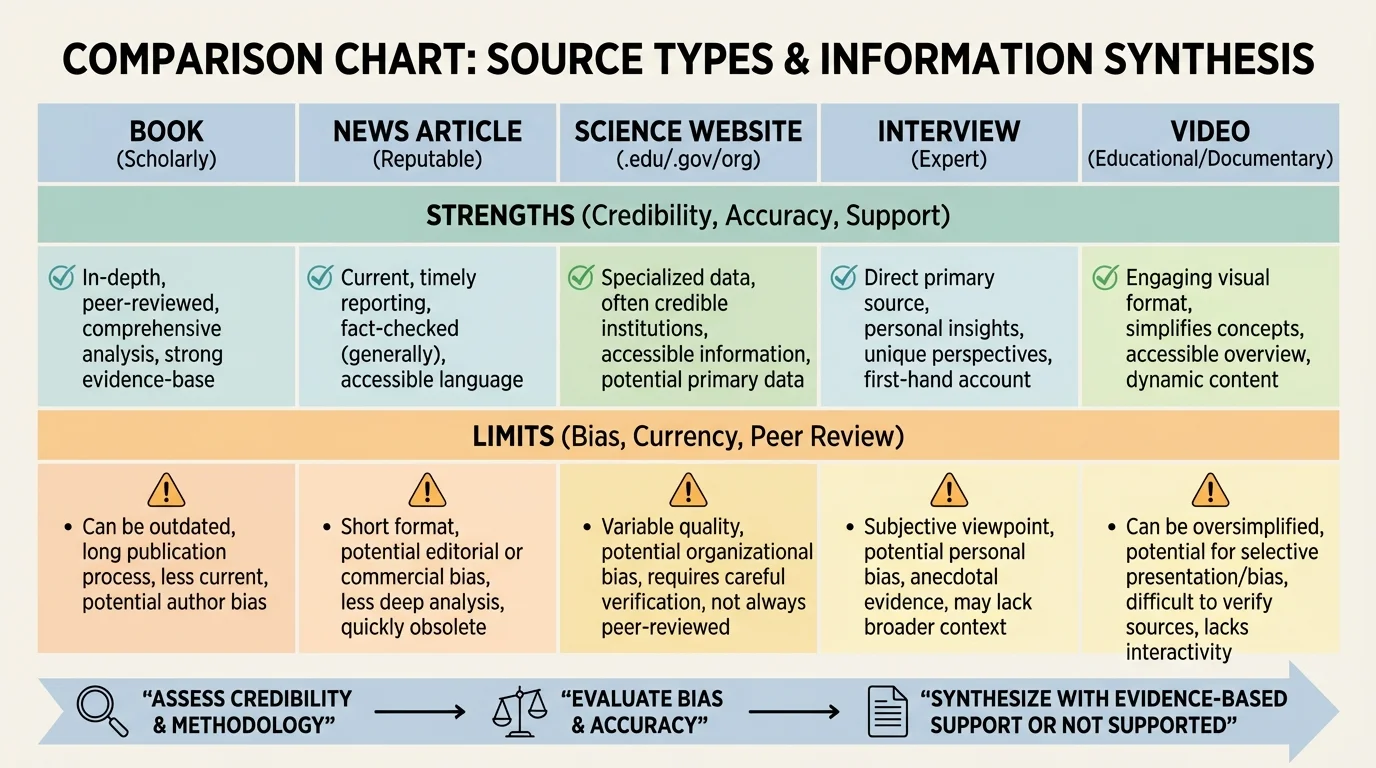
You should also think about reading level and purpose. A source written for adults can be too hard to understand. A source made mainly to sell a product may not be fair. A source made to teach, inform, or report is often more useful for research.
Two sources can both be real and still be useful in different ways. A park ranger interview may tell what animals are seen most often, while a wildlife report may give the exact counts collected over time.
It is often best to use a mix of source types. For example, if you study volcanoes, you might use a textbook for basic facts, a recent science article for new discoveries, and a video from a science organization to see how eruptions happen.
Finding sources is only the beginning. Next, you need to read them closely. Close reading means slowing down enough to notice the main idea, the supporting details, and the evidence used. It also means paying attention to words that seem emotional, unclear, or exaggerated.
As you read, take notes in your own words. Write down the title, author, date, and important facts. If a source gives a strong claim, record the evidence that goes with it. For example, if an article says, "School gardens improve learning," ask: What examples, data, or expert opinions support that statement?
It helps to separate facts from opinions. A fact is something that can be checked, such as "Honeybees help pollinate many crops." An opinion shows what someone thinks or feels, such as "Honeybees are the most interesting insects." Opinions are not always useless, but they are different from facts.
Remember that a question can have more than one kind of answer. Some questions ask for facts, some ask for explanations, and some ask for different viewpoints. Your notes should match the kind of question you are trying to answer.
Good readers also notice what is missing. If a source makes a claim but gives no examples, no data, and no explanation of how the writer knows, then the information may be weak.
Credibility is about trust. A source may look polished and colorful, but that does not automatically make it reliable. A careful reader checks several parts of a source, and [Figure 2] lays out a useful checklist for doing that.
First, ask who created it. Is the author named? Does the person have knowledge or experience in the topic? An article about space written by an astronomer is usually more trustworthy than one written by an unknown writer with no background listed.
Next, ask where it was published. Information from a museum, university, government agency, major newspaper, or respected educational group is often more dependable than information from a random post with no clear publisher.
Then, ask when it was published. Some topics change quickly. Weather reports, technology information, and disease updates need current sources. A source from many years ago can still be useful for history, but it may not work well for recent scientific topics or current events.
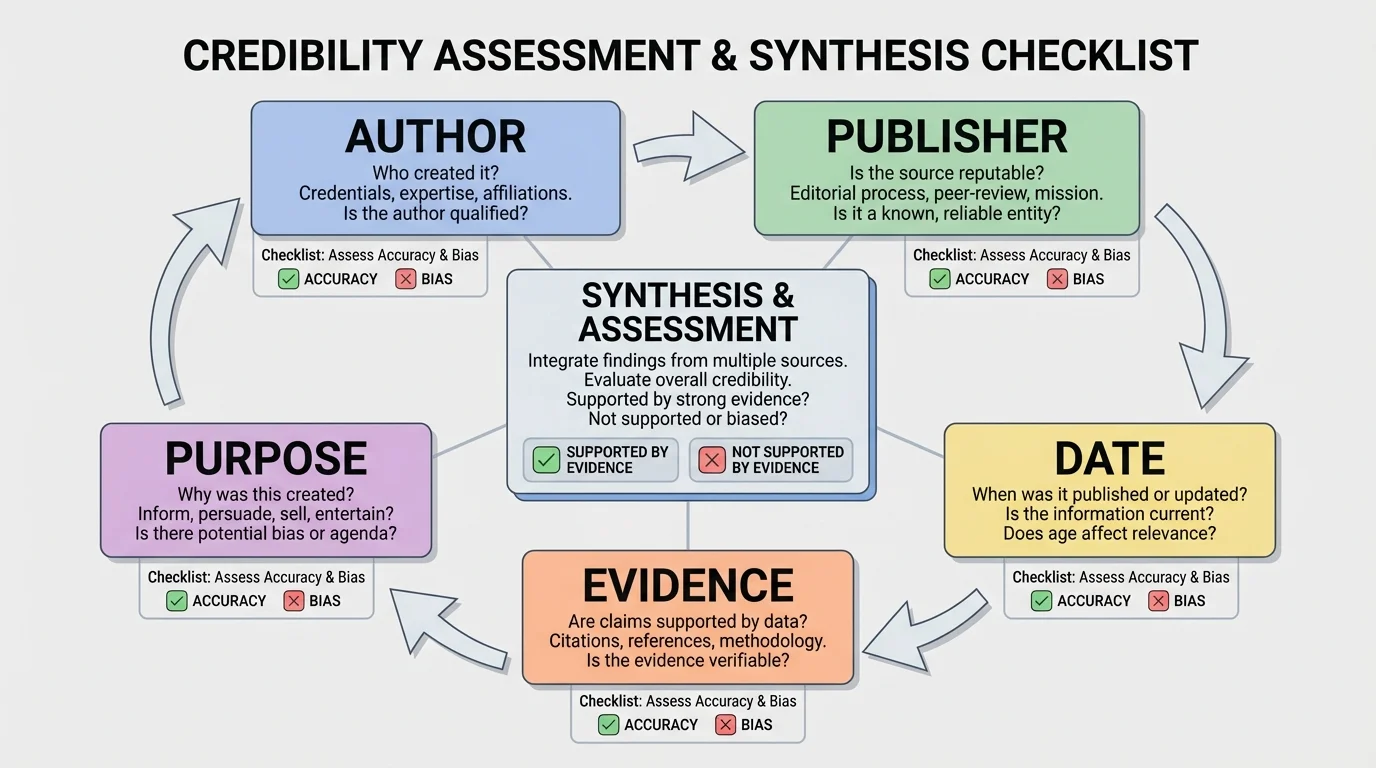
Another important question is what evidence is included. Does the source use data, observations, quotes from experts, photographs, or references to studies? Strong sources do not just make statements; they support them.
Finally, ask why it was made. Was the purpose to inform, entertain, persuade, or sell something? A source that tries to sell a product may only show information that makes the product seem great. Later, when you compare sources, the checklist in [Figure 2] helps you explain exactly why one source seems stronger than another.
Accuracy means how correct the information is. A source can be attractive and easy to read but still contain mistakes. To check accuracy, compare facts across multiple trustworthy sources. If several strong sources agree on a date, a process, or a measurement, that fact is more likely to be accurate.
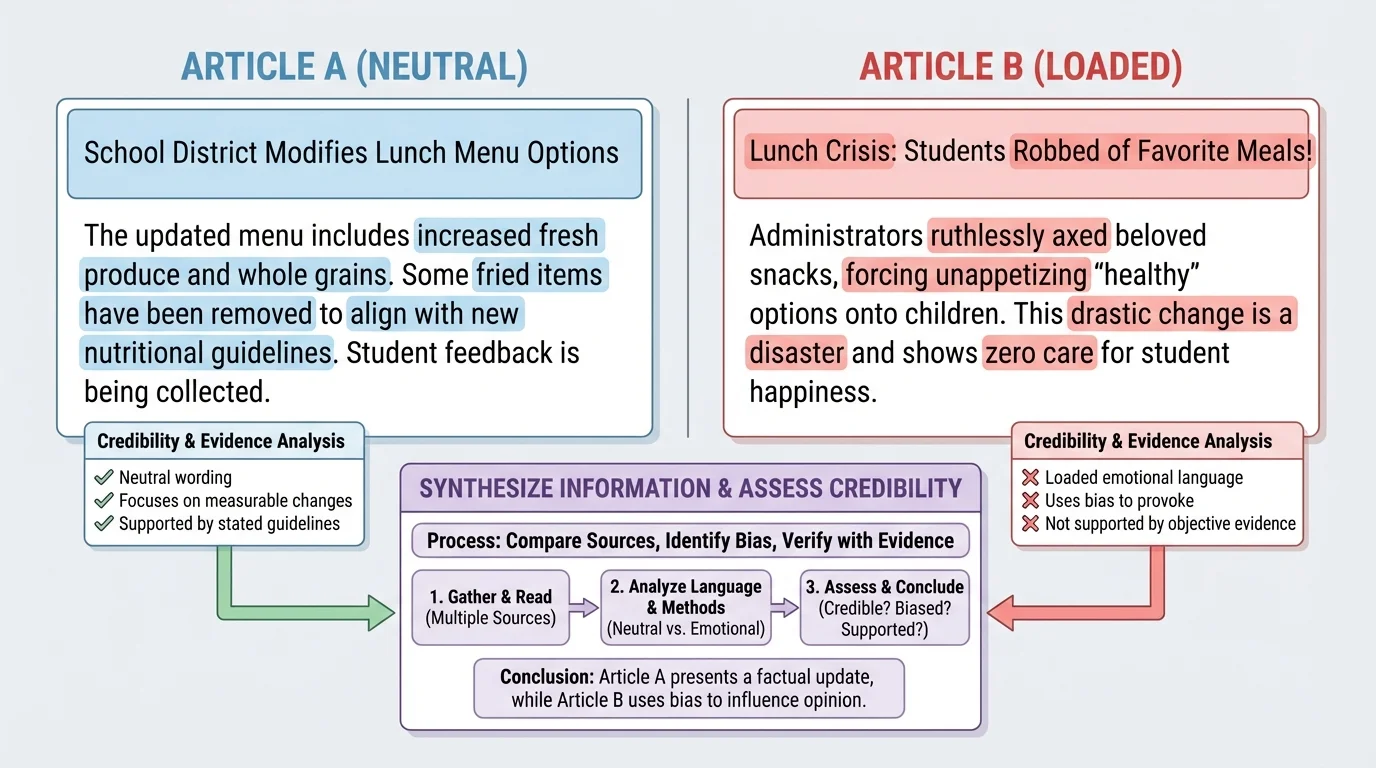
Bias is different from accuracy, although the two can be connected. Bias means that a source may present information from one side more than another. Sometimes bias appears in strong emotional words. As [Figure 3] illustrates, one article might say a rule is a "smart improvement," while another calls it a "terrible mistake." Those phrases push readers toward a feeling instead of simply explaining the facts.
Bias can also appear when a writer leaves out important information. For example, if a publication says a new playground is "a huge waste of money" but does not mention that it replaces unsafe equipment, the reader is not getting the full picture.
This does not mean every biased source is useless. Some sources are meant to share opinions. Opinion pieces, editorials, and advertisements can still teach you something about what people believe or want. But you should not treat them the same way you treat a factual report.
Neutral language and loaded language
Neutral language tries to describe information fairly, without pushing strong feelings. Loaded language uses words meant to make the reader feel impressed, angry, worried, or excited. When you notice loaded language, slow down and look for evidence.
A useful habit is to ask, "What is the claim, and what proof is given?" If the claim is strong but the proof is weak, missing, or one-sided, then the source may not deserve much trust.
A publication should not only tell what it believes. It should also show how the information was gathered. The word method means the way information was collected. Different methods can produce stronger or weaker evidence.
Some common methods are observation, experiment, survey, interview, and research review. An observation is when someone carefully watches and records what happens. An experiment tests an idea under controlled conditions. A survey gathers answers from many people. An interview gives detailed information from one person or a few people.
Each method has strengths and limits. An experiment can test cause and effect, but it may happen in a special setting that is not exactly like real life. A survey can collect many opinions quickly, but the answers depend on who was asked and how the questions were written. An interview can give rich details, but one person's experience may not represent everyone.
| Method | What it does well | Possible limit |
|---|---|---|
| Observation | Shows what happens in real situations | May miss hidden causes |
| Experiment | Tests ideas carefully | May not match everyday conditions |
| Survey | Collects many responses | Depends on who answered |
| Interview | Gives detailed personal information | May reflect only one viewpoint |
| Research review | Combines results from several studies | Depends on the quality of the studies used |
Table 1. A comparison of common methods used to gather information, including strengths and limitations.
When you assess evidence, ask whether the method fits the question. If someone claims, "Students learn better with music," and the evidence is only one student's comment, that is weak support. If the claim is backed by classroom observations, several studies, and teacher reports, it is stronger.
Case study: Comparing two claims about sleep
Source A says, "Almost all students do fine with very little sleep." Source B says, "Most students need regular sleep for healthy learning and growth."
Step 1: Check the method
Source A gives no study, no survey, and no expert explanation. Source B includes a health organization report and data from sleep research.
Step 2: Check the evidence
Source A uses a broad claim with no support. Source B uses expert information and research findings.
Step 3: Decide what is better supported
Source B is better supported by evidence because it explains where the information came from and how it was studied.
The stronger conclusion is that Source B is more trustworthy.
Asking about methods protects you from believing a claim just because it sounds confident. Strong evidence depends on both the quality of the information and the way it was gathered.
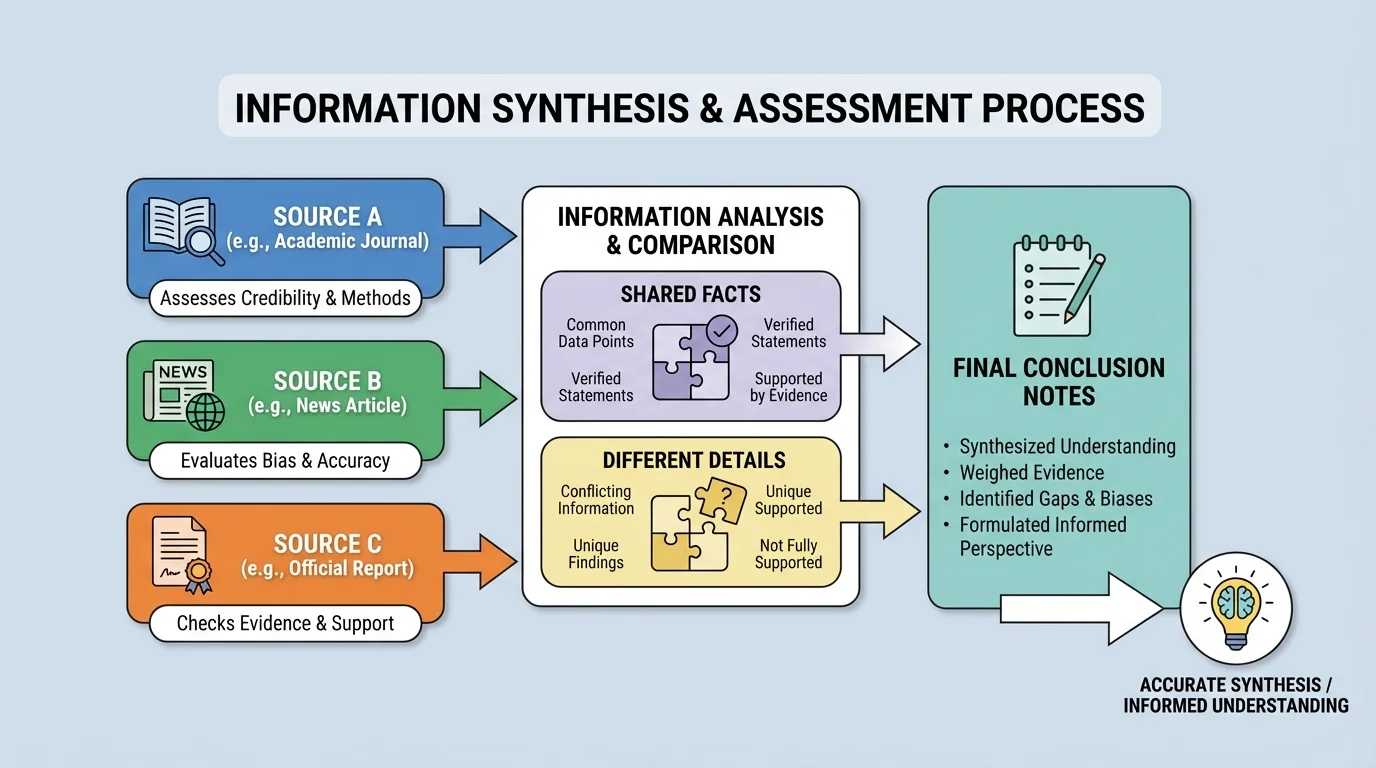
Synthesize means to put information from different sources together to build a fuller understanding. You are not just copying facts from one source after another. You are combining pieces, as [Figure 4] shows, to answer a question clearly and fairly.
[Figure 4] When you synthesize, look for three things: what sources agree on, what they disagree on, and what each source adds. One source might explain the science of recycling, another might give local recycling numbers, and a third might describe problems people have using the bins correctly. Together, those ideas create a more complete answer.
A good way to synthesize is to organize your notes by topic instead of by source. For example, if your topic is school gardens, your note categories might be "plant growth," "student learning," "cost," and "care needed." Then you place facts from different sources under those headings.
Synthesis also means being honest when sources disagree. If two strong sources disagree about how much an action helps, you should say so. You might write, "Most sources agree that trees cool schoolyards, but they differ on how much they reduce energy use." That is better than pretending all sources say the same thing.
Later, if you need to explain your final conclusion, this process helps you show that your answer comes from comparing several pieces of evidence, not just picking your favorite source.
After gathering and evaluating information, the last job is to explain your findings clearly. This is the "communicating" part of obtaining, evaluating, and communicating information. You should tell the main answer to your question, mention which sources were strongest, and explain whether important claims were supported by evidence.
Clear communication includes using your own words, grouping similar ideas together, and naming the evidence behind your conclusion. For example, instead of saying, "The article said it," you could say, "Two science sources and one park report all show that native plants help local insects."
You should also be fair. If a source was weak, explain why. If a source was strong, explain that too. For example: "This claim is not well supported because the article gives no author and no evidence." Or: "This conclusion is supported by observations, survey data, and a report from a trusted organization."
"Good research is not about finding one answer fast. It is about finding the best-supported answer."
When you communicate, avoid copying exact sentences unless you are using a direct quote and showing where it came from. Most of the time, it is better to paraphrase, which means to restate the idea in your own words while keeping the meaning accurate.
Let's say students want to answer the question, "Should our school plant more trees?" This is a real question with science, money, and community concerns all mixed together.
One source is a city website explaining how trees provide shade and help cool neighborhoods. Another source is a gardening book about which trees grow well in the local climate. A third source is an interview with the school custodian about leaf cleanup and root problems. A fourth source is a local weather report showing how hot the playground gets in late spring.
To evaluate these sources, students would check credibility, dates, evidence, and possible bias. The city website may be credible and useful, but it may also strongly favor planting trees. The custodian interview gives real local knowledge, but it is still one person's point of view. The weather report gives factual measurements. The gardening book gives background knowledge.
How a student might explain the evidence
Step 1: State the shared support
Several sources support planting more trees because trees provide shade, help lower the temperature, and can improve the look of the schoolyard.
Step 2: State the concerns
Some evidence shows that trees also require care, cost money, and may create cleanup work.
Step 3: Give a balanced conclusion
A reasonable conclusion is that planting more trees is supported by evidence if the school chooses suitable tree types and plans for maintenance.
This answer is stronger than simply saying "Trees are good" because it uses multiple sources and explains both support and limits.
This kind of balanced explanation is often the best result of research. Real questions do not always have simple yes-or-no answers.
One common mistake is trusting the first source you find. Fast is not always accurate. Another mistake is using only sources that agree with what you already think. Good researchers stay open to new evidence.
A third mistake is confusing confidence with truth. A source can sound certain and still be wrong. Bright colors, dramatic headlines, and exciting words do not prove anything. Evidence proves things.
Another mistake is ignoring dates. A source about a current disease, a weather event, or new technology can become outdated quickly. A final mistake is failing to explain how claims are supported or not supported by evidence. If you make a conclusion, show what facts led you there.
