Have you ever smelled popcorn before you saw it, or wondered how a cut on your skin can get red and swollen even though you cannot see what is happening inside? Science often studies things that are too tiny, too far away, too slow, too fast, or too hidden for us to watch directly. To understand those hidden processes, scientists build models. A model is not just a toy or a copy. It is a useful way to explain how something works, especially when the real mechanism cannot be seen with our eyes.
Some things are easy to observe. You can see rain falling, hear thunder, or watch a ball roll across the floor. These are observations. But many causes of what we observe are hidden. We cannot see air particles moving in a room. We cannot watch food break into nutrients inside the small intestine. We cannot look directly into deep layers of Earth. These hidden causes are called mechanisms when they explain how or why something happens.
Scientists use evidence from observations to build explanations for these hidden mechanisms. A model helps connect what we can see to what we cannot see. For example, if a plant leans toward a window, we observe the leaning. A model helps explain the hidden mechanism: the plant is growing in response to light.
Observable means able to be noticed directly with the senses or with tools. Unobservable means not directly seen or measured in a simple way. Model means a representation that helps explain an object, system, or process. Mechanism means the hidden parts and actions that make something happen.
Models are part of the science practice called developing and using models. Scientists make models to explain ideas, show relationships, predict what might happen, and test whether their thinking makes sense. Students use this same practice when they draw diagrams, build simple systems, or explain a process with arrows and labels.
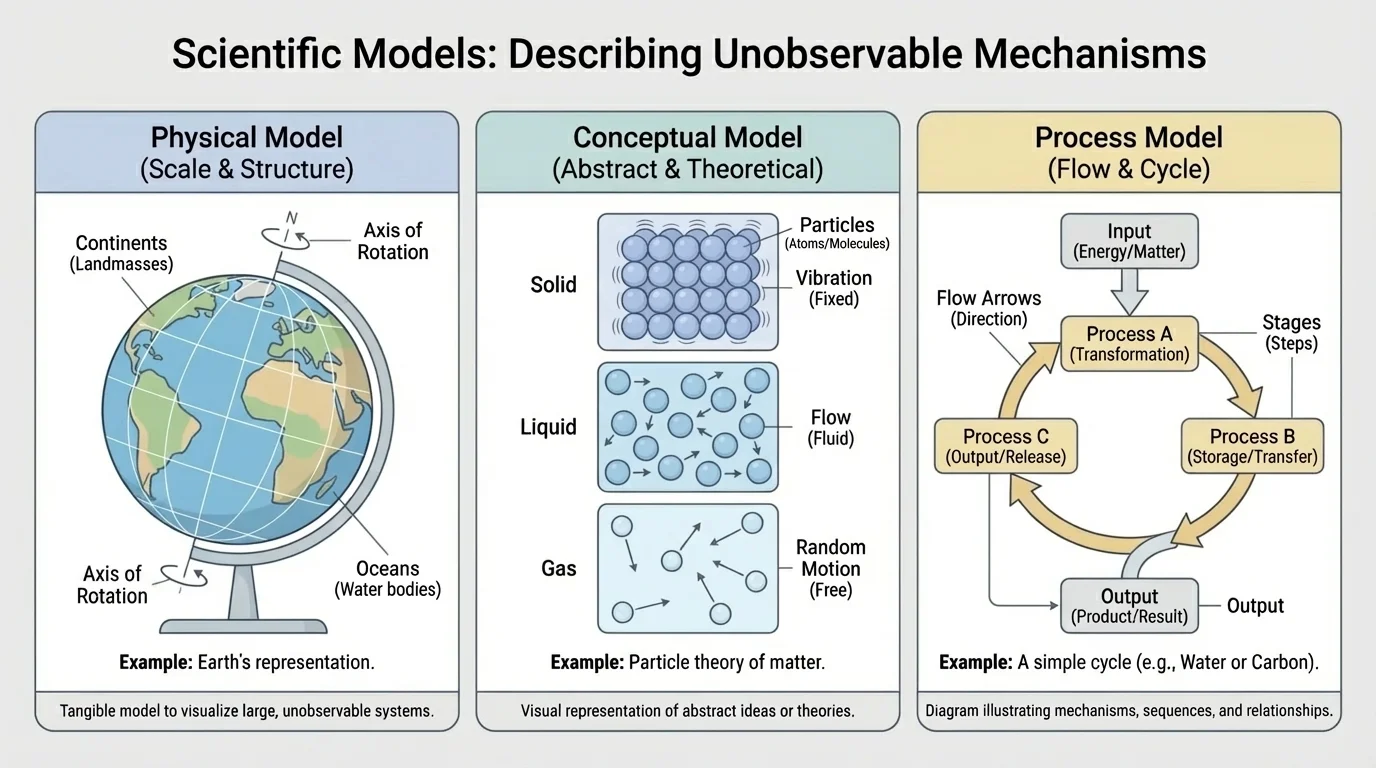
A scientific model stands for something real. It may be a drawing, a physical object, a set of arrows, a map-like picture, or even a mathematical model. As [Figure 1] shows, models can take different forms, but all of them help us think about something that may be hard to observe directly or too complicated to study all at once.
A globe is a model of Earth. It is smaller than the real planet, but it helps us understand shape and location. A diagram of the water cycle is a model of how water moves through nature. A set of arrows showing food moving through the digestive system is a model of a process inside the body. None of these is exactly the real thing, but each helps explain important features.
Good models are simplified. That means they leave out some details so the important ideas are easier to see. This is a strength, not a weakness, as long as the model keeps the main cause-and-effect relationships correct. A map of a town does not show every blade of grass, but it still helps you find your way.
Scientists also know that every model has limitations. A globe shows Earth's shape well, but it does not show tiny streets. A particle drawing may use big circles, but real particles are much smaller and do not actually look like the drawing. A model is useful because it helps us think, not because it is a perfect copy.
Scientists often use more than one model for the same thing. Weather forecasters use maps, computer models, and satellite images together because each model shows a different part of the story.
When you use [Figure 1] again later in your thinking, remember this big idea: one model may show structure, another may show motion, and another may show a sequence of steps. Choosing the right kind of model helps make the hidden mechanism clearer.
Building a model starts with clues. Scientists look for patterns in observations. If the same event happens again and again, that pattern suggests a hidden cause. Then they create a possible explanation and ask, "If this model is correct, what else should we observe?"
This process is a bit like solving a mystery. Suppose your classroom smells like oranges right after someone peels one at the back of the room. You do not see the smell moving. But you notice that the smell reaches nearby students first and then spreads farther. Those clues help you build a model that tiny particles from the orange move through the air.
A model becomes stronger when it matches several pieces of evidence, not just one. It should also help predict new observations. If the air in the room is moving because of a fan, the model predicts the smell may spread faster in one direction. If that happens, the model gains support.
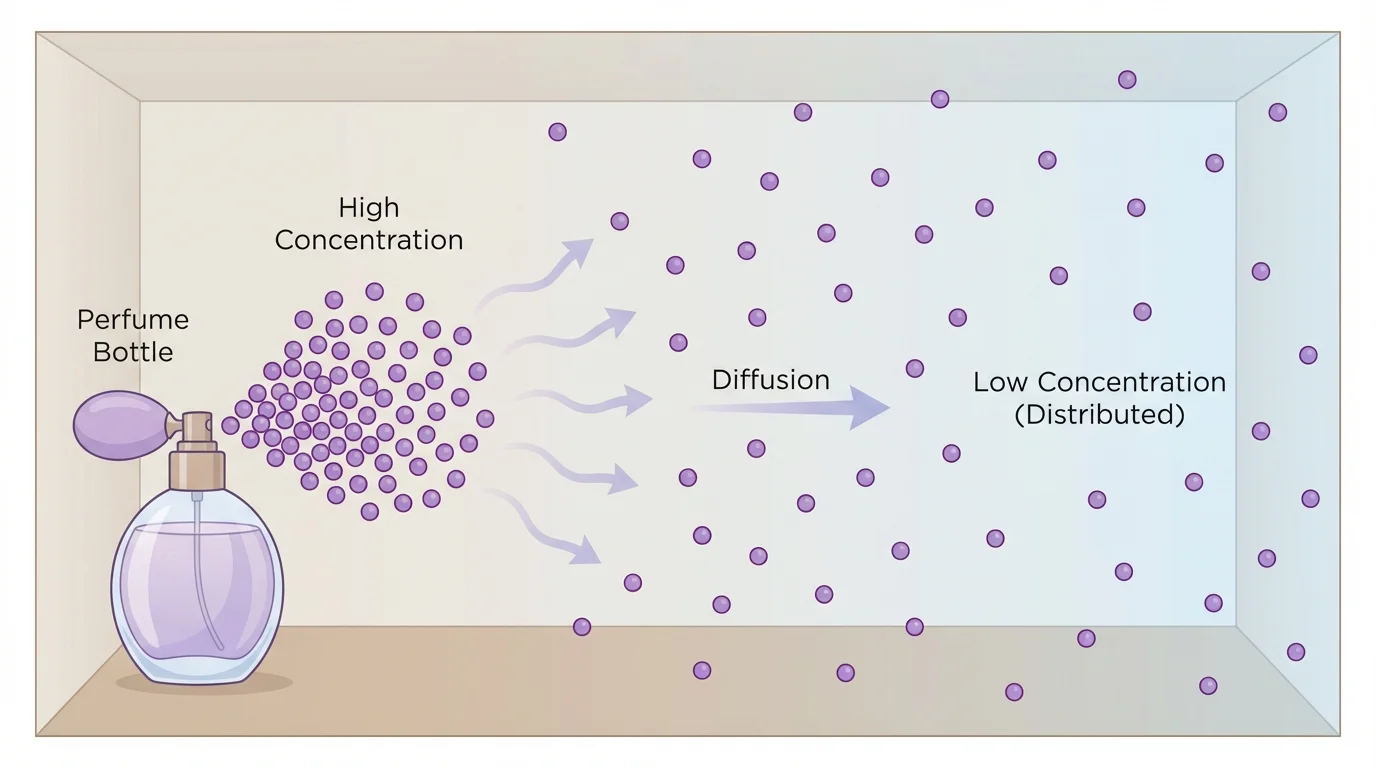
Smell is a great example of an unobservable process. We can smell soup from the kitchen, but we cannot watch individual scent particles traveling through the room. To explain this, scientists use a particle model of matter. In this model, air and scent are made of tiny particles that are always moving. As [Figure 2] illustrates, particles from the smell begin concentrated in one place and then spread out by moving and mixing with the air.
This hidden spreading process is sometimes called diffusion. You do not need to see the particles to know something is happening. The evidence is the changing pattern of who smells the odor first and how the smell slowly fills the room.
In the model, particles move from places where there are many of them crowded together to places where there are fewer. Over time, they spread more evenly. If we could count particles in one corner of the room and compare them with another corner, the difference would become smaller over time. For example, if one area started with about \(100\) scent particles in a small space and another area had only \(10\), movement would tend to mix them until the amounts were closer.
This model explains more than just perfume or popcorn. It also helps explain why the smell of smoke spreads, why air freshener works, and why gas leaks can be dangerous even when the gas itself is invisible. The model does not show every exact path of every particle, but it explains the main mechanism well.
The particle model also helps make predictions. If the room is hotter, particles usually move faster, so the smell may spread more quickly. If a window is open, moving air can carry particles faster in one direction. When observations match those predictions, the model becomes more useful. That is why [Figure 2] matters beyond one example: it shows a hidden mechanism that can explain many everyday events.
Models connect evidence to explanation. A model is strongest when it does three things at once: it fits the evidence we already have, it explains the hidden process causing the evidence, and it predicts what we might observe next.
Notice that the model is not the same as the smell itself. You cannot wave a drawing around and make a room smell like cinnamon. The model is a thinking tool. It helps us answer the question, "What unseen process can explain what we observe?"
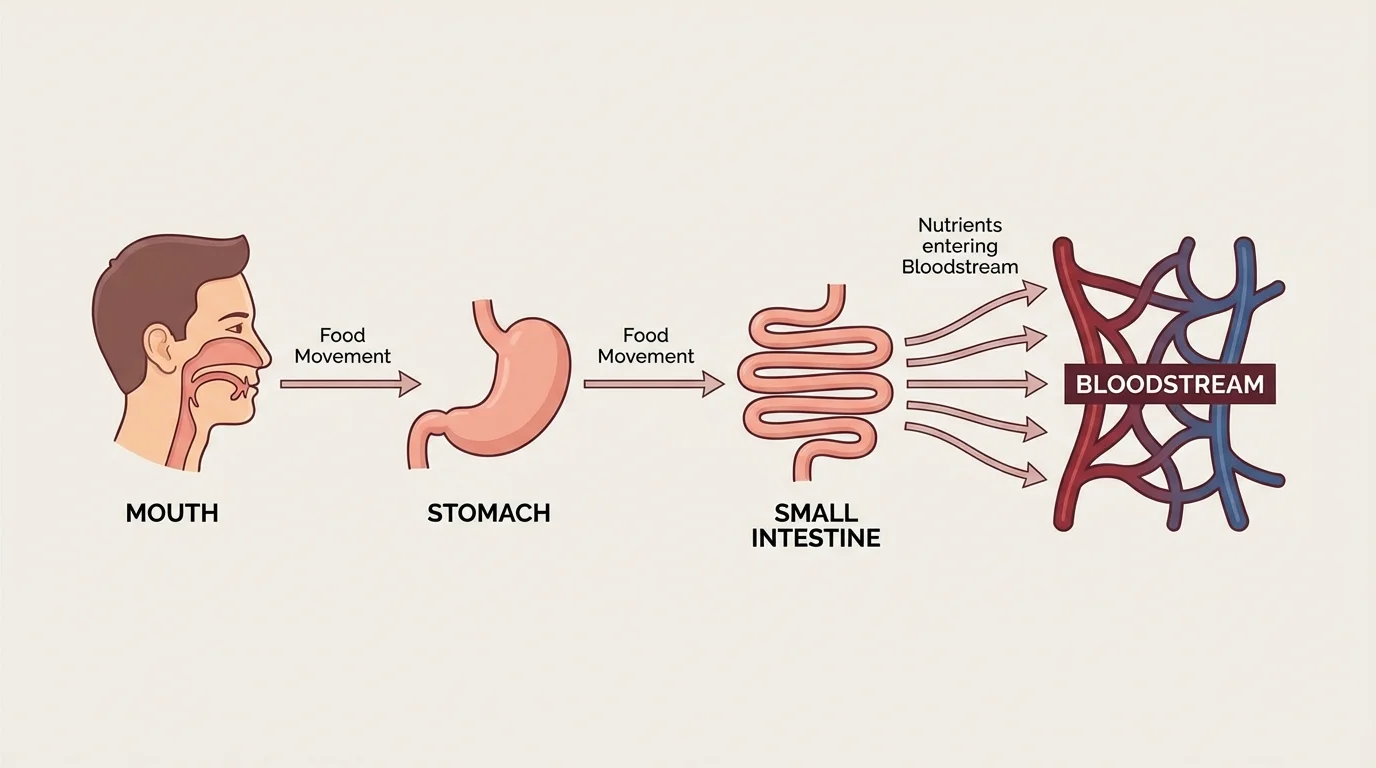
Many body processes are unobservable without special tools. You can feel hungry, chew food, and swallow it, but you cannot directly watch your stomach mixing food or your small intestine taking in nutrients. A system model helps explain these hidden steps. In the digestive process shown by [Figure 3], food moves through connected organs, gets broken into smaller pieces, and useful substances move into the blood.
This is an example of a body system with parts that work together. The mouth starts breaking food down. The stomach churns and mixes it. The small intestine absorbs nutrients. The blood carries those nutrients to cells. A model with arrows helps show both order and movement.
Another body model explains infection. You may scrape your knee and later see redness, warmth, and swelling. You cannot see germs entering the body or white blood cells responding without a microscope, but a model helps describe the mechanism: germs enter through the opening, the immune system reacts, and the area becomes inflamed as the body fights back.
Doctors use models all the time. An X-ray is one kind of model-like image of bones. A diagram of the heart shows blood moving through chambers and vessels. Even when doctors cannot watch every cell working, they can use evidence such as temperature, pulse, and lab tests to build and improve models of what is happening inside a patient.
Later, when you think back to [Figure 3], notice how arrows and labels make the hidden mechanism easier to understand. A flowchart model is especially useful when a process happens in a sequence of steps.
Building a simple digestion model from evidence
Suppose a student eats lunch and later has energy for soccer practice. How can a model explain that hidden process?
Step 1: Start with observations.
The student eats food, time passes, and the student has energy to run.
Step 2: Add the hidden mechanism.
Food is broken down in the digestive system, nutrients are absorbed into the blood, and body cells use those nutrients.
Step 3: Show the connections.
Use arrows: food \(→\) stomach mixing \(→\) small intestine absorption \(→\) blood transport \(→\) muscles working.
Step 4: Check whether the model explains the evidence.
The model links eating food to getting usable energy, so it explains why the student can be active later.
This model does not show every chemical detail, but it clearly explains the main hidden steps.
Scientists often begin with a simple model like this and then make it more detailed as they learn more. Younger students may use arrows and labels, while older scientists may add cells, molecules, or measured data.
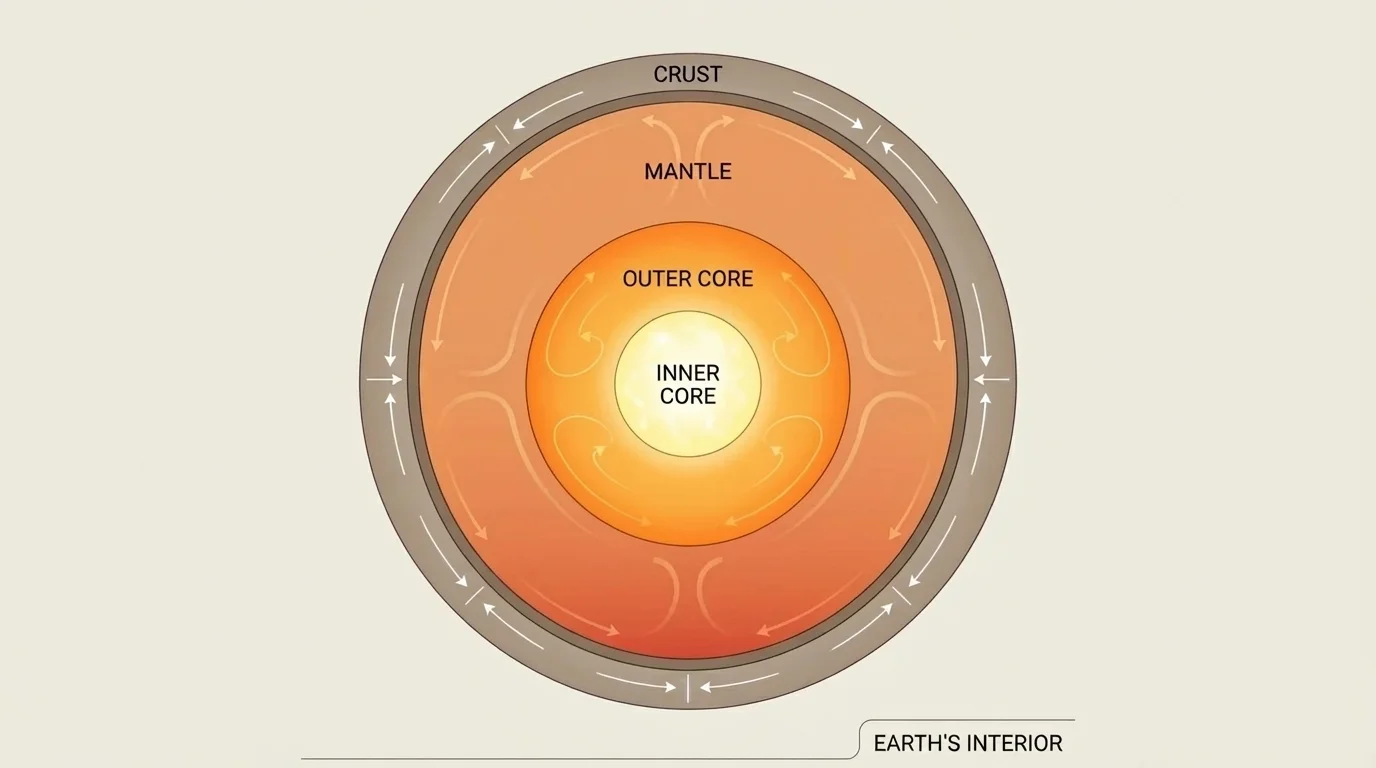
Some hidden mechanisms happen on a huge scale. We cannot dig to the center of Earth. We also cannot watch continents move the way we watch a bike roll down a street, because plate motion is extremely slow. Scientists use evidence and models to explain these hidden Earth processes. A cross-section model in [Figure 4] shows Earth's layers and the movement of plates near the surface.
Earth is often modeled with layers: crust, mantle, outer core, and inner core. Scientists infer these layers from evidence such as earthquake waves, rock studies, and measurements of heat and density. Even though the inside of Earth is unobservable directly for us, the model helps explain volcanoes, earthquakes, and mountain building.
Plate tectonics is another model-based idea. In this model, Earth's crust is broken into plates that move slowly. Where plates push together, mountains can form. Where they pull apart, new crust can form. Where they slide past each other, earthquakes may happen. The motion is hidden because it is too slow to watch easily, but the results can be observed.
This kind of model is powerful because it ties many observations together. One model helps explain ocean trenches, earthquake zones, and chains of volcanoes. That is much better than having separate explanations for each observation with no connection between them.
Scientists also model groundwater, which is water stored underground. We may see water in a well, but we cannot easily watch it moving through tiny spaces in rock and soil. A model can show rain soaking into the ground, filling spaces, and moving slowly downhill underground. Once again, the hidden mechanism is inferred from clues.
Evidence does not have to mean "seeing with your eyes only." Scientists also use sound waves, temperature measurements, microscopes, and other tools to gather clues about things that are otherwise hidden.
When students return to [Figure 4], they should notice that a cross-section model is especially useful for showing inside layers and motions that are impossible to view all at once in the real world.
A useful model usually has several important parts. First, it identifies the thing or process being explained. Second, it includes the key parts of the system. Third, it shows relationships such as movement, change, or cause-and-effect. Fourth, it connects to evidence. Finally, it makes clear what the model does not include.
For grade-level science, many good models use simple features: labeled parts, arrows, short notes, and a clear title. If you are modeling how roots take in water, your model might include soil, roots, water, arrows upward, and sunlight above the plant. You do not need every tiny cell in the root unless that detail is needed for the explanation.
A good model should answer a question. If the question is "How does smell travel?" then the model must show movement of particles. If the question is "Why does a scraped knee swell?" then the model must show germs entering and the body reacting. The best model depends on the purpose.
| Part of a strong model | What it does | Example |
|---|---|---|
| Labels | Name important parts | Mouth, stomach, small intestine |
| Arrows | Show direction or change | Food moving through the body |
| Evidence link | Connect the model to observations | Smell spreads across a room |
| Cause-and-effect | Explain why one thing leads to another | Germs enter, body responds |
| Limits | Show what the model leaves out | Particle drawing is not full size |
Table 1. Features that help make a scientific model clear and useful.
Because all models are simplified, model builders must choose carefully. Leaving out unimportant details can help. Leaving out an important cause can make the model weak or misleading.
Scientists do not make a model once and keep it forever without checking it. They compare the model's predictions with real evidence. If the evidence does not fit, they revise the model. This means scientific knowledge can improve over time.
Suppose a model says that smell spreads equally in every direction. Then a fan is turned on, and the smell reaches one side of the room much faster. The original model is not entirely wrong, but it is incomplete. It needs a new part about moving air.
Revising a model
A class models why puddles disappear after rain.
Step 1: Original model.
The class says puddles "soak into the ground."
Step 2: New evidence.
Some puddles on blacktop disappear too, even though water cannot soak into the road.
Step 3: Revision.
The class adds evaporation to the model: liquid water changes to water vapor and moves into the air.
Step 4: Better explanation.
The improved model now explains puddles on soil and puddles on pavement.
Revision makes the model stronger because it fits more evidence.
Sometimes scientists compare two models and ask which one explains the evidence better. The better model is usually the one that matches more observations, makes more accurate predictions, and stays clear and logical.
This is why models are powerful learning tools. They are not random guesses. They are evidence-based explanations that can be checked, discussed, and improved.
You may not call them scientific models every day, but people use them constantly. Weather maps and computer forecasts model the atmosphere. Doctors use body-system models to diagnose illness. Engineers model bridges before building them. Game designers model motion on a screen. Even a fire drill map is a model that helps predict the safest path out of a building.
These examples matter because hidden mechanisms affect real decisions. A weather model may suggest when a storm is likely to arrive. A doctor's model of infection may guide treatment. An engineer's model may reveal where a design could fail before anyone gets hurt.
Many scientists use computer models to study events that are too dangerous, too expensive, or too slow to test directly, such as hurricanes, climate patterns, or changes inside stars.
When you understand how models work, you become better at asking strong questions: What does this model explain? What evidence supports it? What details did it leave out? Those are the kinds of questions scientists ask all the time.
One common mistake is thinking that a model must look exactly like the real thing. That is not true. A model of air particles may use dots and arrows even though real particles do not look like cartoon dots. The important point is whether the model explains the mechanism correctly.
Another mistake is confusing evidence with explanation. Seeing that a room smells like cookies is evidence. Saying that scent particles spread through air is a model-based explanation. Observations and explanations work together, but they are not the same thing.
A third mistake is making a model too simple. If a model of digestion shows only a stomach and ignores the small intestine, it misses a major part of the mechanism. But a model can also become too crowded with details. The goal is to include what matters most for the question being asked.
Strong science thinking means using evidence, building a clear model, checking it against observations, and improving it when needed. That is how we learn about many of the most important processes in nature, even when they are hidden from direct view.
