A sunny morning can turn into a thunderstorm by afternoon, and that change is not random. Scientists look for the causes behind the change: where the air came from, how warm it is, how much water vapor it holds, and how it moves. When we understand what causes something, we can often predict its effects. That idea is one of the most powerful tools in science, whether we are studying weather, body systems, or machines people design.
In science, a cause-and-effect relationship means that one event, condition, or action helps bring about another. If dark pavement heats up in sunlight, the warmer surface heats the air above it. If warm, moist air rises and cools, clouds may form. If enough water droplets or ice crystals grow inside those clouds, rain or snow can fall. Science asks: What caused this to happen, and what effect did it produce?
These relationships are especially useful for making predictions. A prediction is not just a guess. It is a statement based on evidence, patterns, and understanding. If weather instruments show falling air pressure, increasing humidity, and a cold front moving closer, meteorologists can predict a higher chance of stormy weather. If a doctor sees signs of dehydration, they can predict effects on the body, such as lower energy or dizziness. If an engineer knows that a bridge material expands when heated, that engineer can design gaps to prevent damage in summer.
Cause and effect also help us understand systems that are too big, too small, or too complicated to observe all at once. We cannot watch every particle of air in the atmosphere, but we can study patterns and build explanations. Over time, repeated evidence shows that some causes usually lead to certain effects.
Scientists often study systems by looking at inputs, outputs, and interactions. An input is something that enters a system, such as energy from the Sun. An output is something the system produces, such as wind, rain, or heat leaving the ground.
That is why meteorology, biology, and engineering all rely on the same big idea: if you can identify the important causes and understand how they interact, you can make better predictions about the effects.
A system is a group of connected parts that interact with one another. In a weather system, air, water vapor, land, oceans, sunlight, and Earth's rotation all influence one another. A change in one part of the system can lead to changes in many other parts.
[Figure 1] In science, it is important to identify the variables in a system. A variable is something that can change, such as temperature, wind speed, or humidity. If one variable changes, another may respond. For example, when the Sun heats land faster than water during the day, the air above the land warms faster too. Warm air becomes less dense and rises. Cooler air moves in to replace it, creating wind. Here, uneven heating is a cause, and moving air is an effect.
Some effects have more than one cause. Rain may depend on moisture in the air, lifting of the air, cooling, and the presence of tiny particles where droplets can form. This is why scientists usually look for multiple pieces of evidence before making a prediction.
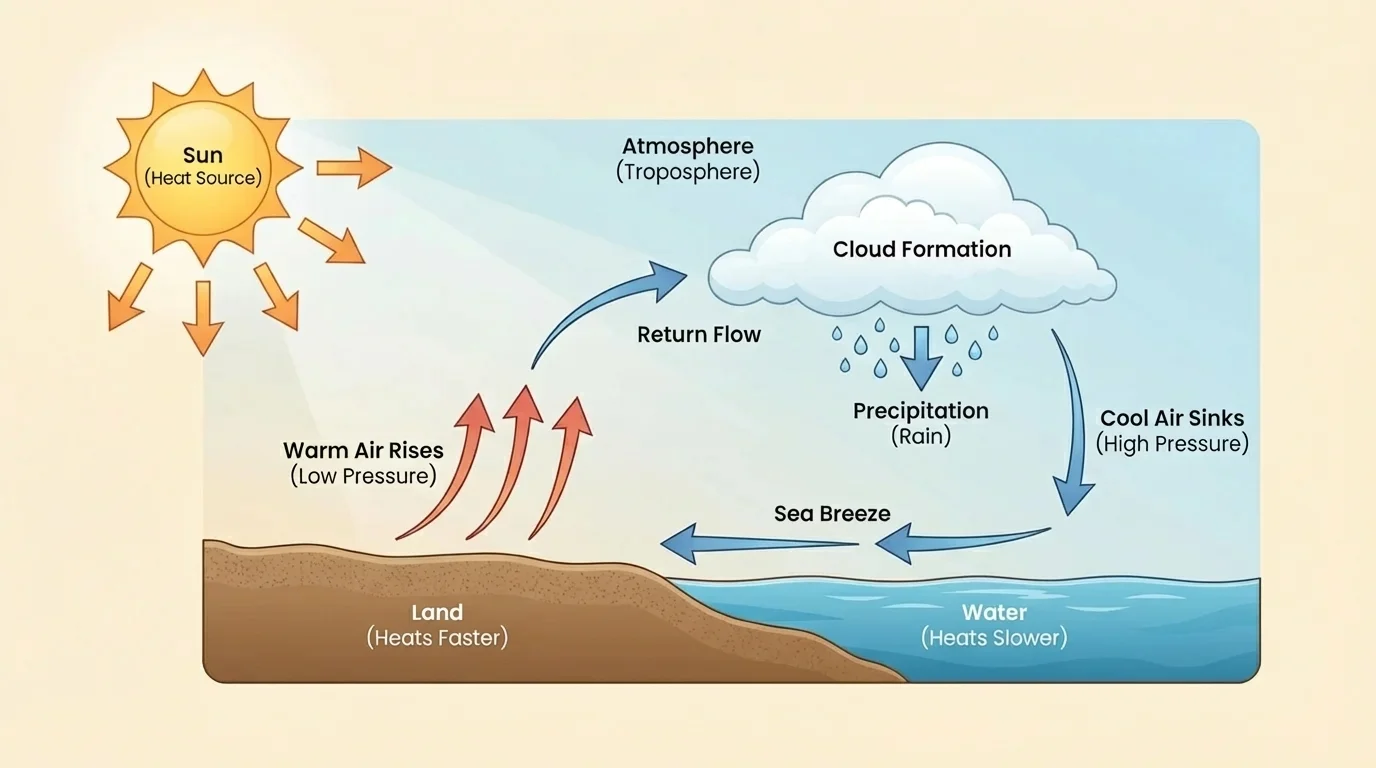
Cause and effect are not always simple chains. Often they form networks. Warm ocean water can heat the air above it. That warmer, moister air can rise and form clouds. Clouds can block some sunlight from reaching the surface. So one effect may become a new cause. As a result, systems can change over time in ways that are connected and sometimes surprising.
Cause is something that makes another event or change happen. Effect is the result of that cause. Prediction is a statement about what is likely to happen, based on evidence and scientific understanding. Variable is a factor in a system that can change and influence outcomes.
Scientists strengthen cause-and-effect explanations by collecting data again and again. If the same pattern appears in many observations, confidence grows. For weather, this can mean comparing temperature readings, pressure maps, wind directions, cloud types, and radar images over time.
An air mass is a large body of air with similar temperature and humidity throughout. Air masses form when air stays over one region long enough to take on that region's conditions. Air over a cold, dry land area becomes cold and dry. Air over a warm ocean becomes warm and moist.
As air masses move, they carry those properties with them. This means that a city's weather can change when a different air mass arrives. If warm, humid air moves into an area that had cool, dry air, the temperature may rise and the air may feel more humid and uncomfortable. If a cold, dry air mass replaces warm air, the weather may turn cooler and clearer.
Two important variables in weather are temperature and humidity. Temperature tells how warm or cool the air is. Humidity describes the amount of water vapor in the air. Warm air can usually hold more water vapor than cold air. That matters because when warm, moist air cools, some water vapor may condense into droplets, forming clouds.
Another important variable is air pressure, which is the force of air pushing on surfaces. Areas of low pressure are often linked with rising air and cloud formation. Areas of high pressure are often linked with sinking air and clearer skies. If air pressure at a location drops over time, that can be a clue that unsettled weather is approaching.
Why rising air matters
When air rises, it moves into regions where pressure is lower. The air expands and cools. Cooler air cannot hold as much water vapor, so some vapor condenses into tiny droplets or ice crystals. This is one major cause of cloud formation. If enough moisture collects, precipitation can follow.
The same cause-and-effect logic works in reverse. If air sinks, it warms as it is compressed. Warmer air can hold more water vapor, so clouds are less likely to form. This is why high-pressure systems often bring dry, fair weather.
A front is the boundary where two different air masses meet, and these boundaries often produce strong weather changes. Fronts matter because the air masses usually differ in temperature, humidity, and density.
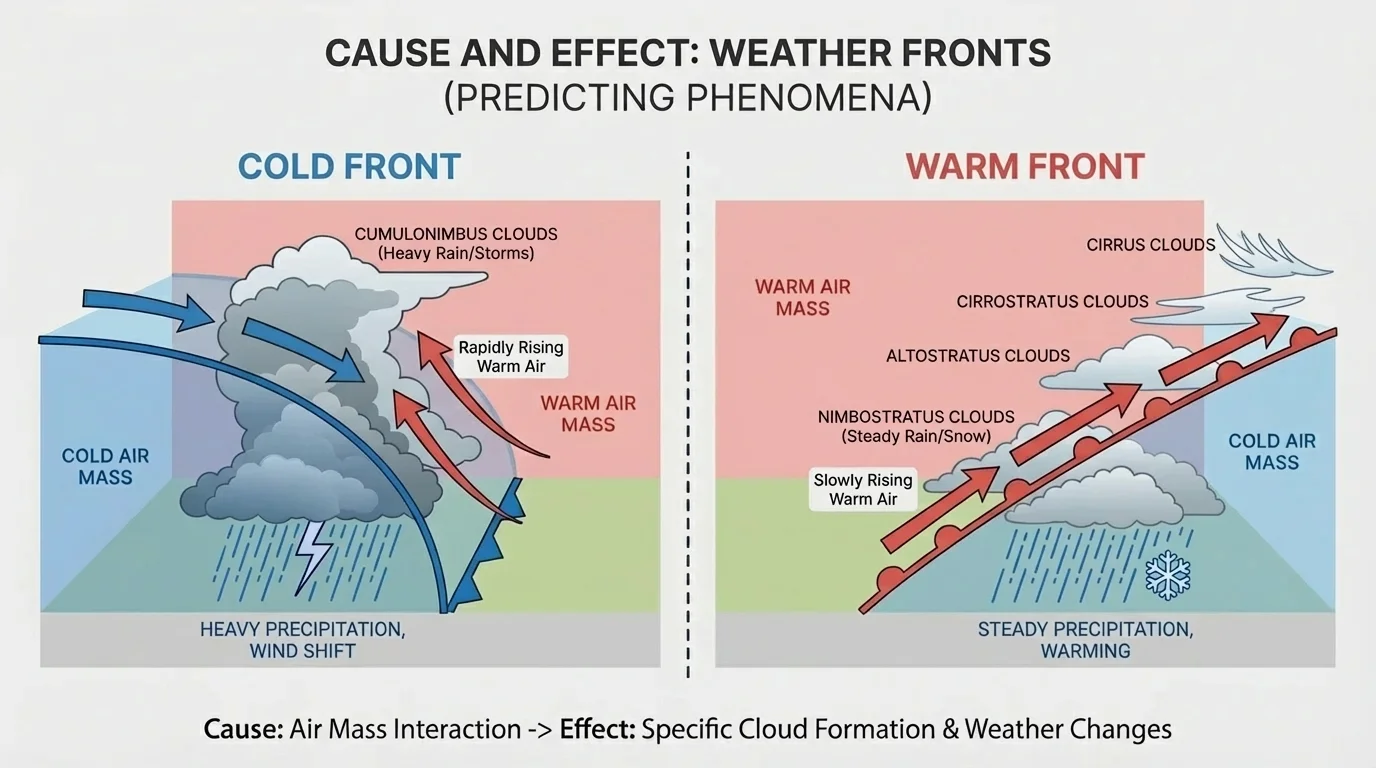
[Figure 2] At a cold front, a colder, denser air mass moves toward a warmer air mass. The cold air wedges under the warm air and forces it upward quickly. That rapid lifting can produce tall clouds, heavy rain, thunderstorms, and sudden drops in temperature. So if a cold front is approaching, a likely prediction is a short period of intense weather followed by cooler air.
At a warm front, warm air moves toward colder air. Because the colder air is denser, the warm air rises more gradually over it. This often leads to layered clouds and longer periods of lighter, steadier precipitation. The temperature usually rises after the warm front passes.
Wind direction can also help identify the motion of air masses. If winds shift from one direction to another and temperature and humidity change at the same time, that suggests a new air mass is moving in. Meteorologists use this evidence together, not one clue alone.
Storms often form where air is forced to rise quickly. However, the exact result depends on several causes at once: how moist the air is, how unstable the atmosphere is, and how fast the front moves. This is a good reminder that in complex systems, one cause may be important but not sufficient by itself.
Some thunderstorms can build from towering clouds that rise more than 10 kilometers into the atmosphere. Their growth begins with the basic cause-and-effect process of warm, moist air rising and cooling.
Later, when students compare weather events, they often notice that the same front type does not produce identical effects every time. That is because the atmosphere includes many interacting variables. Even so, the relationships in [Figure 2] remain useful because they show the main pattern of what usually happens when air masses meet.
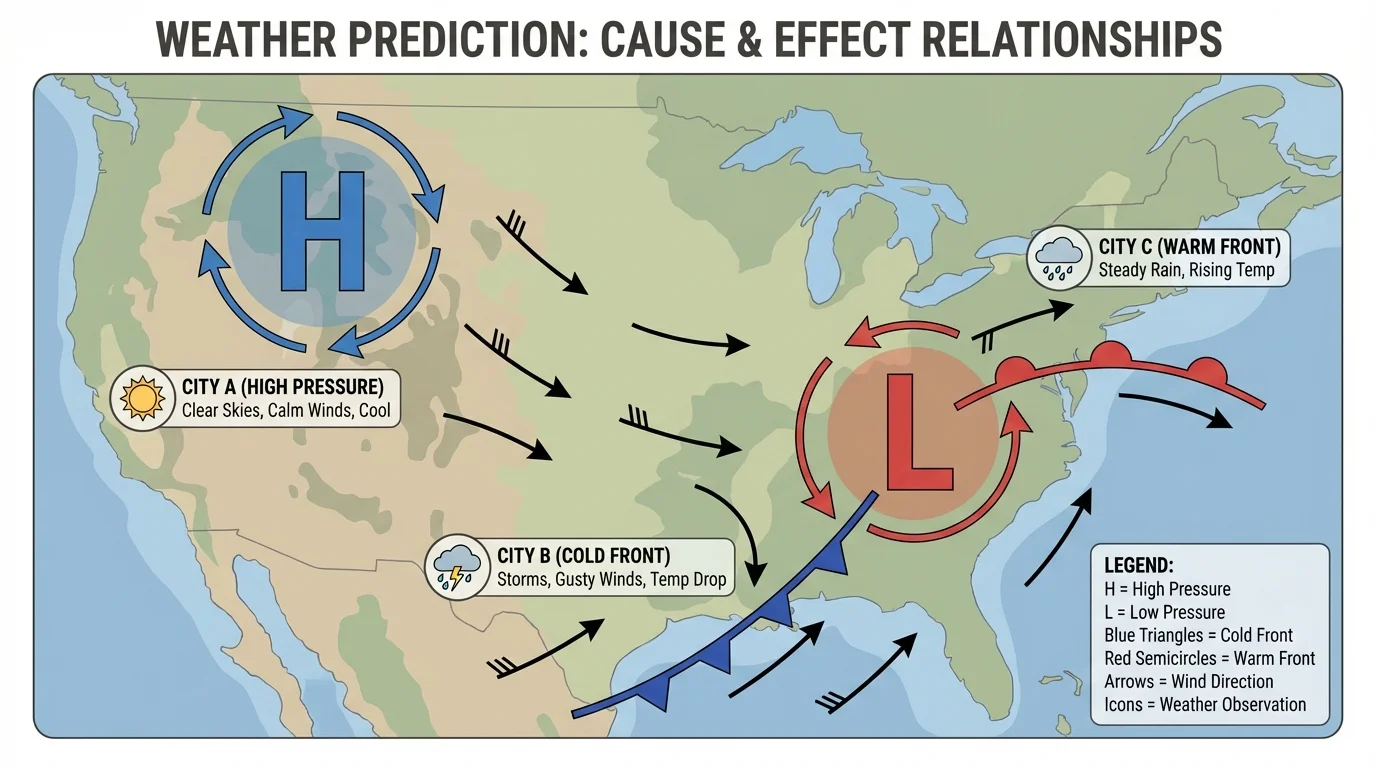
Weather maps organize many cause-and-effect clues in one place. Scientists do not rely on one measurement; they look for patterns across several kinds of data.
[Figure 3] Suppose a city has these observations over one day: temperature falls from \(24 \textrm{ °C}\) to \(17 \textrm{ °C}\), humidity rises, air pressure drops from \(1016 \textrm{ mb}\) to \(1008 \textrm{ mb}\), winds shift direction, and dark clouds increase. Each change is evidence. Together, they suggest that a front may be approaching and rain is becoming more likely.
Meteorologists also compare changes over time. A single pressure reading is useful, but a trend is better. If pressure keeps falling hour after hour, that is often more meaningful than one number by itself. The same is true for radar images, satellite views, and wind measurements at different altitudes.
Some predictions are based on simple numerical comparisons. For example, if the temperature difference between two places is \(8 \textrm{ °C}\), and one air mass is moving toward the other, a noticeable change in local temperature may follow. If a weather station reports rainfall of \(12 \textrm{ mm}\) yesterday and \(25 \textrm{ mm}\) today, then the increase is \(25 - 12 = 13 \textrm{ mm}\). That change suggests stronger precipitation conditions.
Scientists also estimate rates. If a front moves \(120 \textrm{ km}\) in \(6 \textrm{ h}\), then its average speed is \(\dfrac{120}{6} = 20 \textrm{ km/h}\). If it is still \(60 \textrm{ km}\) away, it may arrive in about \(\dfrac{60}{20} = 3 \textrm{ h}\), if it keeps moving at the same average speed. This does not guarantee exact arrival time, but it helps make a practical prediction.
Case study: predicting an afternoon storm
A town begins the day warm and humid. By noon, clouds are growing, pressure is falling, and radar shows a cold front nearby.
Step 1: Identify the causes
The air is warm and moist, which provides water vapor. The cold front can force this air upward. Falling pressure suggests rising air and unsettled weather.
Step 2: Connect the likely effects
Rising warm air cools, water vapor condenses, clouds grow taller, and precipitation becomes more likely.
Step 3: Make the prediction
The best prediction is that the town may experience showers or thunderstorms later in the day, followed by cooler air after the front passes.
This prediction is based on several connected causes, not on a random guess.
Even advanced weather forecasts use the same basic idea: measure important causes, analyze interactions, and predict likely effects. Computers help by processing huge amounts of data, but the scientific reasoning is still rooted in cause and effect.
The same crosscutting idea appears in biology. Living things respond to changes in their environment, and their internal systems help them maintain stable conditions. For example, if the outside temperature rises, the body may sweat. Sweating increases cooling as water evaporates from the skin. Here, the environmental change is a cause, and sweating is an effect that helps the body respond.
If a person exercises hard, muscles need more oxygen and energy. That causes breathing rate and heart rate to increase. These effects help deliver oxygen and nutrients faster. If a person becomes dehydrated, less water is available for sweating, which can make it harder to cool the body. Understanding these relationships helps us predict how the body will react under stress.
Plants also show cause and effect. If a plant does not get enough water, its cells lose pressure and the plant may wilt. If a plant receives more sunlight, photosynthesis may increase, as long as water and carbon dioxide are available. In each case, one change leads to another within a system of interacting parts.
Cause and effect supports survival
Organisms survive by detecting changes and responding to them. A stimulus such as heat, cold, lack of water, or danger can trigger responses in body systems. These responses are not random; they are built into the organism and can often be predicted.
This is similar to weather in an important way. In both living systems and Earth systems, the outcome depends on interactions among many parts. A single factor may not explain everything, but understanding the main causes improves prediction.
[Figure 4] Engineers design machines and structures so that one change leads to another predictable response, as shown in a thermostat system. A thermostat senses room temperature. If the temperature drops below a set value, the heater turns on. When the room warms back up, the heater turns off. This is a designed cause-and-effect relationship.
Many technologies connected to weather work the same way. An umbrella is designed to reduce the effect of rain on a person. Storm drains are designed so that when heavy rain falls, water is carried away instead of flooding streets. Weather satellites and radar systems are designed to detect changes in clouds, water droplets, and storm movement so people can prepare earlier.
Buildings are also designed with weather causes in mind. In hot places, light-colored roofs reflect more sunlight, reducing heating. In snowy regions, sloped roofs help snow slide off rather than build up. Engineers think carefully about what effects weather can produce and how to reduce risk.
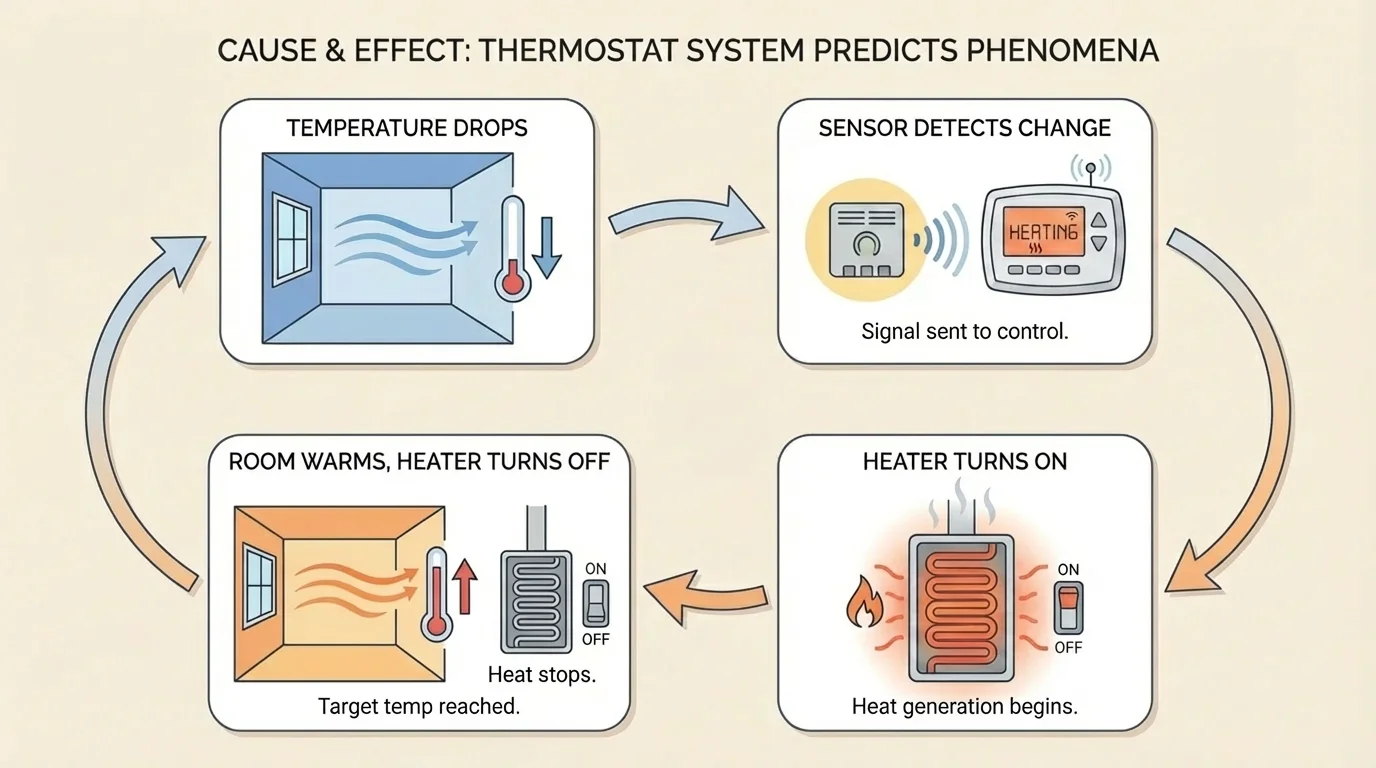
One useful idea in designed systems is feedback. Feedback happens when the output of a system influences the system itself. In a thermostat, the heater changes the room temperature, and the thermostat senses that temperature again. This loop helps keep the system stable. In weather, feedback can also occur, but it is often more complex than in a machine.
| System | Cause | Effect | Prediction |
|---|---|---|---|
| Weather | Cold front approaches | Warm air rises, clouds and rain may form | Stormy weather becomes more likely |
| Human body | Body temperature rises | Sweating increases | Evaporation helps cool the body |
| Thermostat | Room temperature drops | Heater turns on | Room warms toward the set temperature |
| Drainage system | Heavy rainfall | Water flows into drains | Flooding risk is reduced if drains work well |
Table 1. Examples of cause-and-effect relationships in natural and designed systems.
When students compare these examples, they see the same pattern again and again: identify the trigger, understand the mechanism, and predict the result. The feedback loop in [Figure 4] is especially useful because it shows how designed systems can be built to respond automatically to changes.
If cause and effect are so useful, why are predictions sometimes wrong? One reason is that real systems can be extremely complex. In the atmosphere, tiny changes in temperature, pressure, wind, or moisture can interact over large distances. A forecast for tomorrow is often very accurate, but a forecast for two weeks from now is less certain because small differences grow over time.
Another reason is incomplete data. Scientists cannot measure every point in the atmosphere or every process inside a storm. They use the best data available, but there are always limits. That is why forecasts are often given as probabilities, such as a \(70\%\) chance of rain. This does not mean scientists are guessing. It means the evidence suggests rain is likely, but not guaranteed.
"The goal of science is not perfect certainty. It is the best explanation and prediction supported by evidence."
Still, cause-and-effect reasoning remains one of the strongest tools in science. It helps us prepare for storms, protect crops, design safer buildings, understand our bodies, and explain patterns in the natural world. Every time scientists ask what change led to another, they are using the same powerful idea.
