A single volcanic eruption can cool parts of Earth for a short time, while invisible gases released little by little over decades can warm the whole planet. That contrast is one of the most important ideas in Earth science: systems can seem stable, but that stability can be disturbed either by sudden events or by slow changes that pile up until the system shifts.
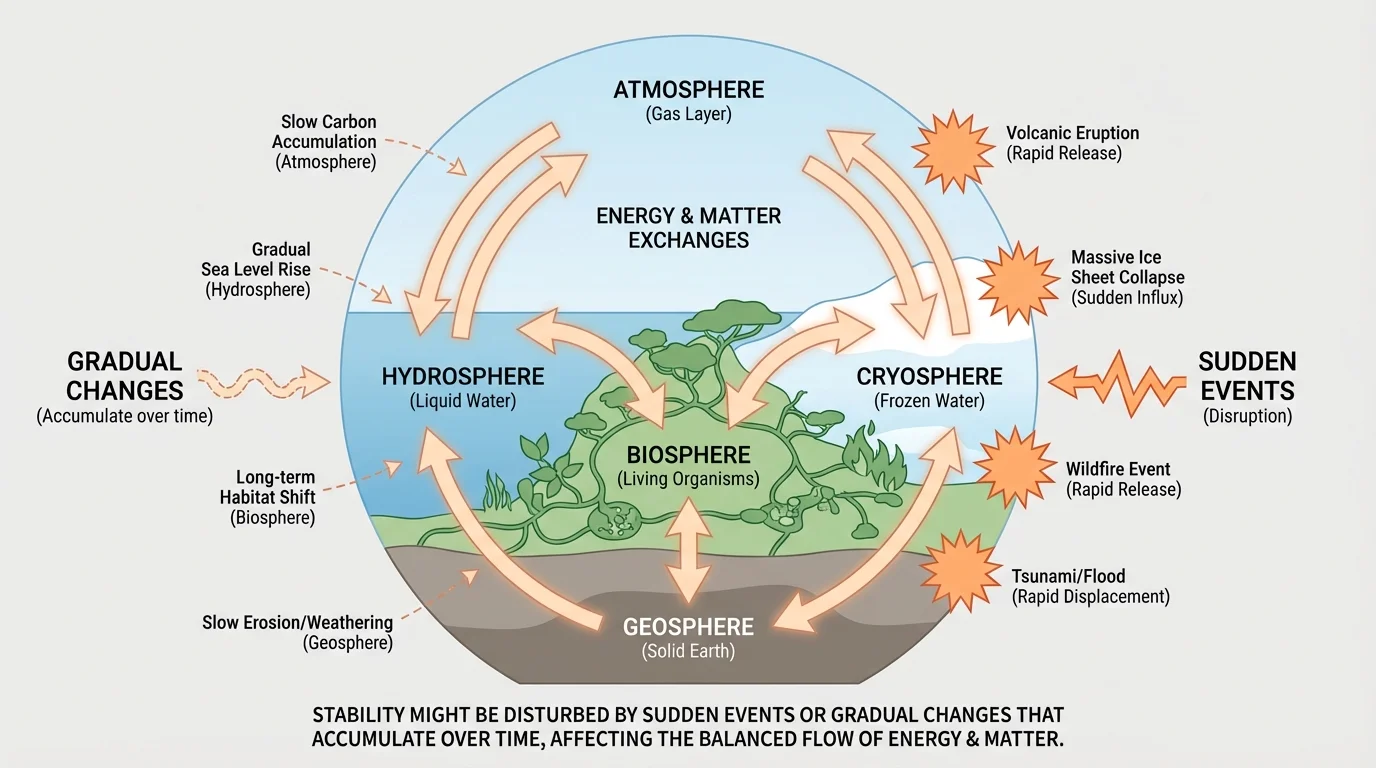
When scientists talk about stability, they mean that a system stays within a certain range instead of changing wildly all the time. Earth is made of connected systems: air, water, land, ice, and living things. These systems interact constantly, and they remain fairly steady only when energy and materials move in balanced ways, as [Figure 1] illustrates.
For example, sunlight reaches Earth, Earth absorbs some of that energy, and then Earth releases energy back into space as heat. If the amount coming in and the amount going out are close to balanced, global temperatures stay within a livable range. This balance is not perfect or unchanging, but it has limits. A disturbance can push the system away from its usual state.
Stability does not mean "nothing changes." Seasons change. Weather changes daily. Ocean currents shift. Plants grow and die. Stability means the overall system does not move too far too fast from the range that supports life and the environments we know.
Think of a bicycle rider. The bike is never perfectly still, but the rider can stay balanced. Earth works in a somewhat similar way. Natural processes can keep things within a workable range, but a sudden shove or many small pushes in the same direction can upset the balance.
Stability is the tendency of a system to remain within a certain range over time.
Disturbance is an event or change that disrupts the usual state of a system.
Climate is the long-term pattern of temperature, precipitation, winds, and other conditions in a region or across Earth.
In climate science, one especially important idea is Earth's energy balance. If more energy stays in the Earth system than leaves it, the planet warms. If more energy leaves than stays, the planet cools. Even a small imbalance, repeated year after year, can matter a lot.
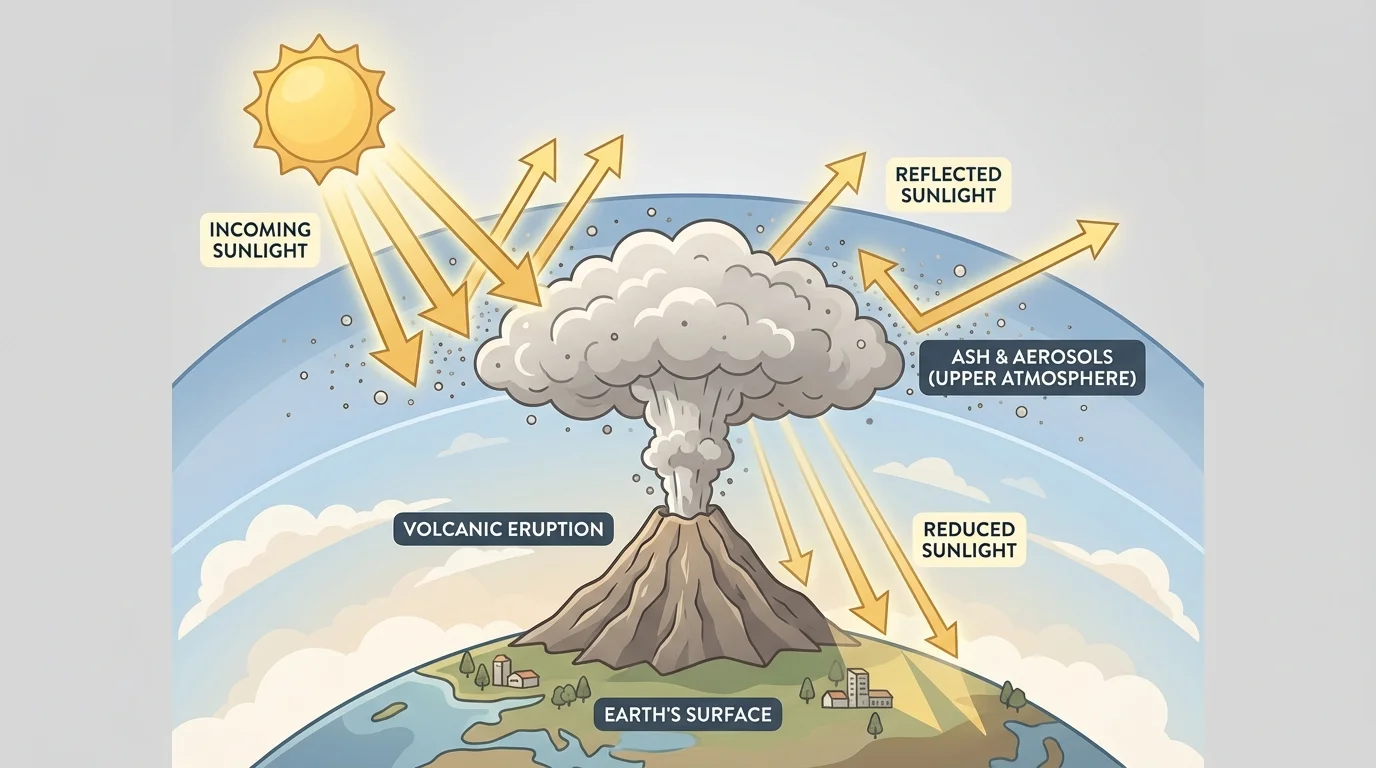
Some disturbances happen quickly. A volcanic eruption, a major storm, a heat wave, or a giant wildfire can change conditions over days, weeks, or months. Sudden events can damage ecosystems, alter local weather, or temporarily affect global temperature patterns, as [Figure 2] shows.
One important example is a powerful volcanic eruption. Volcanoes can send ash and tiny particles high into the atmosphere. Some of these particles, called aerosols, reflect sunlight back into space. When less sunlight reaches Earth's surface, temperatures can drop for a while.
That cooling effect can be strong but usually does not last very long. The particles eventually fall out of the atmosphere or are washed out by precipitation. So a sudden volcanic event may disturb climate briefly, but it usually does not create century-long warming.
Wildfires are another sudden disturbance. They can destroy habitats quickly, release smoke and gases into the atmosphere, and change how much sunlight the land surface absorbs. A burned forest often becomes darker than snow-covered or leafy ground, so it may absorb more solar energy after the fire.
Sudden disturbances are important because they remind us that Earth systems can shift quickly. But if we ask what has changed global temperature over the past century, we have to look beyond short-term events and examine long-term evidence. A one-time disturbance and a long-lasting trend are not the same thing.
After some major volcanic eruptions, scientists measured short-term drops in global temperature because sunlight-reflecting particles spread through the atmosphere. This is one reason scientists compare many years of data instead of judging climate from a single season.
Storms and heat waves can also feel like major climate changes, but one event alone does not define climate. Climate is based on long-term patterns. A single cold winter or one blazing summer is not enough evidence by itself. Scientists look at averages and trends over many decades.
Other disturbances happen so slowly that people may not notice them at first. A tiny change each year may seem unimportant. But after many years, those small changes can add up to a major shift. This is exactly what makes climate change so important to study.
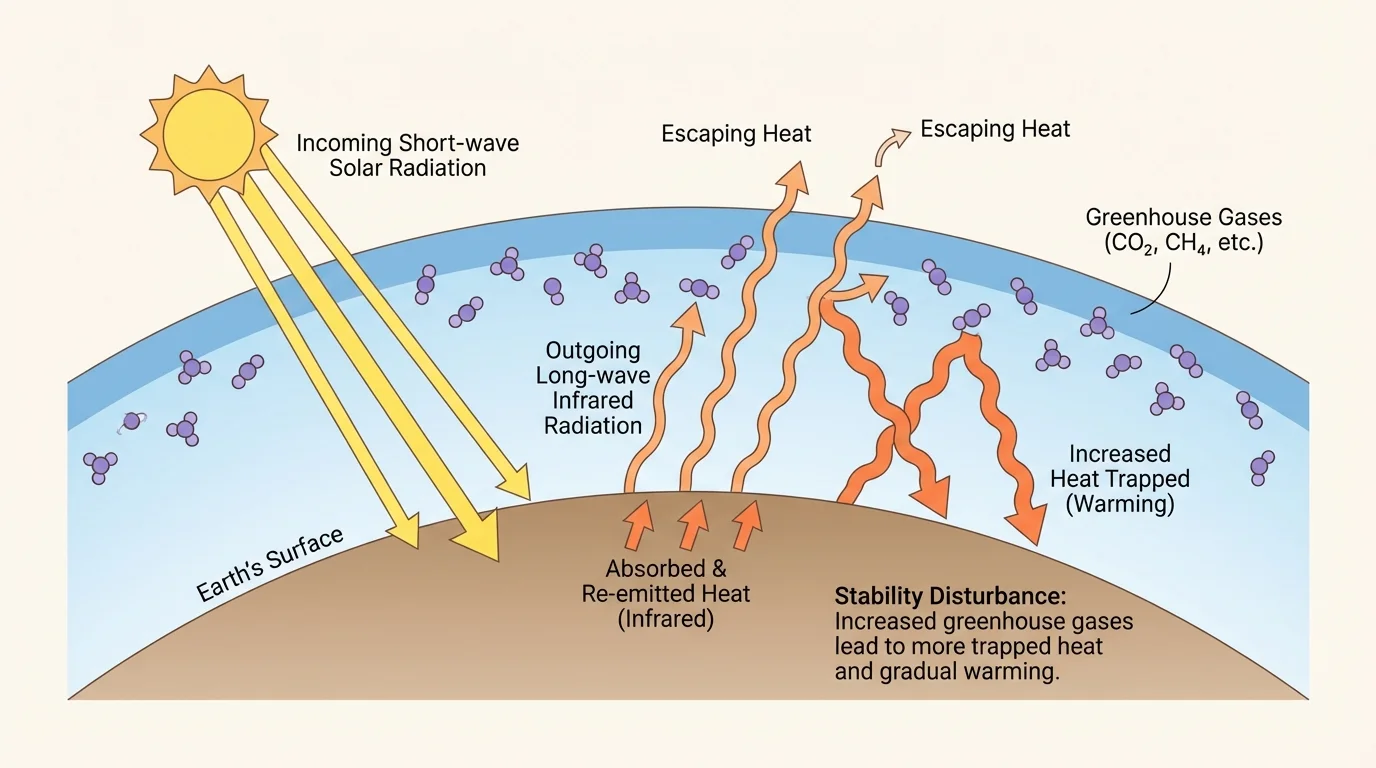
One key example is the increase in greenhouse gases in the atmosphere. Gases such as \(\textrm{CO}_2\) and methane trap some of the heat that Earth radiates back toward space. This natural greenhouse effect helps keep Earth warm enough for life. But when the amounts of these gases increase, more heat stays in the system, as [Figure 3] illustrates.
Carbon dioxide is released naturally by respiration, decomposition, and volcanoes. It is also released by human activities such as burning coal, oil, and natural gas, as well as cutting down forests. Forests normally remove some \(\textrm{CO}_2\) from the air through photosynthesis. When forests are removed, less carbon dioxide is taken in, and more may stay in the atmosphere.
Here is the important point: even if the added amount each year seems small compared with the whole atmosphere, the extra \(\textrm{CO}_2\) accumulates. If more is added than removed, the total rises. That long-term buildup changes Earth's energy balance.
A simple way to think about accumulation is with a net change equation:
\[\textrm{Net change} = \textrm{added amount} - \textrm{removed amount}\]
If a system gains \(5\) units of carbon each year and removes \(3\) units each year, then the atmosphere keeps \(5 - 3 = 2\) extra units annually. After \(10\) years, that is \(2 \times 10 = 20\) extra units. Small yearly increases become large over time.
This is why gradual change can be powerful. It is like dripping water filling a bucket. One drop is tiny. But if drops keep falling and nothing removes enough water, the bucket eventually overflows. In climate, the "bucket" is Earth's atmosphere and oceans storing extra heat.
Slow change can cross a threshold. A system may seem stable for a long time even while pressure is building. Then, after enough small changes accumulate, the system shifts into a noticeably different state. In climate, this can happen when warming melts enough ice, changes enough ocean water, or pushes ecosystems beyond what they can easily tolerate.
Ocean warming is another gradual change. Water absorbs a lot of heat, so oceans can store extra energy for long periods. As the ocean warms, this affects weather patterns, sea level, and marine life. The oceans do not heat up instantly, but over decades the change becomes measurable and significant.
The same pattern appears in melting glaciers and shrinking sea ice. A little loss each summer may not seem dramatic. But repeated year after year, it changes coastlines, habitats, and how much sunlight Earth reflects.
To answer this question, scientists ask careful questions: What factors changed? How large were those changes? Did they happen at the same time as the temperature trend? Could they explain the size and pattern of warming?
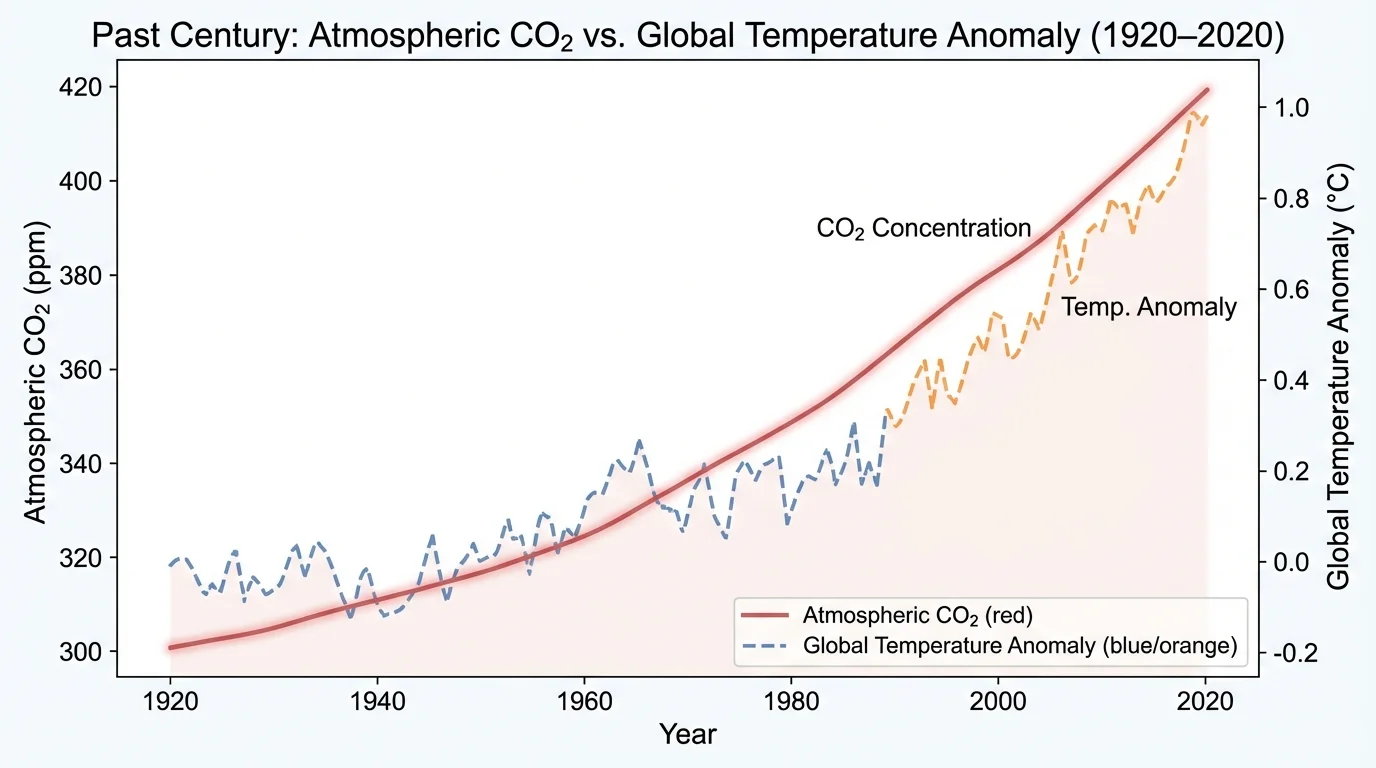
Over the past century, Earth's average temperature has risen. At the same time, atmospheric \(\textrm{CO}_2\) from human activity has increased strongly. This does not mean scientists rely on just one clue. They compare temperature measurements, greenhouse gas data, ice cores, ocean heat, glacier records, and satellite observations.
Natural factors can affect temperature too. The Sun's energy output changes slightly over time. Volcanic eruptions can cause temporary cooling. Ocean patterns such as El Niño and La Niña can warm or cool parts of the planet for months to a few years. But when scientists examine the full evidence, these natural factors do not explain the long-term warming trend as well as rising greenhouse gases do.
That is an important scientific habit: do not stop at the first possible explanation. Ask whether the explanation fits the data over the right time scale. A factor that changes temperature for \(2\) years is not enough to explain a trend that lasts more than \(100\) years.
Some disturbances trigger feedbacks, which are processes that either increase or reduce the original change. Feedbacks are one reason a small disturbance can lead to a bigger result.
A well-known example is the ice-albedo effect. Ice and snow reflect a lot of sunlight. Dark ocean water and land absorb more sunlight. If warming melts some ice, Earth reflects less sunlight and absorbs more. That extra absorbed energy leads to more warming, which can melt even more ice. This is a positive, or amplifying, feedback.
Water vapor provides another example. Warmer air can hold more water vapor, and water vapor is itself a greenhouse gas. So warming can increase water vapor, which can increase warming further. This does not mean water vapor starts the whole process by itself; instead, it can strengthen warming that begins from another cause.
Not all feedbacks amplify change. Some resist it. For instance, in some places increased plant growth can remove more \(\textrm{CO}_2\) from the atmosphere, which can slightly reduce warming. These are stabilizing feedbacks, but they are not always strong enough to cancel the amplifying ones.
The interaction of feedbacks helps explain why climate is not controlled by one simple cause. Earth behaves more like a network of connected parts, similar to the system shown earlier in [Figure 1]. A change in one part can ripple through the others.
Climate science depends on evidence collected over long periods. Scientists compare many lines of evidence, and [Figure 4] highlights one of the clearest patterns: as atmospheric carbon dioxide has risen over the past century, global average temperature has also increased.
Temperature records come from weather stations on land, ships and buoys in the ocean, and satellites. Scientists do not trust a single thermometer or one location. They combine many measurements from around the world and check them carefully for errors.
Ice cores drilled from glaciers and ice sheets contain tiny bubbles of ancient air. These trapped gases let scientists measure past atmospheric composition. They can compare old \(\textrm{CO}_2\) levels with temperature clues preserved in the ice.
Sea level is another source of evidence. When ocean water warms, it expands. Melting land ice also adds water to the oceans. Rising sea level is therefore one sign that the climate system is changing.
Glaciers, snow cover, spring flowering dates, animal migration patterns, and ocean heat content all provide additional evidence. When many different indicators point in the same direction, confidence in the conclusion increases.
Reading climate evidence across time scales
Suppose scientists notice that global average temperature drops slightly after a major volcanic eruption but continues rising over many decades.
Step 1: Identify the short-term factor.
The eruption adds aerosols that reflect sunlight, so short-term cooling makes sense.
Step 2: Check duration.
If the cooling lasts only a few years, it cannot by itself explain a century-long trend.
Step 3: Compare with long-term factors.
If greenhouse gas levels keep rising for decades, they are a better match for long-term warming.
This is how scientists separate sudden disturbances from gradual drivers.
Looking at several kinds of evidence also helps scientists test ideas. If one explanation predicts warming in one place but observations show warming almost everywhere, that explanation may be incomplete. Good science means comparing predictions to actual data.
It helps to compare factors side by side. Some causes are natural, and some are related to human activity. The key question is not whether natural causes exist. They do. The key question is which causes best explain the observed warming over the last century.
| Factor | Type | Typical Time Scale | Effect on Temperature | Can it explain recent long-term warming well? |
|---|---|---|---|---|
| Volcanic eruptions | Natural | Months to a few years | Usually short-term cooling | No, not by itself |
| Solar variation | Natural | Years to decades | Small warming or cooling changes | Not enough to explain the full trend |
| Orbital changes | Natural | Thousands of years | Long-term climate shifts | No, too slow for recent trend |
| El Niño and La Niña | Natural | Months to a few years | Short-term regional and global shifts | No, not for century-long warming |
| Rising \(\textrm{CO}_2\) from fossil fuels | Human-related | Decades to centuries | Long-term warming | Yes, strongly supported by evidence |
| Deforestation | Human-related | Years to decades | Reduces carbon uptake, can increase warming | Yes, contributes |
Table 1. Comparison of major natural and human-related factors that affect global temperature.
One reason rising greenhouse gases fit the evidence so well is that they affect the whole planet's energy balance. Also, their concentrations have risen sharply during the same period in which global average temperature has increased.
The graph in [Figure 4] helps show why scientists look for matching trends over time. A cause must not only exist; it must fit the timing, size, and pattern of the observed change.
Changes in global temperature matter because they affect human life and natural systems. Agriculture depends on temperature, rainfall, and seasonal timing. If a region becomes hotter and drier, crops may struggle. If warmer temperatures allow more evaporation, drought risk can increase.
Human health is affected too. More frequent extreme heat can be dangerous, especially for older adults, young children, and people without access to cooling. Some diseases carried by insects may spread to new places if temperatures and rainfall patterns shift.
Infrastructure can also be stressed. Roads can buckle in extreme heat. Coastal cities face greater flood risks as sea level rises. Water supplies may become less reliable when snowpack and rainfall patterns change.
Weather describes short-term atmospheric conditions, such as today's rain or this week's temperature. Climate describes long-term patterns over many years. A heat wave is weather; an increase in the frequency of heat waves over decades is climate evidence.
Human choices can reduce some disturbances or limit their buildup. Using energy sources that release less \(\textrm{CO}_2\), improving efficiency, protecting forests, and designing cities to handle heat and flooding are examples. These actions matter because they influence the factors that disturb Earth's stability.
Scientists, engineers, farmers, doctors, and city planners all use climate evidence in real life. Understanding gradual accumulation is especially important. If people wait until every effect is obvious, the system may already be much harder to bring back toward balance.
One of the biggest ideas in Earth science is that time scale matters. A storm can reshape a beach in a day. A volcanic eruption can affect temperatures for a year or two. But a century of rising greenhouse gases can shift climate across the whole globe.
This is why students should ask strong scientific questions: Is this change sudden or gradual? Is it local or global? Is it temporary or long-lasting? What evidence supports the explanation? Are there feedbacks that could strengthen or weaken the effect?
When those questions are applied to global temperatures over the past century, the evidence points strongly to human activities, especially the increase of greenhouse gases, as a major factor in long-term warming. Natural events still matter, but they do not match the long, persistent pattern as well.
The volcanic cooling pattern shown earlier in [Figure 2] is a useful contrast with the greenhouse warming pattern in [Figure 3]. One is sudden and usually temporary; the other builds gradually and can last much longer because gases remain in the atmosphere for extended periods.
Understanding stability means understanding both kinds of disturbance. Earth can be pushed by dramatic events that happen fast, and it can be transformed by quiet changes that accumulate year after year. Both are real. Both matter. And good science depends on telling them apart using evidence.
