Why are recording studios covered with soft foam, while a greenhouse is built with clear panels, and a bicycle helmet uses hard plastic with soft padding inside? These are not random choices. Every useful structure, from a bridge to a lunchbox, is designed for a purpose. To design well, people must think carefully about the function of the structure, the properties of the materials, and even the shape of those materials. A structure that blocks sound may need very different materials from one that lets light pass through.
A structure is something made of parts arranged in a way that can support, protect, cover, contain, or help do a job. Structures include buildings, helmets, musical instruments, backpacks, walls, and even the casing of a smartphone. Good design means the structure works well for its job and also meets limits such as cost, safety, weight, and durability.
When people design something, they think about criteria, which are the things the design must do, and constraints, which are the limits it must work within. For example, a classroom door should be strong, open and close easily, last for years, and help reduce noise from the hallway. But it also cannot be too heavy or too expensive.
Design often involves trade-offs. A material might be very strong but also heavy. Another might be light but easy to scratch. A window should transmit light, but it may also need to reduce heat loss and outside noise. Engineers and designers solve these problems by matching material properties and shapes to the function of the structure.
Matter is made of particles, and different materials have different particle arrangements. Those differences help explain why some materials are stiff, some are flexible, some are transparent, and some interact with sound or light in different ways.
Even small design changes can matter. A paper sheet lying flat bends easily, but when folded into ridges it becomes much stiffer. A smooth metal wall reflects sound differently from soft fabric. A clear plastic shield lets light pass through, while wood blocks it. The job of the structure decides what kind of behavior is helpful.
To choose a material wisely, designers study its properties. A material property is a characteristic that can be observed or measured. Properties help predict how a material will behave in a structure.
Strength is how well a material resists breaking or changing shape under force. Flexibility is how easily it bends without breaking. Hardness is resistance to scratching or denting. Transparency describes how much light passes through. Absorbency tells how well a material takes in liquids or energy such as sound. Conductivity describes how well energy, such as heat or electricity, moves through a material.
Other important properties include mass, density, water resistance, thermal insulation, texture, and resistance to corrosion. For middle school science, it is useful to notice that these properties are not just labels. They explain why one material works better than another in a given situation.
For example, steel is often chosen for building frames because it is strong. Rubber is used in shoe soles because it is flexible and helps grip surfaces. Glass is used in windows because it is transparent and rigid. Cotton towels absorb water well, while plastic raincoats are designed not to absorb water. Each property fits a different job.
Sometimes one structure uses several materials because no single material has every needed property. A winter coat may have an outer waterproof layer, an inner insulating filling, and a soft lining. A phone case might combine hard plastic for shape and soft rubber for shock absorption. Combining materials can make a structure more useful than using just one material alone.
Materials do more than hold shape. They also affect how waves behave, as [Figure 1] shows in a room built with different surfaces. When a wave meets a material, three important things can happen: it can be reflected, absorbed, or transmitted. This matters for both sound waves and light waves, so it affects how many structures are designed.
Reflection happens when a wave bounces off a surface. A smooth, hard wall can reflect sound, causing echoes. A mirror reflects light in a very organized way, letting us see images. Absorption happens when the material takes in wave energy. Thick curtains and acoustic foam absorb more sound than bare tile walls. Dark pavement absorbs more sunlight than a shiny white surface. Transmission happens when waves pass through a material. Clear glass transmits visible light, which is why we can see through windows.
The same material may interact differently with different kinds of waves. Glass transmits visible light well, but it does not transmit sound nearly as well. Foam padding may absorb sound, but it does not usually let much light pass through. This means a designer must ask, Which wave matters here? A classroom projector screen, a movie theater wall, and a pair of sunglasses all need different wave behavior.
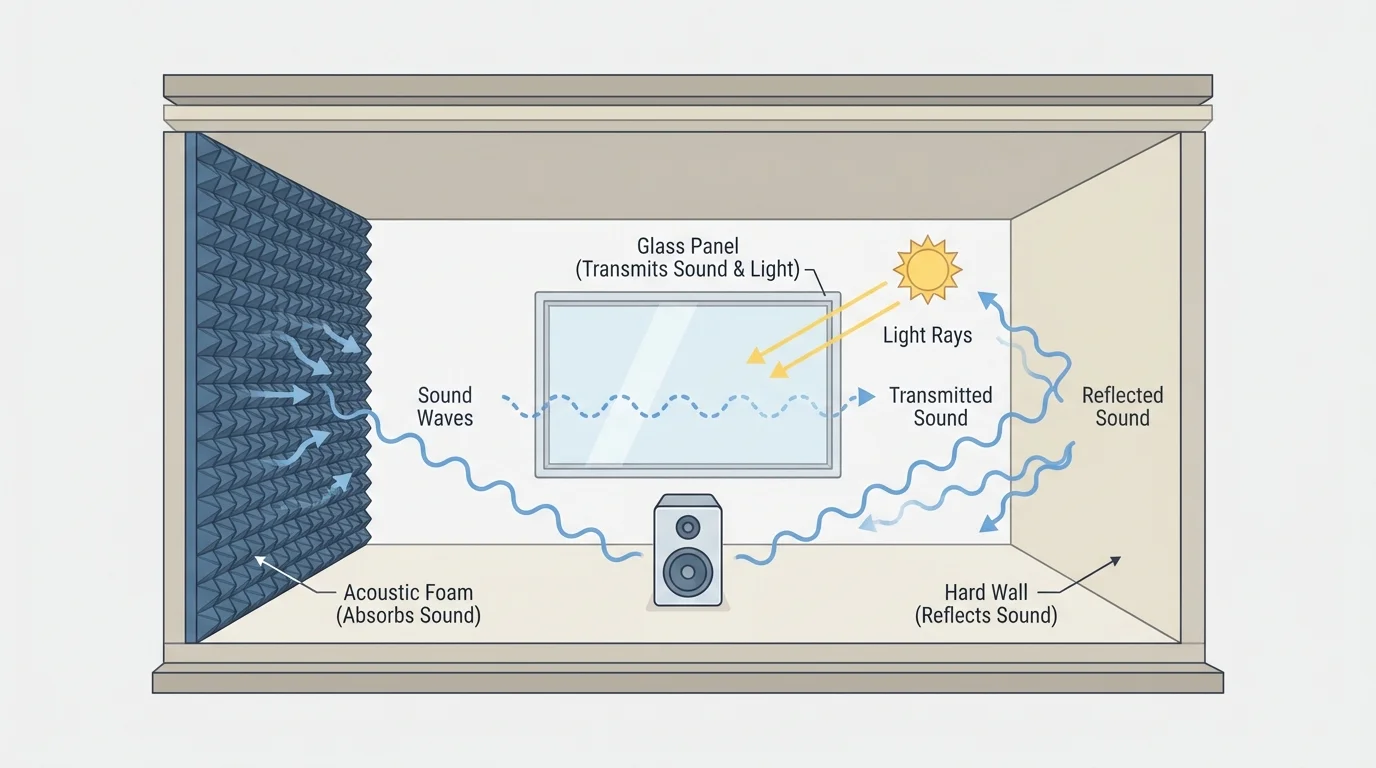
A recording studio is a good example. If the walls strongly reflect sound, extra echoes can ruin a recording. Soft, porous materials are often added to absorb sound energy. By contrast, a lighthouse lens is designed to transmit and direct light efficiently. In both cases, the structure serves a function by using materials with the right wave-related properties.
Home design also depends on wave behavior. Curtains, carpets, and upholstered furniture often reduce echoes because they absorb some sound. Insulated windows can help reduce energy transfer by heat and may also lower outside noise. Polarized sunglasses reduce some reflected light, helping people see more clearly near water or snow.
Bats and dolphins rely on reflected sound waves to learn about their surroundings. Human technology uses the same idea in sonar and medical ultrasound, where structures and materials must be chosen to reflect or transmit waves in useful ways.
Later, when engineers improve a room or device, they often return to the same ideas shown in [Figure 1]: should the material bounce the wave back, let it pass through, or take in the energy? The answer depends on the job the structure must do.
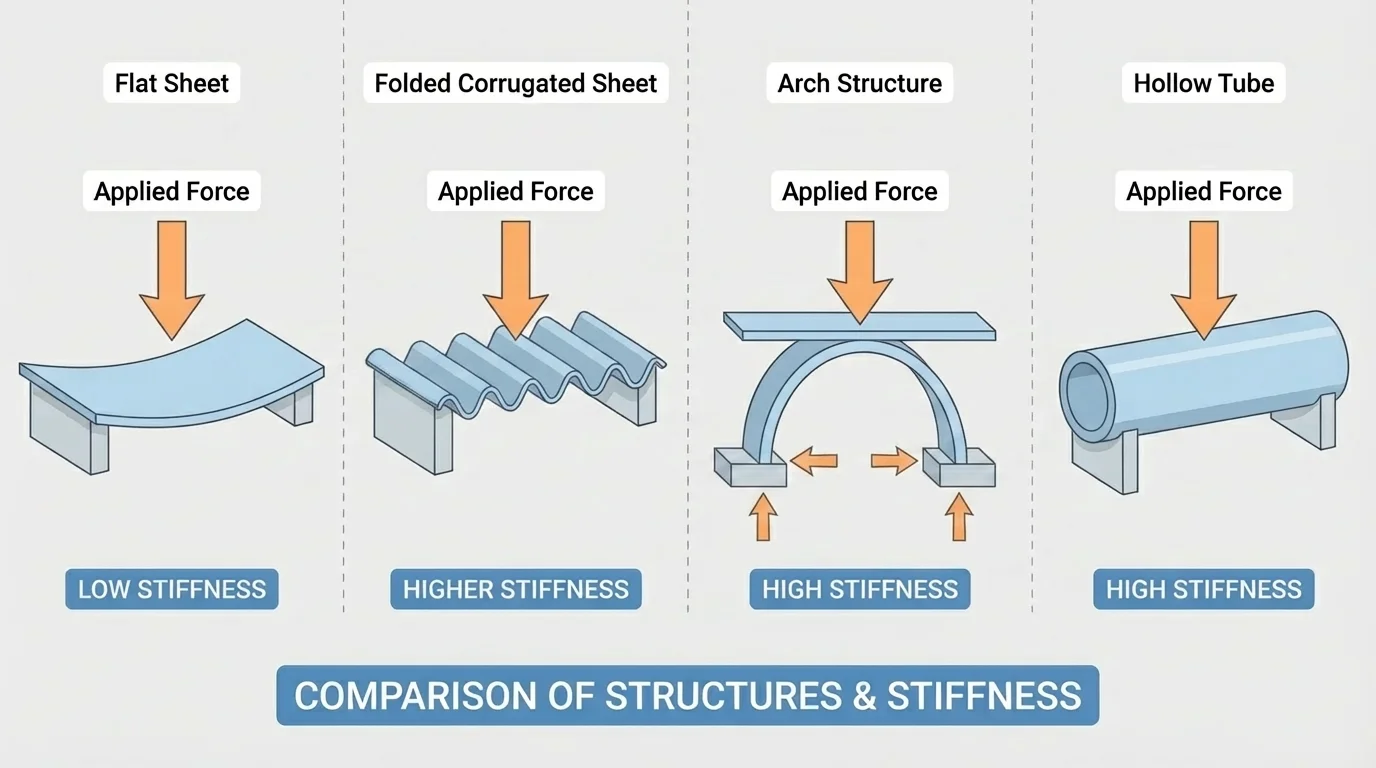
Material choice is only part of design. Shape matters too, and [Figure 2] illustrates how the same amount of material can behave differently when it is folded, curved, or made hollow. Designers often change shape to increase strength, reduce mass, improve wave behavior, or make an object safer.
A flat sheet of paper bends easily. Fold that same paper into a fan or accordion shape, and it becomes much harder to bend. The amount of material may stay almost the same, but the shape changes how forces spread through it. This is why roofs, cardboard, and metal panels are often ridged or corrugated.
Curved shapes can also be stronger than flat ones. Arches in bridges and doorways help spread force outward and downward. Domes can cover large spaces while staying stable. Hollow tubes are another smart design. A hollow metal bicycle frame can be strong while using less material and weighing less than a solid rod of the same outside size.
Shape can affect waves as well. A curved satellite dish reflects radio waves toward a receiver. A megaphone guides sound waves outward. A textured wall can scatter sound differently from a smooth wall. Surface shape changes the path of waves, not just the material itself.
Protective gear often combines shape and material. A bicycle helmet has a rounded outer shell that helps deflect impact and an inner foam layer that absorbs energy. The outer shape helps spread force over a larger area, while the foam compresses and reduces the force that reaches the head. Even though this lesson is not about full force calculations, it is useful to know that spreading force over more area and over more time can reduce injury risk.
Why shaping works
When a material is folded, curved, layered, or hollowed, the arrangement changes how forces and waves move through it. Designers are not only choosing what a structure is made from. They are also choosing how that material is arranged so the structure behaves in a useful way.
The ideas in [Figure 2] appear everywhere: soda cans use curved walls, bridges use arches or trusses, and roof panels use folds for stiffness. Shape is a powerful design tool because it can improve performance without always adding more material.
Design becomes clearer when we compare common materials side by side. Different materials can serve similar functions, but they do so in different ways.
| Material | Useful properties | Possible limits | Common uses |
|---|---|---|---|
| Wood | Moderately strong, easy to shape, good insulator | Can absorb water, may rot or burn | Furniture, houses, doors |
| Steel | Very strong, durable | Heavy, can rust if unprotected | Bridges, building frames, tools |
| Glass | Transparent, hard, smooth | Can shatter, poor at blocking some heat transfer | Windows, bottles, screens |
| Plastic | Lightweight, moldable, often waterproof | Some types scratch or crack, environmental concerns | Containers, toys, phone cases |
| Rubber | Flexible, shock-absorbing, grips well | Can wear out, may weaken in extreme conditions | Tires, seals, shoe soles |
| Foam | Light, compressible, often absorbs sound or impact | Not very strong for support | Helmets, cushions, sound panels |
Table 1. Comparison of common materials, their useful properties, limits, and typical uses in structures.
No material is best in every situation. The best choice depends on the function. A window needs transparency, so steel alone would not work well for the main panel. A bridge needs very high strength, so cloth would not be appropriate for the support beams. The important idea is to match the material to the job.
Some designers use composites, which are materials made by combining two or more materials to get improved properties. For example, reinforced concrete combines concrete, which handles squeezing forces well, with steel bars, which help with pulling forces. Plywood layers wood in alternating directions to increase strength and reduce splitting.
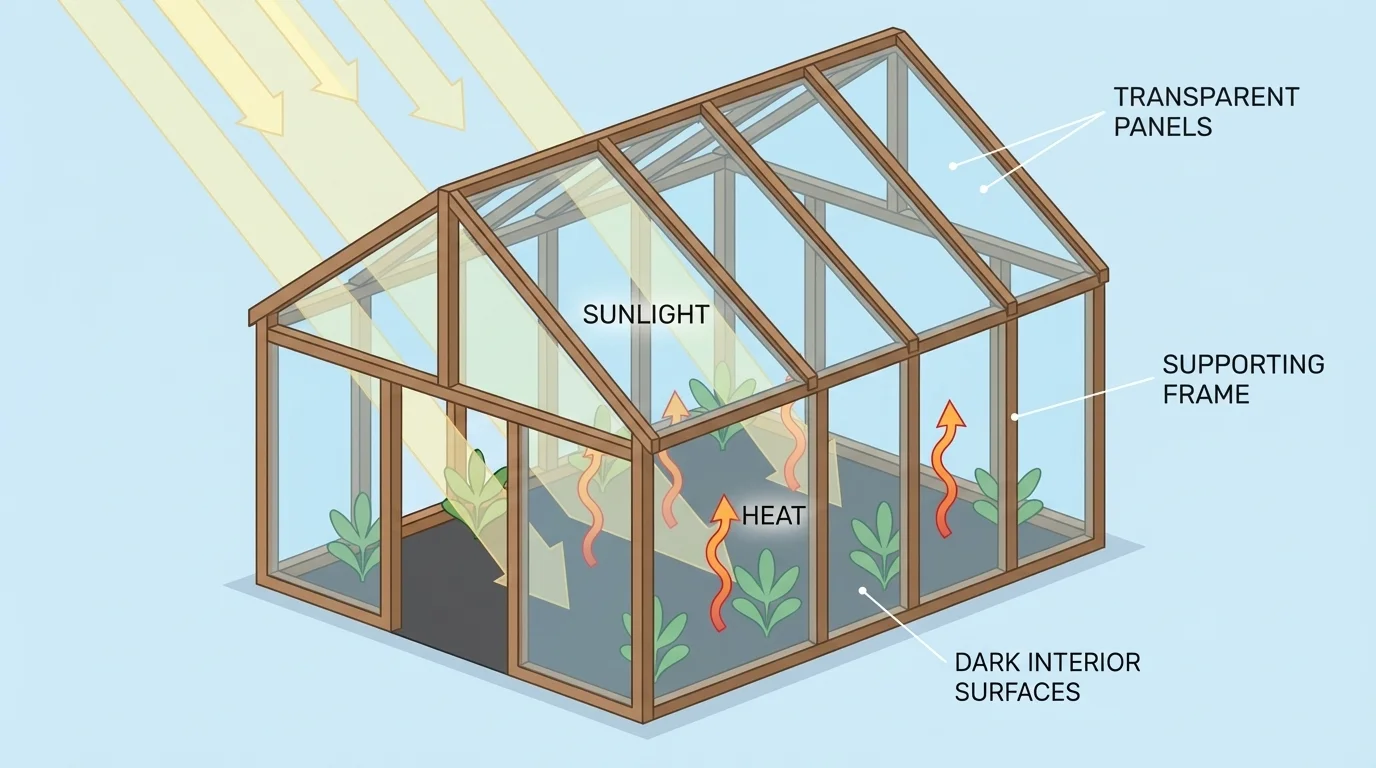
Many technologies around us show how function, material properties, and wave behavior come together. [Figure 3] illustrates one important example. Looking closely at everyday structures helps reveal the science built into them.
A greenhouse is designed to transmit sunlight through clear walls or roof panels. Plants inside need visible light for photosynthesis. The transparent covering also helps trap warmth, making the inside environment different from the outside. The frame must support the panels and resist wind and weather.
Inside a greenhouse, the floor or dark containers may absorb light and heat. The clear panels transmit much of the incoming light, while the structure as a whole protects the plants. This is a strong example of a design that depends on both support and wave behavior.
A classroom uses similar thinking. Windows transmit light so people can see. Walls and doors reduce outside noise. Ceiling tiles may absorb sound to make speech clearer. If every surface were hard and reflective, the room would echo more and be harder to learn in.
Smartphone screens must be transparent, smooth, and hard enough to resist scratches. They also need to transmit light from the display to your eyes. Often the screen is made of specially strengthened glass, while the phone case may use metal or plastic for support and shock resistance.
Sports equipment offers another clear example. A tennis racket frame must be stiff enough to transfer energy well, while the strings must deform in a controlled way. Shin guards and helmets must protect the body by combining hard outer parts with energy-absorbing inner materials. The structure is designed not just to exist, but to perform under real conditions.
Case study: Choosing a material for a music room wall
A school wants a wall surface that reduces echoes rather than creating them.
Step 1: Identify the function
The surface should reduce reflected sound and improve clarity of speech or music.
Step 2: Match the needed property
The best property is strong sound absorption, not high sound reflection.
Step 3: Compare materials
Hard tile and smooth painted concrete reflect more sound. Foam panels, fabric coverings, and thick cork absorb more sound.
Step 4: Make the design choice
A soft, porous covering is a better choice for this function than a hard, smooth surface.
The design works because the structure takes wave behavior into account.
The same ideas also apply to solar panels on buildings, car windshields, theater curtains, and laboratory goggles. Materials are chosen not only for strength but also for how they interact with light, heat, and sound.
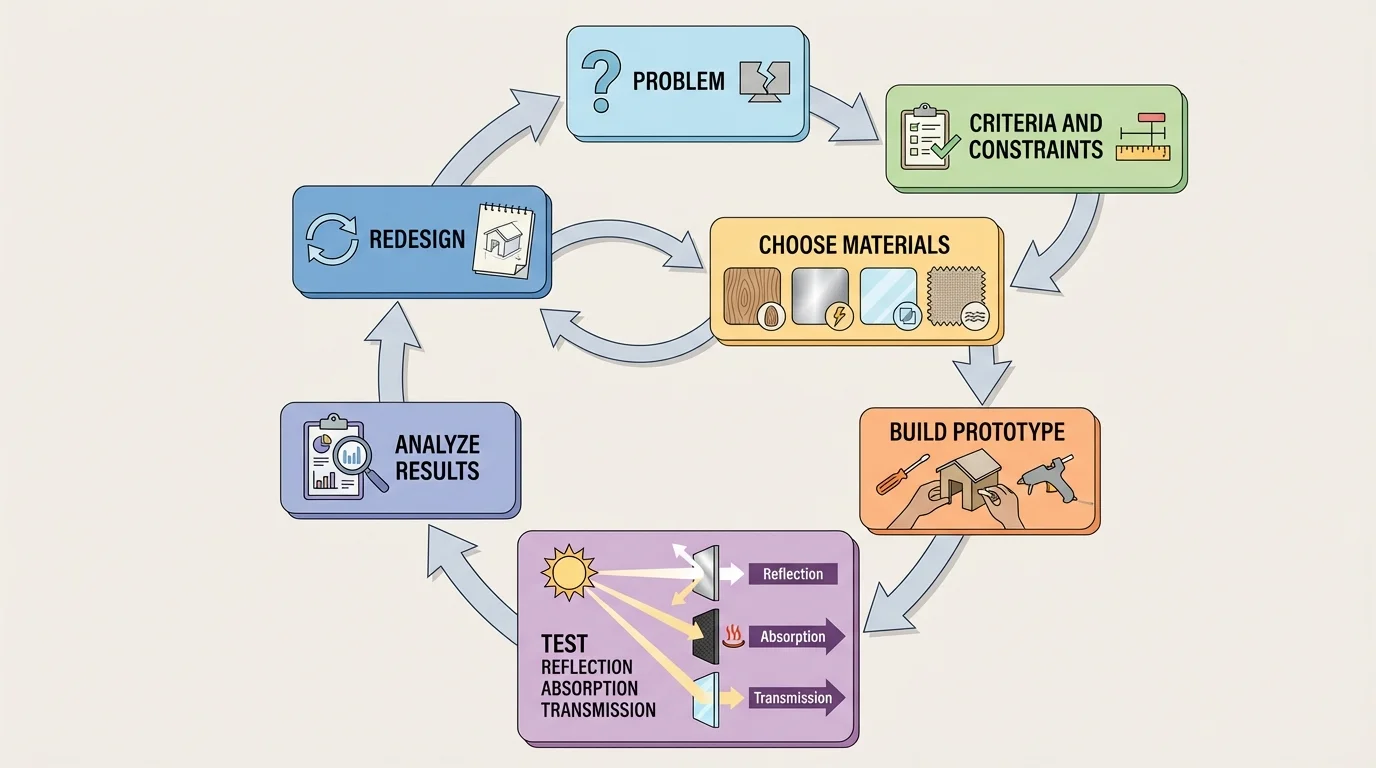
Designers rarely get everything perfect on the first try. They build models, test materials, collect data, and improve the design, as [Figure 4] shows in a simple design cycle. A model can be a drawing, a computer simulation, or a small physical prototype.
Suppose students are comparing materials for a mini sound barrier. They might send the same sound toward cardboard, foam, plastic, and fabric, then measure how loud the sound is on the other side. If foam lowers the sound more than plastic, that suggests foam absorbs or blocks sound more effectively in that setup.
Simple numbers can help with comparisons. If one test starts with a sound level reading of \(80\) units and another side of the barrier reads \(30\) units, the decrease is \(80 - 30 = 50\) units. A different material that lowers the reading only to \(55\) units gives a decrease of \(80 - 55 = 25\) units. In this comparison, the first material reduces the sound more.
Light tests can be done in a similar way. If a flashlight shines on wax paper, clear plastic, and aluminum foil, students can compare which materials transmit, scatter, or reflect the light. These tests do not have to be complicated. They are ways of gathering evidence for a design decision.
Engineers also test for safety and durability. A structure may work on day one but fail after repeated use. A reusable water bottle should not crack easily. A theater curtain should keep working after many openings and closings. A good design must perform over time, not just once.
Simple numeric comparison in design
A team compares two window materials. Material A lets \(90\) units of light pass through, while Material B lets \(60\) units pass through.
Step 1: Identify the goal
If the goal is to brighten a greenhouse, higher light transmission is better.
Step 2: Compare the data
Material A transmits \(90\) units. Material B transmits \(60\) units.
Step 3: Find the difference
The difference is \(90 - 60 = 30\) units.
Step 4: Conclude
Material A is the better choice for that specific function, as long as it also meets other needs such as strength and cost.
When designers return to the process shown in [Figure 4], they often discover that changing one feature affects another. A thicker panel may block sound better but weigh more. A more transparent material may scratch more easily. Testing helps balance these competing needs.
Different materials have different properties because their particles are arranged differently and because they are made of different substances. Some materials are mostly one substance, while others are mixtures or combinations of substances. This helps explain why materials can look similar but behave very differently.
For example, pure aluminum and steel are both metals, but they do not have the same strength, density, or resistance to rust. Plastic is not one single material; many kinds of plastic exist, each with different properties. Foam can be made from different substances too, so one foam may be soft and flexible while another is rigid.
Processing can also change properties. Heating, cooling, stretching, or mixing materials can produce new behaviors. When clay is fired, it becomes much harder. When silica-rich sand is processed into glass, it becomes transparent. When layers of material are combined into laminated safety glass, the final structure behaves differently from a single thin sheet.
Properties depend on composition and arrangement
The same basic ingredients can lead to different useful materials if the particles are arranged differently or if the material is processed in different ways. That is why science and engineering often overlap: understanding matter helps people build better structures.
This idea connects to why designers cannot choose by appearance alone. Two materials may both seem smooth and solid, yet one may absorb sound better, resist impact better, or transmit light more effectively. Testing and knowledge of material composition are both important.
A strong design is not only useful; it should also be safe and responsible. Safety means the structure should reduce harm. Efficiency means using materials and energy wisely. Sustainability means thinking about how choices affect the environment now and in the future.
For example, building insulation is chosen partly because it slows energy transfer, helping buildings stay warm or cool with less energy use. Recycled materials can reduce waste if they still meet performance needs. Designers may choose durable materials so products last longer and do not need frequent replacement.
Sometimes a sustainable choice involves using less material through better shaping rather than adding more material. Hollow supports, folded panels, and carefully placed reinforcements can reduce mass while keeping strength. That is another reason structure and shape matter so much.
"The best design is not just the one that works. It is the one that works well for its purpose, safely and wisely."
When you look around a school, home, stadium, or city, almost every structure shows the same big idea: materials are selected and shaped for a function. Walls can absorb or reflect sound. Windows can transmit light. Helmets can spread and absorb impact. Good design depends on understanding both the properties of materials and how form changes performance.
