A sea turtle can lay more than 100 eggs, yet only a few hatchlings may survive long enough to become adults. Why? It is not because of just one cause. Sand temperature, predators, storms, the distance to the water, and even the behavior of the mother all matter. This is one of the most important ideas in science: phenomena may have more than one cause, and some cause-and-effect relationships can only be described using probability, or the chance that something will happen.
In living things, especially in reproduction, there is rarely a single simple reason for success or failure. An animal may find a mate because of its behavior, but whether its young survive can also depend on food, weather, shelter, and predators. A plant may produce many seeds, but the number that grow into new plants depends on pollinators, wind, water, soil, and competition. Scientists study these systems by gathering evidence and asking not just, "What caused this?" but also, "What combination of causes changed the chances of this outcome?"
A phenomenon is something that happens and can be observed. A bird population increasing in spring, a flower producing fruit, or a frog calling for a mate are all examples of phenomena. In science, we often look for causes. But in real systems, one effect often comes from several causes working together.
Cause and effect describes a relationship in which one factor helps produce a result. In biological systems, effects often have multiple causes, and those causes may interact.
Probability is the likelihood that an event will happen. In biology, scientists often describe outcomes as more likely or less likely, rather than guaranteed.
Think about a plant producing seeds. Seed production can be affected by flower shape, the number of pollinators, rainfall, temperature, soil nutrients, and damage from insects. Even if one factor is helpful, another factor may reduce success. That is why scientists are careful about making claims. They use evidence to support explanations instead of assuming one cause explains everything.
This idea also matters for animals. A peacock's bright tail can attract mates, but if food is scarce or predators are common, that same tail may also create problems. The final outcome depends on many linked causes, not just one dramatic trait.
A biological system is full of events that do not happen with certainty. A flower that attracts bees does not guarantee pollination every single time. A bird that builds a nest does not guarantee that all its eggs hatch. Instead, these traits and behaviors change the probability of success.
This is an important difference. Scientists do not usually say, "This behavior causes reproduction every time." They say, "This behavior increases the chance of successful reproduction." If a behavior raises the chance from about 20 out of 100 to about 70 out of 100, that is a major effect even though success is still not certain.
Probability example in biology
Suppose 100 flowers of one plant species are visited by pollinators, and 80 develop seeds. Another 100 flowers are covered so pollinators cannot reach them, and only 15 develop seeds.
Step 1: Compare the two groups.
Visited flowers succeed 80 times out of 100, while covered flowers succeed 15 times out of 100.
Step 2: Describe the pattern using probability.
The presence of pollinators increases the probability of seed production.
Step 3: Explain scientifically.
Pollinators transfer pollen between flowers, which makes fertilization more likely.
This does not mean every visited flower forms seeds, but it does show a strong cause-and-effect relationship described by probability.
Probability is useful because living things interact with changing environments. Wind may carry pollen on one day but not another. A nesting site may be safe one week and unsafe the next. Chance events matter, so scientific explanations often include words like likely, less likely, higher probability, and lower probability.
Many animals perform behaviors that improve their chances of finding mates or helping offspring survive, as [Figure 1] illustrates. The key idea is not that behavior guarantees success. Instead, the behavior changes the probability that reproduction will happen successfully.
One important behavior is courtship behavior. Courtship includes actions such as songs, dances, calls, bright displays, or chemical signals that help animals attract mates. Male birds of paradise perform complex dances. Frogs call loudly to attract females. Fireflies flash light patterns. These signals help members of the same species recognize one another and choose mates. If the display is effective, mating becomes more likely.
Another behavior is nest building or preparation of a safe place for eggs and young. Birds gather twigs, grass, and mud to create nests. Some fish guard eggs in a hidden area. Sea turtles bury eggs in sand. These actions reduce danger from predators and harsh conditions, increasing the probability that offspring survive long enough to grow.
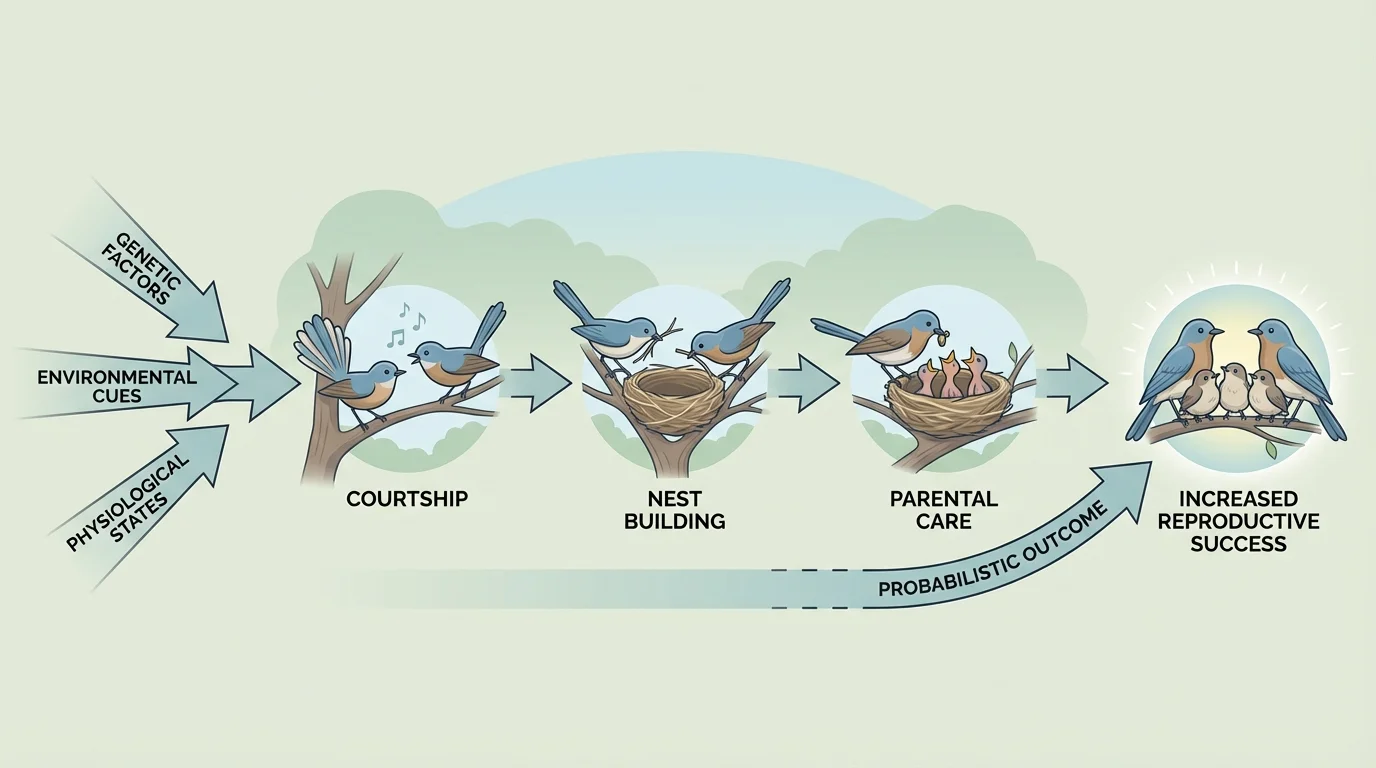
Parental care is another major factor. Penguins take turns protecting eggs from freezing temperatures. Wolves bring food back to pups. Many mammals feed and protect their young for long periods. The more support young receive, the better their chances of survival. However, parental care also uses time and energy, so different species solve this problem in different ways.
Timing matters too. Some animals migrate or breed only during certain seasons. Deer often breed when conditions will allow babies to be born during times of more available food. Salmon return to specific streams to reproduce. These behaviors connect reproduction to environmental cycles. If the timing is wrong because of unusual weather or habitat changes, reproductive success may drop.
Territorial behavior can also help. Some animals defend an area with food, shelter, or nesting space. A bird that protects a good nesting site may improve the survival chances of its eggs. But territory defense can also make the animal more visible to predators or use up energy. Again, there are multiple causes affecting the outcome.
Some bowerbirds do not build nests to raise chicks in. Instead, males build and decorate special structures called bowers just to attract females. The quality of the bower can affect the male's chance of mating.
When scientists argue that a behavior affects reproduction, they rely on empirical evidence. That means observations and measurements. For example, if birds with more careful nest-building lose fewer eggs to predators, scientists can use that evidence to support a claim. Later in the lesson, the same evidence-based reasoning will help us connect behaviors and structures in larger systems, much like we return to the behavioral patterns shown in [Figure 1].
Plants cannot walk to find mates, but they still reproduce successfully because they have specialized structures that increase the chances of pollination and seed dispersal, as [Figure 2] shows. A flower's shape, color, scent, nectar, and pollen placement can all affect whether pollen reaches another flower of the same species.
Pollination happens when pollen moves from the male part of a flower to the female part. Some plants depend on animals such as bees, butterflies, bats, or birds. Bright petals may attract pollinators. Sweet nectar rewards them for visiting. A flower's shape may fit a certain pollinator especially well. For example, tubular red flowers often attract hummingbirds, while wide flat flowers may be better for bees or butterflies.
These structures do not guarantee reproduction, but they raise the probability. If a flower is easy for a bee to find and built so pollen brushes onto the bee's body, pollen transfer becomes more likely. The more often this transfer happens, the more likely seeds will form.
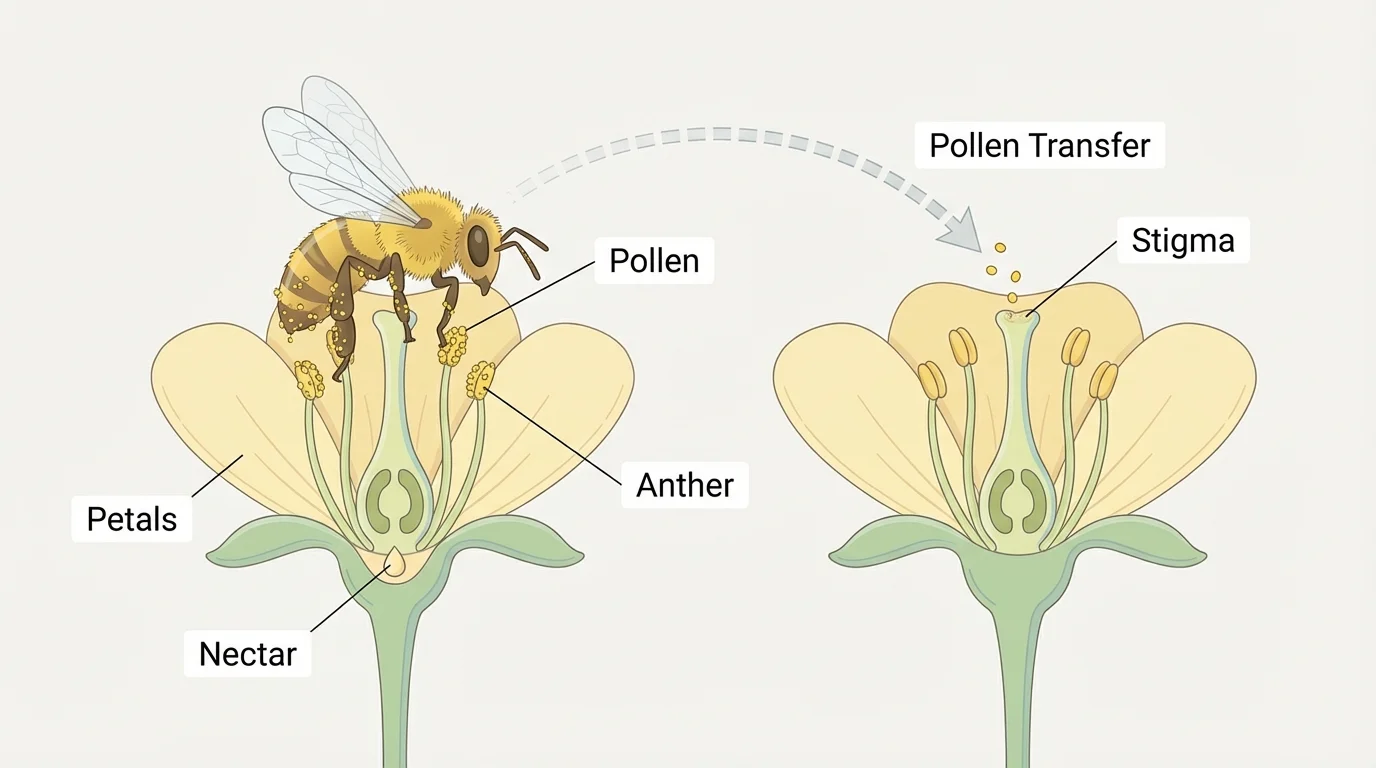
Plants also show special structures for seed dispersal. Some seeds have hooks that cling to animal fur. Some have wings that catch the wind. Others float on water. Fruits may be juicy and colorful so animals eat them and later spread the seeds elsewhere. These traits affect the probability that seeds land in places where they can grow instead of staying crowded near the parent plant.
A dandelion is a great example. Its lightweight seeds are carried by air, so a single plant can spread offspring over a wide area. A coconut floats in water and can travel long distances. A burr sticks to fur or clothing. In each case, the structure changes the chance of successful dispersal.
Structure affects function in reproduction
In plants, a structure is a body part with a particular form, such as a petal, seed coat, fruit, or pollen grain. The function is the job that structure does. A flower with a deep tube functions well for pollinators with long mouthparts, while a winged seed functions well for wind dispersal. The match between structure and function affects reproductive success.
Plant reproduction also depends on outside conditions. A flower may be perfectly shaped for a bee, but if few bees are present, successful pollination becomes less likely. A seed may be well designed for wind dispersal, but if heavy rain soaks the ground and causes rot, fewer seedlings survive. This is why biological explanations usually involve more than one cause.
Reproductive success is part of a system, meaning a set of interacting parts. In that system, behavior, structure, weather, food supply, predators, competitors, and habitat all influence the outcome. A single effect, such as "more seeds produced" or "more young survive," can result from many linked factors.
[Figure 3] Consider a flowering plant in a field. More rain may help it grow more flowers. More flowers may attract more pollinators. More pollinators may increase seed production. But too much rain could also damage pollen or keep insects from flying. At the same time, hungry insects might eat leaves, and nearby plants might compete for sunlight. The final result depends on interactions among many causes.
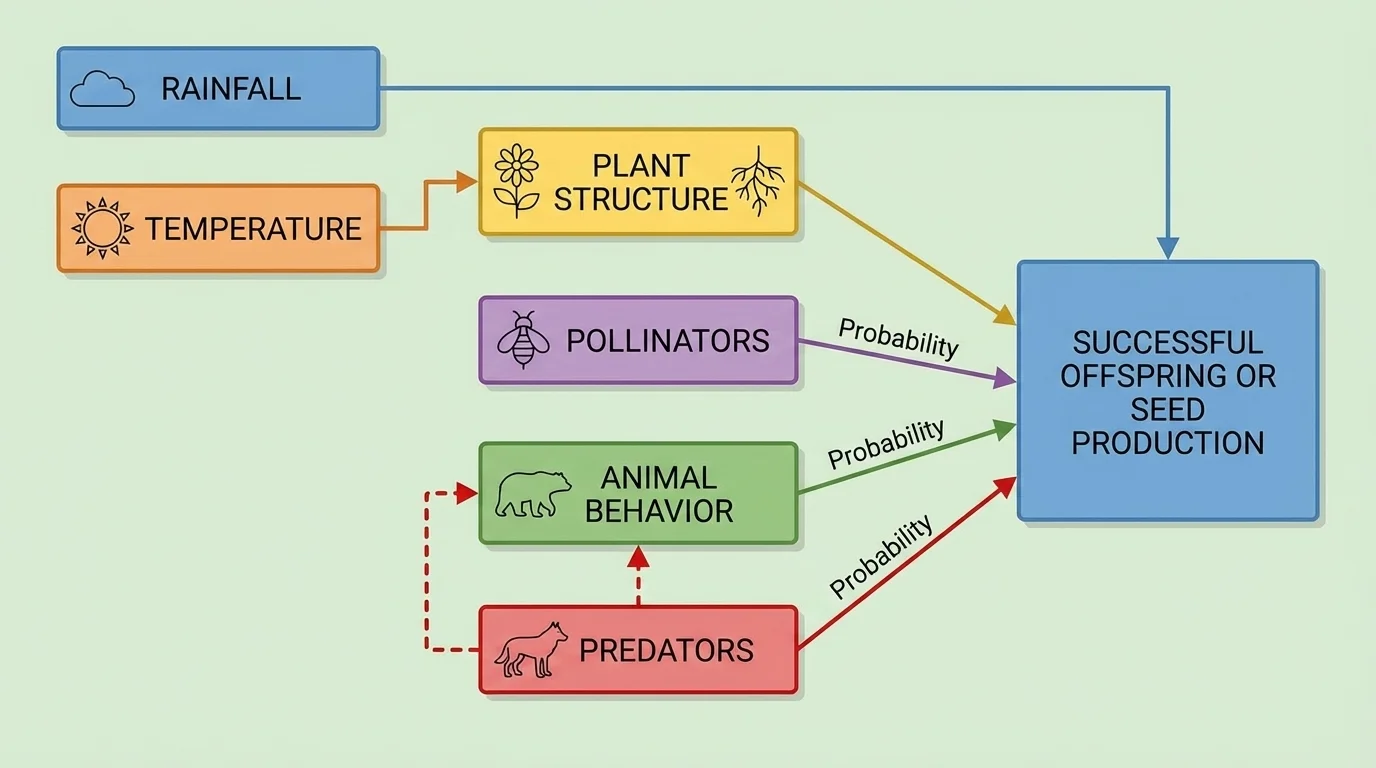
The same is true for animals. A songbird may sing strongly and defend a territory, but if a late frost reduces insect food, its chicks may still starve. A sea turtle may choose a good nesting beach, but high tides can wash away nests. A frog's calls may attract mates, but they may also attract predators. One cause can have both positive and negative effects at the same time.
This is why scientists often avoid simple statements like "This one thing caused reproduction." They may say instead that a factor contributed to increased reproductive success or that it changed the probability of success under certain conditions. As the cause-and-effect network in [Figure 3] makes clear, biological systems are interactive rather than one-directional.
| Factor | Example | Possible Effect on Reproduction |
|---|---|---|
| Animal behavior | Bird song, nest building | Can increase chances of attracting mates or protecting young |
| Plant structure | Bright petals, winged seeds | Can increase chances of pollination or dispersal |
| Environment | Rainfall, temperature | Can improve or reduce survival and timing |
| Other organisms | Pollinators, predators, competitors | Can help or harm reproductive success |
| Chance events | Storms, droughts | Can change outcomes even when traits are helpful |
Table 1. Examples of multiple factors that influence reproductive success in living systems.
Science is not just about having an idea. It is about supporting that idea with evidence and reasoning. If someone claims that a certain bird dance helps attract mates, they should be able to point to observations such as how often the dance is performed, how often females choose dancing males, and whether those males produce more offspring.
Building an argument from evidence
A scientist studies two groups of lizards. In one area with many hiding places, 60 out of 100 eggs survive. In another area with little shelter, only 25 out of 100 eggs survive.
Step 1: Identify the pattern.
Egg survival is higher where shelter is available.
Step 2: Suggest a cause.
Shelter may reduce predation or protect eggs from heat.
Step 3: State the argument carefully.
The evidence supports the claim that nesting in sheltered places increases the probability of successful reproduction.
This claim is strong because it is based on data, not just opinion.
Scientists also compare groups. They may compare flowers with and without nectar, birds with large versus small nests, or seeds dispersed by wind versus seeds that simply fall nearby. If one group consistently has more success, scientists can argue that the trait or behavior affects reproductive probability.
Still, careful scientists look for other causes too. Maybe the flowers without nectar were also in poor soil. Maybe the birds with small nests lived in colder weather. Good reasoning asks whether another variable could explain the pattern. This is one reason experiments and repeated observations are so valuable.
Earlier science lessons may have introduced the idea that organisms have structures and behaviors that help them survive. Reproduction extends that idea: traits that improve mating, pollination, seed dispersal, or care of young affect whether genes are passed on to the next generation.
These ideas are not only for textbooks. Farmers, gardeners, wildlife biologists, and conservation scientists use them in the real world. If crops depend on bees for pollination, then protecting pollinator habitats can raise the probability of good fruit or seed production. If a rare bird species needs quiet nesting spaces, conservation plans may focus on reducing disturbance during breeding season.
Habitat loss can break important cause-and-effect relationships. A plant may still produce flowers, but without the right pollinators nearby, successful reproduction drops. An animal may still perform courtship behaviors, but if nesting sites are destroyed, offspring survival falls. The traits are still useful, but the system around them has changed.
Climate change also affects these systems. Warmer temperatures can shift flowering time. If flowers bloom before pollinators are active, the probability of pollination may decrease. Some animals may breed at times that no longer match food availability. This mismatch shows how even effective structures and behaviors can lose value when the environment changes.
"In nature, success often depends not on a single cause, but on many connections working together."
Understanding probability helps people make better decisions. Conservation programs may not be able to guarantee success, but they can increase the odds. Protecting nesting beaches, restoring wetlands, planting native flowers, and limiting pesticide use are all actions that can improve reproductive success in populations.
When you examine any biological phenomenon, ask two questions: What are the possible causes, and how do they change the probability of the outcome? Those questions help scientists move beyond simple answers and understand life as a system of interacting parts.
