A city adds a new road to reduce traffic, and within a few years local frog populations crash, songbirds disappear from nearby forest edges, and stormwater carries extra fertilizer into a stream. None of those effects were the road's intended purpose, but all of them are real. That is what makes environmental design problems so challenging: a human action that solves one problem can create several others. Protecting life in an ecosystem is not just about caring for nature in a general way. It requires careful design, evidence, and the willingness to revise a solution when the data show it is not working.
Biodiversity includes variation at several levels: genetic diversity within a species, the number of species in an area, and the variety of ecosystems across a region. Ecosystem health refers to how well an ecosystem maintains its structure, functions, and ability to recover from change. Human activities such as land development, overfishing, deforestation, invasive species introduction, fertilizer runoff, and greenhouse gas emissions can reduce both biodiversity and ecosystem stability.
These problems involve complex systems because many parts interact at the same time. If a wetland is drained for building, the change is not limited to the plants growing there. Water storage decreases, flood risk can rise, insects lose breeding habitat, fish nursery areas may shrink, and birds that feed there may decline. A solution has to consider all these connected effects rather than fixing only one visible symptom.
Complex real-world problem means a problem with multiple causes, multiple stakeholders, and no perfect solution. Criteria are the features used to judge whether a solution is successful, such as effectiveness, cost, speed, and environmental impact. Tradeoffs are compromises in which improving one feature may reduce another.
For students in environmental science or biology, this means the task is not simply to ask, "What sounds helpful?" The stronger question is, "What solution is most likely to work under real conditions, based on ecological science, measurable evidence, and reasonable tradeoffs?"
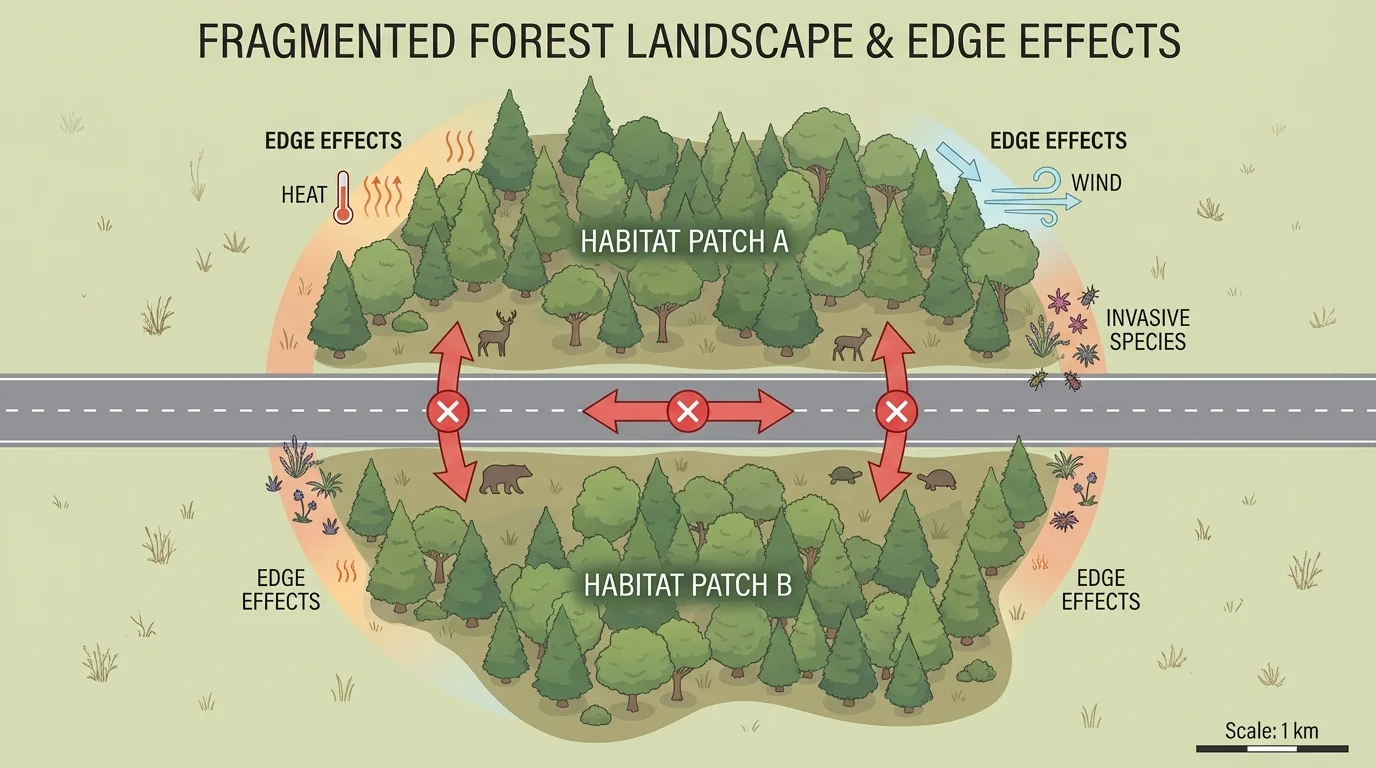
Ecosystems operate through relationships among organisms and between organisms and their physical environment. Habitat fragmentation changes movement, feeding, breeding, and shelter access, as [Figure 1] shows in a broken landscape. A species may still technically be present in an area, but if individuals cannot reach mates, food, or nesting sites, the population may still decline.
One major idea is habitat fragmentation. A large forest cut into smaller patches by roads or housing developments often supports fewer species than one continuous forest of the same total area. Edge zones become hotter, windier, and more exposed to predators and invasive species. Interior forest organisms, such as some salamanders and nesting birds, may lose the conditions they need.
Another key idea is the carrying capacity of an environment, the largest population size that available resources can support over time. If a river is polluted and oxygen levels drop, its carrying capacity for fish decreases. If native flowering plants are removed from a landscape, the carrying capacity for pollinators such as bees and butterflies also falls. In this way, habitat quality matters as much as habitat size.
Scientific knowledge also includes understanding nutrient cycling and chemical change. Excess fertilizer adds nitrogen and phosphorus to water systems, which can trigger algal blooms. When algae die and decomposers break them down, dissolved oxygen can decrease, creating conditions in which aquatic organisms struggle to survive. Carbon emissions add carbon dioxide to the atmosphere as \(\textrm{CO}_2\), strengthening the greenhouse effect and shifting temperature and rainfall patterns that species depend on.
Resilience is another important concept. A resilient ecosystem can recover after disturbance, such as fire, flooding, or drought. Biodiverse ecosystems are often more resilient because they contain multiple species that perform similar ecological roles. If one species declines, another may partly maintain the function. This does not mean biodiversity loss is harmless; it means diversity acts like a biological safety net.
Why scientific knowledge matters in design
Environmental solutions work best when they match how ecosystems actually function. A plan to increase fish populations, for example, will fail if it ignores water temperature, oxygen levels, predator-prey relationships, spawning habitat, and food availability. Science provides the mechanism behind the problem, so design choices are based on causes rather than guesses.
Later, when solutions are evaluated, the same ecological ideas remain important. A corridor may reconnect populations, as we see again in [Figure 1], but if it also increases contact with invasive species or disease, the design may need modification.
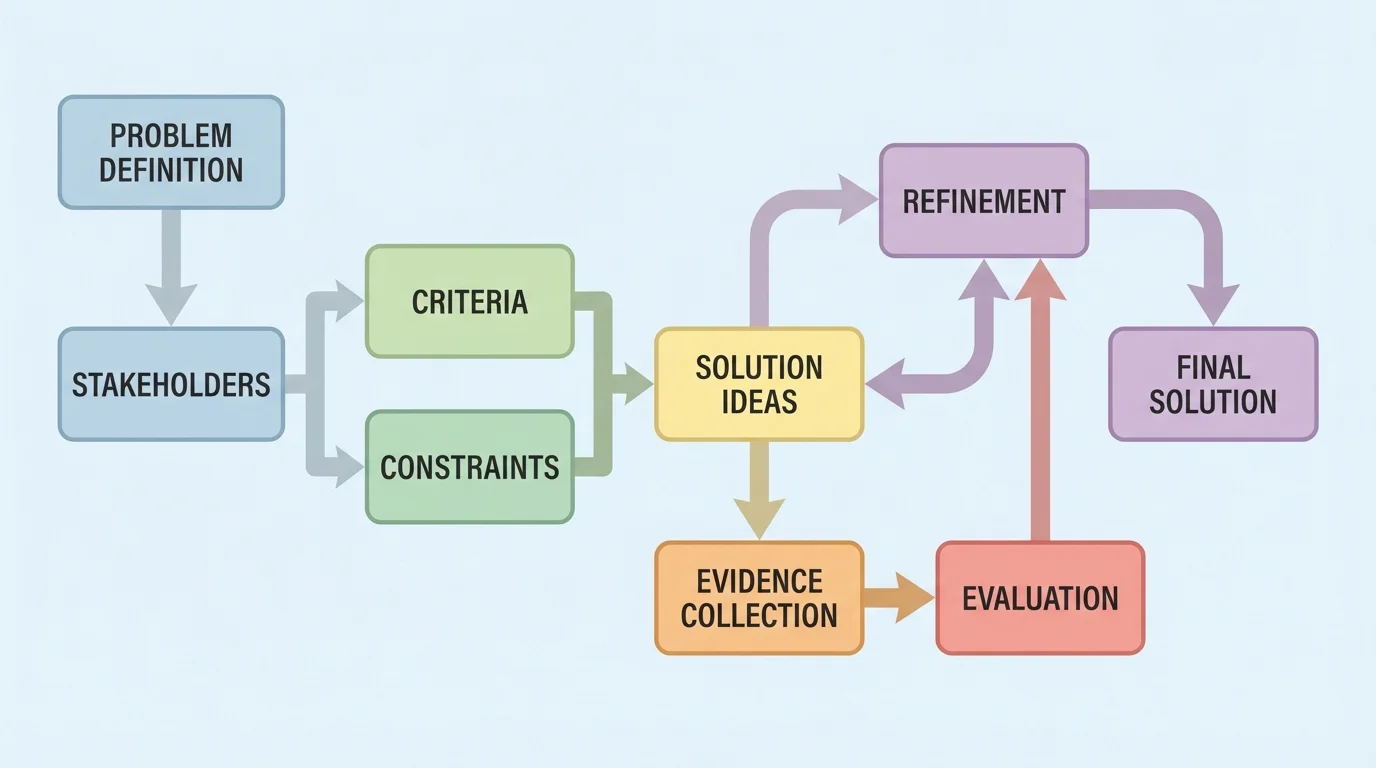
Design begins by clearly defining the problem. This process unfolds in a sequence, from identifying the ecological issue to testing and revision. A vague problem such as "save nature near our school" is too broad to guide useful action. A stronger version might be: "Reduce stormwater pollution entering the school-adjacent creek while increasing habitat for native insects and birds within one year."
[Figure 2] Once the problem is defined, designers identify stakeholders: groups affected by the problem or the solution. These may include local residents, farmers, transportation planners, Indigenous communities, conservation organizations, business owners, and government agencies. Stakeholders may agree on some goals and disagree on others. A plan that improves biodiversity but creates unsafe road conditions or impossible maintenance costs will be hard to sustain.
Designers then create and prioritize criteria. Common criteria include ecological effectiveness, cost, feasibility, durability, speed of implementation, public acceptance, and side effects. Constraints are limits such as available land, budget, laws, time, and climate. The strongest designs do not pretend these limits do not exist; they work within them.
Prioritizing criteria means not all goals are equally important. In some projects, biodiversity improvement may be the top priority. In others, flood control and human safety may come first, provided ecological harm is minimized. A team might assign weights to criteria so they can compare options more systematically. If effectiveness is weighted at \(40\%\), cost at \(25\%\), feasibility at \(20\%\), and maintenance at \(15\%\), then a solution with the highest ecological benefit does not automatically win if it is impossible to maintain.
Tradeoffs appear almost everywhere. Planting a dense native buffer along a stream improves filtration and habitat, but it may reduce short-term open space for recreation. Installing wildlife fencing can reduce animal-vehicle collisions, but fencing alone may block movement if crossing structures are not included. The question is not whether tradeoffs exist; it is whether they are understood and judged responsibly.
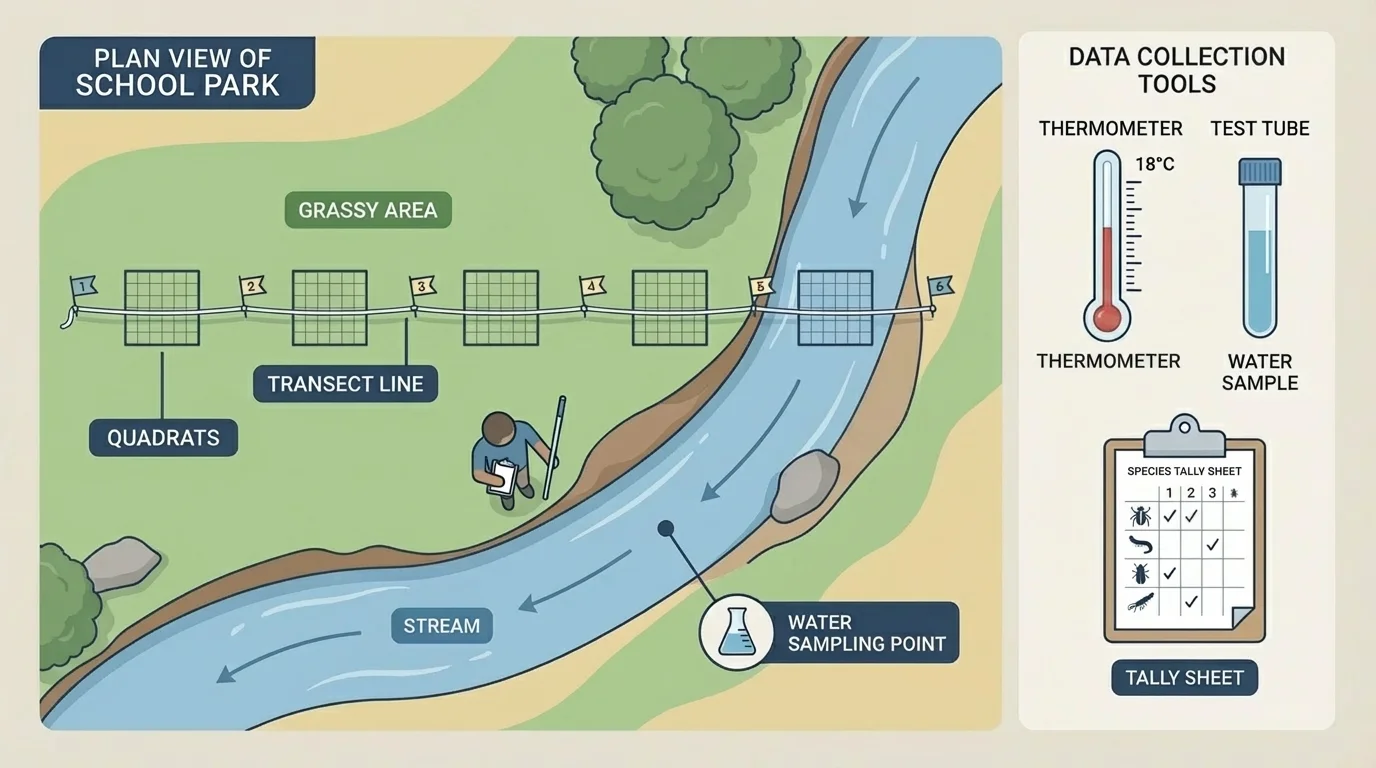
To evaluate a solution, students need evidence they collect themselves. Systematic sampling matters because random impressions are not enough. Saying "there seem to be more birds now" is weaker than reporting repeated counts from the same locations over the same time period before and after a habitat change.
[Figure 3] Biodiversity index data can come from species counts within quadrats, transects, camera traps, acoustic recordings, or insect surveys. Water-quality evidence might include temperature, turbidity, pH, nitrate concentration, phosphate concentration, and dissolved oxygen. Soil evidence might include moisture, organic matter, or compaction. Even human-use surveys can matter if a solution depends on public cooperation.
Suppose students compare two stream sections. In one section, the average dissolved oxygen is \(8.2 \textrm{ mg/L}\); in another, it is \(4.6 \textrm{ mg/L}\). Many aquatic organisms survive better in the first section. If the lower-oxygen site also has more algae and higher nitrate levels, that evidence supports the idea that nutrient runoff is damaging ecosystem health.
Students can also use simple mathematical comparisons to interpret evidence. If native plant cover increases from \(20\%\) to \(35\%\) after restoration, the increase is \(15\) percentage points. If amphibian counts rise from \(12\) to \(18\), the proportional increase is \(\dfrac{18-12}{12} = \dfrac{6}{12} = 0.5\), or \(50\%\). These values do not prove causation by themselves, but they help evaluate whether a solution is associated with improvement.
Case evidence example: testing runoff reduction
A school installs a rain garden to reduce polluted runoff into a nearby creek.
Step 1: Choose evidence
Students measure turbidity, nitrate concentration, and the number of macroinvertebrate groups upstream and downstream before installation and again three months later.
Step 2: Compare before and after data
Nitrate downstream drops from \(6.0 \textrm{ mg/L}\) to \(3.5 \textrm{ mg/L}\). The change is \(6.0 - 3.5 = 2.5 \textrm{ mg/L}\).
Step 3: Interpret carefully
If macroinvertebrate diversity also increases and no major storm differences occurred during sampling, the evidence suggests the rain garden may be helping water quality and habitat conditions.
The key point is that evidence must be measurable, repeatable, and tied to the criteria.
Good evidence collection also includes controls when possible. If one area is restored and another similar area is not, comparing both can help separate the effect of the intervention from normal seasonal change.
Environmental solutions can target different causes of biodiversity loss. If habitat loss is the main problem, responses may include native plant restoration, wetland reconstruction, wildlife corridors, or reduced mowing schedules. If pollution is central, solutions may include vegetated buffers, rain gardens, improved fertilizer practices, permeable pavement, or wastewater treatment upgrades. If overexploitation is the issue, solutions may involve fishing limits, seasonal closures, or protected breeding areas.
Some solutions are technological, some ecological, and some social. For example, replacing standard streetlights with shielded lighting can reduce disruption to nocturnal species. Restoring oyster reefs can improve habitat and water clarity. Education campaigns can reduce pesticide misuse by homeowners. In many cases, the best solution is a combination rather than a single action.
Designers should also think in terms of scale. A pollinator garden on one campus may support local insects, but it will not solve regional habitat fragmentation by itself. However, many small actions across a city can connect into a larger network. In ecology, scale often changes what counts as an effective solution.
Some wildlife overpasses built above major highways have reduced animal-vehicle collisions while reconnecting habitats used by bears, elk, wolves, and smaller mammals. A structure designed for human safety can also become a biodiversity solution when ecology is included in the design.
When selecting a design, students should ask: What mechanism makes this work? If the answer is unclear, the design is weak. A rain garden works because it slows runoff, increases infiltration, and helps plants and soil microbes remove or retain pollutants. A native hedgerow works because it provides nectar, seeds, nesting space, and movement pathways. Mechanisms connect design to science.
Evaluation means comparing possible solutions against the prioritized criteria. One useful method is a decision matrix. Each solution is scored on the same set of criteria, and the scores can be weighted. This does not make the choice purely objective, because people still decide the weights, but it makes the reasoning clearer.
For example, imagine three options for improving a stream corridor: installing a rain garden, planting a native riparian buffer, or adding concrete drainage channels. The concrete channels may move water away quickly, but they often provide little habitat value and can increase downstream erosion. The rain garden may be moderate in cost and good for runoff control. The native buffer may take longer to establish but could provide the strongest long-term biodiversity benefit.
| Solution | Main Benefit | Main Limitation | Likely Biodiversity Effect |
|---|---|---|---|
| Rain garden | Reduces runoff and filters water | Needs space and maintenance | Moderate to high |
| Native buffer | Improves habitat and stabilizes banks | Slower to mature | High |
| Concrete channel | Moves water quickly | Low habitat value | Low or negative |
Table 1. Comparison of three stream-corridor design options and their likely ecological effects.
Unintended consequences must also be part of evaluation. Introducing a species to control a pest may seem effective at first but may create a new invasive species problem. Building a dam may create a reservoir useful for people while blocking fish migration. Spraying pesticides may reduce crop pests and also harm pollinators or aquatic invertebrates.
Strong evaluation is evidence-based, but it also involves judgment. A lower-cost option may be chosen if it achieves most of the benefit and can actually be maintained. An expensive option with slightly better performance may fail if no one can sustain it over time.
Environmental design is usually iterative. A first solution is rarely perfect. Scientists and engineers monitor outcomes, compare them to the criteria, identify weaknesses, and improve the plan. This process is sometimes called adaptive management, especially in conservation and natural resource work.
Suppose a school plants native species to attract pollinators, but after two months, the garden has low flowering success. Evidence shows the soil is compacted and irrigation is inconsistent. The solution is not abandoned immediately. Instead, the design is refined: compost is added, watering schedules are changed, and species better suited to the site are selected.
Refinement can involve changing location, materials, timing, scale, or maintenance. A wildlife crossing may need taller fencing to guide animals toward the overpass. A restored wetland may need altered water depth. A no-fishing zone may need better enforcement or clearer boundaries. The point of refinement is not to prove the original idea wrong; it is to improve performance based on evidence.
Ecosystems are dynamic, not static. Population sizes, nutrient levels, rainfall, and temperature all change over time. Because of that, a single measurement rarely tells the full story. Repeated observations are essential for fair evaluation.
Long-term monitoring is especially important because some ecological responses are delayed. Trees planted today may not provide full habitat value for years. A stream may respond quickly to reduced pollution, while fish populations recover more slowly. Patience is part of scientific evaluation.
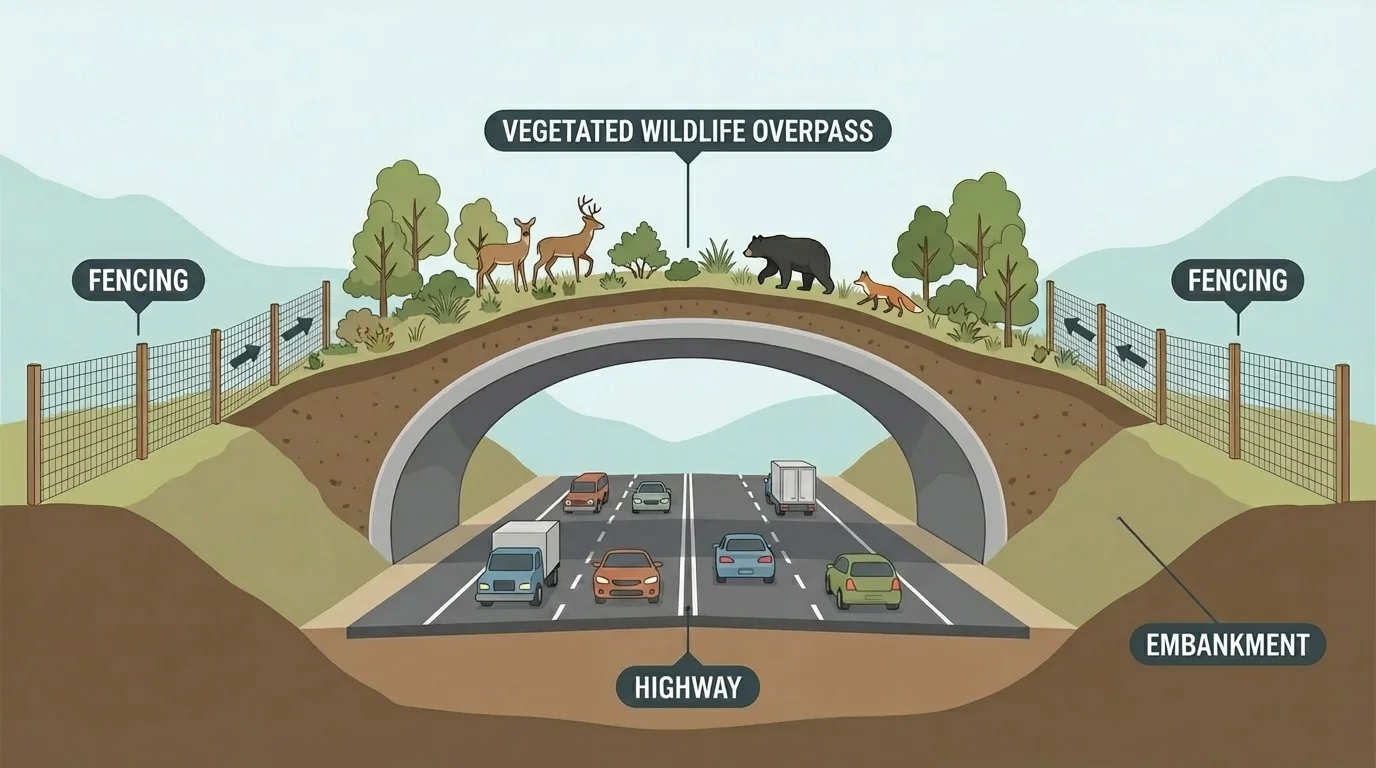
A well-known example involves highways cutting across migration routes. The crossing design reconnects habitat by combining fencing with a vegetated overpass. Without fencing, many animals continue attempting to cross at dangerous points. Without the overpass or underpass, fencing alone can become a barrier. The refined solution combines both human safety and ecosystem connectivity.
[Figure 4] In this case, prioritized criteria might include reducing collisions, allowing animal movement, keeping construction durable, and controlling cost. Evidence can include motion-triggered cameras, track counts, and collision records before and after installation. If collisions drop and multiple species use the crossing, the solution scores well on both transportation and biodiversity goals.
A second example is wetland restoration. A drained wetland near farmland may be restored by recontouring the land, reestablishing native wetland plants, and reducing fertilizer runoff from adjacent fields. The criteria may include flood storage, bird habitat, water filtration, and compatibility with nearby agriculture. One tradeoff is that some land may no longer be available for crops, but the gain may include reduced flooding and improved water quality downstream.
A third example is a school-campus biodiversity plan. Students might notice that most of the campus is short-cut grass with few insects or birds. They design a solution involving native flowering plants, reduced mowing in selected areas, and a bioswale to capture runoff. They gather pre- and post-data on pollinator visits, soil moisture, and runoff patterns. If one part of the plan causes problems, such as blocking foot traffic, that portion can be redesigned without abandoning the entire project.
These case studies show an important pattern. The strongest solutions are not just environmentally positive in theory. They are matched to place, tested with evidence, and revised when needed. The logic of [Figure 2] appears again here: define the problem, set criteria, collect evidence, evaluate, and refine.
Environmental design also involves values. Who benefits from a project? Who bears the cost? A factory cleanup may improve river health, but if nearby communities were exposed to pollution for years, fairness and public trust matter too. Conservation plans that ignore local communities often fail because they treat people as obstacles instead of partners.
Ecosystem services help explain why biodiversity protection matters to humans as well as to other species. Wetlands reduce flooding, forests store carbon, pollinators support food production, and healthy soils improve agriculture. These benefits are not separate from ecosystem health; they depend on it.
"The environment is where we all meet; where we all have a mutual interest; it is the one thing all of us share."
— Lady Bird Johnson
When students design solutions, they are practicing more than biology. They are learning how evidence, ethics, and decision-making work together in the real world. Protecting biodiversity is not a matter of finding a magical perfect answer. It is the disciplined process of using science to make the best possible choice, testing that choice honestly, and improving it over time.
