A single graph, lab result, or headline can look convincing at first glance. But science does not ask only, "What do the data say?" It also asks, "How do these data connect to the claim?" and "How strongly do they support it?" That difference matters everywhere from medicine to climate science to engineering. A treatment may appear to work, a material may seem stronger, or a pattern may look meaningful, yet without sound reasoning the conclusion can still be weak.
In science, evidence is not just a collection of facts. It is information used to support or challenge an explanation. But evidence becomes scientifically useful only when it is linked to a conclusion through scientific reasoning. Reasoning explains why the evidence matters. If a student says, "The plant with fertilizer grew taller," that is an observation. If the student says, "Therefore fertilizer increases growth because it provides nutrients needed for making proteins and new cells," that is a reasoned explanation.
This is why scientists rarely accept conclusions based on raw data alone. They look for a chain of logic: observation, interpretation, principle, and conclusion. If one link in that chain is weak, the whole explanation becomes less trustworthy.
Claim is a statement or conclusion that answers a question. Evidence is the data or observations used to support the claim. Reasoning is the scientific explanation that shows why the evidence supports the claim, often using a theory, law, or model. Theory is a broad, well-supported explanation of natural phenomena. Model is a simplified representation of a system or process used to explain, predict, or test ideas.
Scientific conclusions are usually not judged as simply "right" or "wrong." Instead, scientists ask to what extent the data and reasoning support them. A conclusion may be strongly supported, partly supported, weakly supported, or not supported at all. It may also be supported in one context but not in another.
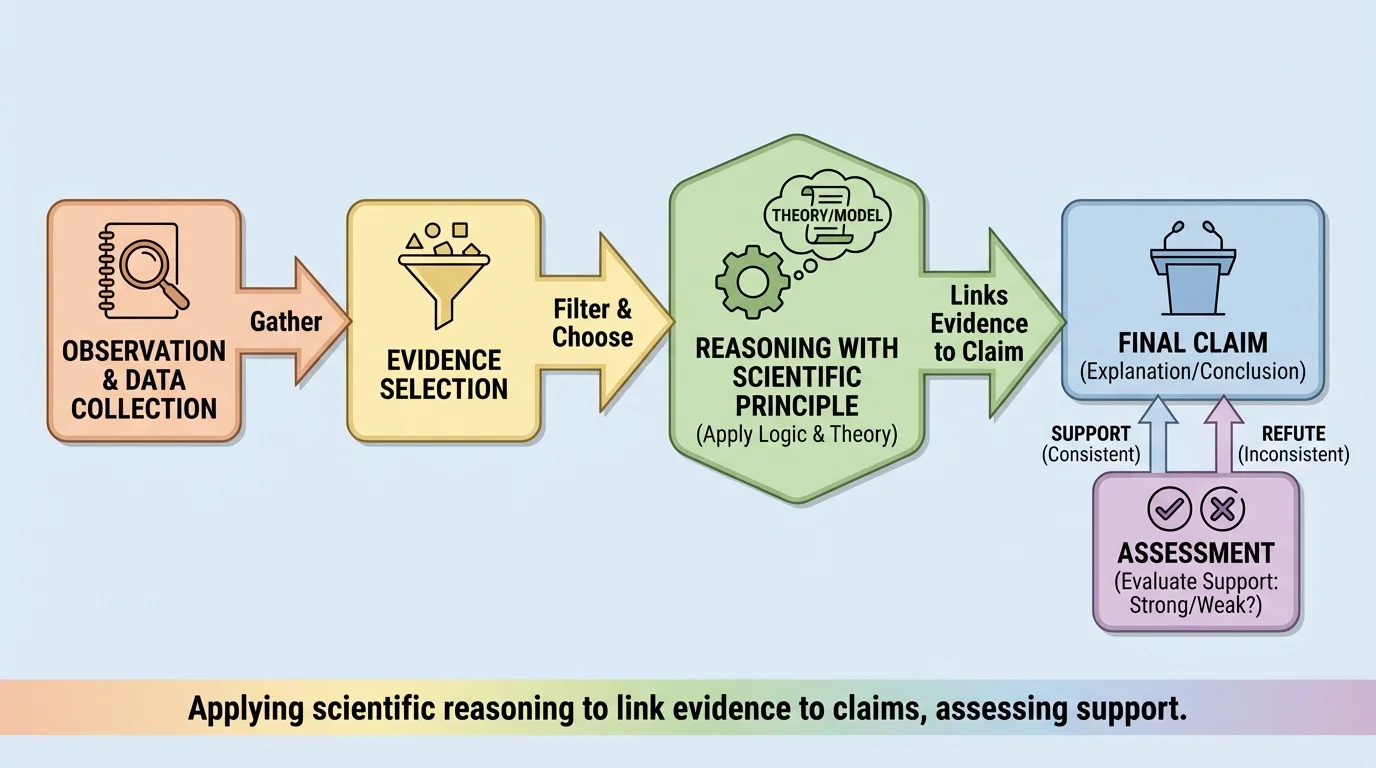
A useful framework for analyzing explanations is the CER framework: claim, evidence, and reasoning. As [Figure 1] shows, the process is not just "collect data and decide." Scientists gather observations, select relevant evidence, connect it to scientific ideas, and then build a claim that can be tested and challenged.
Suppose a class investigates whether a metal rod expands when heated. Students measure the rod before heating and after heating, and the length increases slightly. The claim might be that heating causes the rod to expand. The evidence is the repeated measurements showing a greater length after heating. The reasoning links those measurements to particle theory: when temperature rises, particles in the metal vibrate more and tend to occupy slightly more space, so the object expands.
If the students only say, "The length got bigger," they have not fully explained the result. If they say, "The length increased because heating transferred energy to the particles, increasing their motion," then they are using science to link evidence to the claim.
The same pattern appears in biology. If bacteria grow more slowly when exposed to an antibiotic, the claim might be that the antibiotic inhibits bacterial growth. The evidence is the measured decrease in colony size or number. The reasoning uses knowledge of how that antibiotic disrupts cell-wall formation or protein synthesis. Without that reasoning, the conclusion remains incomplete.
Scientific reasoning often relies on larger explanatory systems. A theory provides general principles supported by many lines of evidence, while a model helps scientists represent complex systems that may be too large, too small, too slow, or too complicated to study directly.
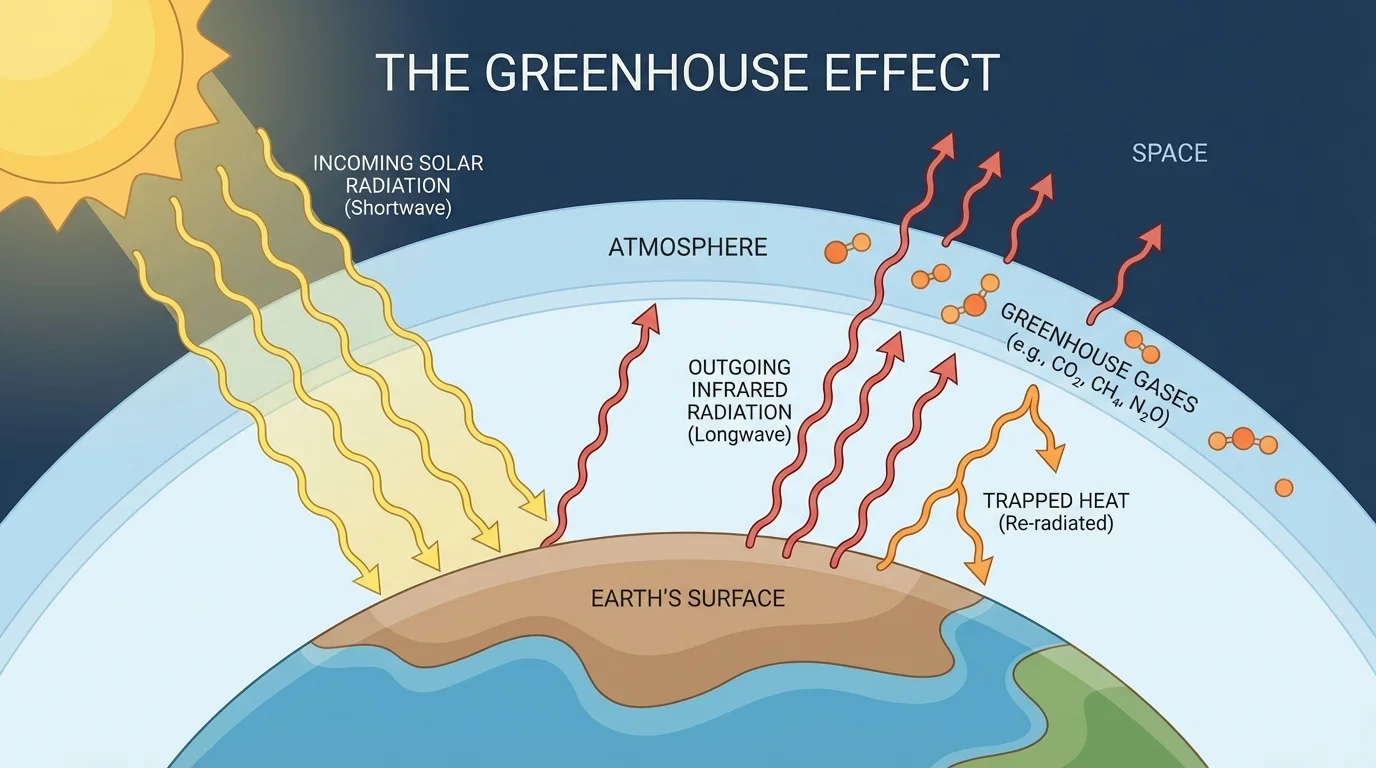
Climate science gives a strong example. The claim that increasing atmospheric concentrations of \(CO_2\) contribute to global warming is not based on one thermometer reading. As [Figure 2] illustrates, scientists use a greenhouse model in which incoming solar energy reaches Earth, Earth emits infrared radiation, and gases such as \(CO_2\) and \(CH_4\) absorb and re-radiate some of that energy. The evidence includes rising greenhouse gas concentrations, measured global temperature trends, ice core records, and satellite observations.
The reasoning connects the evidence to the claim through physical principles. Molecules like \(CO_2\) interact with infrared radiation in specific ways, so increasing their concentration changes how energy moves through the atmosphere. That does not mean every weather event proves climate change. It means the overall pattern is interpreted through a scientific model grounded in physics.
Models are not exact copies of reality. They simplify. A cell model might omit many molecules. A weather model may estimate average behavior rather than every tiny air movement. Still, a model can be powerful if it predicts observations well and matches known science. Later, when scientists compare competing explanations, they often ask which model better fits the evidence.
How theories and models strengthen explanations
A strong explanation usually does more than describe what happened. It shows how the evidence fits within a broader understanding of nature. Theories provide tested principles, and models help apply those principles to real systems. When evidence agrees with predictions from a theory or model, confidence in the explanation increases. When evidence repeatedly conflicts with them, scientists revise the model, the reasoning, or sometimes the claim itself.
Physics provides another example. If an object's acceleration is measured while different net forces are applied, students may use Newton's second law, \(F = ma\), to reason from evidence to claim. If a \(2\,\textrm{kg}\) cart experiences a net force of \(6\,\textrm{N}\) and accelerates at \(3\,\textrm{m/s}^2\), the numbers fit the law because \(6 = 2 \times 3\). That agreement supports the explanation that greater net force produces greater acceleration for a given mass.
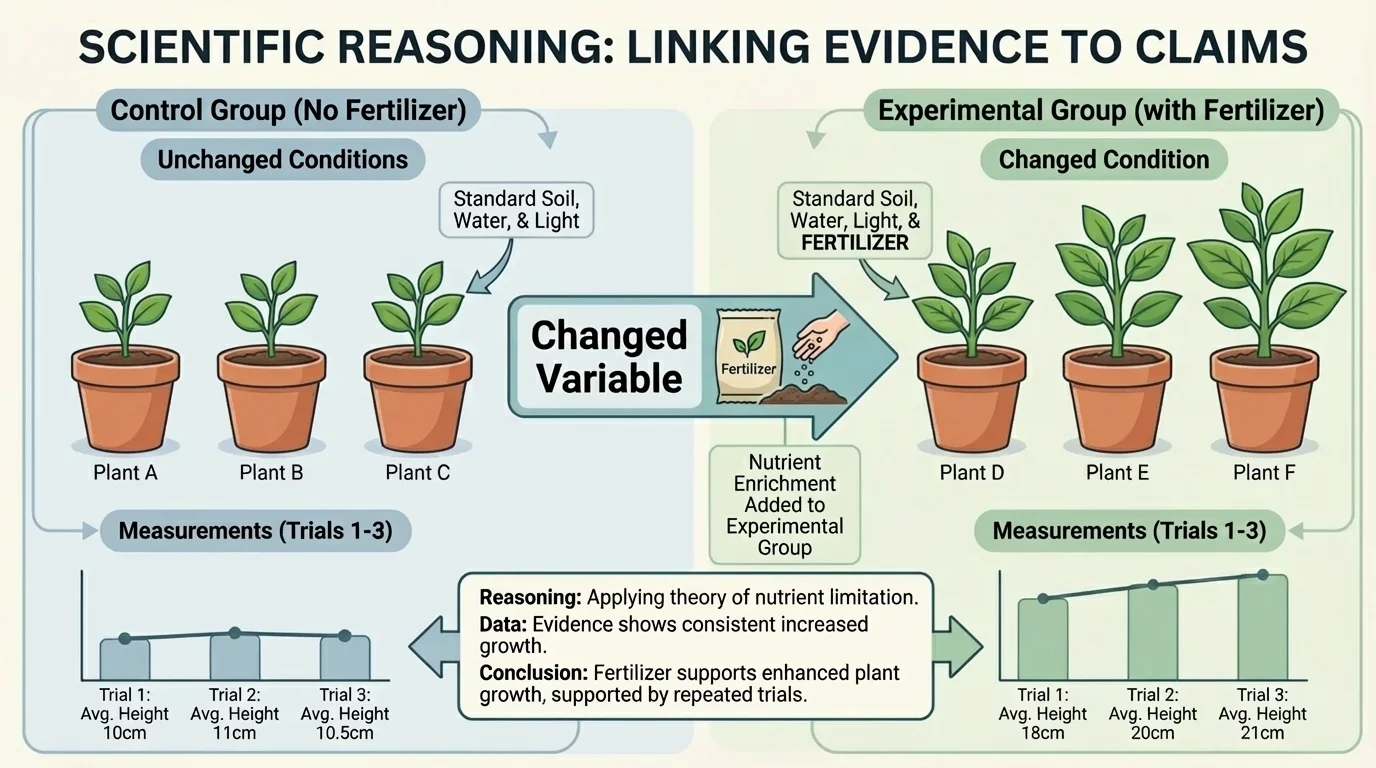
Not all evidence supports a claim equally well. In judging the strength of an explanation, scientists consider whether the data are accurate, relevant, sufficient, and consistently interpreted. As [Figure 3] shows in a controlled plant experiment, strong support usually comes from fair comparisons, repeated trials, and careful attention to what variable was changed.
Several questions help assess support. Were there enough data points? Was there a control group? Were measurements repeated? Were instruments precise? Could another variable explain the result? Were the data collected under conditions appropriate to the claim?
For example, if one plant with fertilizer grows taller than one plant without fertilizer, that is only limited support. The plants may have started at different sizes, received different light, or had different genetics. But if \(30\) plants in each group are grown under the same conditions except for fertilizer, and the fertilized group consistently shows greater average growth, the support becomes much stronger.
Scientists also consider reliability and validity. Reliability means results are consistent when measurements are repeated. Validity means the investigation actually tests what it claims to test. A method can be reliable but invalid. For instance, a scale that is always \(2\,\textrm{kg}\) too high gives consistent readings, but those readings are not accurate for true mass.
Uncertainty is also part of science. No measurement is perfectly exact. If a thermometer reads \(22.4^\circ\textrm{C}\) with an uncertainty of \(\pm 0.2^\circ\textrm{C}\), values between \(22.2^\circ\textrm{C}\) and \(22.6^\circ\textrm{C}\) may be reasonable. When differences between groups are smaller than the uncertainty range, scientists must be cautious about making strong claims.
Another key issue is sample size. A sample of \(5\) may suggest a pattern, but a sample of \(500\) generally gives stronger support if the sample is chosen fairly. Larger samples reduce the impact of unusual cases.
| Factor | Why it matters | Effect on support |
|---|---|---|
| Control group | Provides a comparison baseline | Stronger if present and appropriate |
| Repeated trials | Checks consistency | Stronger if results repeat |
| Sample size | Reduces effect of random variation | Usually stronger when larger |
| Measurement precision | Limits uncertainty | Stronger when uncertainty is low |
| Relevant variables controlled | Reduces alternative explanations | Stronger when fewer confounding variables exist |
| Fit to theory/model | Connects evidence scientifically | Stronger when logically consistent |
Table 1. Factors that affect how strongly evidence supports a scientific claim.
It is also important to distinguish correlation from causation. If two variables change together, that does not automatically mean one causes the other. Ice cream sales and sunburn rates may both increase in summer, but buying ice cream does not cause sunburn. The hidden factor is increased sunny weather and time outdoors.
Some of the most famous scientific mistakes happened not because scientists had no data, but because they linked the data to the wrong explanation. Better instruments, larger data sets, and stronger reasoning later corrected those conclusions.
That point matters in medicine. If patients taking a new drug improve, we still need to ask whether they would have improved anyway, whether the sample was large enough, and whether a placebo-controlled trial showed the same effect. Strong conclusions require more than a hopeful pattern.
In science and engineering, evidence-based reasoning is used not only to explain natural events but also to evaluate solutions. Constructing explanations means using scientific ideas to explain why a phenomenon happens. Designing solutions means applying evidence and reasoning to decide which design best solves a problem.
Consider water filtration. Suppose engineers test three filter materials and measure how well each removes particles and bacteria while maintaining flow rate. The best solution is not simply the one with the highest removal percentage. Engineers must balance multiple criteria: effectiveness, cost, durability, speed, and safety. A claim that "Filter B is the best design" must be supported by evidence from tests and reasoning about trade-offs.
Case study: choosing a bridge material
An engineering team compares steel, aluminum, and a composite material for a pedestrian bridge.
Step 1: Identify the claim
The team claims that the composite material is the best overall choice for this bridge.
Step 2: Identify the evidence
Tests show the composite has high strength-to-mass ratio, resists corrosion better than steel, and requires less maintenance over time.
Step 3: Add the reasoning
Because the bridge must be strong, lightweight, and durable in outdoor conditions, the composite's properties align better with the design criteria, even if its initial cost is higher.
The conclusion is stronger if the data come from repeated stress tests, weathering studies, and cost analyses rather than from a single trial.
This same practice appears in environmental science. If a town wants to reduce algal blooms in a lake, scientists may test whether excess \(N\) and \(P\) from fertilizer runoff increase algae growth. The evidence may come from water chemistry, algae counts, and comparisons among sites. The reasoning uses ecosystem science: added nutrients can increase producer growth, which can later lower dissolved oxygen and harm fish.
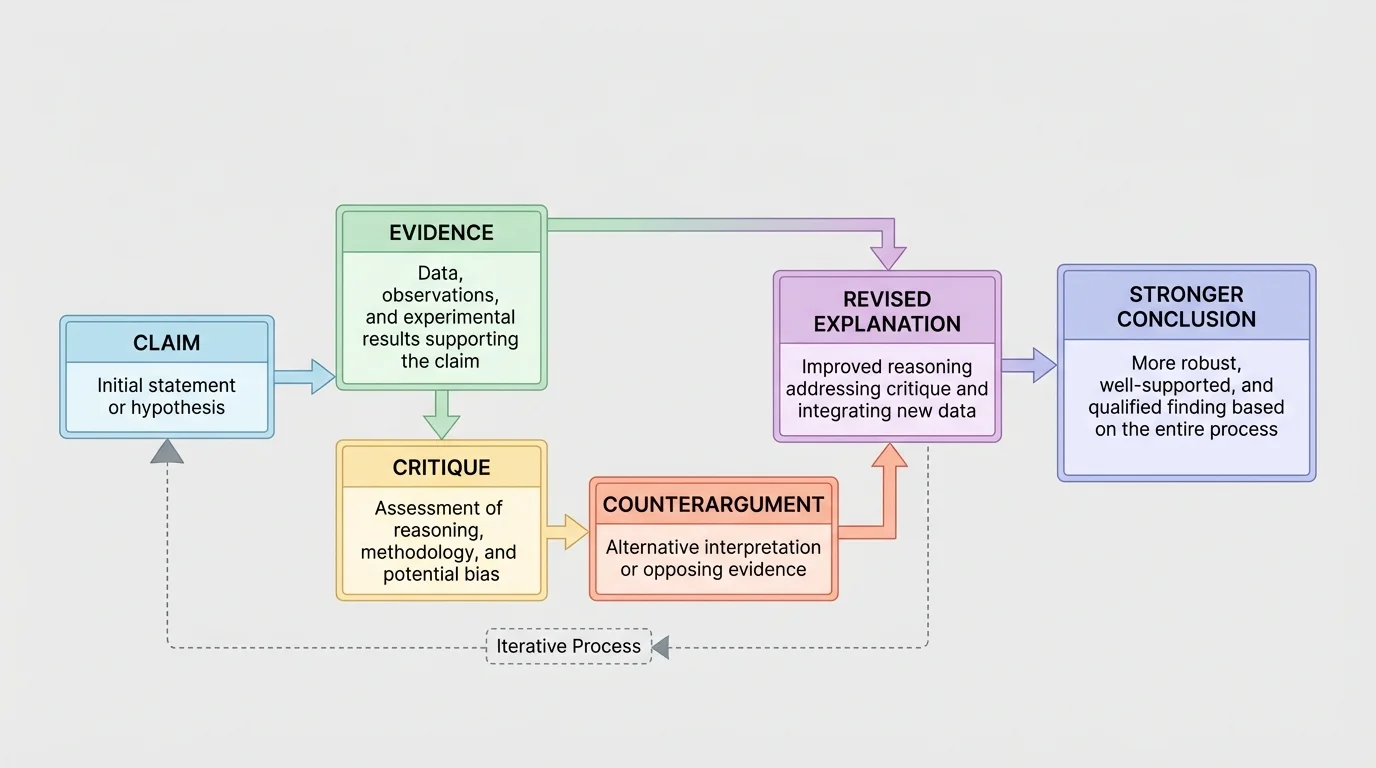
Scientific argument does not mean yelling or defending an opinion at all costs. It means using evidence and reasoning to justify a claim, listening to critique, and revising the explanation when necessary. As [Figure 4] illustrates, scientific argument is a cycle: claim, evidence, critique, counterargument, revision, and stronger conclusion.
When scientists engage in argument from evidence, they compare explanations. They ask which claim fits the data best, which reasoning is most logical, and which interpretation handles conflicting evidence more successfully. A strong argument also addresses counterclaims rather than ignoring them.
Suppose two students debate why fish died in a pond. One claims low oxygen caused the deaths. Another claims a toxin was released upstream. To evaluate these claims, they would compare evidence such as dissolved oxygen levels, water temperature, chemical tests, and timing of the event. The stronger conclusion is the one better supported by the full body of evidence and the reasoning that connects those data to a biological or chemical mechanism.
Peer review is part of this process. Other scientists examine methods, challenge interpretations, and test whether the reasoning is sound. This does not weaken science. It strengthens it. The goal is not to protect a favorite claim but to reach the explanation best supported by evidence.
"The great tragedy of science—the slaying of a beautiful hypothesis by an ugly fact."
— Thomas H. Huxley
That quote captures a central scientific value: explanations must answer to evidence. Even elegant ideas are rejected or revised when the data do not support them strongly enough.
Different fields use the same core skill in different ways. In chemistry, a claim that a gas produced in a reaction is carbon dioxide can be supported by evidence such as bubbling through limewater and observing a cloudy precipitate. The reasoning uses known reaction behavior of \(CO_2\) with calcium hydroxide. A chemical equation may support the explanation, for example \(\mathrm{Ca(OH)_2 + CO_2 \rightarrow CaCO_3 + H_2O}\). The cloudiness is not the claim itself; it is evidence interpreted through chemistry.
In epidemiology, scientists may claim that a disease spreads mainly through respiratory droplets. Evidence can include infection patterns, distances between cases, and experiments on particle movement. The reasoning uses models of transmission, human behavior, and biology of the pathogen. During outbreaks, these claims are often revised as new data appear.
In astronomy, scientists cannot manipulate stars directly in a lab, so models become especially important. A claim about a star's life stage may rely on brightness, color, spectral lines, and stellar evolution theory. Even without direct experimentation, reasoning can still be strong when multiple lines of evidence agree.
Returning to climate science, the greenhouse model in [Figure 2] remains useful because it connects several independent forms of evidence. The support is stronger not because any single measurement proves the conclusion, but because many kinds of data converge on the same explanation.
One common error is cherry-picking, which means selecting only evidence that supports a claim while ignoring conflicting data. Another is overgeneralization, drawing a broad conclusion from too little evidence. A third is confirmation bias, the tendency to notice what fits expectations and overlook what does not.
Students also sometimes confuse a model with reality. A model is a tool, not the thing itself. The particle model of matter explains many patterns, but actual substances can behave in more complex ways than a simple classroom diagram suggests.
Another mistake is using reasoning that is logically disconnected from the evidence. For example, if students observe that a solution changed color and conclude it became acidic, that conclusion is only justified if the indicator used is known to signal acidity and the procedure was valid. A color change by itself does not automatically prove acidity.
The CER flow in [Figure 1] helps prevent this problem because it forces scientists to state explicitly how the evidence leads to the claim. If that link cannot be clearly explained, the argument is not yet strong enough.
Earlier science learning about variables, measurement, graph interpretation, and controlled experiments is essential here. Those skills provide the foundation for deciding whether evidence is trustworthy and whether the reasoning actually fits the data.
Scientists also avoid claiming more than the data justify. If a study shows that a treatment worked under specific conditions for adults aged \(20\)–\(40\), that does not automatically prove the same outcome for children, older adults, or different doses. The scope of a claim should match the scope of the evidence.
A scientifically strong judgment balances confidence with caution. It uses the best available evidence, explains the reasoning clearly, compares alternative explanations, and acknowledges uncertainty. It does not demand absolute certainty before acting, but it also does not treat weak evidence as if it were decisive.
In real life, this matters constantly. Public health officials decide whether evidence is strong enough to recommend vaccines or masks. Engineers decide whether test data are sufficient to approve a design. Environmental scientists decide whether trends justify policy changes. In each case, the key question is not simply whether there is evidence, but how well the evidence and reasoning support the conclusion.
As the argument cycle in [Figure 4] shows, science advances by testing, criticizing, and refining explanations. Good scientific thinkers do not just collect facts. They connect those facts to claims with logic, models, and theory, then judge honestly how strong that support really is.
