Every day, people buy, use, share, and need many things. You may wear shoes, ride a bus, eat lunch, read a library book, or visit a doctor. But here is an important question: are all of these the same kind of thing? In economics, they are not. Some are goods, and some are services. Learning the difference helps us understand how people live, work, and make choices.
Economics is the study of how people use what they have. People want many things, but time, money, materials, and workers are limited. Because of that, people must choose. To make smart choices, it helps to know whether something is a good or a service.
Goods are things people can touch, hold, use, or own. A book, an apple, a toy, and a jacket are goods.
Services are actions or jobs that one person does for another person. A haircut, a bus ride, teaching, and fixing a sink are services.
A good is a real object. You can usually put it in a bag, on a shelf, or on a table. If you buy a sandwich, the sandwich is a good. If you buy a notebook, the notebook is a good.
A service is work someone does to help another person. If a dentist checks your teeth, that is a service. If a teacher helps you learn to read, that is a service. You cannot hold a service in your hands, but you can still use it and need it.
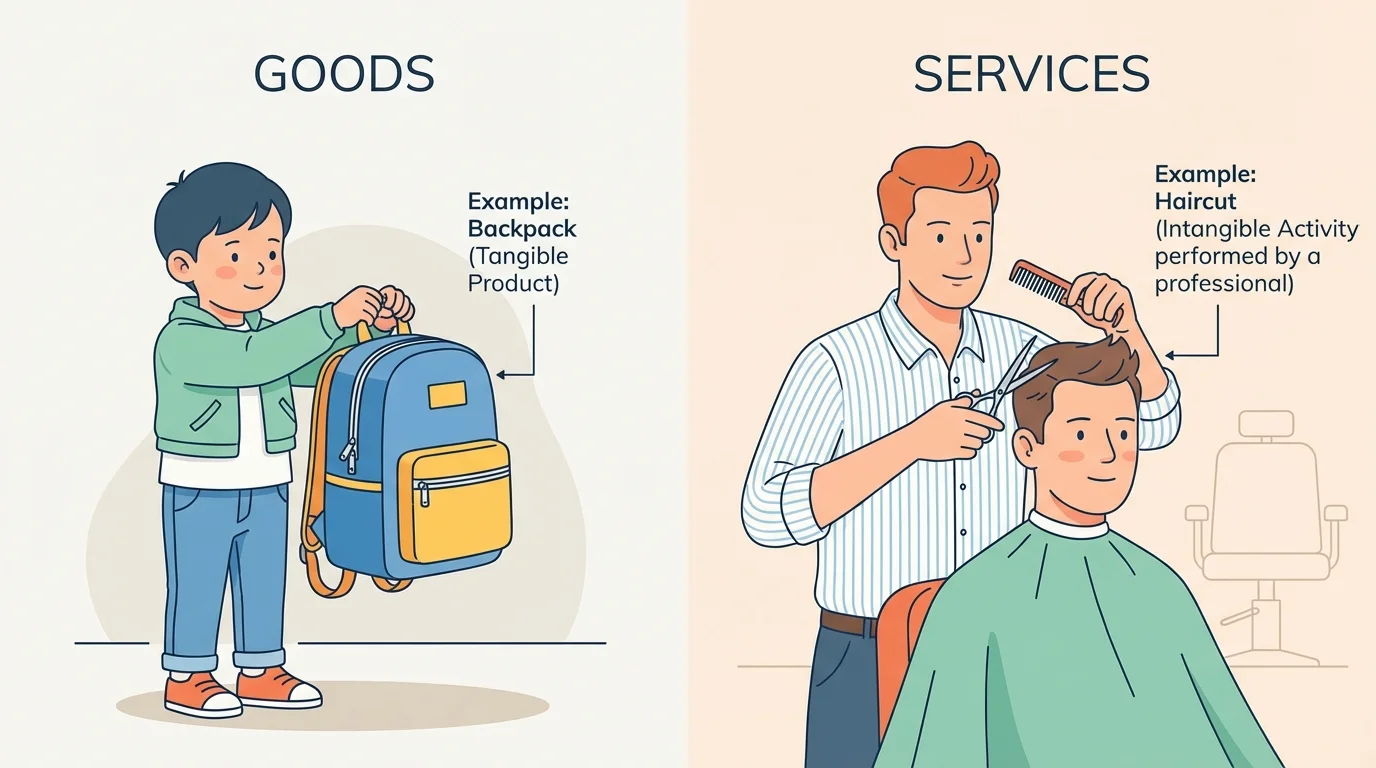
A simple way to tell the difference is this: if you can touch it and keep it, it is probably a good. If someone is doing something for you, it is probably a service, as shown in [Figure 1]. A backpack is a good because you can carry it home. A haircut is a service because someone does the work for you.
Sometimes this can feel tricky. A pizza from a restaurant is a good because it is an item you eat. But the work of cooking and bringing the pizza to your table is a service. One place can provide both goods and services.
You can ask two helpful questions. Question 1: Can I touch it and keep it for a while? Question 2: Is this something a person is doing for me? These questions help you sort many examples correctly.
For example, shoes are goods. A doctor visit is a service. A soccer ball is a good. A music lesson is a service. The comparison in [Figure 1] makes this idea easier to understand because one side shows an object and the other shows an action.
At home, families use many goods and services. Goods at home may include soap, dishes, blankets, milk, bread, and chairs. Services at home may include garbage pickup, electrical repair, mail delivery, and internet installation.
At school, students also use both kinds. Goods at school include crayons, pencils, paper, rulers, books, desks, and computers. Services at school include teaching, cooking lunch, driving the school bus, cleaning the building, and helping in the library.
In a community, people depend on many workers. Firefighters provide a service by helping keep people safe. Police officers provide a service by protecting the community. Nurses and doctors provide health services. Store workers sell goods, and mechanics repair cars and bikes as a service.
Many jobs are services. Even when a worker uses tools or machines, the main thing the person gives may still be helpful work.
Some examples can include both. At a movie theater, the ticket seller and workers provide services, while popcorn and drinks are goods. At a bike shop, the bike is a good, but repairing the bike is a service.
Goods can be placed into groups. Grouping helps us notice how goods are alike. Some goods help us stay alive. Some help us learn. Some help us work. Some are mainly for fun.
One important group is food goods. Apples, rice, cheese, carrots, and bread are goods we eat. Another group is clothing goods. Shirts, socks, coats, hats, and shoes are clothing goods.
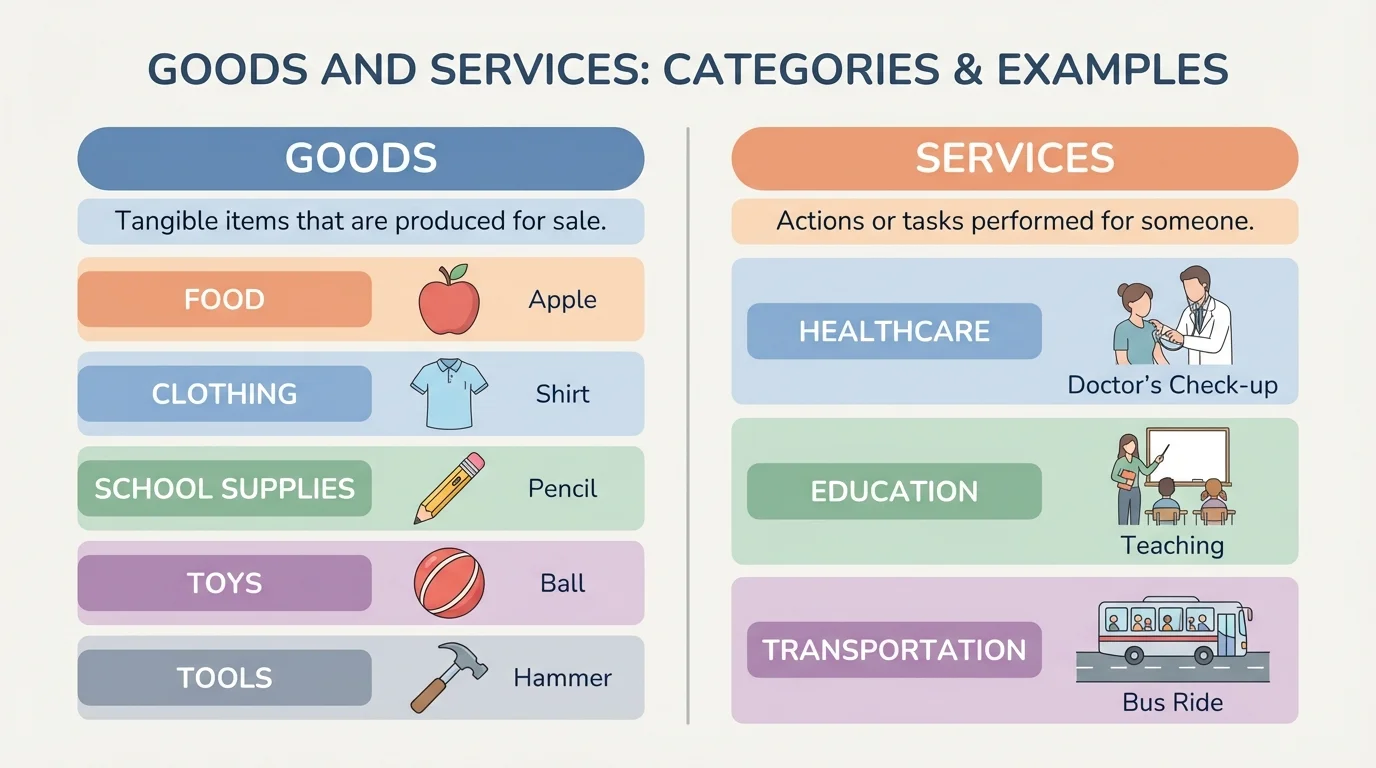
There are also school supply goods such as folders, markers, glue, and notebooks, as shown in [Figure 2]. Toy and game goods include dolls, blocks, cards, and balls. Tool goods include hammers, brooms, scissors, and kitchen spoons. Some goods fit more than one group. A backpack can be a school supply and a travel good.
People may also sort goods by how long they last. A banana may be used quickly. A winter coat may last for years. Both are goods, but they are used in different ways.
| Category of goods | Examples | How people use them |
|---|---|---|
| Food | apple, milk, bread | to eat and drink |
| Clothing | shirt, coat, shoes | to wear |
| School supplies | pencil, paper, book | to learn and write |
| Toys and games | ball, puzzle, doll | to play |
| Tools | hammer, broom, spoon | to make or fix things |
Table 1. Examples of different categories of goods and how people use them.
When you look around a room, you can probably find many goods in just a few seconds. That is because goods are objects we use often every day. The grouped items in [Figure 2] remind us that goods can have different uses.
Services can also be grouped. Some services help people travel. Some help people stay healthy. Some help people learn. Some keep places clean and safe.
Transportation services include bus rides, taxi rides, train rides, and airplane trips. Health services include doctor visits, dentist visits, and nursing care. Education services include teaching, tutoring, and coaching.
There are also repair services such as fixing a bicycle, mending clothes, or repairing a broken sink. Safety services include firefighting and police work. Entertainment services can include a puppet show, a concert, or a guided museum tour.
A service often takes skill and time. A barber learns how to cut hair. A mechanic learns how to repair engines. A teacher learns how to help students understand new ideas. That is why services are valuable, even though they are not objects.
People produce and consume
A producer makes goods or provides services. A baker is a producer of bread. A bus driver is a producer of transportation service. A consumer is a person who buys or uses goods and services. Families, students, and workers are all consumers when they use things they need or want.
One person can be both a producer and a consumer. A teacher provides a service at school, but that same teacher may buy groceries after work. That means the teacher produces a service and also consumes goods.
People need some goods and services in order to live safely and stay healthy. Food, water, clothing, shelter, and medical care are important needs. Other goods and services are wants. A toy robot, a video game, or a ride to an amusement park may be wants. But people may not be able to get everything they want because of scarcity, as [Figure 3] shows.
Scarcity means there is not enough of something for everyone to have all they want. Resources are limited. Money is limited. Time is limited. Workers are limited. Materials are limited. Because resources are limited, people have to make choices.
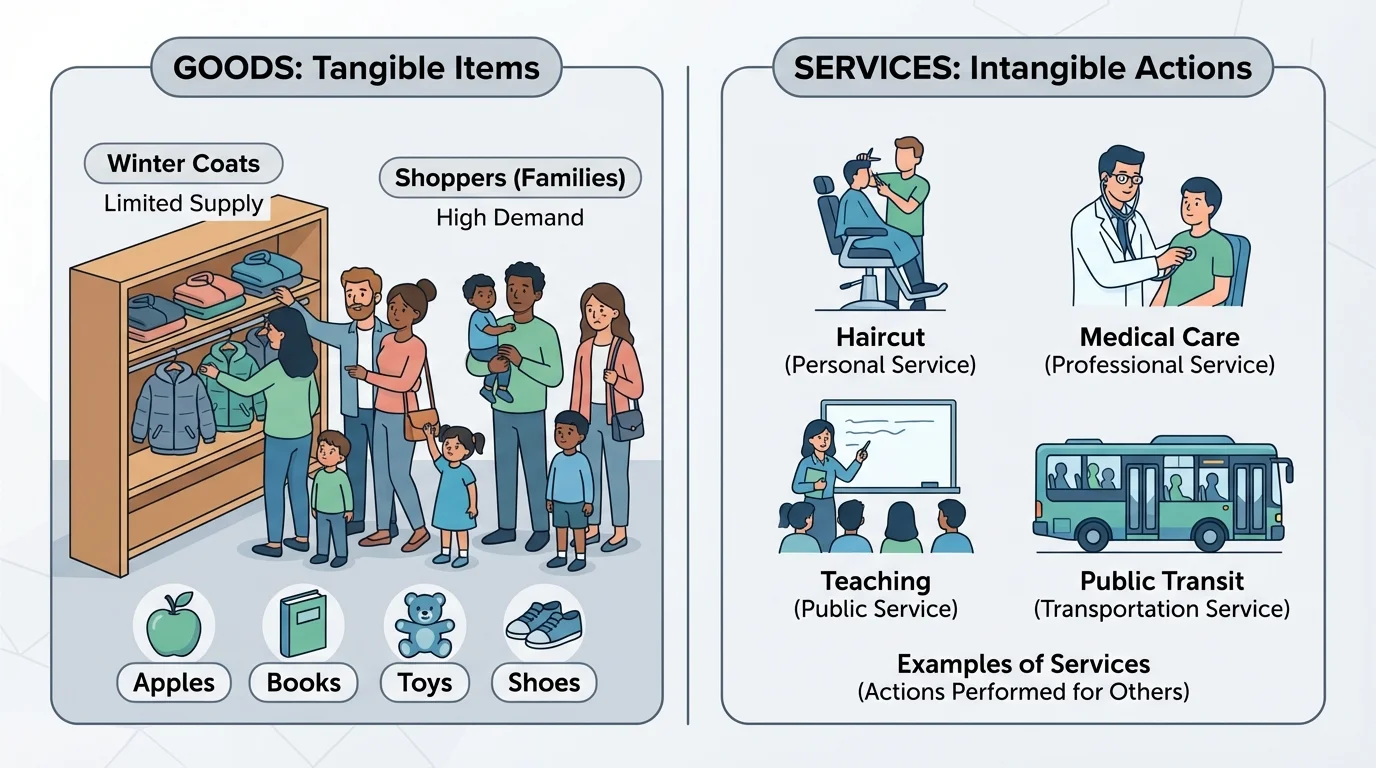
Think about winter coats. If a store has only a few coats and many families need them, not everyone may get the coat they want. Some families may choose a different color. Some may need to wait. Some may not have enough money for the most expensive coat. Scarcity helps explain why people cannot always get all the goods and services they want or even need right away.
Scarcity also affects services. A doctor can help only so many patients in one day. A bus has room for only so many riders at one time. If many people need the same service, they may have to wait. The crowded shelf and shoppers in [Figure 3] show this idea of limited supply and choice.
People make choices every day. When something is limited, choosing one thing often means not choosing another thing.
Families often think carefully about needs first. They may buy food before candy, shoes before a toy, or medicine before a game. This does not mean wants are bad. It means needs usually come first when resources are limited.
Many parts of life include both goods and services together. A bicycle repair shop gives a service when a mechanic fixes the bike. But the shop may also use goods such as tires, chains, and tools.
A restaurant serves meals. The food is a good. Cooking, serving, and cleaning are services. At a hospital, medicine can be a good, while nursing care and checkups are services. At school, a textbook is a good, while teaching is a service.
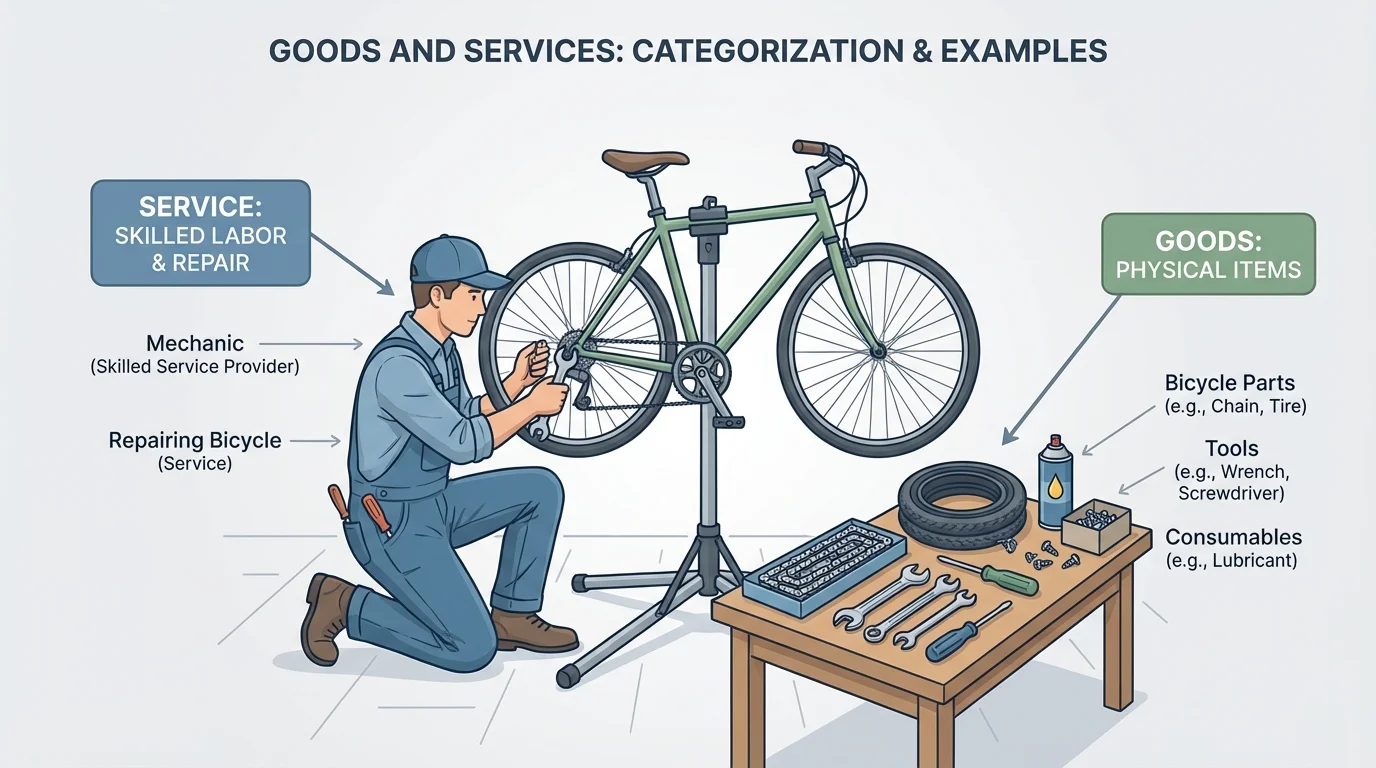
This is important because goods and services are often connected. Workers use goods to provide services, and services help people use goods. A bus driver provides transportation service, but the bus itself is a good. A librarian provides a service, and the books are goods.
When you think about a place, it can help to ask: What objects are here? and What work is being done? Those two questions help you find the goods and the services in almost any situation. The bike repair scene in [Figure 4] makes that teamwork easy to notice.
People usually pay money to buy goods and services. A family might pay for milk, shoes, and soap. They might also pay for a haircut, bus ride, or doctor visit. Since money is limited, families choose carefully.
Stores, businesses, and workers also make choices. A bakery decides how much bread to bake. A bus company decides how many buses to send. A doctor's office decides how to use workers' time. These choices are part of economics because resources are not unlimited.
Sometimes communities help provide important services for everyone. Schools, firefighters, roads, and libraries help many people in a town or city. These services matter because they support daily life and help communities work well.
Sorting examples
Here are some examples of how to decide whether something is a good or a service.
Step 1: Look at pencil.
You can touch it, hold it, and keep it. It is a good.
Step 2: Look at haircut.
A person does the work for you. It is a service.
Step 3: Look at school lunch.
The food itself is a good, but cooking and serving the meal are services.
Some situations include one category, and some include both.
When you understand goods, services, needs, wants, producers, consumers, and scarcity, you begin to see economics everywhere. It is in stores, schools, homes, buses, playgrounds, and hospitals. It is part of daily life.
