Two mathematical expressions can look completely different and still mean exactly the same thing. For example, would you rather see repeated addition written as \(y+y+y\) or as \(3y\)? They look different, but every time you choose a value for \(y\), both expressions give the same result. That idea is one of the central ideas of algebra: different-looking expressions can name the same number.
An expression is a math phrase made of numbers, variables, and operations, such as \(4x+7\) or \(2(a+3)\). Two expressions are equivalent expressions when they name the same number no matter which value is substituted for the variable. The outputs match for every input when expressions are truly equivalent.
[Figure 1] This means the expressions must stay equal for all possible values of the variable, not just one single value. For example, \(y+y+y\) and \(3y\) are equivalent because repeated addition of \(y\) three times is the same as multiplying \(y\) by \(3\).
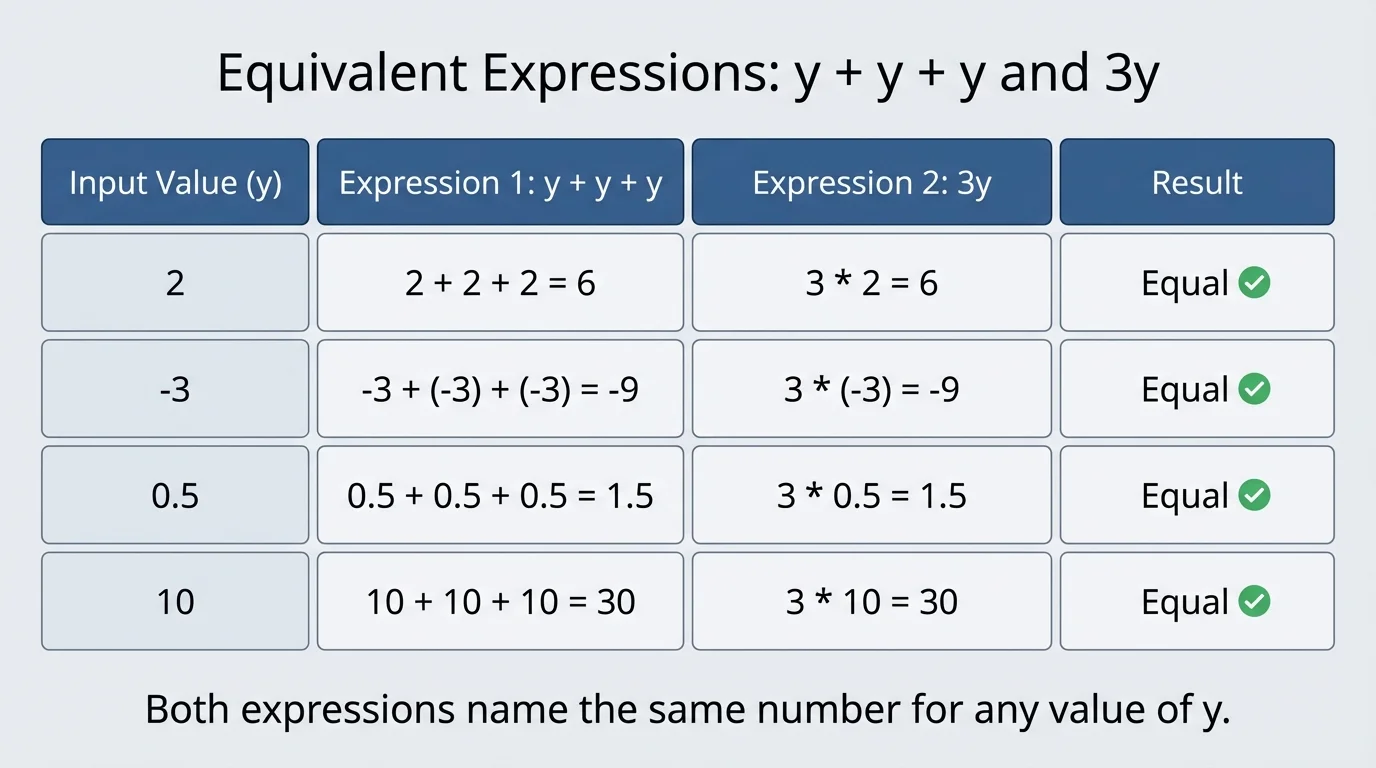
Here are some more pairs of equivalent expressions:
\(x+x = 2x\)
\(5n+2n = 7n\)
\(a+4+3 = a+7\)
\(2(b+1) = 2b+2\)
Equivalent expressions do not need to look alike. One may be shorter, more organized, or easier to use. Algebra often involves rewriting an expression in another equivalent form that is simpler to understand.
Equivalent expressions are expressions that have the same value for every value of the variable.
Variable means a letter that stands for a number, such as \(x\), \(y\), or \(n\).
Substitute means to replace a variable with a number.
It helps to think of equivalent expressions as two labels on the same quantity. They may be written differently, but they point to the same amount.
One way to explore equivalence is through substitution. You choose a value for the variable and calculate each expression. If the results match, that is a clue that the expressions may be equivalent.
For example, compare \(2x+3x\) and \(5x\). If \(x=4\), then \(2x+3x=2(4)+3(4)=8+12=20\). Also, \(5x=5(4)=20\). The values match.
If \(x=10\), then \(2x+3x=20+30=50\), and \(5x=50\). They still match. In fact, they will match for every value of \(x\), so the expressions are equivalent.
But there is an important warning: matching for one value does not prove equivalence. Two expressions might accidentally be equal for one substitution and then disagree for another.
From earlier arithmetic, you already know that \(3+3+3=3\cdot 3\). Algebra uses the same idea, but now the repeated number might be a variable, such as \(y+y+y=3y\).
Consider \(x+2\) and \(2x\). If \(x=2\), then \(x+2=4\) and \(2x=4\). They match for that one value. But if \(x=3\), then \(x+2=5\) and \(2x=6\). They do not match. So these expressions are not equivalent.
Substitution is excellent for checking examples and building understanding. However, to know expressions are truly equivalent, we usually use properties and algebra rules that work for every value.
Algebra becomes powerful when you can see why two forms are the same. One important idea is like terms. Like terms have the same variable part. For example, \(3x\) and \(5x\) are like terms, but \(3x\) and \(3y\) are not.
When terms are alike, you can combine them. That is why \(4x+2x=6x\), and \(7n-n=6n\). The variable part stays the same, and the coefficients are added or subtracted.
As [Figure 2] illustrates, another important rule is the distributive property. This property lets you multiply a number by everything inside parentheses. For example, \(3(x+2)\) means \(3\) groups of \(x+2\), so it becomes \(3x+6\). Each group contains one \(x\) and two extra units, making a total of \(3x+6\).
So we can say:
\(3(x+2)=3x+6\)
\(5(a+4)=5a+20\)
\(2(m+n)=2m+2n\)
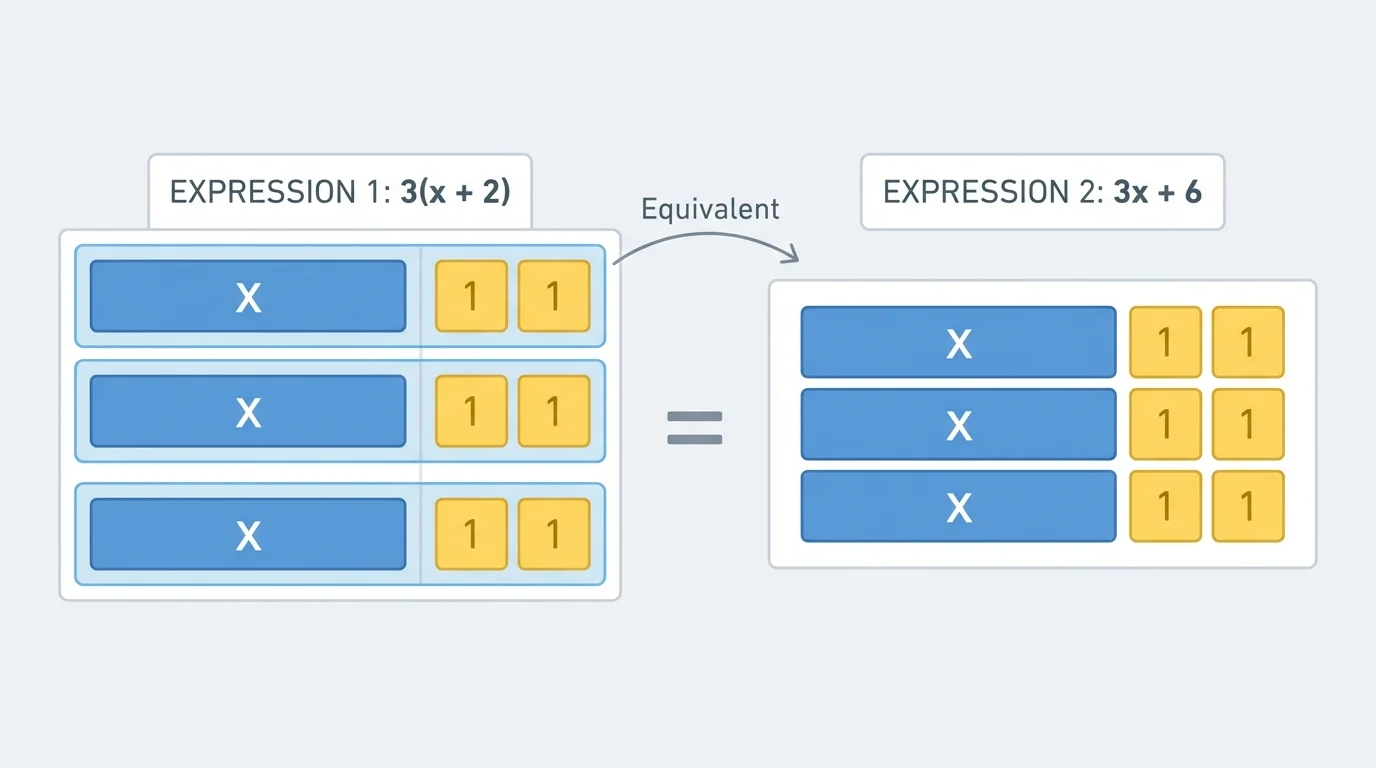
The order of addition also does not change the value. So \(x+5\) and \(5+x\) are equivalent. Also, grouping can sometimes change without changing value, such as \((a+b)+c\) and \(a+(b+c)\).
These ideas come from properties of operations. They help us rewrite expressions in simpler or more useful forms while keeping the value exactly the same.
Different form, same value
Equivalent expressions are like two routes to the same destination. One form may show repeated addition, another may show multiplication, and another may show a product expanded with the distributive property. If each form gives the same result for every possible value, the expressions are equivalent.
Be careful, though: not every rewrite is correct. For example, \(2(x+3)\) equals \(2x+6\), not \(2x+3\). The \(2\) must multiply every term inside the parentheses.
One of the best ways to understand equivalence is to see it in action.
Worked example 1
Are \(p+p+p+p\) and \(4p\) equivalent?
Step 1: Recognize the pattern.
The expression \(p+p+p+p\) is repeated addition of \(p\) four times.
Step 2: Rewrite repeated addition as multiplication.
Adding \(p\) four times is the same as \(4\cdot p\), which is written as \(4p\).
Step 3: State the conclusion.
Because both expressions name the same number for every value of \(p\), they are equivalent.
Answer: \(p+p+p+p\) and \(4p\) are equivalent.
Notice that this example did not depend on one special value. It depended on the meaning of multiplication as repeated addition.
Worked example 2
Are \(6x+2x\) and \(8x\) equivalent?
Step 1: Identify like terms.
Both \(6x\) and \(2x\) have the same variable part, \(x\), so they are like terms.
Step 2: Add the coefficients.
\(6x+2x=(6+2)x=8x\).
Step 3: State the conclusion.
The expressions simplify to the same form, so they are equivalent.
Answer: \(6x+2x\) and \(8x\) are equivalent.
Combining like terms is one of the fastest ways to identify equivalence.
Worked example 3
Are \(2(n+5)\) and \(2n+10\) equivalent?
Step 1: Use the distributive property.
Multiply \(2\) by each term inside the parentheses: \(2\cdot n\) and \(2\cdot 5\).
Step 2: Rewrite the expression.
\(2(n+5)=2n+10\).
Step 3: Compare the results.
The second expression is exactly the expanded form of the first expression.
Answer: \(2(n+5)\) and \(2n+10\) are equivalent.
The distributive property lets you move between a grouped form and an expanded form.
Worked example 4
Are \(x+7\) and \(7x\) equivalent?
Step 1: Test a value.
If \(x=1\), then \(x+7=8\) and \(7x=7\). The values are different.
Step 2: Conclude from the mismatch.
If two expressions differ for even one value, they are not equivalent.
Answer: \(x+7\) and \(7x\) are not equivalent.
This example shows that adding \(7\) is very different from multiplying by \(7\).
A very common mistake is thinking that expressions are equivalent because they match for one value. Remember the earlier example: \(x+2\) and \(2x\) are equal when \(x=2\), but not for every value. Equivalent expressions must match always.
Another mistake is combining unlike terms. For example, \(3x+4\) cannot be simplified to \(7x\). The term \(3x\) has a variable, but \(4\) does not, so they are not like terms.
Students also sometimes distribute incorrectly. For example:
Incorrect: \(4(a+2)=4a+2\)
Correct: \(4(a+2)=4a+8\)
The \(4\) must multiply both \(a\) and \(2\).
One more mistake is confusing order in multiplication and order in subtraction. For addition, \(x+3\) and \(3+x\) are equivalent. But for subtraction, \(x-3\) and \(3-x\) are usually not equivalent.
| Pair of expressions | Equivalent? | Reason |
|---|---|---|
| \(2x+5x\) and \(7x\) | Yes | Like terms combine |
| \(3(y+1)\) and \(3y+3\) | Yes | Distributive property |
| \(a+a+a\) and \(3a\) | Yes | Repeated addition |
| \(x+4\) and \(4x\) | No | Addition is not the same as multiplication |
| \(5-m\) and \(m-5\) | No | Subtraction order matters |
Table 1. Examples of pairs of expressions and whether they are equivalent.
As we saw earlier in [Figure 1], a true pair of equivalent expressions keeps matching outputs. If a pair fails even once, the expressions are not equivalent.
Computer programs often simplify expressions before doing calculations. Recognizing that \(x+x+x+x\) and \(4x\) are equivalent helps software work faster and keeps formulas organized.
That means the idea of equivalent expressions is not only for school math. It is also useful in computer science, science, and engineering.
Equivalent expressions appear in everyday situations. Suppose a school club sells notebooks for the same price each. If one notebook costs \(n\) dollars, then buying \(3\) notebooks can be written as \(n+n+n\) or as \(3n\). These expressions are equivalent because both represent the same total cost.
[Figure 3] Geometry gives another great example. The perimeter of a rectangle with length \(l\) and width \(w\) can be written as \(l+w+l+w\). By combining like terms, that becomes \(2l+2w\). It can also be written as \(2(l+w)\). These forms all describe the same perimeter.
So we can write:
\(l+w+l+w=2l+2w=2(l+w)\)
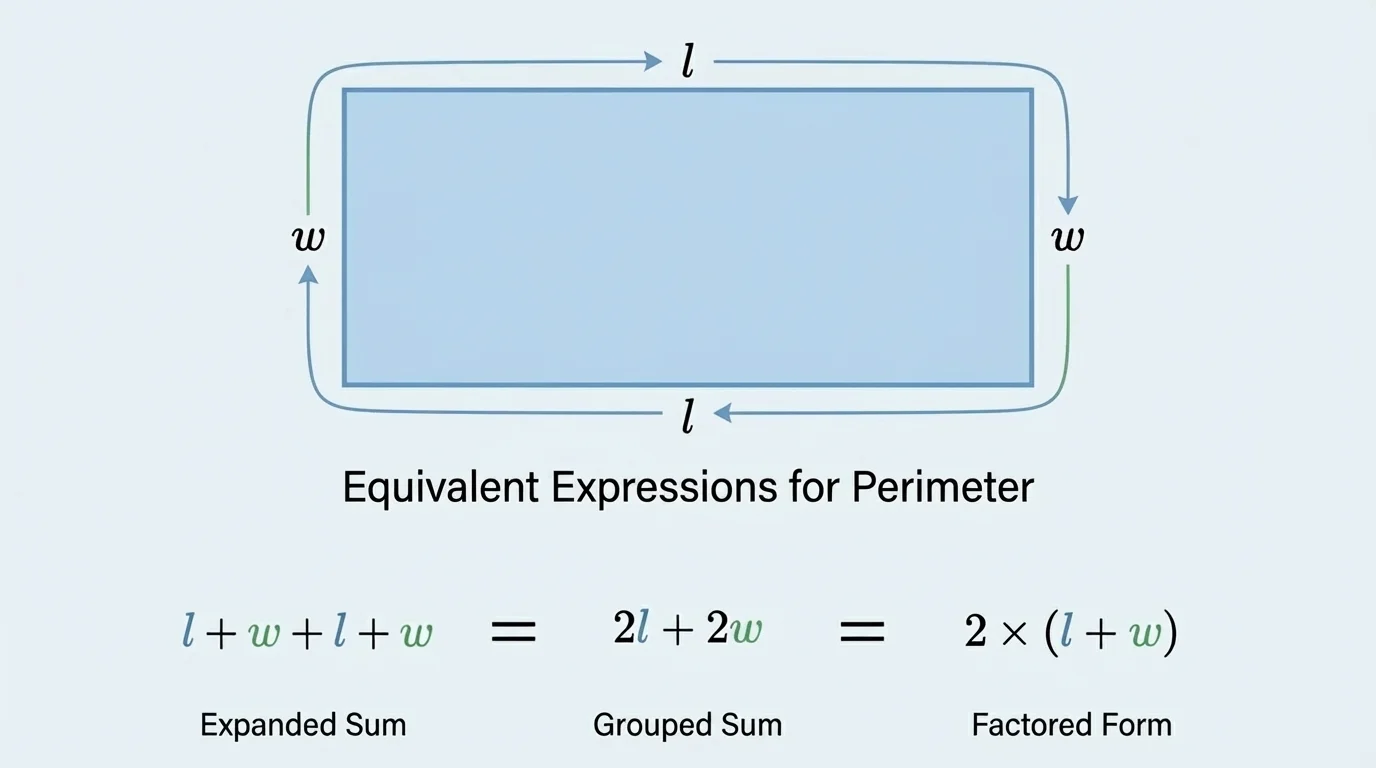
Equivalent expressions help people choose the form that is easiest to use. If you are adding side lengths one by one, \(l+w+l+w\) may feel natural. If you want a shorter form, \(2l+2w\) works well. If you want to emphasize two copies of the sum of length and width, \(2(l+w)\) is useful.
In shopping, building, and science, expressions are often rewritten in equivalent forms to make calculations quicker or ideas clearer.
Later, when you work with more complicated algebra, the same thinking helps you recognize that different formulas can still describe the same quantity.
Sometimes an expression changes only a little, but that small change matters. Compare these pairs:
\(3x+2x\) and \(5x\) are equivalent.
\(3x+2\) and \(5x\) are not equivalent.
\(4(a+1)\) and \(4a+4\) are equivalent.
\(4(a+1)\) and \(4a+1\) are not equivalent.
Looking carefully at operations is important. Are you adding, multiplying, or grouping? The details decide whether the expressions stay equal for every value.
A strong habit is to ask, "Can I explain why these expressions must always match?" If the answer comes from repeated addition, combining like terms, the distributive property, or another operation rule, then you are using algebra in a powerful way.
"Different-looking expressions can still describe the same quantity."
— A central idea of algebra
That idea becomes more important every year. The better you are at spotting equivalence now, the easier it will be to solve equations, work with formulas, and understand functions later.
