Getting exactly the right answer is not always enough in real life. If a coach says your team must score more than \(40\) points, then scoring \(40\) is not enough. If you need at least $100 in pay, then $99.99 still misses the goal. That is why inequalities matter: they help us describe situations where a value can be greater than, less than, at least, or at most some amount.
In many word problems, one quantity depends on another. A job might pay a starting amount plus money for each item sold. A phone plan might charge a monthly fee plus a cost per gigabyte. A container might already hold some water, and you want the total to stay below a limit. These situations often lead to expressions like \(px + q\), and comparing that expression to another number gives an inequality such as \(px + q > r\) or \(px + q < r\).
A inequality compares two quantities that may not be equal. Instead of using the equals sign, it uses symbols such as \(<\), \(>\), \(\le\), or \(\ge\).
An equation tells us two expressions are exactly the same, such as \(2x + 5 = 17\). An inequality tells us one expression is greater or less than another, such as \(2x + 5 > 17\). In word problems, clue words often tell you which one to use.
| Words in the problem | Symbol | Meaning |
|---|---|---|
| more than, greater than | \(>\) | greater than |
| less than | \(<\) | less than |
| at least, no less than | \(\ge\) | greater than or equal to |
| at most, no more than | \(\le\) | less than or equal to |
Table 1. Common words in word problems and the inequality symbols they suggest.
If a problem asks for all possible values that make a statement true, then you are looking for a solution set. For example, if \(x > 4\), then \(5\), \(6\), and \(4.2\) are all part of the solution set.
Variable means a letter that represents an unknown number. Coefficient means the number that multiplies the variable, as in \(p\) multiplying \(x\) in \(px + q\). Constant term means the part without a variable, like \(q\). Rational numbers are numbers that can be written as fractions, including integers, decimals that end, and decimals that repeat.
For this topic, we focus on inequalities that can be written in forms like \(px + q > r\) or \(px + q < r\), where \(p\), \(q\), and \(r\) are rational numbers. Sometimes the problem uses \(\ge\) or \(\le\), which are closely related and solved in the same way.
Suppose a babysitting job pays $12 per hour plus a one-time bonus of $7, and you want to earn more than $55. If \(h\) is the number of hours, then the total pay is \(12h + 7\). Comparing that to the goal gives
\[12h + 7 > 55\]
In this model, \(12\) is the rate for each hour, \(7\) is the starting amount, and \(55\) is the target amount you compare against. Many real-life problems follow this pattern: rate times number of units, plus or minus a fixed amount, compared to a goal or limit.
To solve an inequality, you use many of the same moves used for equations: add, subtract, multiply, or divide to isolate the variable. The big difference is this: if you multiply or divide both sides by a negative number, the inequality sign must reverse direction.
Most grade-level problems here use positive coefficients, so the sign usually stays the same. Still, it is important to remember that negative numbers can appear in some contexts.
When translating a word problem, it helps to slow down and identify the quantities. Ask yourself four questions.
First, what does the variable represent? Second, what amount changes each time? Third, is there a starting amount already there? Fourth, what comparison word tells me which symbol to use?
Building the model from words
A reliable pattern is: starting amount plus rate times variable, then compare that total to the target. In symbols, that looks like \(q + px\) compared with \(r\). Some problems subtract instead of add, but the idea is the same: write the expression for the quantity, then compare it to the amount in the problem.
For example, "You already have $8 and save $2.50 each week. You want more than $20" becomes \(8 + 2.5w > 20\), where \(w\) is the number of weeks.
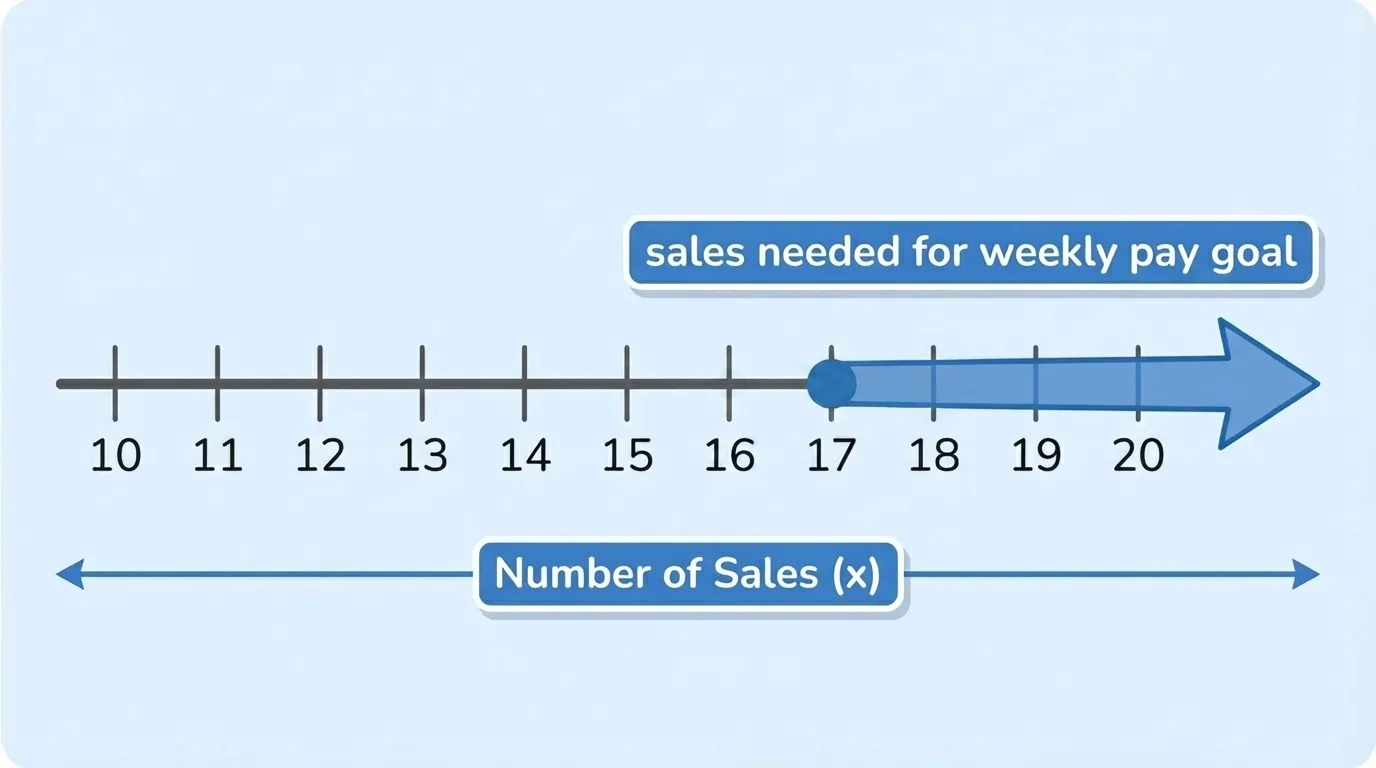
A salesperson earns $50 per week plus $3 per sale. This week the goal is to earn at least $100. Let \(x\) represent the number of sales. The inequality, its solution, and the graph all work together, as [Figure 1] shows later when the number line displays all sales counts that meet the goal.
Worked example 1
Write and solve an inequality for the number of sales needed.
Step 1: Write the expression for total pay.
The salesperson gets $50 no matter what, plus $3 for each sale. So total pay is \(3x + 50\).
Step 2: Choose the correct inequality symbol.
"At least $100" means the pay must be greater than or equal to $100, so
\[3x + 50 \ge 100\]
Step 3: Solve the inequality.
Subtract \(50\) from both sides: \(3x \ge 50\).
Divide both sides by \(3\): \(x \ge \dfrac{50}{3}\).
Step 4: Interpret the result.
Since \(\dfrac{50}{3} = 16\dfrac{2}{3}\), the salesperson cannot make \(16\dfrac{2}{3}\) sales. Sales must be a whole number, so the least possible number of sales is \(17\).
The solution in context is:
\(x \ge 17\)
This is a great example of why context matters. Algebra says \(x \ge \dfrac{50}{3}\), but the real-world situation says sales are counted in whole numbers. So the practical answer begins at \(17\), not at \(16\dfrac{2}{3}\).
Check it: with \(16\) sales, pay is \(\$98\) because \(3(16) + 50 = 98\). With \(17\) sales, pay is \(\$101\) because \(3(17) + 50 = 101\). That confirms that \(17\) is the smallest whole-number solution.
Suppose a student has $4.50 already saved and adds $1.25 each day. The student wants the total savings to stay below $15 before buying a game. Let \(d\) be the number of days.
Worked example 2
Write and solve the inequality.
Step 1: Write the total amount saved.
The student starts with $4.50 and adds $1.25 each day, so the total is \(1.25d + 4.5\).
Step 2: Translate the comparison.
"Stay below $15" means less than $15, so
\[1.25d + 4.5 < 15\]
Step 3: Solve.
Subtract \(4.5\): \(1.25d < 10.5\).
Divide by \(1.25\): \(d < 8.4\).
Step 4: Interpret.
Because days are usually counted by whole numbers, the possible numbers of days are \(0, 1, 2, 3, 4, 5, 6, 7, 8\).
In context, the student can save for at most \(8\) full days and still remain below $15.
Notice something subtle: the algebraic solution is \(d < 8.4\), not \(d \le 8\). But in real life, if \(d\) counts full days, then the whole-number solutions stop at \(8\). Both statements are useful, but they answer slightly different questions.
Not every inequality is about money. Rational numbers also appear in science. Suppose a freezer starts at \(-1.5\) degrees and cools by \(0.8\) degrees each hour. You want the temperature to be less than \(-5.1\) degrees. Let \(h\) be the number of hours.
Worked example 3
Write and solve the inequality.
Step 1: Write the temperature expression.
Each hour, the temperature drops \(0.8\) degrees, so the expression is \(-1.5 - 0.8h\).
Step 2: Write the inequality.
We want the temperature to be less than \(-5.1\), so
\[-1.5 - 0.8h < -5.1\]
Step 3: Solve carefully.
Subtract \(-1.5\) from both sides, or add \(1.5\) to both sides: \(-0.8h < -3.6\).
Now divide by \(-0.8\). Because this is a negative number, the inequality sign reverses: \(h > 4.5\).
Step 4: Interpret.
The freezer must cool for more than \(4.5\) hours to be below \(-5.1\) degrees.
The solution is
\(h > 4.5\)
This example shows the one move students most often forget: dividing by a negative reverses the inequality sign. That one detail changes the answer completely.
Weather reports, sports statistics, and digital sensors often use rational numbers rather than whole numbers. Inequalities help decide whether a measured value is above a safety level, below a speed limit, or within an acceptable range.
Even though many answers in context become whole numbers, the algebra itself can produce fractional boundaries such as \(4.5\) or \(8.4\). Those boundary numbers are important because they show exactly where the solution set begins or ends.
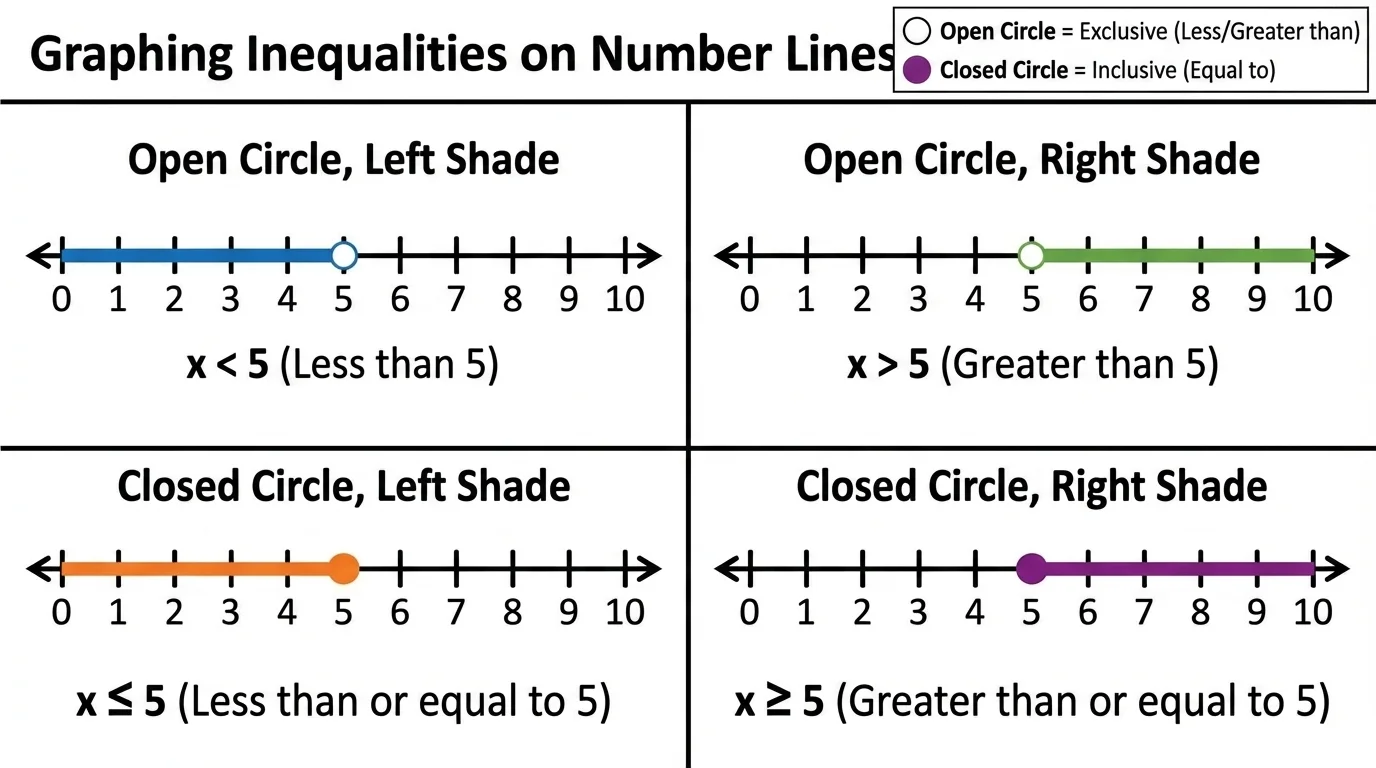
A graph on a number line is one of the clearest ways to show all solutions. As [Figure 2] illustrates, the type of circle and the direction of shading tell you whether the endpoint is included and which values make the inequality true.
Use an open circle when the endpoint is not included, as in \(x > 3\) or \(x < 3\). Use a closed circle when the endpoint is included, as in \(x \ge 3\) or \(x \le 3\).
Shade to the right for greater-than inequalities because the numbers get larger as you move right. Shade to the left for less-than inequalities because the numbers get smaller as you move left.
For the salesperson problem, the graph has a closed circle at \(17\) and shading to the right because all whole numbers greater than or equal to \(17\) work. For the temperature problem, the graph would have an open circle at \(4.5\) and shading to the right because the solution is \(h > 4.5\), not \(h \ge 4.5\).
You can also test a point on the graph. If the inequality is \(x < 8.4\), then \(7\) should satisfy it and belong in the shaded part, while \(9\) should not. Substituting confirms this idea.
Solving the inequality is only part of the job. The final step is to explain what the answer means in the situation. The boundary between an exact algebraic answer and a practical answer becomes especially clear with the jump from \(16\) to \(17\) in a sales problem.
When interpreting a solution, as [Figure 3] shows, ask questions like these: Can the variable be a fraction? Must it be a whole number? Can it be negative? Is there a maximum or minimum that makes sense in real life?
For example, if \(x\) is the number of tickets sold, then \(x = 12.5\) does not make sense. If \(x\) is the number of miles run, then a decimal may make perfect sense. If \(x\) is time, then negative values usually do not make sense.
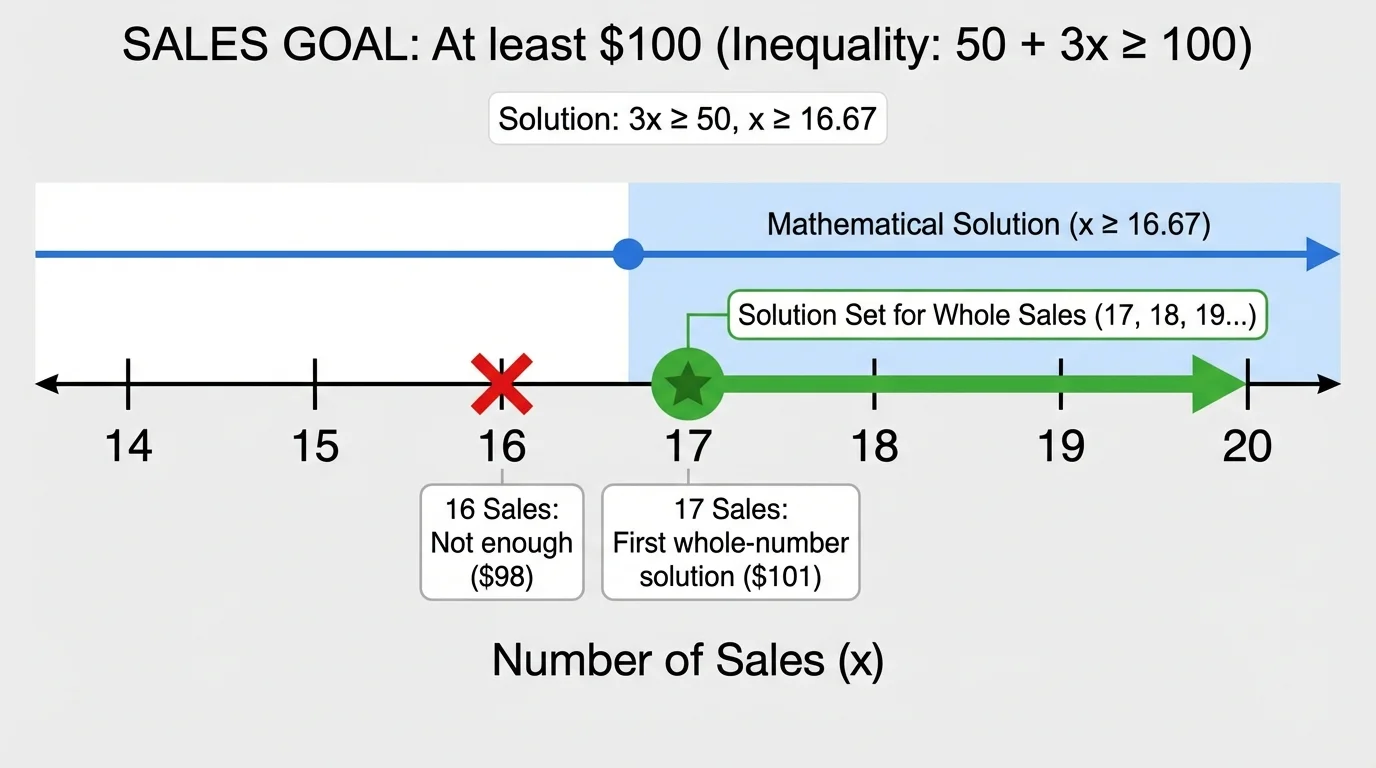
Return to the salesperson problem we saw earlier in [Figure 1]. Algebra gave \(x \ge \dfrac{50}{3}\), but the practical solution became \(x \ge 17\) because sales are counted in whole numbers. That adjustment is not a trick; it is part of understanding the situation correctly.
In the saving-money problem, \(d < 8.4\) means any number less than \(8.4\) works mathematically. But if \(d\) counts complete days, then the practical solution set is the whole numbers from \(0\) through \(8\).
One common mistake is choosing the wrong symbol from the words. "At least" means \(\ge\), not \(>\). "Less than" means \(<\), not \(\le\). Reading these phrases carefully matters.
Another mistake is forgetting to reverse the sign when dividing by a negative number. In the freezer example, dividing \(-0.8h < -3.6\) by \(-0.8\) changes the inequality to \(h > 4.5\), not \(h < 4.5\).
A third mistake is stopping too early. If the variable represents a count, like games, people, or sales, then you often need a whole-number answer. The graph patterns in [Figure 2] help with the inequality itself, but the context decides whether values like \(16.7\) are realistic.
"Algebra gives the boundary; context gives the meaning."
Checking your answer is always smart. Pick a value that should work and substitute it into the original inequality. Then pick a value just outside the solution set and verify that it fails.
Inequalities appear in many situations outside math class. A streaming service might charge a base monthly fee plus a cost for extra features, and you may want the total to stay under a budget. A scientist might compare measured temperatures to a safety threshold. An athlete might need training time above a certain minimum to reach a goal.
Here are a few quick examples:
Each of these follows the same structure: variable, rate, starting amount, comparison symbol, and target value. Once you recognize that structure, word problems become much easier to model and solve.
When you see a word problem leading to an inequality, follow this path: define the variable, write the expression for the quantity, choose the inequality symbol from the words, solve, graph, and interpret in context.
If the answer is a boundary like \(x > 4.5\), think carefully about what kinds of values the variable can take. If the variable counts objects, whole numbers may be required. If the variable measures time, distance, mass, or temperature, fractions and decimals may make sense.
