A country may have vast oil reserves but little freshwater. Another may have fertile soil and strong rivers but depend on imports for energy. A third may control minerals that power smartphones, electric vehicles, and satellites. This uneven pattern is not a small detail of world geography; it helps explain alliances, trade networks, border disputes, military strategies, and even migration. To understand modern global relationships, we have to understand who has access to what, who needs what, and how those needs connect people across great distances.
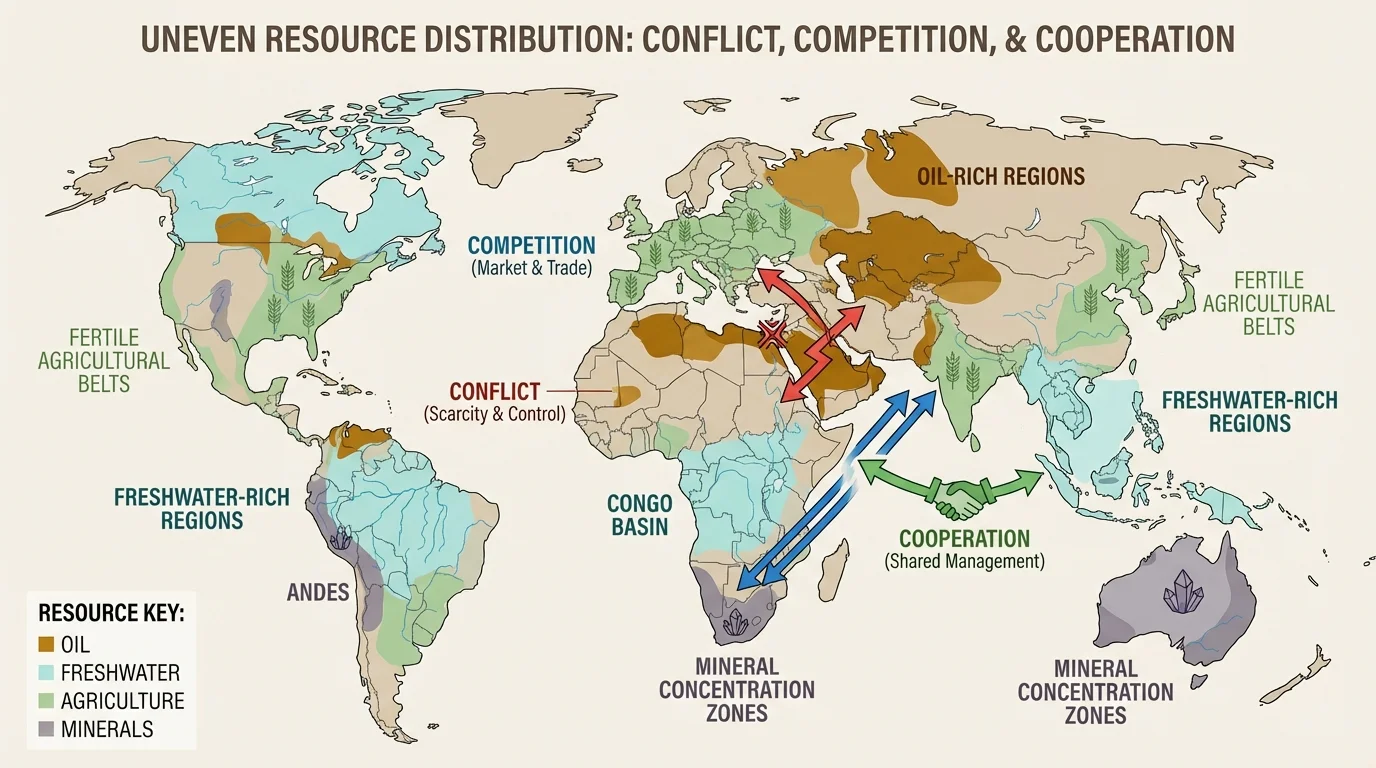
Earth's resources are not spread evenly across space, as [Figure 1] shows through broad global patterns of concentration and scarcity. This is mainly because physical geography differs from place to place. Climate affects water supply, growing seasons, and forests. Geology determines where fossil fuels and valuable minerals form. Rivers, coastlines, mountains, and soils influence transportation, farming, and settlement. Some places are rich in more than one resource, while others must adapt to serious limits.
For example, oil is highly concentrated in a relatively small number of regions, especially in Southwest Asia. Freshwater is abundant in some places, such as Canada and parts of the Amazon Basin, but scarce in many arid and semi-arid regions. Fertile agricultural land is also unevenly distributed, with major grain-producing zones in places such as the North American prairies, the Eurasian steppe, and parts of South Asia. Certain minerals, including cobalt, lithium, and rare earth elements, are concentrated in a small number of countries, which gives those places strategic importance.
Human history also matters. Even when two places have similar natural conditions, their access to resources may differ because of colonization, industrialization, infrastructure, and technology. A region with strong ports, rail systems, and investment can use its resources more effectively than a region with weak transportation or political instability. In that sense, resources are not only natural facts; they are also shaped by power, technology, and decision-making.
Resource distribution refers to the way useful materials, energy sources, water, land, and other assets are spread across different places.
Scarcity means that a resource is limited compared with the demand for it.
Interdependence is a situation in which places rely on one another for resources, goods, markets, or services.
These patterns matter because modern societies require enormous quantities of energy, food, metals, and water. When populations grow and economies expand, pressure on limited resources increases. A region's geographic advantages can become a source of wealth and influence, while its disadvantages can create vulnerability.
A strategic resource is a resource that is especially important for national power, security, or economic strength. Oil is a classic example because transportation, industry, and military systems have long depended on it. Today, lithium, cobalt, copper, and rare earth elements are increasingly strategic because they are essential for batteries, electronics, renewable energy technologies, and advanced manufacturing.
Resources can be grouped in several ways. Natural resources include water, forests, soil, minerals, and fossil fuels. Human resources include labor, skills, and knowledge. Capital resources include machines, roads, pipelines, and ports. A country may lack one category but compensate with another. Japan, for example, has limited domestic fossil fuel resources but developed into a major industrial power through technology, trade, and a highly skilled labor force.
The value of a resource can also change over time. Before the modern energy era, crude oil had much less importance than it does today. In the digital age, materials used in semiconductors, batteries, and communication systems have become more valuable. This means geography and technology are always interacting. A place that seemed peripheral in one century may become highly important in another because the world begins to need what it has.
Sand is one of the most used natural materials on Earth after water, because construction and manufacturing depend on it. Yet not all sand is suitable for building, so even something that seems common can become scarce in the right geographic and economic conditions.
That changing value helps explain why competition is not just about owning land. It is often about controlling access, transport routes, refining capacity, and supply chains. Sometimes the most important advantage is not having the raw material itself, but controlling the processing or shipping of it.
Competition begins when multiple countries, regions, or groups seek access to the same limited resource or trade route. This can happen over farmland, fisheries, freshwater, energy, or mineral deposits. Competition is not always violent. It may appear through trade policy, investment, diplomatic pressure, naval patrols, or efforts to gain influence over another region.
Energy provides a clear example. Countries that import large amounts of oil and natural gas often try to secure stable suppliers and transport routes. That can lead to alliances, overseas investment, or political involvement in producing regions. At the same time, resource-exporting countries may use their supplies as leverage. If one side depends heavily on the other, access to the resource becomes a source of power.
Competition also appears in the oceans. Fishing grounds are important resources, especially where large populations depend on seafood for jobs and food. Disputes in the South China Sea involve more than shipping lanes and territory; they also involve fisheries and possible offshore oil and gas reserves. As fish populations shift because of warming waters and overfishing, competition can intensify.
Another form of competition involves land and agricultural production. Countries concerned about food security may invest in farmland abroad, especially in regions where land and water seem more available. Supporters view this as development and investment, while critics argue it can displace local farmers or reduce local control over essential resources.
| Resource | Why It Matters | Common Forms of Competition |
|---|---|---|
| Oil and natural gas | Energy, industry, transportation | Pipeline routes, export markets, political influence |
| Freshwater | Drinking, irrigation, electricity | Dams, river use, groundwater extraction |
| Fertile land | Food production | Land purchases, border disputes, settlement pressure |
| Critical minerals | Electronics, batteries, defense technology | Mining rights, processing control, supply-chain security |
| Fisheries | Food and employment | Maritime boundaries, overfishing, patrols at sea |
Table 1. Major resource types and the forms of competition they often produce.
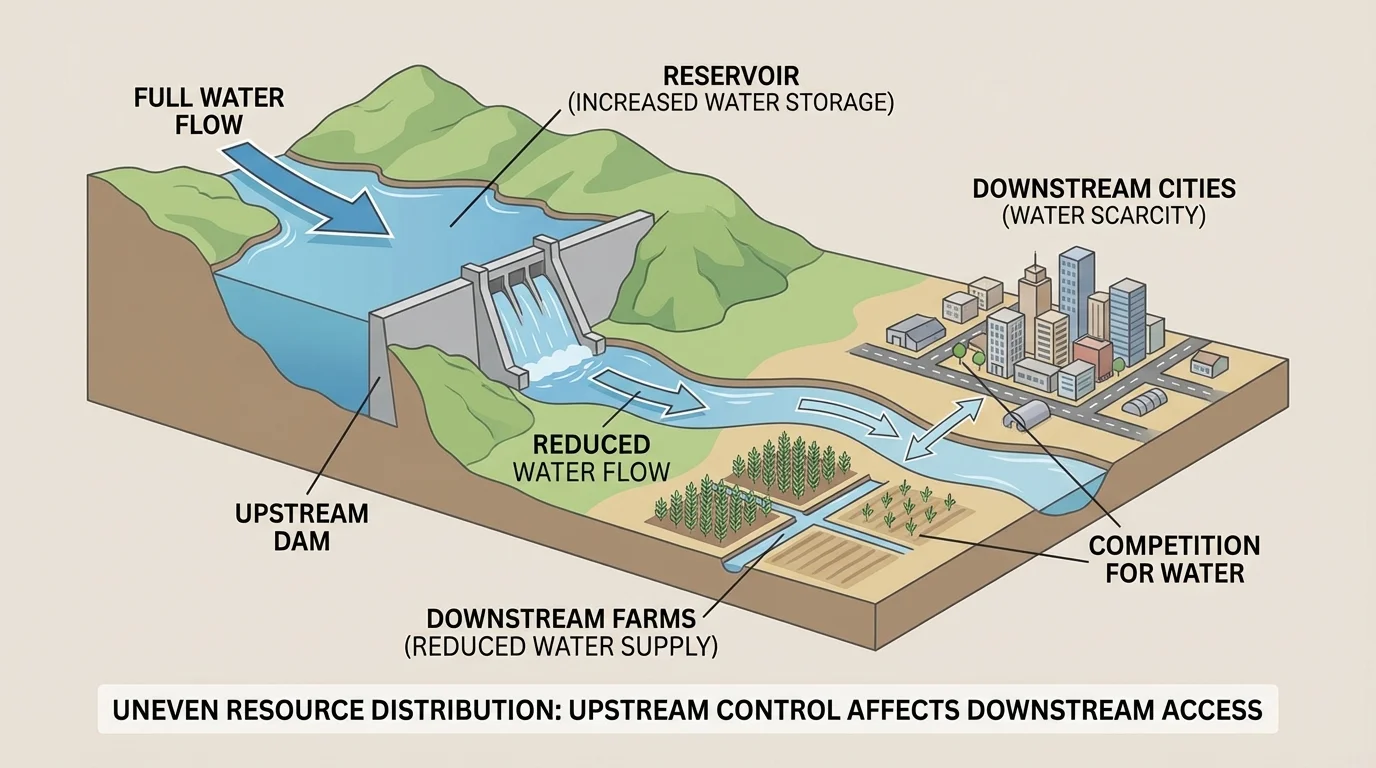
Not every resource shortage leads to war, but resource stress can increase the risk of conflict, especially where governments are weak, populations are growing, or political tensions already exist. Shared water systems are one major example, and [Figure 2] illustrates why upstream and downstream users often see the same river very differently. If one country builds dams upstream, it may gain hydroelectric power and irrigation, while downstream countries worry about reduced water flow for farms and cities.
The Nile River shows how this works. Ethiopia's construction of the Grand Ethiopian Renaissance Dam has been linked to tensions with Egypt and Sudan. Ethiopia sees the dam as essential for development and electricity. Egypt, which depends heavily on Nile water, fears a reduction in supply. The issue is not only the river itself; it is the unequal ability of states to shape water flow, timing, and access.
Similar concerns appear in the Indus River Basin, shared mainly by India and Pakistan. Because agriculture depends on the river system, any change in water management can raise political anxiety. Geography creates the connection, but history and national identity make the stakes even higher.
Oil has also been linked to conflict. In some cases, states have fought partly over territory believed to contain oil or to control routes that move oil to world markets. In other cases, valuable resources inside a country have fueled internal conflict. Armed groups may fight to control mines, wells, or export revenues. This is sometimes called the resource curse: a situation in which resource wealth does not bring broad prosperity, but instead contributes to corruption, inequality, and instability.
How resources can turn stress into conflict
Resources rarely cause conflict by themselves. More often, they interact with other pressures: unequal political power, poverty, ethnic divisions, weak institutions, climate stress, and historical grievances. A drought in a well-governed region may lead to conservation measures and negotiated solutions. The same drought in a fragile state may contribute to migration, unrest, or violence.
Climate change can intensify these risks. Hotter temperatures and changing rainfall can reduce crop yields, dry out grazing lands, and shrink water supplies. When pastoral groups and farming communities are pushed into the same space, competition may increase. In this way, environmental change can act as a threat multiplier, worsening existing tensions rather than creating entirely new ones.
The Sahel region of Africa offers an important example. In parts of this semi-arid belt, communities already face pressure from desertification, water scarcity, and fast population growth. Where governments struggle to provide security and fair access to land, these pressures can feed local conflict and displacement. The issue is geographic, but its effects are political and cultural as well.
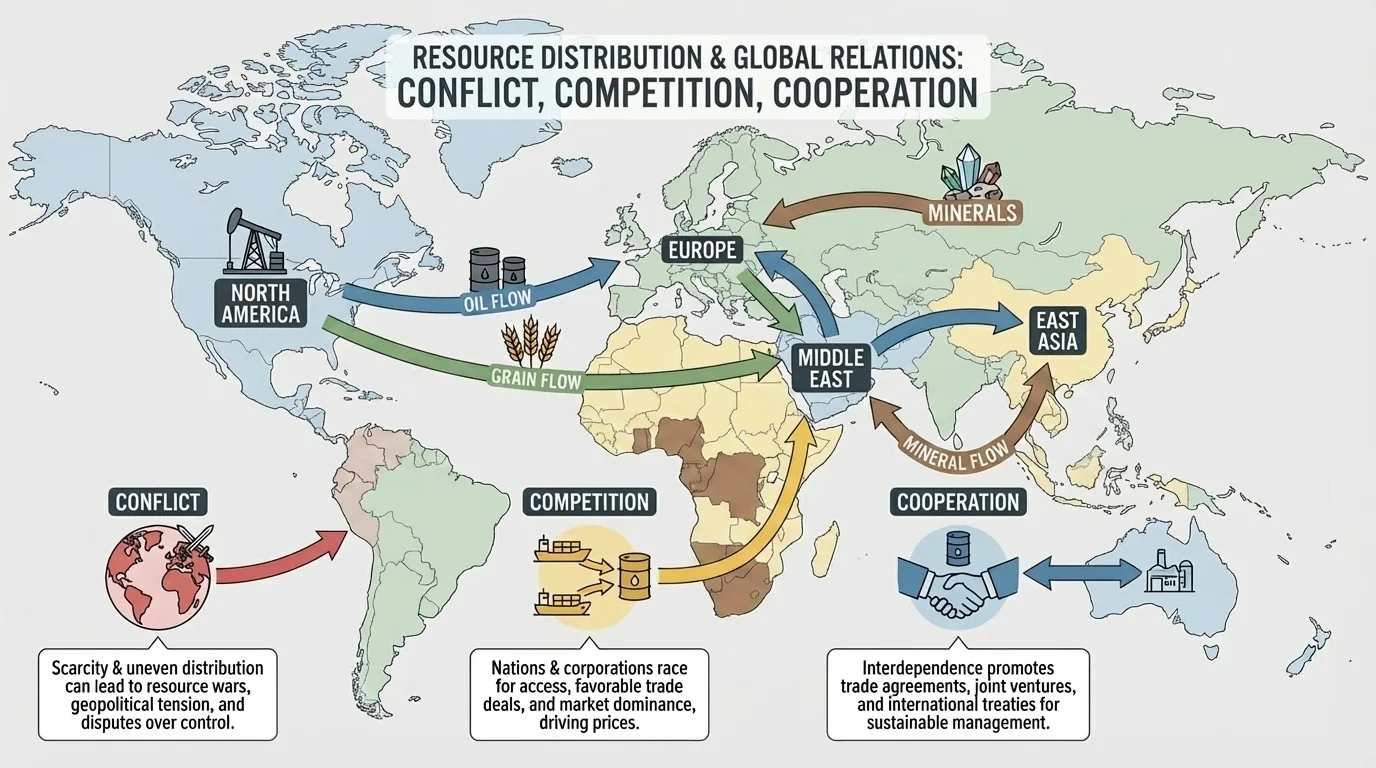
Uneven distribution does not only create rivalry. It also creates cooperation, because no country is fully self-sufficient in everything it needs. As [Figure 3] makes clear, global trade links resource-rich regions with manufacturing centers and consumer markets. A country with abundant energy may export fuel and import machinery. A country with advanced industry may import raw materials and export high-value products. This exchange is one foundation of the modern world economy.
Europe's energy relationships show both the benefits and risks of interdependence. For many years, several European countries imported large amounts of natural gas from Russia. This arrangement supported industry and heating, but it also created political vulnerability when relations worsened. In response, European countries expanded liquefied natural gas imports, renewable energy investment, and alternative pipeline connections. Cooperation remained necessary, but diversification became a security strategy.
Shared rivers can also encourage cooperation. The same geography that creates tension can push countries toward treaties, data sharing, and joint management. River basin agreements may set rules for dam construction, water release, irrigation timing, or flood control. These arrangements are rarely simple, but they can reduce uncertainty and prevent crises.
Regional organizations often grow out of this logic. The European Union began partly from the idea that linking key economic resources would make future conflict less likely. When countries depend on one another for coal, steel, markets, labor, and energy, war becomes more costly and cooperation more practical.
International cooperation is also common in science and environmental management. Countries share weather data, ocean research, and satellite information because storms, droughts, fisheries, and pollution do not stop at borders. Geographic interconnection means that managing resources often requires information networks as well as physical ones.
Case study: Cooperation over the Mekong River
The Mekong River flows through multiple countries in Southeast Asia, making it a shared resource for fishing, farming, transportation, and electricity.
Step 1: Identify the shared geographic system.
Countries along the river depend on the same flowing water, even though they use it in different ways.
Step 2: Identify the source of tension.
Hydroelectric dams, irrigation withdrawals, and changing rainfall can alter water levels and fish habitats.
Step 3: Identify the cooperative response.
Regional institutions and negotiations help countries share information, discuss development plans, and reduce misunderstandings.
This does not remove every disagreement, but it shows how common dependence can push states toward ongoing dialogue.
Trade itself is a kind of geographic problem-solving. Countries use exchange to overcome limits in climate, geology, and location. The fact that this system sometimes breaks down does not make it less important; it shows how vital stable cooperation is to everyday life.
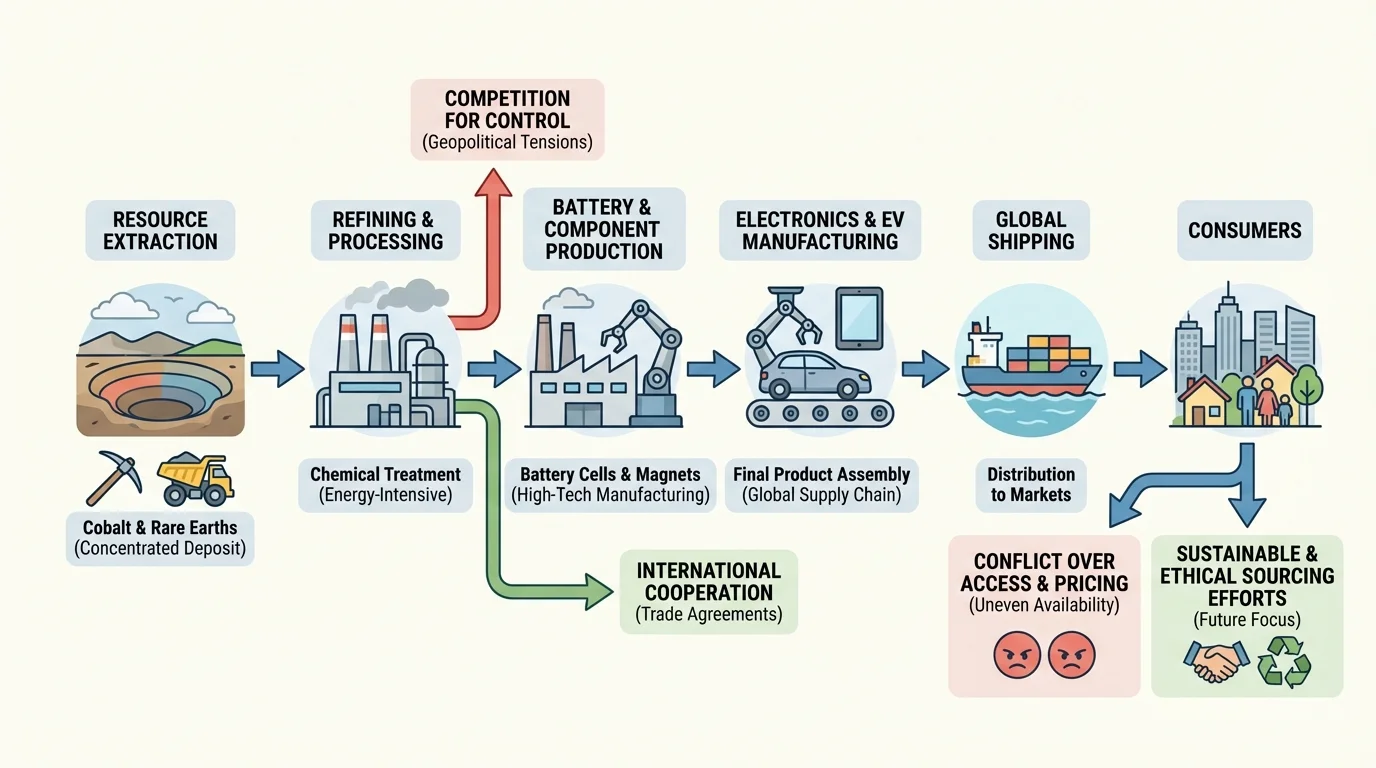
One smartphone contains materials and components connected to many places. Copper may come from Chile or Peru, cobalt from the Democratic Republic of the Congo, lithium from South America or Australia, rare-earth processing from China, chip manufacturing from East Asia, and consumers from nearly everywhere. This long chain of production, as [Figure 4] illustrates, shows how resource geography and industrial geography are deeply intertwined.
China plays a major role in the processing of many critical minerals and rare earth elements. This does not always mean it has the largest raw deposits of every material, but it has built strong refining and manufacturing capacity. As a result, many countries are trying to diversify supply chains so they are not overly dependent on a single state for strategically important materials.
The Democratic Republic of the Congo is central to cobalt supply, a mineral used in many battery technologies. However, the presence of a valuable resource does not automatically bring broad development. Weak governance, labor exploitation, and conflict can prevent local populations from benefiting fairly. This is another reminder that geography creates opportunities, but political systems shape outcomes.
Southwest Asia remains one of the clearest examples of strategic resource concentration because of its oil and gas reserves. These resources have generated wealth, foreign investment, and geopolitical influence. They have also drawn outside powers into the region and heightened the global importance of stability there.
The Arctic is becoming more significant as warming reduces sea ice. New shipping routes, fisheries access, and possible energy and mineral extraction have increased interest from surrounding states such as Russia, Canada, the United States, Norway, and Denmark through Greenland. This is a good example of how changing physical geography can reshape political geography.
Food is another major case. Ukraine's fertile soils and large grain exports affect food prices and food security far beyond Europe. When war disrupts production or shipping, countries in North Africa and Southwest Asia may face shortages or rising costs. A local conflict can therefore produce global consequences through interconnected resource systems.
Remember that geographic patterns operate at more than one scale. A resource issue may begin locally, such as a drought in one river basin, but its effects can spread nationally, regionally, and globally through migration, trade, and political alliances.
The same interconnection applies to energy transitions. As countries try to reduce carbon emissions, demand for some fossil fuels may eventually change, while demand for metals used in batteries, electric grids, and renewable technologies may rise. This could shift the map of strategic importance in the coming decades.
Resource issues are not only about states. They also affect cultural groups, indigenous peoples, pastoral communities, farmers, and urban populations in different ways. A government may approve mining or dam construction because it sees national economic benefits, while local communities may face displacement, pollution, or loss of sacred land. The conflict then becomes not just economic, but cultural and political.
Control over resources can shape identity and autonomy. Indigenous communities in the Amazon, North America, and Australia have often challenged projects that threaten forests, rivers, or ancestral territory. Their arguments are not simply about ownership in a legal sense; they are about ways of life, historical rights, and relationships with the land.
Power matters at every scale. Wealthier states can often import scarce resources, invest in new technology, or build desalination systems. Poorer states may have fewer options. Within countries, wealthy urban areas may secure water and electricity more easily than rural or marginalized communities. Uneven distribution is therefore not just global; it exists within nations and regions too.
"Geography is not destiny, but it sets the stage on which human choices are made."
That stage includes perceptions. If a group believes another group is taking an unfair share of land, water, or revenue, tensions can grow even when the resource itself has not disappeared. Fair institutions, transparency, and participation are therefore crucial to preventing disputes from becoming violent.
Reducing resource conflict does not require making every country identical. That is impossible. Instead, it involves managing interdependence more fairly and sustainably. One important strategy is sustainability, which means using resources in ways that meet present needs without destroying the ability of future generations to meet theirs. Sustainable management includes conserving water, protecting soil, limiting pollution, and preventing overfishing.
Diversification is another strategy. Countries that rely too heavily on one export or one supplier are more vulnerable to shocks. Building a wider range of energy sources, trade partners, and industries can reduce risk. Technological innovation also matters. Desalination, drip irrigation, recycling of metals, and renewable energy can ease pressure on some scarce resources, though these solutions also require investment and careful environmental management.
Good governance may be the most important factor. Where rules are clear, revenues are transparent, and benefits are shared more fairly, societies are more likely to turn natural wealth into development. Where corruption is widespread, resource abundance can intensify inequality and resentment.
International law, treaties, and diplomacy remain essential because many major resources cross borders or move through global networks. No country can solve ocean depletion, climate stress, or supply-chain vulnerability alone. The interconnected nature of the world means that cooperation is not optional; it is built into the geography of modern life.
