Some of the strongest teams fail for a simple reason: the people on them do not actually understand one another. A group can have talent, ideas, and motivation, but if members ignore differences in communication style, values, or expectations, even basic tasks can turn frustrating. In online school, part-time jobs, gaming teams, volunteer projects, and community groups, you will keep working with people whose backgrounds are different from yours. Knowing how to handle that well is not just "being nice." It is a real-life skill that affects trust, productivity, opportunities, and relationships.
When cultural awareness and respect are present, collaboration usually becomes smoother. People feel safer sharing ideas, asking questions, and solving problems together. When they are missing, small issues can grow into conflict fast. A joke lands badly. Someone feels ignored on a video call. A teammate assumes another person is rude, lazy, or uninterested, when the real issue is a difference in style or expectation. Learning to notice these patterns helps you avoid unnecessary drama and become someone others want to work with.
Your world is already diverse, even if you spend much of your school time at home. You might join a virtual club with students from different regions, work a shift with coworkers from different countries, collaborate on social media content with people of different ages, or volunteer in a local organization serving families with different languages and traditions. In each setting, collaboration depends on more than completing tasks. It depends on whether people feel seen, heard, and respected.
Respect also has practical consequences. If you develop a reputation for being easy to work with across differences, people trust you with more responsibility. You are more likely to be included in projects, leadership roles, internships, and jobs. On the other hand, if you often dismiss others, make assumptions, or refuse to adapt, people may avoid working with you even if you are skilled. Talent matters, but teamwork matters too.
Many employers prioritize communication, adaptability, and teamwork as top skills they seek because technical ability is far less useful when people cannot cooperate effectively across different backgrounds and perspectives.
That is why cultural awareness is not an extra topic off to the side. It is part of how you function in real life. It helps you make better decisions, respond with empathy, and contribute to a stronger community.
Cultural awareness means recognizing that people's backgrounds can shape how they communicate, interpret behavior, solve problems, and build relationships. Culture can include nationality, ethnicity, religion, language, family traditions, region, age, disability culture, gender identity, and community norms. It does not mean every person from a group acts the same way. It means background can influence expectations, and wise collaborators pay attention to that.
Respect means treating people as fully worthy of dignity, even when their habits, opinions, or customs differ from yours. Respect is not the same as agreeing with everything someone says. It means you do not mock, dismiss, or devalue them. In collaboration, respect shows up in your actions: how you listen, how you speak, whose ideas you include, and how you respond when differences appear.
Cultural awareness is the ability to notice and understand that people may have different norms, values, communication styles, and experiences based on their backgrounds.
Respect is showing care for another person's dignity through your words, tone, choices, and behavior.
Collaboration is working with other people toward a shared goal in a way that allows everyone to contribute.
A helpful way to think about this is simple: awareness helps you notice, and respect helps you respond well. You might notice that someone pauses before answering, prefers formal language, or avoids interrupting others. Respect means you do not instantly label that behavior as awkward, cold, or weak. Instead, you stay curious and adjust your approach.
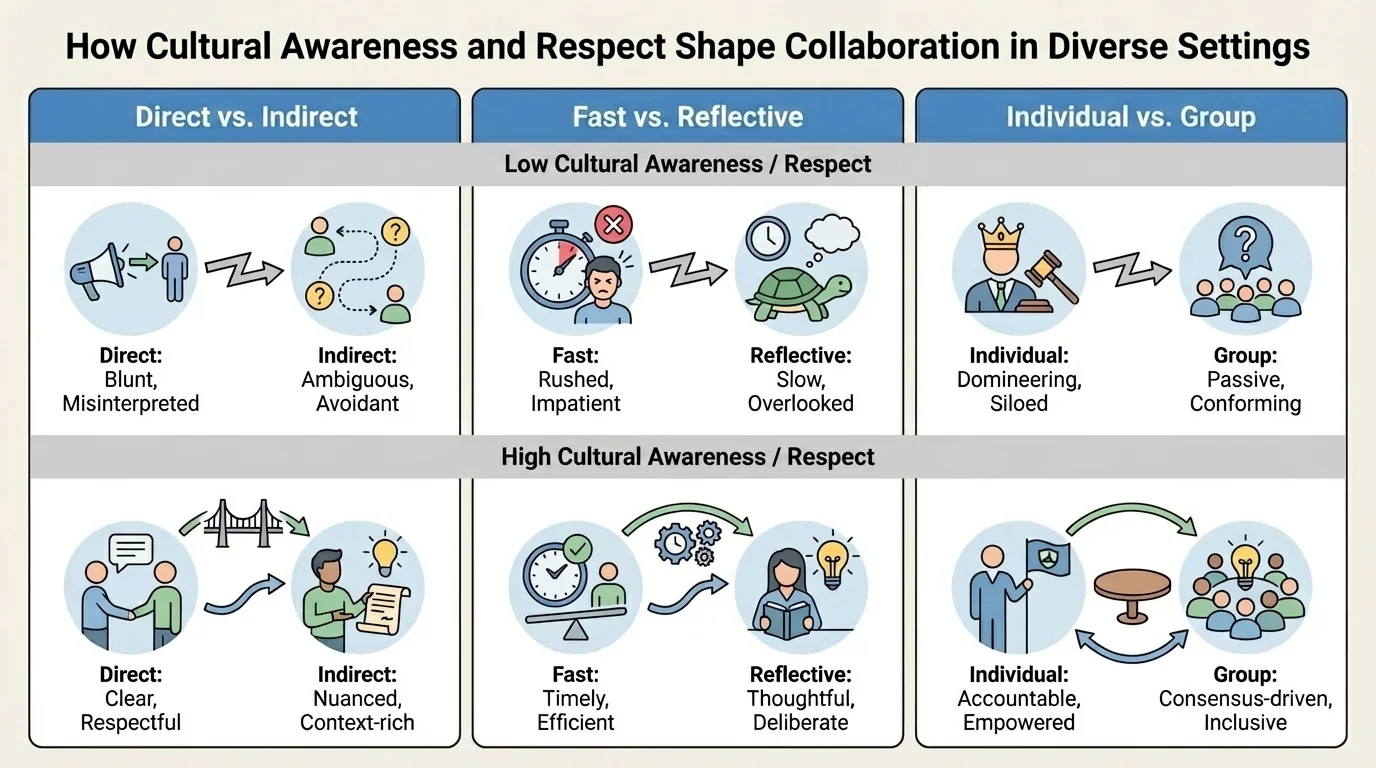
Culture affects teamwork in ways that are easy to miss at first. Different groups may have different ideas about what counts as polite, confident, efficient, or trustworthy. As [Figure 1] shows, collaboration patterns can vary in communication style, response timing, and decision-making preferences. One person may be comfortable speaking directly and quickly on a call, while another prefers to think before responding and chooses words carefully. Neither style is automatically better; they simply create different expectations.
Culture can also affect how people view time, leadership, disagreement, humor, privacy, and group roles. Some people see fast replies as respectful, while others do not treat instant responses as necessary. Some view open disagreement as healthy honesty, while others see it as embarrassing or disrespectful in a group. Some are comfortable using first names with adults or supervisors, while others prefer titles and formality. If you do not realize these differences exist, you may judge people unfairly.
Language differences matter too. A person may be fluent in English but still process certain phrases, slang, sarcasm, or fast speech differently. In online spaces, this can lead to confusion when messages are short, full of abbreviations, or written with a tone that is hard to read. If someone seems quiet or cautious, the issue may not be confidence. They may be translating, processing, or trying to avoid saying the wrong thing.
Even basic collaboration habits can be shaped by culture. For example, one teammate may think interrupting means enthusiasm, while another experiences it as disrespect. One person may value individual initiative, while another expects more group consultation before decisions. The point is not to memorize stereotypes about groups. The point is to realize that your "normal" is not universal.
| Area of collaboration | Possible difference | Respectful response |
|---|---|---|
| Communication | Direct or indirect style | Clarify meaning instead of assuming tone |
| Response time | Quick replies or slower, thoughtful replies | Set shared expectations for deadlines and check-ins |
| Decision-making | Independent or group-centered | Ask how the team wants to make decisions |
| Conflict | Open debate or private discussion | Choose a method that protects dignity and clarity |
| Formality | Casual or formal language | Match the setting and ask preferences if unsure |
Table 1. Examples of how cultural differences may appear during collaboration and how to respond respectfully.
One major barrier is assumption. This happens when you decide what someone means without checking. If a teammate keeps their camera off, answers briefly, or misses a social cue, it is easy to invent a story: "They do not care," "They are rude," or "They think they are better than us." Sometimes the real explanation is different: limited bandwidth, family responsibilities, anxiety, language processing, or a different norm around online interaction.
Another barrier is stereotype. A stereotype is an oversimplified belief about a group. Stereotypes can seem harmless when they are framed as jokes or "general truths," but they reduce people to assumptions. That damages trust. It can also make people feel they must prove they belong, which increases stress and reduces participation.
Why trust breaks so fast
People collaborate best when they believe their ideas will be heard fairly and that their identity will not be used against them. Even one mocking comment, dismissive joke, or repeated interruption can signal, "You are not fully respected here." Once that happens, people may withdraw, contribute less, or protect themselves instead of focusing on the shared goal.
Ethnocentrism is another problem. It means judging other cultures by the standards of your own and assuming your way is the correct or normal one. This mindset can make you reject unfamiliar practices before understanding them. It often sounds like, "Why would anyone do it that way?" A better question is, "What value or logic might be behind that approach?"
There are also subtle harms called microaggressions. These are comments or actions that communicate disrespect or bias, often in everyday ways. Examples include repeatedly mispronouncing someone's name after they correct you, acting surprised that a person "speaks good English," or treating one person as the spokesperson for an entire group. A single moment may seem small to the person who says it, but repeated experiences can make someone feel unwelcome.
Sometimes people try to include others in a shallow way called tokenism. That is when someone is included mainly for appearance rather than meaningful participation. For example, inviting one person from an underrepresented background into a planning group but ignoring their ideas is not real inclusion. Respect means making room for contribution, not just visibility.
[Figure 2] You do not need perfect knowledge of every culture to collaborate well. You need a strong process. A useful approach is to pause, notice, ask, listen, adjust, and repair when needed. This helps you stay curious instead of defensive and makes misunderstandings easier to fix before they become bigger problems.
Start by observing without judging. Notice what is happening before attaching a label to it. Instead of thinking, "They are being rude," try, "Their style is more direct than I expected," or, "They have not spoken much yet." This small shift keeps you open and reduces emotional reactions.
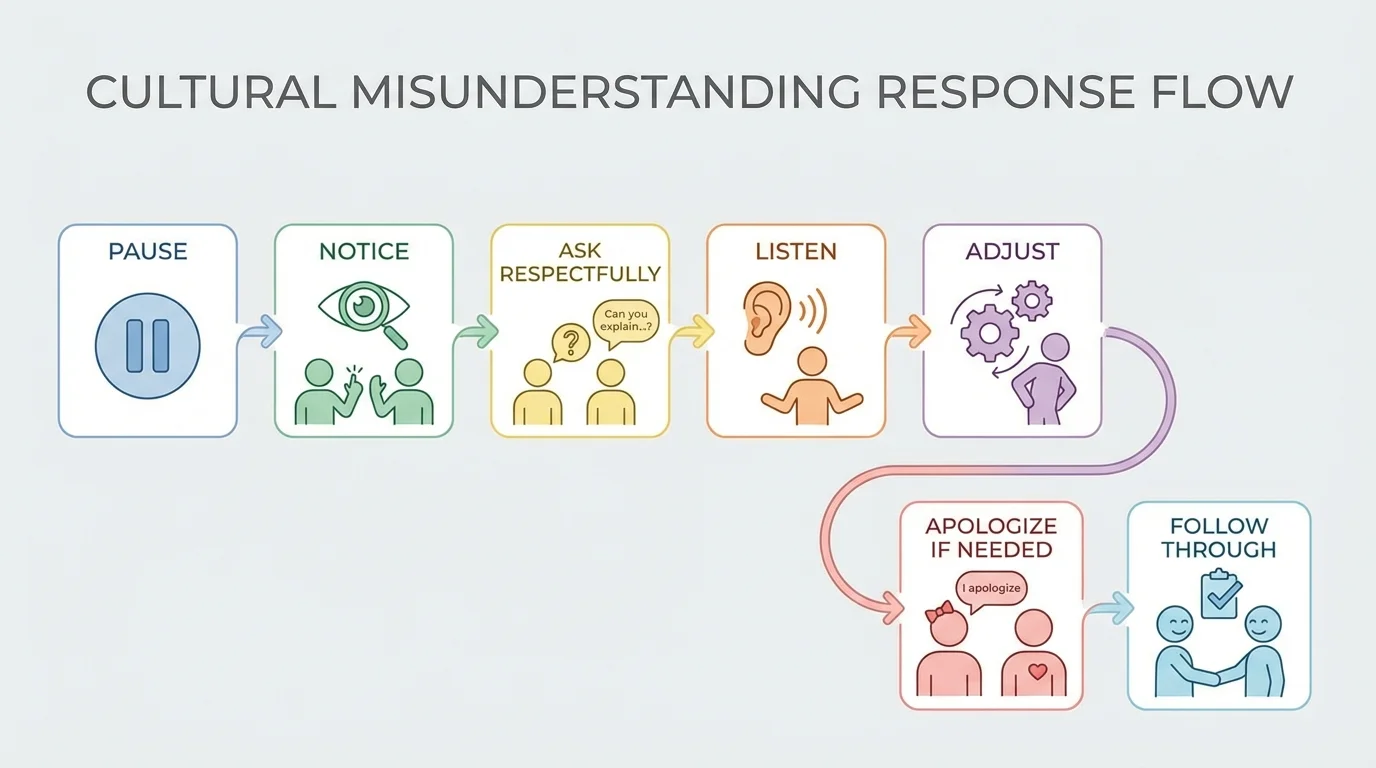
Ask respectful questions. If you are confused, ask in a way that invites explanation rather than demanding justification. You might say, "What is the best way for us to make decisions as a group?" or "Do you prefer feedback in the group chat or in a private message?" Questions like these show maturity because they focus on working well together.
Listen for meaning, not just words. Good listening includes tone, pace, and context. If someone says very little, that does not always mean they have little to contribute. You may need to create more space by slowing the conversation, avoiding interruption, or inviting input directly and politely.
Use inclusive language. Avoid slang, inside jokes, or references that only some people understand when clarity matters. Explain acronyms. Keep written instructions specific. If a meeting or call includes people with different language backgrounds or accessibility needs, offer captions, shared notes, or follow-up messages. These choices communicate respect through action.
Adapt without losing yourself. Respect does not mean pretending to be someone else. It means adjusting your behavior enough to collaborate effectively. If you are naturally blunt, you can still be honest while softening your delivery. If you are quiet, you can still contribute by preparing comments in advance or using the chat. Flexibility is a strength, not fake behavior.
Example: turning a mistake into trust
You joke about someone's accent during a group call, and the room goes quiet. You realize you crossed a line.
Step 1: Stop defending yourself.
Do not say, "It was just a joke," or "You are too sensitive." That shifts the focus away from the impact.
Step 2: Acknowledge the harm clearly.
Say something like, "I should not have said that. It was disrespectful."
Step 3: Apologize without making it about you.
Keep it brief and sincere: "I'm sorry."
Step 4: Change your behavior.
Correcting yourself matters more than sounding perfect. Learn from the moment and avoid repeating it.
This kind of repair often rebuilds more trust than pretending nothing happened.
Knowing how to repair mistakes is essential because everyone gets something wrong sometimes. What matters is whether you respond with humility. This process works especially well when emotions are rising, because it gives you a structure instead of relying on impulse.
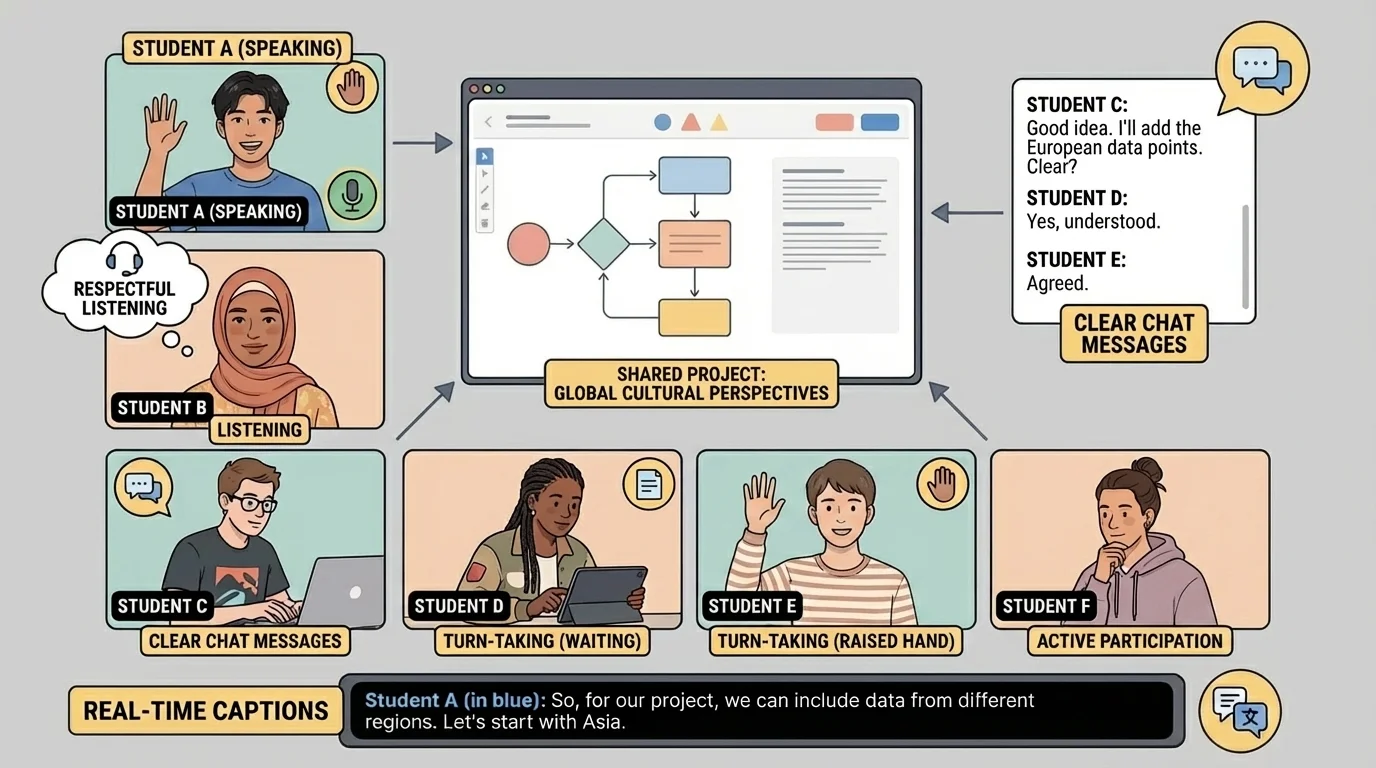
These skills matter most when they show up in real situations. In collaborative online spaces, as [Figure 3] illustrates, respectful teams make room for different communication needs through clear turn-taking, readable messages, and thoughtful listening. The goal is not to remove all differences. The goal is to prevent differences from turning into unfairness or confusion.
Online group work: You are on a shared project and one student rarely speaks during video meetings but writes thoughtful comments in the document later. Instead of assuming they are disengaged, adjust the team process. Share questions ahead of time. Use both live discussion and written feedback. This allows more than one communication style to succeed.
Gaming team or esports group: A teammate from another country communicates more formally and does not respond well to trash talk, even when others think it is harmless. A respectful team notices that the "fun" style is not fun for everyone. You can keep the energy high without normalizing comments that make people feel targeted or out of place.
Part-time job: A coworker avoids eye contact and speaks quietly with customers. If you instantly read that as poor attitude, you may misjudge them. They may come from a culture where strong eye contact with authority figures is less common, or they may simply have a different interaction style. Good collaboration means focusing on whether the job is getting done well and helping with clarity instead of rushing to criticism.
Volunteer event: You are helping organize a community drive. Some families are comfortable speaking openly in a large group; others prefer private conversation. If organizers only use one style, some people may be left out. Cultural awareness helps you offer multiple ways to participate and ask questions.
Social media collaboration: You are making content with others and want broad participation. Be careful with trends, audio, or jokes that rely on stereotypes. Something that gets clicks can still be disrespectful. Respect means thinking beyond your own audience reaction and considering the people represented in the content.
Conflict does not always mean collaboration is failing. Sometimes it means important differences are finally becoming visible. The key is how you handle them. If you react with blame, sarcasm, or shutdown, trust drops. If you stay calm and curious, conflict can actually improve teamwork.
Step 1: Slow down. If a message or comment upsets you, do not answer immediately in anger. Re-read it. Consider at least two possible interpretations before responding.
Step 2: Name the issue clearly. Say what happened without exaggerating. "I noticed my idea was skipped over twice," is clearer than, "You never listen to me."
Step 3: Ask for perspective. "Can you tell me what you meant?" or "How did you see that situation?" creates room for understanding.
Step 4: Focus on impact and next steps. Even if harm was unintentional, the impact still matters. A strong response sounds like, "I see why that came across badly. Next time, I'll phrase it differently and check in first."
Step 5: Agree on a better process. Maybe the group needs clearer speaking turns, translation support, written agendas, private feedback options, or shared norms for respectful chat behavior.
"Seek first to understand, then to be understood."
— Stephen R. Covey
This idea matters in diverse settings because understanding usually comes before influence. If people feel dismissed, they stop listening. If they feel respected, they are more likely to collaborate honestly. That does not erase disagreement, but it makes disagreement more productive.
Strong collaboration is not a one-time performance. It is a set of habits. One habit is empathy, which means trying to understand another person's experience and point of view. Empathy does not require you to have lived the same life. It requires effort, attention, and willingness to care about impact.
Another habit is self-reflection. Ask yourself questions such as: What do I assume is "normal"? When do I become impatient with differences? Do I interrupt certain people more than others? Do I treat names, pronouns, and personal boundaries with care? Honest reflection helps you catch patterns before they harm others.
You already use self-management and communication skills in many parts of life. Cultural awareness adds another layer: it helps you choose those skills in ways that fit the people and setting around you, not just your own preferences.
Inclusive language is another long-term habit worth building. This means choosing words that avoid unnecessary exclusion or disrespect. It includes using the names and pronouns people ask you to use, avoiding group labels people have not chosen for themselves, and speaking in ways that leave room for more than one kind of experience.
It also helps to become an ally. An ally notices when someone is being ignored, stereotyped, or disrespected and takes appropriate action. That could mean redirecting a conversation, making space for a quieter person's idea, correcting a harmful joke, or privately supporting someone who was excluded. Being an ally is not about showing off your values. It is about using your position to improve the group climate.
Over time, these habits shape your reputation. People remember who listens, who learns, and who adjusts. They also remember who mocks differences, who dominates every conversation, and who makes others feel small. Cultural awareness and respect are not about being perfect. They are about becoming trustworthy.
