One of the fastest ways to create stress in your life is to make big choices with no system. That can look like turning in rushed work because you guessed wrong about priorities, clicking a sketchy link because it seemed urgent, or sending a message while angry and then dealing with the fallout for days. Strong decision-making is not about always knowing the perfect answer. It is about using tools that help you slow down, think clearly, and choose on purpose.
Every day, you make choices about time, trust, effort, privacy, and relationships. Some decisions seem small, but they can build into bigger results. Choosing to ignore a deadline reminder may affect your grade. Choosing to repost something without checking it may damage your credibility. Choosing to stay silent when a friend crosses a boundary may lead to repeated stress. Good decision tools help you protect what matters: your goals, your safety, your reputation, and your peace of mind.
When a decision goes well, the result is often boring in the best way: less drama, fewer regrets, and more control. When a decision goes badly, the effects can spread. A weak academic choice can create more work. A weak digital choice can expose private information. A weak social choice can hurt trust. That is why decision tools are practical life skills, not just "thinking skills."
Decision-making is the process of choosing between options. Critical thinking means examining information carefully instead of accepting it automatically. Problem solving means finding a workable solution to a challenge by using reason, evidence, and judgment.
Complex situations are harder because there is not always one obvious right answer. You may have competing goals, limited time, incomplete information, and strong emotions at the same time.
A complex decision usually has more than one good or bad outcome to consider. It may involve trade-offs. For example, if you are deciding whether to take on a volunteer commitment, you might gain experience and help others, but also lose study time and increase stress. Complexity does not always mean the choice is huge. It means the choice has layers.
Here are common signs that a situation is complex:
If you notice two or more of these signs, that is your clue to stop guessing and use a tool.
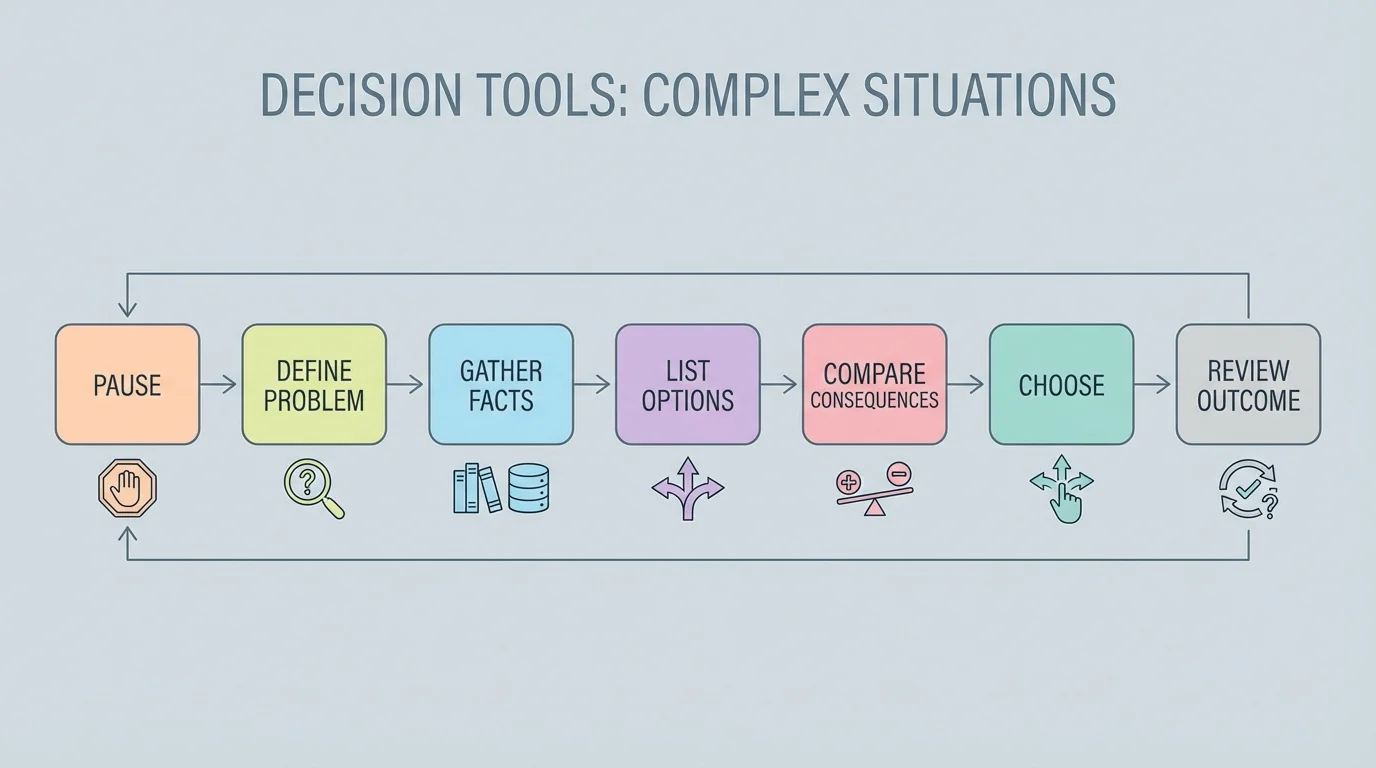
A dependable decision process reduces confusion, as [Figure 1] shows. Instead of asking, "What do I feel like doing right now?" ask, "What are the steps to make a smart choice here?"
Step 1: Pause. If possible, do not decide in the first burst of emotion. A short pause can keep you from turning a problem into a larger one.
Step 2: Define the real decision. Be specific. "What should I do?" is too vague. "Should I spend tonight finishing my project or split the work between tonight and tomorrow morning?" is clearer.
Step 3: Gather facts. What do you actually know? What are you assuming? What information is missing?
Step 4: List your options. Most people think there are only two choices when there may be three or four. Sometimes the best option is a middle path or a delayed response.
Step 5: Compare consequences. Look at short-term and long-term effects, risks, benefits, and who is affected.
Step 6: Choose and act. Pick the option that best fits your goals, values, and limits.
Step 7: Review the result. Ask what worked, what did not, and what you would do differently next time.
This process matters because pressure pushes people toward shortcuts. You may rely on whatever feels easiest, fastest, or most emotionally satisfying. But fast relief is not always the same as a good outcome. The review step is especially important because it turns experience into skill.
The best decision is not always the easiest one. A strong decision often balances what you want now with what you want later. If a choice protects your future goals, safety, honesty, or relationships, it may feel harder in the moment but still be the wiser option.
To make this process easier, you can use specific tools inside it.
A decision filter is a quick set of standards you use before saying yes. Think of it as a screen that catches bad options early. Your filters should reflect your values and your real limits.
Useful filters for teens often include these questions:
Your non-negotiables are the lines you do not cross. For example: "I do not share passwords," "I do not use someone else's work as my own," or "I do not stay in online conversations that become threatening or manipulative." These rules save energy because they remove certain options before you waste time debating them.
Try This: Write down three non-negotiables for academic choices, three for digital choices, and three for social choices. Keep them simple and realistic.
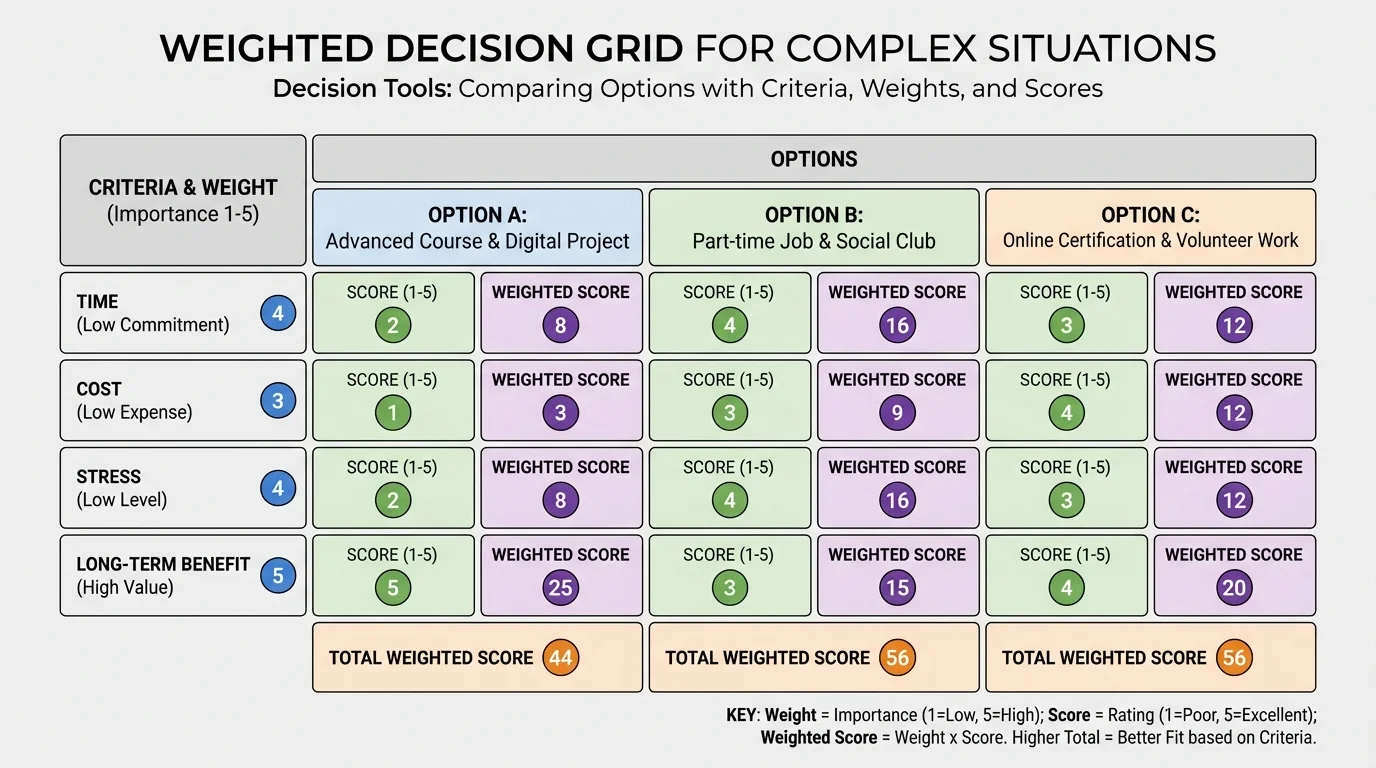
Some decisions need more than a quick filter. A weighted decision grid helps when several options each have strengths and weaknesses. [Figure 2] illustrates how a grid turns a messy decision into something easier to compare.
Start by listing the options. Then choose the criteria that matter most. For example, you might compare options based on time, stress, cost, learning value, and long-term benefit. Give each criterion a weight from low importance to high importance. One simple scale is from \(1\) to \(3\), where \(1\) means "matters a little" and \(3\) means "matters a lot." Then score each option on each criterion, also from \(1\) to \(3\). Multiply weight by score for each criterion and add the totals.
If one criterion matters twice as much as another, the weighting keeps your final choice from being controlled by less important details. This is useful when your emotions are pulling your attention toward the wrong thing.
Choosing between three ways to finish a project
You have a project due soon. Your options are: finish it tonight, split it over two sessions, or ask for an extension.
Step 1: Pick criteria and weights
Suppose your criteria are time pressure \((3)\), quality of work \((3)\), stress level \((2)\), and honesty/fairness \((3)\).
Step 2: Score each option
Option A: finish tonight. Option B: split into two sessions. Option C: ask for an extension without a strong reason.
Step 3: Multiply and total
If Option B gets stronger scores on quality and stress while still being fair, its total may be highest. For example, a simple total could be \(24\) for A, \(29\) for B, and \(16\) for C.
The grid does not make the choice for you, but it helps you see your options more clearly.
You do not need a perfect spreadsheet. Even a quick note on your device can work.
Later, when you face a similar choice, you can reuse the same criteria. That is one reason decision tools get more powerful over time.
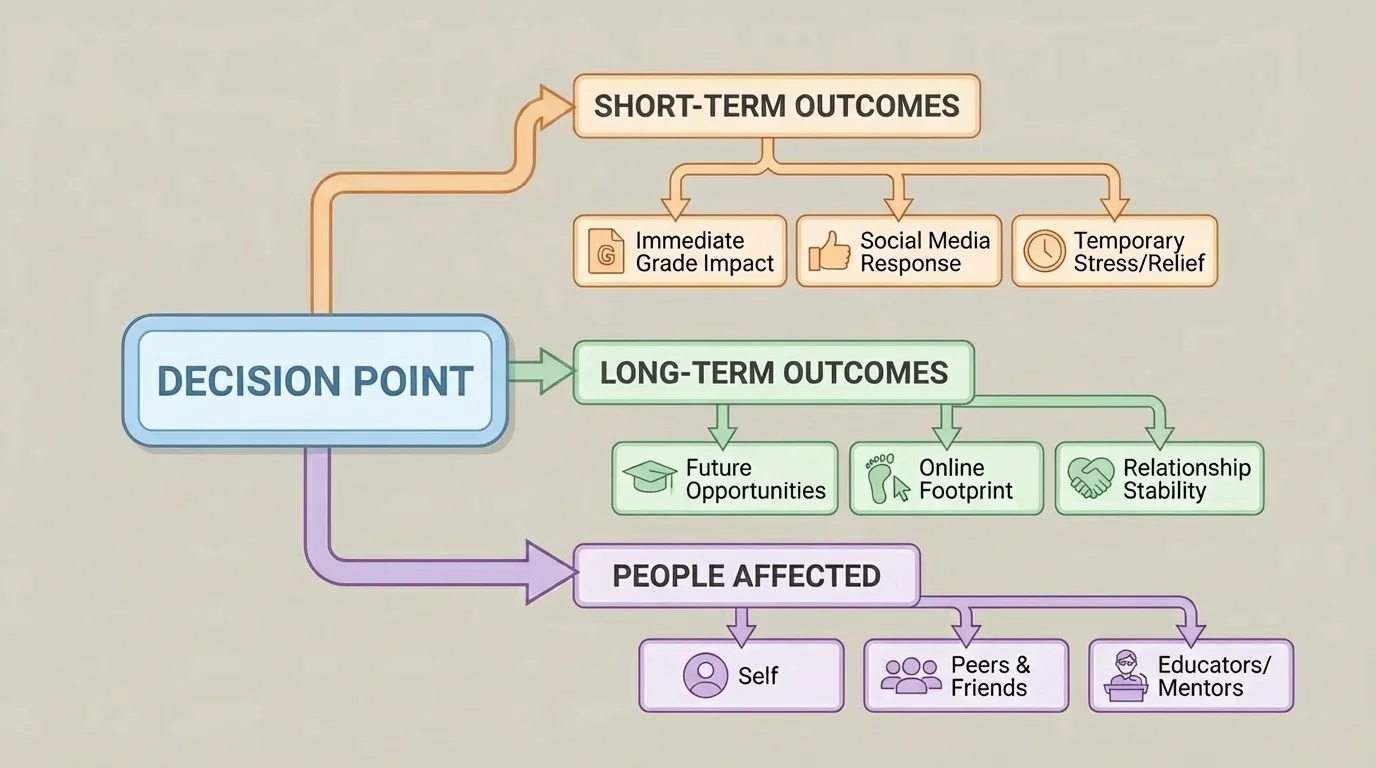
Some options look attractive until you map what happens next. A consequence map, as shown in [Figure 3], helps you trace immediate outcomes, later outcomes, and who else may be affected.
Ask four practical questions:
Then separate short-term consequences from long-term consequences. This matters because short-term comfort can hide long-term cost. For example, copying answers might reduce stress tonight, but it increases the risk of poor learning, dishonesty, and disciplinary consequences later.
A quick risk check also asks whether the downside is reversible. If you choose a bad study plan for one evening, you can adjust tomorrow. If you post private information publicly, the damage may be much harder to reverse. High-impact, hard-to-reverse choices deserve slower thinking.
The same logic applies in social life. A harsh reply may feel satisfying for \(10\) seconds, but the long-term effects on trust and reputation can last much longer.
Your brain is more likely to focus on immediate rewards than distant consequences when you are tired, stressed, or emotionally activated. Even a short pause can improve judgment.
That is why a consequence map works best before you act, not after.
Good decisions require more than listing options. You also need to check whether your thinking is being pushed off course. A cognitive bias is a mental shortcut that can distort judgment.
Common traps include:
Critical thinking means asking: What is the evidence? Is the source reliable? Is there another explanation? Am I reacting to facts, or just to tone, fear, or pressure?
Try This: When you see a claim online, pause before sharing it. Check whether the source is original, whether the evidence is current, and whether another trusted source confirms it.
Academic decisions are not only about grades. They are also about time management, honesty, stress, and long-term habits. One of the most common academic mistakes is solving the wrong problem. You may think the problem is "I have too much work," when the real problem is "I have not prioritized what matters most."
Use this quick method for overloaded work:
For example, "work on English" is vague. "Draft the introduction and find two reliable sources in the next \(30\) minutes" is actionable.
Academic case study: two deadlines, one evening
You have a quiz tomorrow and a discussion post due tonight. You also feel tired.
Step 1: Define the decision
The real question is not "What do I feel like doing?" It is "How do I use tonight so I protect both my grade and my energy?"
Step 2: Use filters
One non-negotiable is academic honesty. Another is getting enough sleep to function tomorrow.
Step 3: Compare options
Option A: stay up late and do everything poorly. Option B: finish the discussion post carefully, review the quiz for a set amount of time, then sleep. Option C: avoid both and hope for the best.
Step 4: Choose the best balance
Option B often wins because it addresses both deadlines while reducing the risk of burnout.
A strong decision is not always the one that includes the most hours. It is the one that uses your energy wisely.
When using sources, apply critical thinking. If an article makes a big claim with no evidence, weak authorship, or a sensational tone, treat it carefully. If you use AI tools, follow instructions honestly, verify information, and do not submit false work as your own.
The decision cycle from [Figure 1] also helps here: pause, define the actual task, gather facts, compare options, then review what worked after the deadline passes.
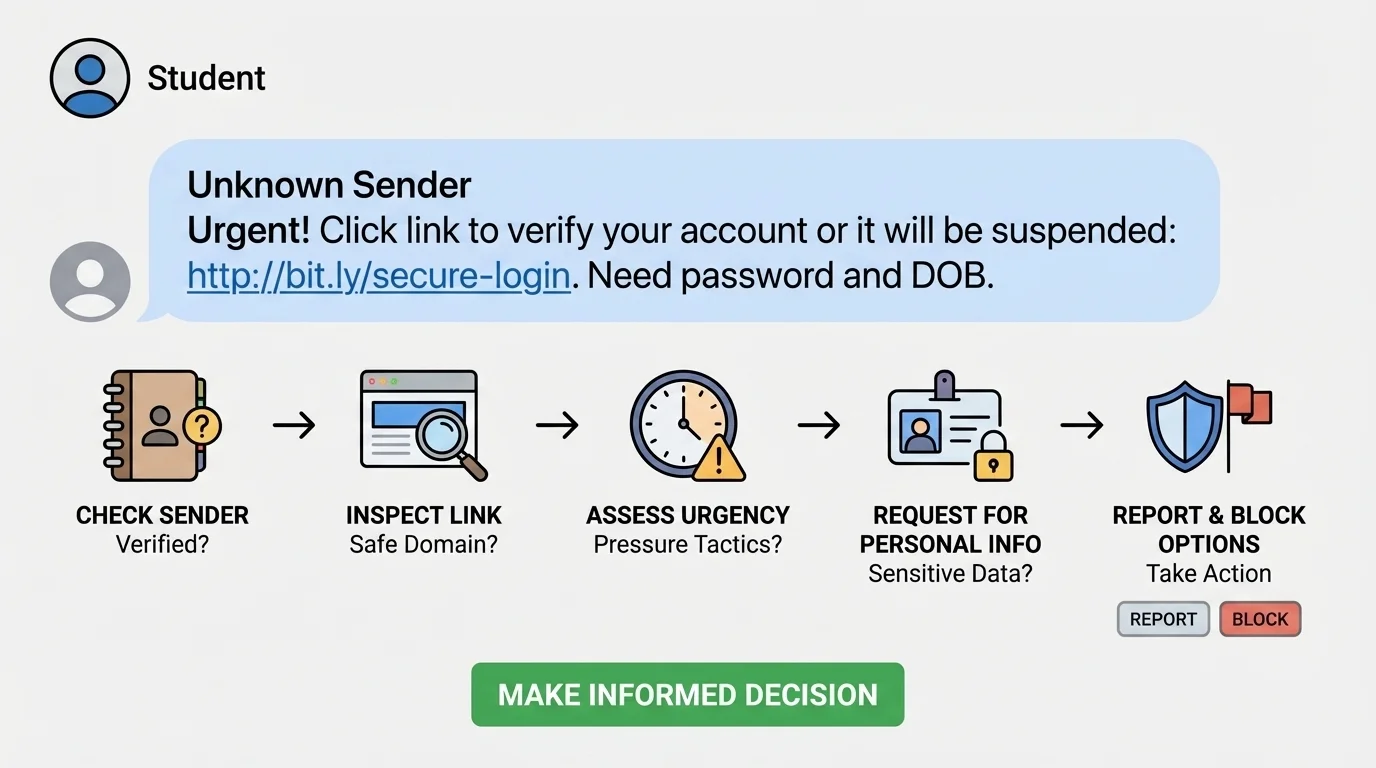
Digital decisions often involve speed, privacy, and permanence. In online spaces, a bad decision can spread fast. Safe digital choices require a digital footprint mindset: what you post, click, save, or share can leave a record. [Figure 4] shows a useful checklist for evaluating a suspicious digital message.
Before clicking, replying, or posting, ask:
Scams and manipulation often use pressure: "Act now," "Don't tell anyone," or "You must respond immediately." Pressure is a warning sign, not proof that something is important.
If a message includes a link, use a simple rule: do not trust urgency more than verification. Check the account, look for signs of impersonation, and if needed, contact the person or company through an official method instead of the message itself.
Privacy decisions matter too. Sharing your location, school schedule, passwords, or personal images can create risks that are hard to reverse. This is where the risk check from [Figure 3] becomes useful: what is the best likely outcome, what is the worst likely outcome, and how reversible is this choice?
Digital tools can also affect your focus. If you are deciding whether to keep multiple apps open while studying, test the actual consequence. You may believe multitasking saves time, but many students find that switching attention increases mistakes and stretches a \(20\)-minute task into \(40\) minutes.
Social decisions can feel hardest because they involve emotions, identity, and relationships. You may be deciding whether to join an online conversation, respond to conflict, set a boundary, or support a friend. The same tools still work.
Start by separating what happened from what you assume it means. If someone leaves you on read, the fact is that they have not replied. The story in your head might be "They are mad at me" or "They do not care." Good decisions rely on facts first.
Then ask what kind of response matches your values. If a message is rude, your options might include replying immediately, waiting until you are calm, asking for clarification, or not engaging at all. The right choice depends on the context, but reacting at your emotional peak is rarely the strongest move.
"Not every thought deserves a reply, and not every feeling deserves immediate action."
Boundaries are also part of decision-making. If someone pressures you to share private information, stay in a draining conversation, or ignore your own needs, you are allowed to say no, step back, mute, block, or ask for support. A healthy relationship does not require you to abandon judgment.
Try This: Use a draft-first rule for emotional messages. Write the response, wait, reread it later, and then decide whether to send, revise, or delete it.
Not every situation gives you plenty of time. If a decision feels urgent, use a shorter version of the process:
If you feel panicked, angry, ashamed, or pressured, your judgment may narrow. That is the moment to delay if possible, or involve a trusted adult, mentor, counselor, coach, or family member. Asking for support is not weakness. It is a decision tool.
Strong independence does not mean handling everything alone. It means knowing when to use your own judgment and when to bring in someone with more experience.
Situations involving threats, blackmail, harassment, self-harm, unsafe meetings, sexual pressure, or requests for explicit images are not "normal drama." They require immediate safety thinking and adult support.
The goal is not to memorize one perfect chart. The goal is to build habits. Over time, your personal decision system might include these parts:
You can even keep a simple note called "What helped?" After a hard decision, write down what signals you noticed, what tool you used, and what result followed. Patterns will appear. You may notice that rushed decisions create regret, or that asking one clarifying question often changes everything.
This is how judgment grows: not by avoiding every mistake, but by learning from decisions in a structured way. The weighted comparison tool in [Figure 2] helps when you need to compare options carefully, while the quick safety check from the digital checklist in [Figure 4] helps when speed and risk matter more than detail.
The more often you use these tools, the less likely you are to be controlled by panic, pressure, or impulse. You become someone who makes intentional choices.
