Many unsafe relationships do not start with obvious danger. They often begin with something that gets brushed off: a demand to share your password, pressure to reply instantly, guilt for spending time with other people, or jokes that make you uncomfortable. Because those behaviors can look small at first, one of the strongest safety skills you can build is learning to recognize your rights, access support systems, and make decisions based on facts instead of pressure.
Relationships should add respect, trust, and support to your life. That includes dating relationships, friendships, online connections, and situations where someone wants more closeness than you do. Safety in relationships is not just about avoiding physical harm. It also includes emotional safety, digital safety, privacy, and the freedom to make your own choices.
When you know what you are allowed to expect, you are less likely to accept treatment that crosses the line. When you know where to get help, you are less likely to feel trapped. When you slow down and make informed choices, you reduce the chance of getting pulled into unsafe situations.
Every person has fundamental rights in relationships. These are not special rewards you have to earn. They are part of being a person. A boundary is a limit that protects your comfort, values, time, body, privacy, and emotional well-being. As [Figure 1] illustrates, these rights work together to protect your safety.
You have the right to be treated with respect. You have the right to say no. You have the right to change your mind, even if you previously said yes to something. You have the right to keep personal information private. You have the right to spend time with other people, to have interests outside the relationship, and to leave a conversation or relationship that feels wrong.
Consent means a clear, freely given, informed, and ongoing yes. It is not silence, fear, pressure, guilt, manipulation, or giving in because someone keeps asking. Autonomy means you are in charge of your own choices, body, time, and personal information.
You also have the right to feel emotionally safe. That means you should not be insulted, humiliated, threatened, controlled, or constantly tested. Someone does not need to hit you for a relationship to become unsafe. Repeated guilt, monitoring, intimidation, and pressure can also be harmful.
Digital rights matter too. You do not owe anyone your passwords, your location, private photos, or nonstop access to you. A person who says, "If you trust me, prove it," is trying to turn trust into pressure. Real trust respects limits.
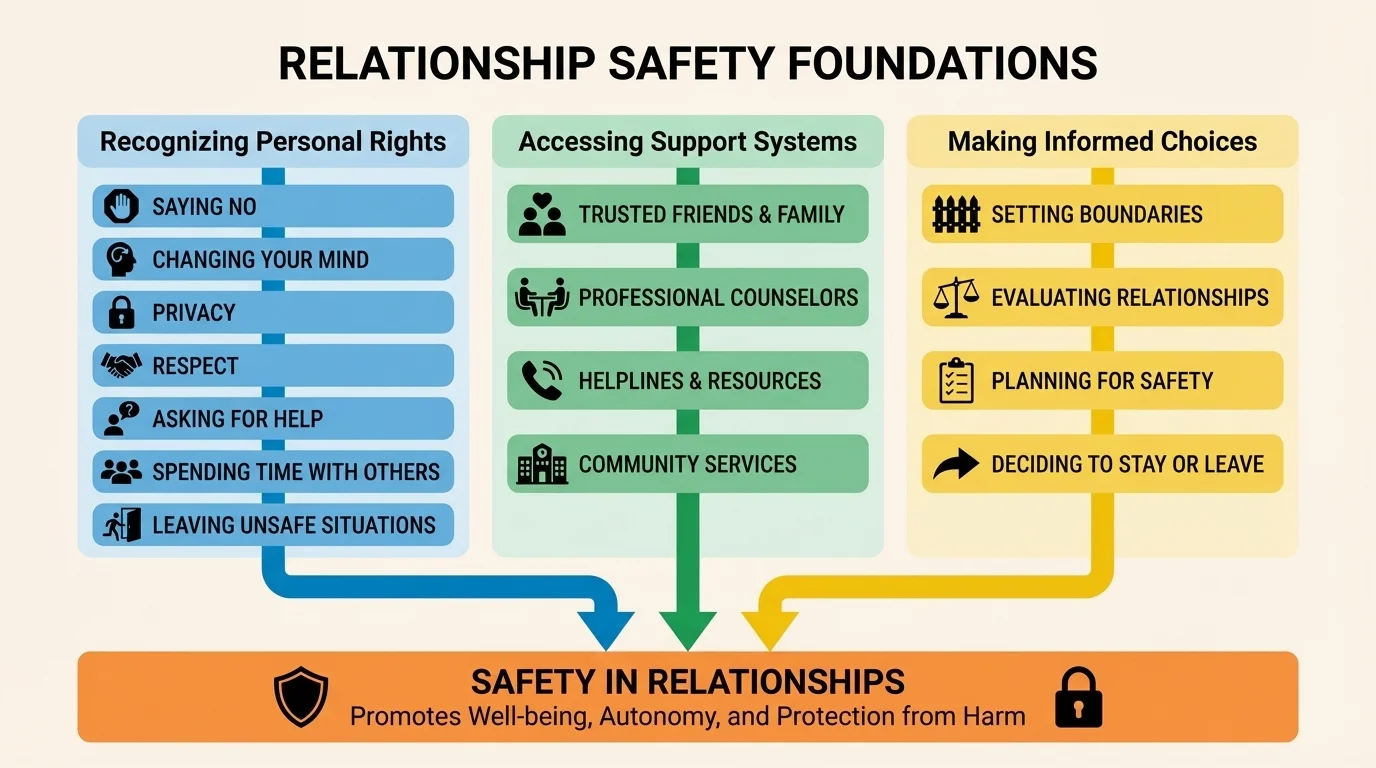
Sometimes people think being in a relationship means giving up privacy or independence. It does not. In a healthy relationship, both people still have separate identities, separate choices, and separate support systems. Personal rights are connected: when one is ignored, others often get weakened too.
A red flag is a warning sign that a relationship may be unhealthy or unsafe. These patterns often grow over time rather than appearing all at once, as [Figure 2] illustrates. Recognizing early signs can help you respond before things become more serious.
Healthy behaviors include listening, honesty, respect for boundaries, calm disagreement, shared decision-making, and support for your other relationships and goals. A healthy person does not punish you for saying no.
Unhealthy behaviors can include jealousy used as control, repeated pressure, guilt-tripping, checking your device without permission, mocking your boundaries, demanding constant replies, or making you feel responsible for their emotions. These behaviors may be dismissed as "just caring," but they can be signs of something more serious.
Unsafe patterns usually build through pressure and control. A person may start by acting intensely interested, then move into monitoring, isolating, demanding proof of loyalty, or making threats. The key question is not just "Are they nice sometimes?" but "Do they regularly respect my choices and safety?"
Abusive behaviors include threats, intimidation, forced sexual activity, physical harm, stalking, blackmail, destroying property, isolating you from support, sharing private images, or making you afraid of what will happen if you disagree. Abuse can happen in person, through text, on social media, or by tracking your accounts and location.
One especially confusing pattern is manipulation. Manipulation happens when someone tries to control your choices by using guilt, fear, shame, lies, or emotional pressure instead of respect. For example, "If you loved me, you would send the photo," is not affection. It is pressure.
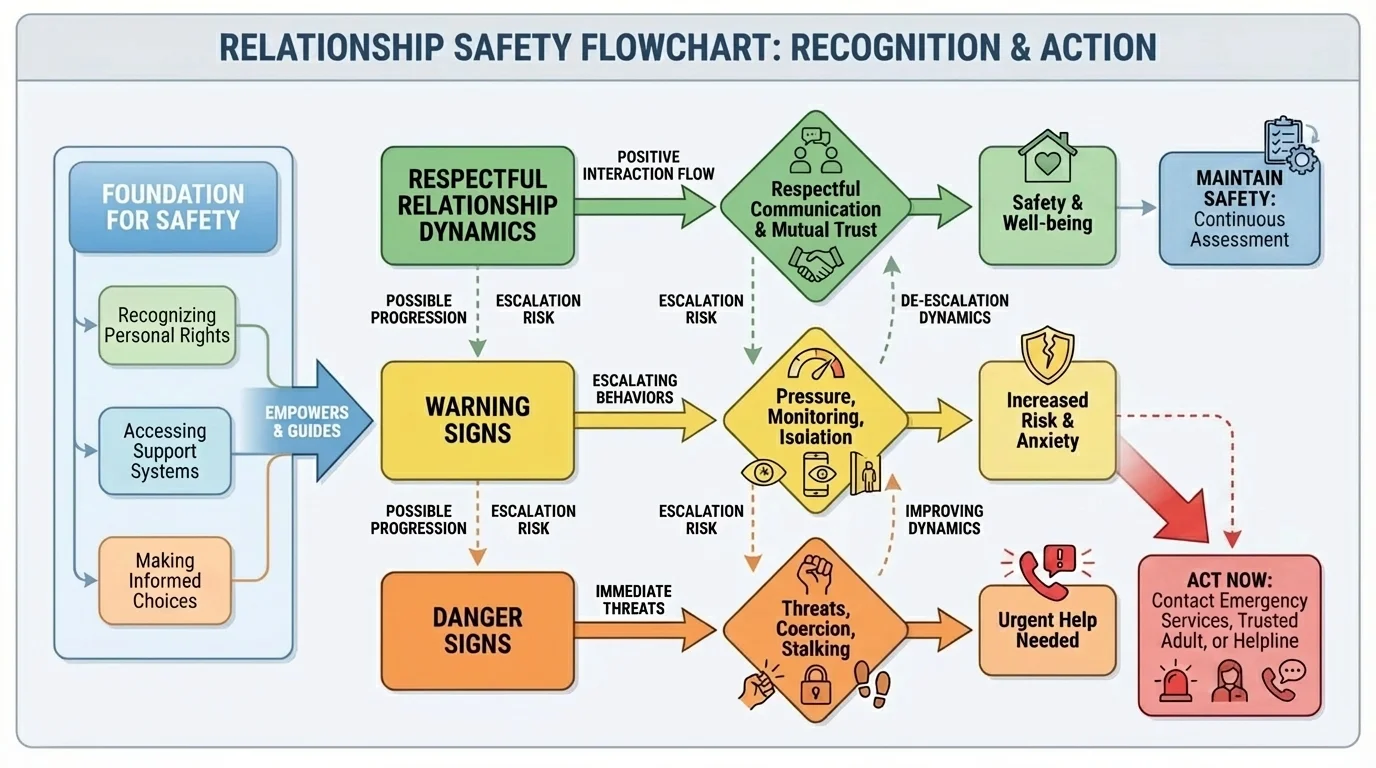
Another warning sign is isolation. Isolation happens when someone tries to cut you off from friends, family, trusted adults, or activities that make you stronger. They may say other people are "bad for you" or act hurt every time you connect with someone else. That can make it harder for you to get perspective or support.
Pay attention to how you feel around someone. If you often feel nervous, guilty, trapped, watched, or afraid to be honest, that matters. Your feelings are not proof by themselves, but they are important signals. As we saw in [Figure 2], unsafe situations often involve a pattern of pressure that keeps increasing.
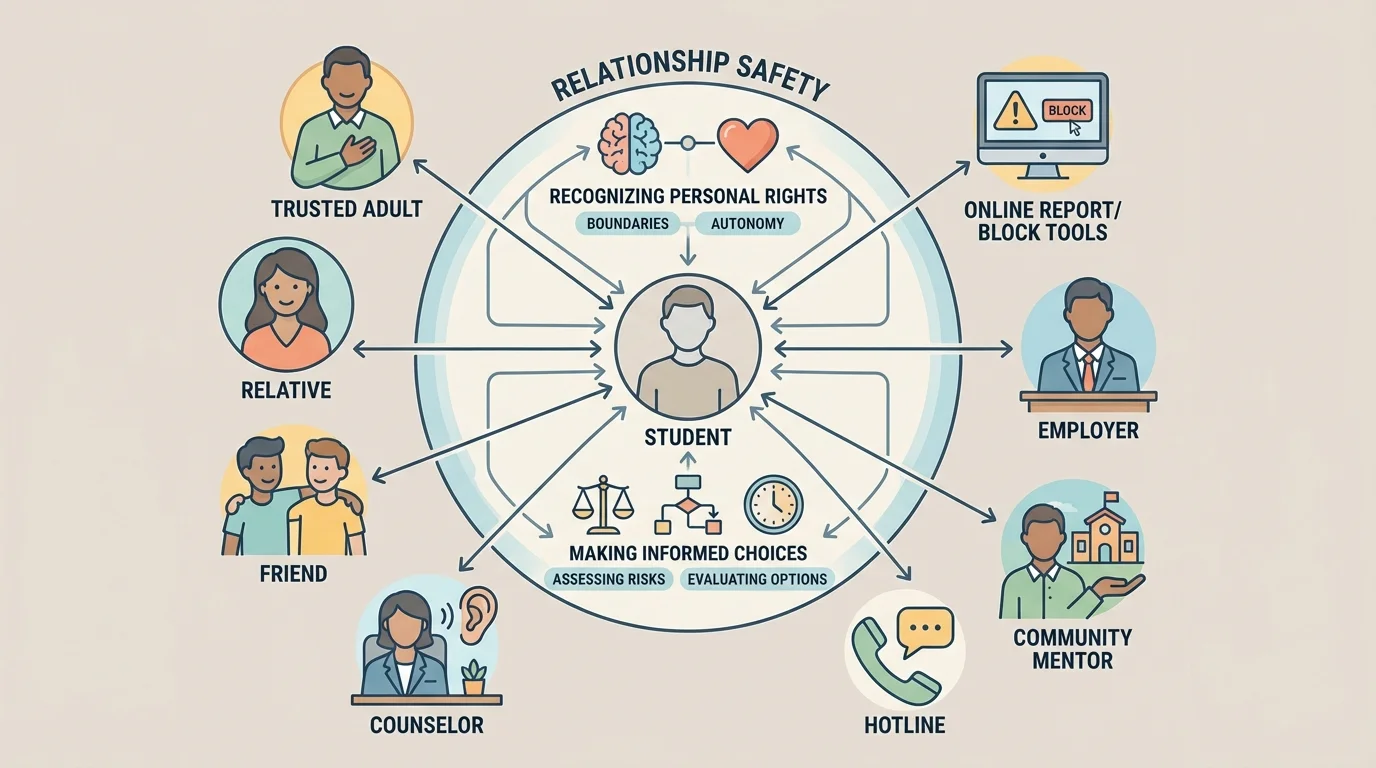
A support system is the group of people, services, and tools you can turn to for help, advice, protection, and perspective. Support is strongest when it includes more than one option. Depending on your situation, that might include a parent, guardian, older sibling, relative, counselor, youth leader, coach, neighbor, employer, hotline, or a trusted friend who knows how to get an adult involved.
Support systems matter because pressure often works best when you feel alone. As [Figure 3] shows, a trusted outside person can notice warning signs, help you think clearly, and assist with next steps. They can also help you stay safer if you need to block someone, report harassment, leave a situation, or document what happened.
People are more likely to recognize unsafe behavior sooner when they talk about it with someone they trust. Secrecy often protects the person causing harm, not the person being harmed.
Support also includes digital tools. Social media platforms, messaging apps, gaming services, and phones usually have options to block, mute, restrict, report, and limit who can see your content or location. Those tools are not overreactions. They are safety tools.
If you are not sure whether something is serious enough to tell someone, that is usually a sign that talking to a trusted adult is a good idea. You do not have to wait until a situation becomes extreme. Early support can prevent bigger harm.
If one person does not listen, try another. Some adults respond better than others, and you deserve support that takes your concerns seriously. [Figure 3] shows why having multiple support options matters: if one path is unavailable, another can still help protect you.
Being informed means slowing down enough to notice what is happening, check what you know, and decide based on safety rather than pressure. As [Figure 4] shows, a good risk assessment asks simple questions about behavior, privacy, pressure, and what could happen next. The decision process organizes this into steps you can actually use.
Step 1: Pause. If someone wants an answer right now, that pressure is important information. Safe people can handle a pause. You can say, "I need time to think," or "I'm not deciding this right now."
Step 2: Check for pressure. Ask yourself: Am I choosing this freely, or am I trying to avoid guilt, anger, embarrassment, or conflict? If fear is driving the decision, it is probably not a safe choice.
Step 3: Verify facts. Online, people are not always who they claim to be. Before sharing personal details, meeting up, or trusting someone deeply, look for consistency. Have they respected your boundaries? Do their stories change? Are they pushing for secrecy?
Step 4: Protect private information. Do not share passwords, home address, school schedule, financial information, or intimate images because someone demands "proof." Once private material is shared, you may lose control over where it goes.
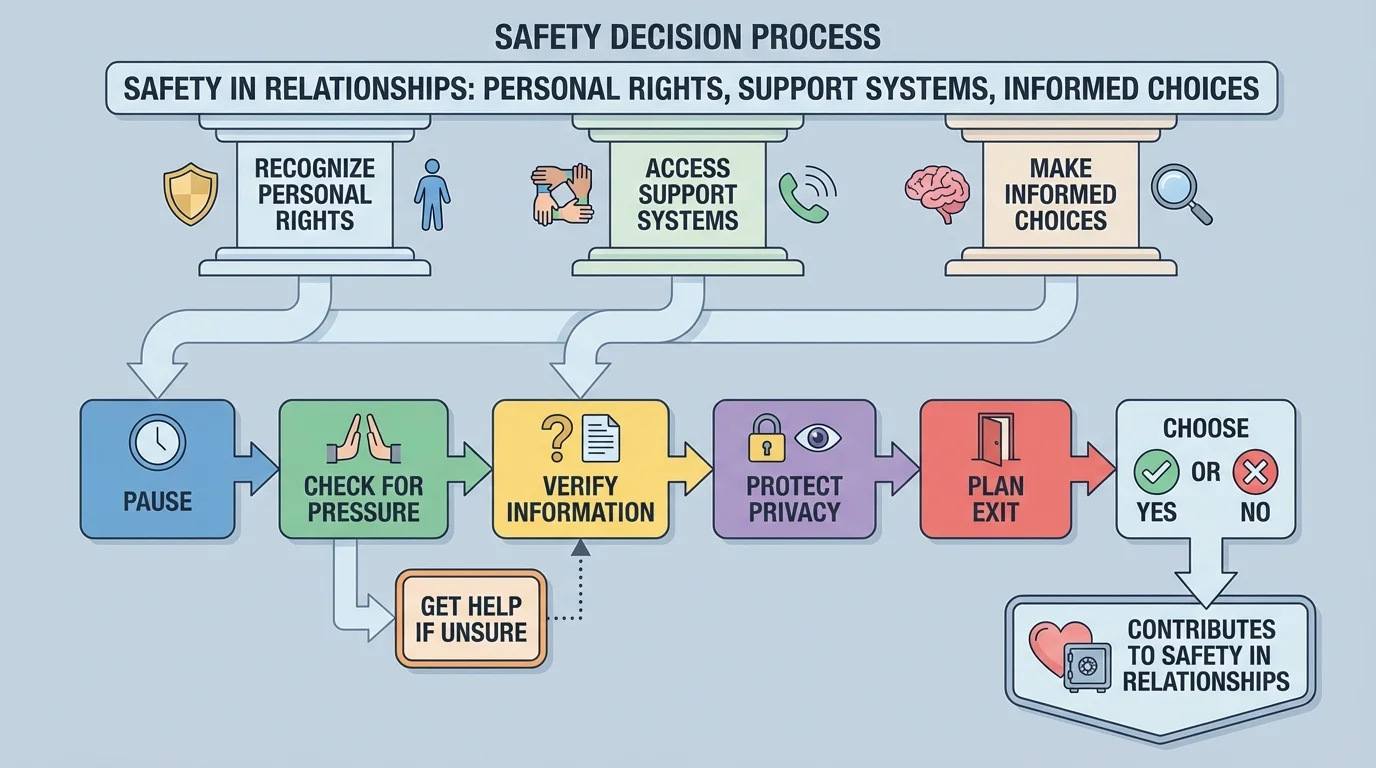
Step 5: Plan for safety. If you are meeting someone, choose a public place, tell a trusted adult where you are going, arrange your own transportation if possible, and decide ahead of time how to leave if you feel uncomfortable. If the other person resists those precautions, that is a major warning sign.
Step 6: Decide whether the choice matches your values and safety. A choice can seem easier in the moment and still be risky. Informed choices fit your boundaries, respect your future, and do not rely on secrecy.
Step 7: Get help when unsure. If you feel confused, ask someone you trust before acting. People under pressure often miss risks they would easily see in someone else's situation. The clear sequence in [Figure 4] helps when emotions are high and thinking feels harder.
Knowing what to say can make a hard moment easier. You do not need the perfect speech. You need clear words that protect you.
Scenario 1: Someone keeps pressuring you for a private photo
Step 1: State the boundary clearly.
"I'm not sending that."
Step 2: Do not debate your right to say no.
"This isn't up for discussion."
Step 3: Take safety action if pressure continues.
Stop replying, save screenshots, block the account, and tell a trusted adult.
This response works because it does not reward manipulation with a long argument.
Short, calm statements are often stronger than long explanations. You are not required to convince someone that your boundary is reasonable.
Scenario 2: A person gets angry when you spend time with other people
Step 1: Name the issue.
"I'm allowed to have other relationships and activities."
Step 2: Set the expectation.
"I won't keep proving my loyalty by giving up time with others."
Step 3: Notice the response.
If the person listens and changes, that matters. If they escalate, blame, threaten, or punish you, that is a danger sign.
The goal is not to win the argument. The goal is to observe whether respect is actually possible.
You can also use support scripts. Try: "Something about this feels off, and I want another opinion," or "I need help dealing with someone who keeps pressuring me." Those sentences are simple, but they open the door to safety.
If you think a relationship or interaction may be unsafe, act sooner rather than later. Waiting can sometimes give controlling behavior more room to grow.
Save evidence if needed. Keep screenshots, messages, usernames, dates, and details of what happened. Documentation can help if you need to report harassment, threats, impersonation, or image-based abuse.
Limit access. Block numbers and accounts. Change passwords. Turn off location sharing. Review privacy settings on apps, shared devices, and connected accounts. If someone knows your login information, update it immediately and enable extra security features.
Emergency situations are different from uncomfortable situations. If you are in immediate danger, contact emergency services right away and get to a safe adult or safe public place as quickly as possible.
Get physically safe if you need to. Leave the area, call a trusted adult, ask a nearby responsible adult for help, or go somewhere with other people around. Trust your instincts if a situation starts to feel unpredictable.
Tell someone clearly what is happening. Instead of saying "It's weird," be specific: "They threatened to share my photos," or "They keep showing up where I am," or "They will not stop pressuring me after I said no." Clear information helps people respond effectively.
If you are helping a friend, do not promise absolute secrecy. You can say, "I care about you, and I may need to involve a trusted adult to help keep you safe." That protects your friend better than trying to manage a serious situation alone.
Safety is easier when it becomes a habit, not just a reaction. Small choices made regularly can protect you before problems grow.
Keep connections with people who respect you. Stay involved with family, friendships, work, hobbies, faith communities, clubs, sports, arts, or volunteering outside the relationship. Strong outside connections make isolation harder.
Practice boundary language before you need it. Sentences like "I'm not comfortable with that," "I need more time," "Don't speak to me that way," and "No" are useful because they are direct. The more you practice them, the easier they are to use under pressure.
"A healthy relationship never requires you to give up your safety in order to keep someone close."
Protect your digital life the same way you protect your physical space. Use strong passwords, review privacy settings, be careful with location sharing, and think before posting details that reveal where you are, who you are with, or how someone could contact you offline.
Finally, remember that being kind does not mean being endlessly available. Being understanding does not mean ignoring warning signs. And caring about someone does not require accepting control, fear, or pressure. Recognizing your rights, using support systems, and making informed choices all work together to protect your safety and your future.
