Being busy is not the same as being balanced. You can spend a whole week moving from assignments to work shifts to screen time and stress and still feel as though you accomplished very little. A balanced plan fixes that. It helps you decide what matters, when it matters, and how to keep moving forward without burning yourself out.
At this stage of life, things can already feel full: online classes, deadlines, chores at home, maybe a part-time job, family responsibilities, hobbies, friendships, and pressure to think about what comes after high school. If you do not plan on purpose, these areas start competing with each other. Then school slips, sleep disappears, stress climbs, and future goals stay stuck in the background.
A balanced plan is not about making every part of life equal every day. Some days school needs more time. Some weeks work may increase. Sometimes your wellness needs to come first because you are exhausted or overwhelmed. Balance really means adjusting wisely so one part of life does not keep damaging the others.
When balance is working, you are more likely to finish important tasks, show up reliably, feel steadier emotionally, and make progress toward long-term goals. When balance is missing, the usual pattern is predictable: you procrastinate, rush, forget things, feel guilty, and then make decisions based on panic instead of priorities.
Small planning habits often work better than dramatic life overhauls. A realistic system you follow for 20 minutes each week is usually more powerful than a perfect schedule you abandon after two days.
That is why balanced planning is a life skill, not just a school skill. It affects your grades, your job performance, your health, your relationships, and your options later.
[Figure 1] Your plan should include four connected areas, not four separate lives. School, work, wellness, and future preparation overlap, and if one area is ignored, the others usually suffer too.
School includes attending online classes, completing assignments, studying, communicating with teachers, and keeping up with deadlines. Work may include a part-time job, paid freelance work, volunteering, or major responsibilities at home. Wellness includes sleep, food, movement, stress management, and mental health. Future preparation includes building skills, exploring careers, learning about training options, creating a resume, saving money, and preparing for opportunities.
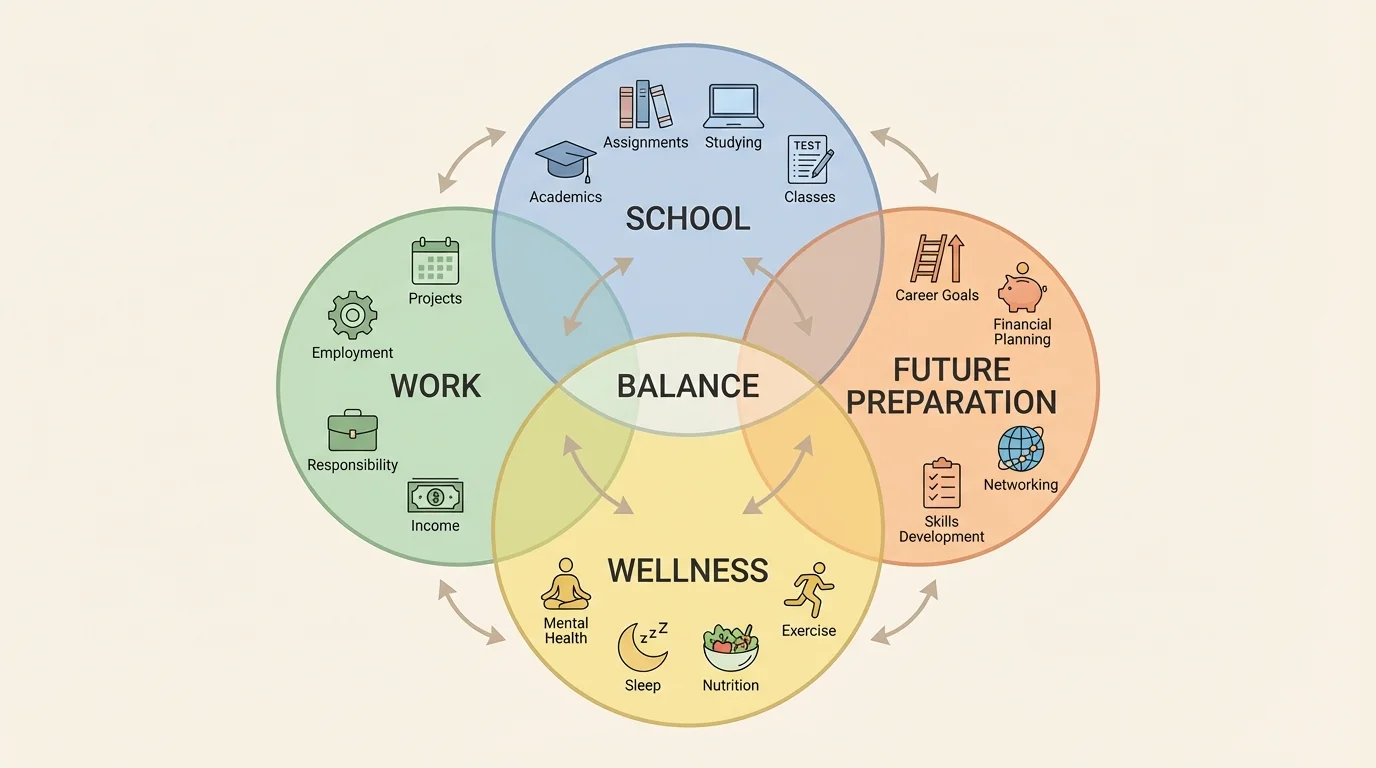
Notice that future preparation is not something you do only after everything else is done. If you wait for a completely free season, you may wait forever. It usually works better to give future preparation a small, regular place in your week.
Priority is something that deserves your attention before less important tasks. Trade-off is a choice in which saying yes to one thing means giving less time, energy, or money to another. Routine is a repeated pattern that helps you do important tasks consistently without having to make a new decision each time.
Balanced planning depends on understanding these ideas. You cannot do everything at once, so you need clear priorities, smart trade-offs, and routines that reduce chaos.
A good plan begins with honesty. Do not build your week around the fantasy version of yourself who wakes up early every day, never gets distracted, and always feels motivated. Build around your actual schedule, actual responsibilities, and actual energy.
Start by listing your non-negotiables. These are the things that must happen whether you feel like it or not: class sessions, assignment due dates, work shifts, family duties, medical appointments, and basic sleep. Then list flexible tasks such as studying extra, exercise, social time, job searching, or skill practice.
Next, look at your time in a realistic way. There are only so many hours in a week. If you work 15 hours at a part-time job, attend online classes, and need 8 hours of sleep each night, your available time is limited. Planning works best when you respect limits instead of pretending they do not exist.
Your energy matters too. Maybe you focus best in the morning. Maybe your job leaves you drained on certain evenings. Maybe long video calls wear you out. A smart plan matches demanding tasks with your strongest times instead of placing everything randomly.
Plan for capacity, not guilt
Your capacity is the amount of time, energy, and attention you can realistically use well. If you build a plan that requires more capacity than you actually have, the plan fails even if your intentions are good. Strong planning is not about proving you can handle everything; it is about matching your responsibilities to what is sustainable.
Try This: For one week, write down what you actually do in rough time blocks. Not to judge yourself; just to notice patterns. You may find that a task you thought took 20 minutes really takes 50 minutes once setup, breaks, and distractions are included.
Many students set goals that sound good but clash in real life. For example, you might want to raise your grades, pick up extra work hours, start working out every day, and begin researching careers all at once. None of those goals is bad. The problem is trying to push all of them to maximum intensity at the same time.
A better approach is to separate goals into short-term goals and long-term goals. Short-term goals help you succeed this week or this month. Long-term goals help you move toward the life you want after graduation.
For example, a short-term school goal might be: submit all assignments on time for the next two weeks. A short-term wellness goal might be: go to bed by the same time on school nights. A long-term future goal might be: learn what training is needed for a health care career. A work goal might be: keep a reliable schedule without taking shifts that hurt school performance.
The best goals are specific enough to guide action. "Do better in school" is too vague. "Complete missing math assignments by Thursday and attend an online help session on Friday" is clearer. "Take care of myself" is broad. "Sleep at least 8 hours on weeknights and take a 20-minute walk three times this week" is easier to follow.
Turning a vague goal into a useful goal
Vague goal: "Get my life together."
Step 1: Break it into life areas.
School: raise consistency. Work: avoid overbooking. Wellness: sleep more. Future: begin career research.
Step 2: Make each part observable.
School: check the course dashboard every morning. Work: limit shifts to weekends. Wellness: phone off by 10:30 p.m. Future: spend 30 minutes on career research each Saturday.
Step 3: Choose one main focus.
If school is currently at risk, make school stability the first focus while keeping the other goals small and manageable.
The result is a plan you can actually follow instead of a promise that is too blurry to act on.
Goals should support each other. Better sleep helps school focus. Reliable work habits strengthen your resume. Future research can help you choose courses or experiences that matter. This is the same connection we saw earlier in [Figure 1]: balanced areas reinforce each other when planned well.
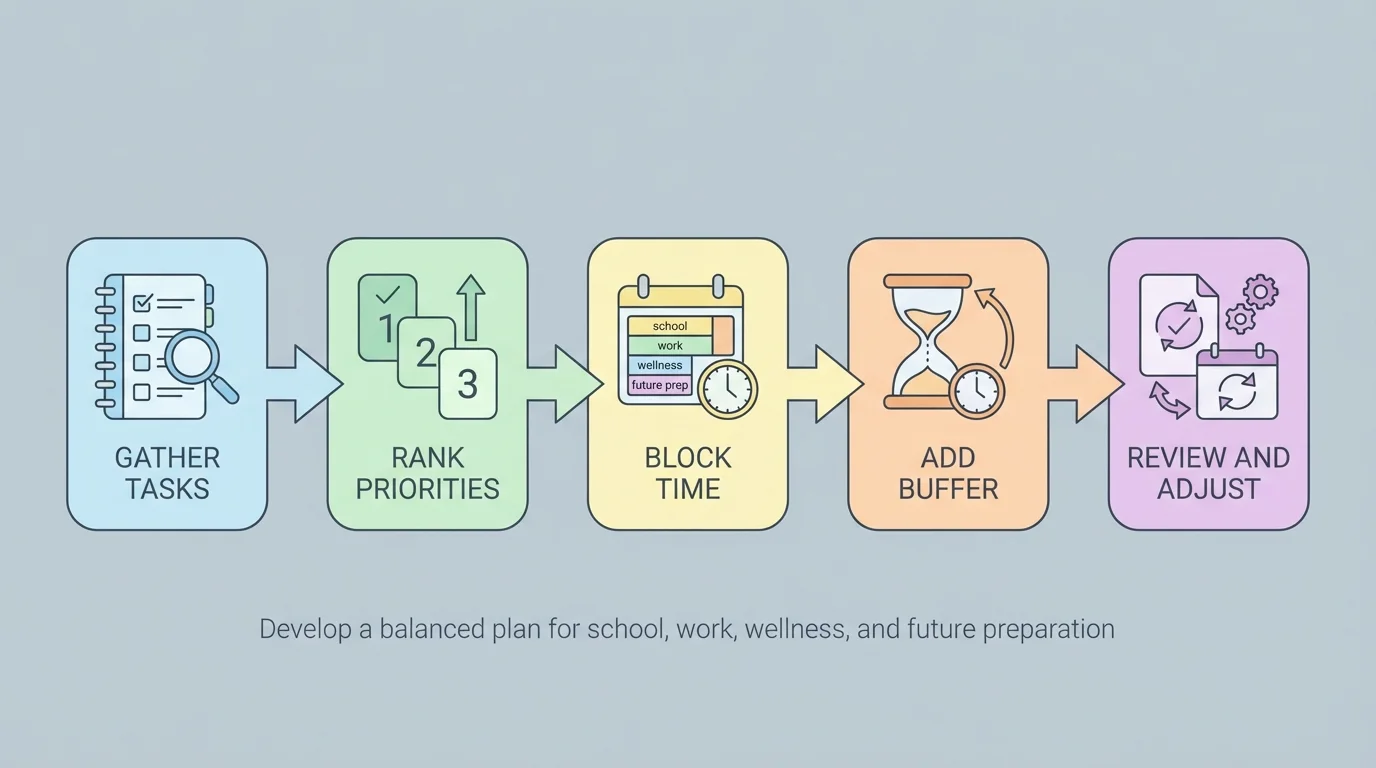
[Figure 2] A weekly system works better than guessing each day. When you know your priorities before the week starts, you spend less time deciding and more time doing.
Here is a practical method.
Step 1: Gather everything in one place. Check your course dashboard, calendar, messages, work schedule, and personal responsibilities. Write them down in one planner, notes app, or calendar.
Step 2: Rank tasks by importance. Ask: What must happen first? What has a deadline? What affects other people? What creates bigger problems if ignored?
Step 3: Block time for your top priorities. Put school deadlines, work shifts, and wellness basics into your week first. Then add future preparation in smaller blocks.
Step 4: Add buffer time. If every minute is packed, one delay can wreck the whole plan. Leave open spaces for spillover, rest, or surprise tasks.
Step 5: Review daily and adjust. Plans are tools, not traps. If something changes, update the plan instead of quitting it.
One reason students struggle with planning is that they schedule only work and forget recovery. If you plan three hours of homework after a long shift without food, rest, or a mental break, the plan may look productive on paper but fail in real life.
It helps to use time blocks instead of giant to-do lists. A to-do list says what you hope to do. A time block says when you will do it. For example: Monday from 4:00 p.m. to 5:00 p.m. for English work, 5:15 p.m. to 5:45 p.m. for dinner, 6:00 p.m. to 6:30 p.m. for a walk, and 7:00 p.m. to 7:30 p.m. for resume updates or career research.
| Area | What to schedule first | What can be flexible |
|---|---|---|
| School | Live sessions, deadlines, tests, major assignments | Extra review, optional enrichment, study location |
| Work | Confirmed shifts, transportation prep, communication with supervisor | Extra hours, optional gigs, non-urgent tasks |
| Wellness | Sleep, meals, medication, stress recovery, movement | Exact workout type, longer recreation blocks |
| Future preparation | Applications, resume deadlines, required forms, scholarship due dates | Career exploration, skill-building practice, networking messages |
Table 1. A comparison of fixed priorities and flexible tasks in each part of a balanced plan.
Try This: Pick one day this week and convert your to-do list into time blocks. Then compare what you actually finish. Many students find that time blocking lowers stress because the day feels less vague.
When everything feels important, a decision filter reduces overload. Instead of reacting emotionally to every request, you can ask a few clear questions before saying yes.
[Figure 3] Ask yourself: Is this urgent? Is it important? Does it fit my current goals? Do I truly have time for it? What would I need to give up in order to do it well?
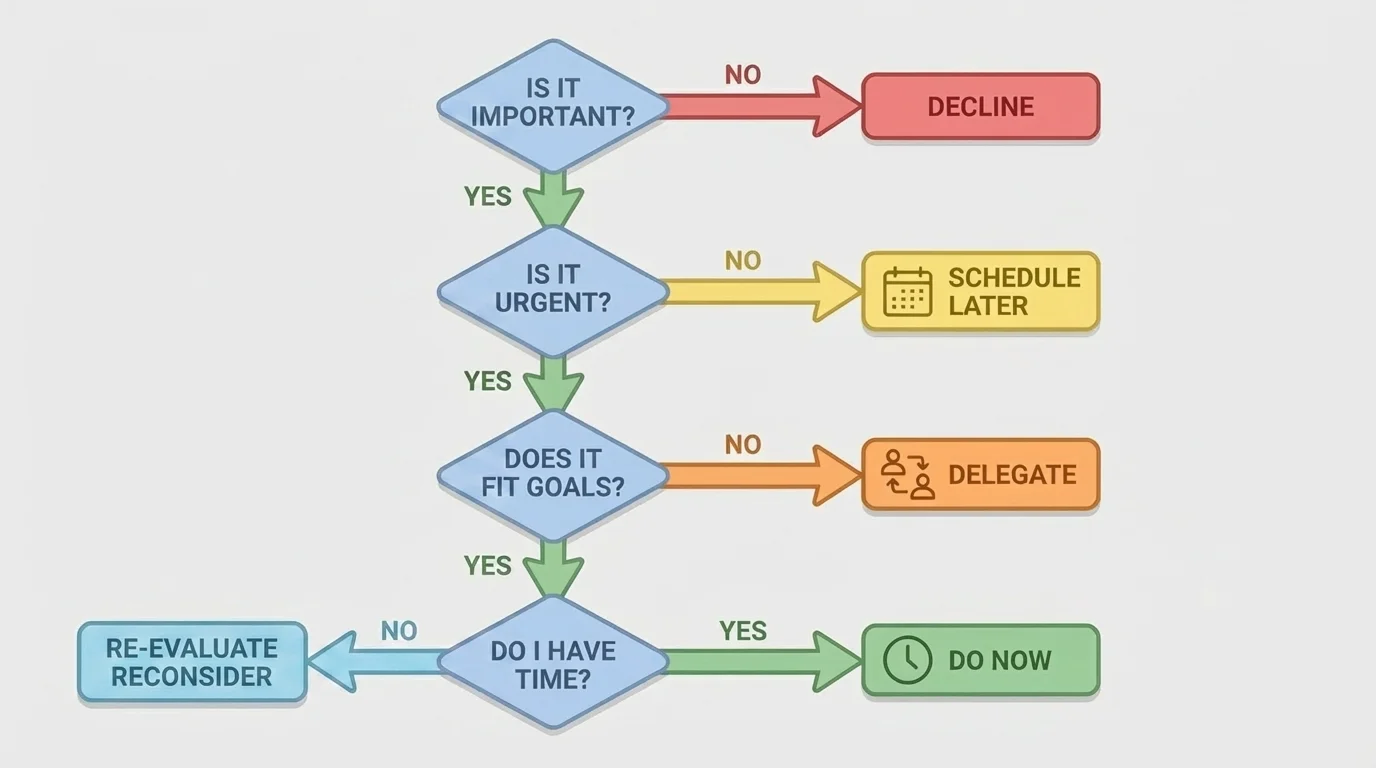
This is where trade-off thinking becomes powerful. If you accept an extra work shift the night before a major assignment is due, the trade-off may be lower sleep and weaker school performance. Sometimes that choice is necessary. But it should be made consciously, not accidentally.
You also need to know when to say no. Saying no does not mean you are lazy or unhelpful. It can mean you are protecting something more important. For example, declining optional extra hours at work during exam week may be a responsible decision, not a selfish one.
"You can do anything, but not everything."
— Common productivity principle
If your week suddenly becomes overloaded, use this order: protect essentials first, reduce extras second, communicate early third. Essentials usually include major deadlines, required work commitments, sleep, food, and health needs. Extras may include optional activities, low-priority tasks, or social plans that can be rescheduled.
Communicating early matters. If you are falling behind, tell the right person before the problem gets bigger. That might mean messaging a teacher through your online platform, asking a supervisor about scheduling limits, or talking with a family member about responsibilities at home.
Wellness is not a reward for finishing everything. It is part of the system that helps you finish what matters. If your body is exhausted and your mind is overloaded, even the best planner will not save you.
Wellness includes physical and mental habits that keep you functioning. The basics sound simple, but they are easy to ignore: enough sleep, regular meals, water, movement, breaks from screens, and ways to calm stress before it builds too high.
Sleep is one of the biggest performance factors. Students often cut sleep to create more time, but poor sleep usually reduces focus, memory, mood, and self-control the next day. That means you may gain an hour at night and lose more than that in weak performance later.
Digital boundaries matter too. Online school already requires screen time, so extra scrolling can quietly steal both time and attention. A small rule can help: no entertainment apps during a study block, or put your phone across the room while doing focused work.
Recovery is productive
Recovery does not mean doing nothing forever. It means giving your brain and body enough rest to return to work effectively. Short breaks, movement, sleep, and quiet time can improve concentration and lower stress, which makes the next work block stronger.
Watch for warning signs that your plan is becoming unhealthy: constant exhaustion, losing track of deadlines, irritability, headaches, skipping meals, working late every night, or feeling numb and unmotivated. These are signs to adjust the plan, not signs that you should simply push harder.
Try This: Choose one wellness habit that would improve everything else if it became more consistent. For many students, the answer is sleep. For others, it is eating before studying, taking a walk after long screen sessions, or using a short breathing routine before stressful tasks.
Future preparation works best as a steady process, not a last-minute panic. Small steps build on each other over time: exploring options, building skills, creating documents, and applying when opportunities appear.
[Figure 4] Future preparation can include researching careers, comparing training pathways, talking to adults in fields you are curious about, learning practical skills, updating a resume, collecting examples of your work, and saving money for future goals. None of this has to take over your life. Even one or two short blocks a week can move you forward.
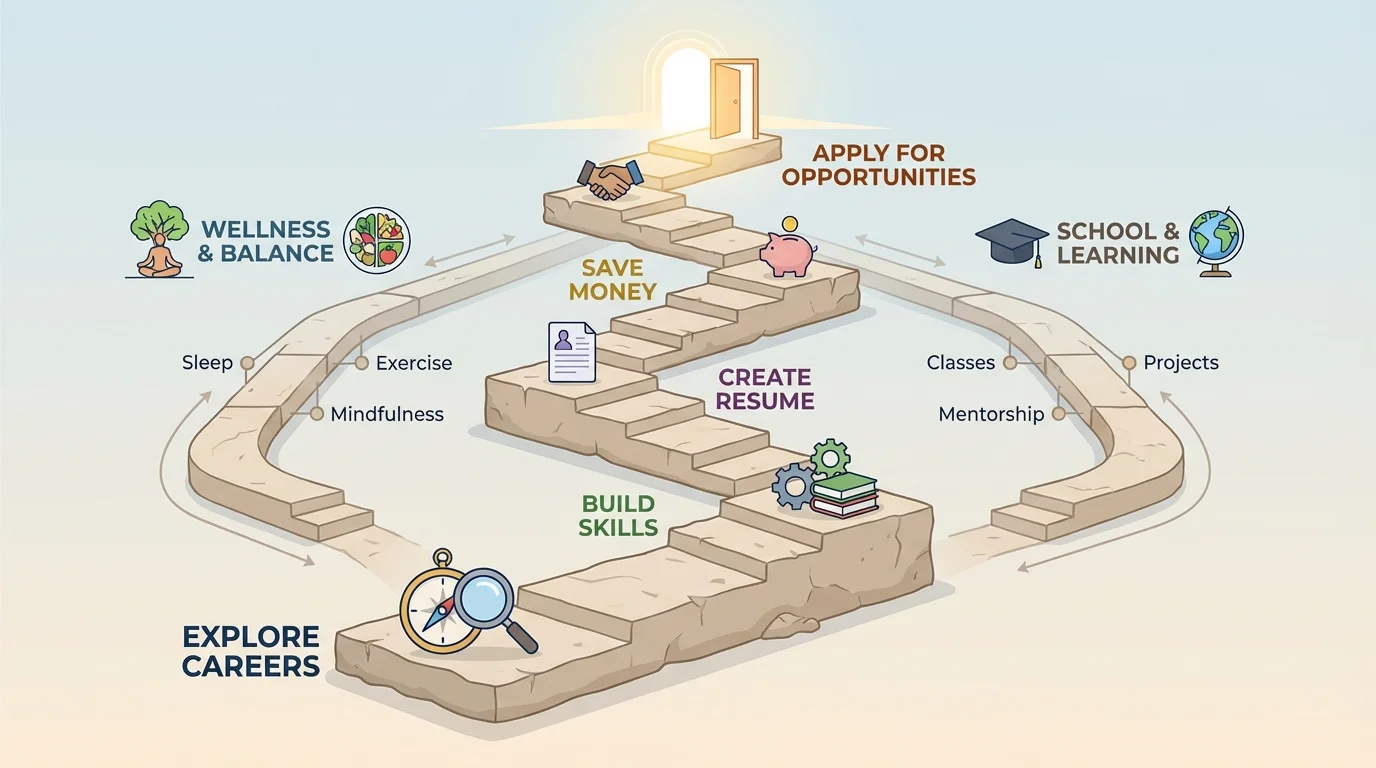
Suppose you are interested in graphic design, welding, nursing, computer support, or running a small business. You do not need a perfect answer immediately. Start by gathering information. What training is needed? What skills matter? What does entry-level work look like? What does the schedule look like? What are the costs and benefits?
Future preparation also includes reputation. Showing up on time, communicating respectfully, finishing tasks, and being dependable all matter. These habits affect references, recommendations, job opportunities, and trust. The staircase idea in [Figure 4] matters here too: your future is often built from repeated small behaviors, not one dramatic moment.
A simple weekly future-prep routine
Step 1: Pick one day and one short time block.
Example: Saturday from 1:00 p.m. to 1:30 p.m.
Step 2: Rotate tasks.
Week 1: research one career. Week 2: update your resume. Week 3: practice a useful skill. Week 4: compare training programs or scholarships.
Step 3: Save what you learn.
Keep a simple folder with notes, documents, links, and deadlines so your effort does not disappear.
This keeps future planning active without overwhelming your present responsibilities.
If money is part of your future goals, even basic saving matters. Setting aside a small amount regularly can build the habit of planning ahead. The amount does not have to be large to be meaningful; consistency matters more than looking impressive.
Balanced planning is personal, but it does not have to be done alone. Community support can make a major difference. In an online school setting, that may mean messaging a teacher, joining a virtual study session, checking in with a counselor, or asking a trusted adult to review your weekly plan with you.
Accountability means having a system that helps you follow through. That could be a friend you text after finishing a goal, a parent or guardian who checks your planner, or a Sunday routine where you review the upcoming week.
Support also helps when your plan breaks. And sometimes it will need adjustment. Illness, family problems, schedule changes, low motivation, and surprise deadlines happen. The goal is not perfection. The goal is getting back on track faster instead of giving up completely.
Good plans are revised plans. If a system works for two weeks and then stops fitting your life, that does not mean planning failed. It means your plan needs updating to match current reality.
A useful check-in has three questions: What worked? What did not work? What should I change this week? Those questions keep your planning honest and practical.
Consider two different students. One takes every extra work shift, does schoolwork late at night, skips meals, and assumes future planning can wait. At first, this may look hardworking. But over time, grades slip, stress builds, and the student has less energy to think clearly about bigger goals.
The other student limits work hours during heavy school weeks, keeps a regular sleep time, uses a weekly planner, and spends one short block each weekend on future steps. This student may not seem busy all the time, but the plan is more sustainable and usually leads to steadier progress.
Here is another example. A student wants money now, better grades, improved mental health, and a stronger resume. A balanced response might be: work two shifts instead of four during a difficult month, schedule school tasks before entertainment, protect sleep on school nights, volunteer once a month instead of overcommitting, and spend 30 minutes weekly building resume material or exploring training options.
That is what responsible planning looks like. It is not perfect. It is thoughtful. It accepts limits, protects what matters, and keeps the future moving even during busy seasons.
Try This: Before the next week starts, write one goal for school, one for wellness, one for work or responsibilities, and one for future preparation. Then ask whether those four goals fit your actual capacity. If not, shrink them until they do.
