An important fact to recognize is this: two people can read the exact same message in a group chat and come away with completely different ideas about what happened, who was rude, and who belongs. That difference is not random. It is often shaped by bias, assumptions, and perspective. If you want to be a good friend, teammate, volunteer, employee, or community member, you need to understand how these forces affect the way people participate.
Communities are not just neighborhoods or large organizations. They include online interest groups, gaming communities, sports teams, faith communities, youth programs, activist groups, workplaces, clubs, and local volunteer efforts. In every one of these spaces, people make fast judgments. Those judgments can help a group work smoothly, but they can also shut people out, create conflict, and make some voices seem more important than others.
Bias is a tendency to favor or judge someone or something in a particular way, often without fully fair evidence. Assumptions are beliefs you treat as true before checking the facts. Perspective is the viewpoint shaped by a person's experiences, identity, culture, needs, and circumstances. Participation means how someone takes part in a community: speaking up, listening, contributing, leading, asking for help, or making decisions.
These ideas matter because communities run on trust. When trust is strong, people share ideas, solve problems, and feel safe contributing. When trust is weak, people hold back, leave, or start protecting themselves instead of helping the group. Sometimes the damage comes from one major event. More often, it comes from many small moments: who gets interrupted, who gets believed, who is welcomed, who is watched more closely, and who gets the benefit of the doubt.
You probably already use shortcuts to make sense of people and situations. Your brain does this to save time. The problem is that fast thinking is not always fair thinking. A bias can make you trust one person's opinion more quickly because they sound confident, look familiar, or match what you expect. It can also make you doubt someone before they have even had a chance to explain themselves.
Assumptions often fill in missing information. For example, if someone leaves a message on read and does not respond, you might assume they are rude, bored, or ignoring you. But there may be another explanation: they are at work, caring for family, dealing with anxiety, or unsure how to answer. Assumptions feel efficient, but they are often incomplete.
Perspective is different from opinion alone. It comes from lived experience. A person who has often been ignored may read a short reply as dismissive. A person who values direct communication may see the same reply as normal and efficient. Neither reaction appears out of nowhere. Both are shaped by experience.
In communities, participation is never just about whether someone shows up. It is also about whether they feel invited, respected, and safe enough to contribute honestly. If bias and unchecked assumptions shape who gets welcomed, then participation becomes unequal even if the group says everyone is included.
Why equal access and equal experience are not the same
A group can technically be open to everyone and still feel easier for some people to join than others. If the communication style, humor, schedule, leadership, or unwritten rules match one set of experiences better than another, some people will participate more easily. Fair communities pay attention not only to who is allowed in, but also to who is actually able to take part fully.
This is why social awareness matters. It is not just being "nice." It is noticing that your view is only one view, and that other people may be reacting to patterns you do not personally face.
[Figure 1] Bias affects participation by influencing who seems credible, mature, responsible, or "a good fit." In many groups, some members are praised for ideas that are ignored when someone else says the same thing. This can happen because of age, gender, race, accent, social status, follower count, disability, religion, or simply because certain members are already seen as central to the group.
Over time, this shapes behavior. People who are listened to more often speak up more. People who are dismissed more often may go quiet, stop sharing, or leave. That means bias does not only affect feelings. It affects who stays involved, who becomes a leader, and whose needs are considered important.
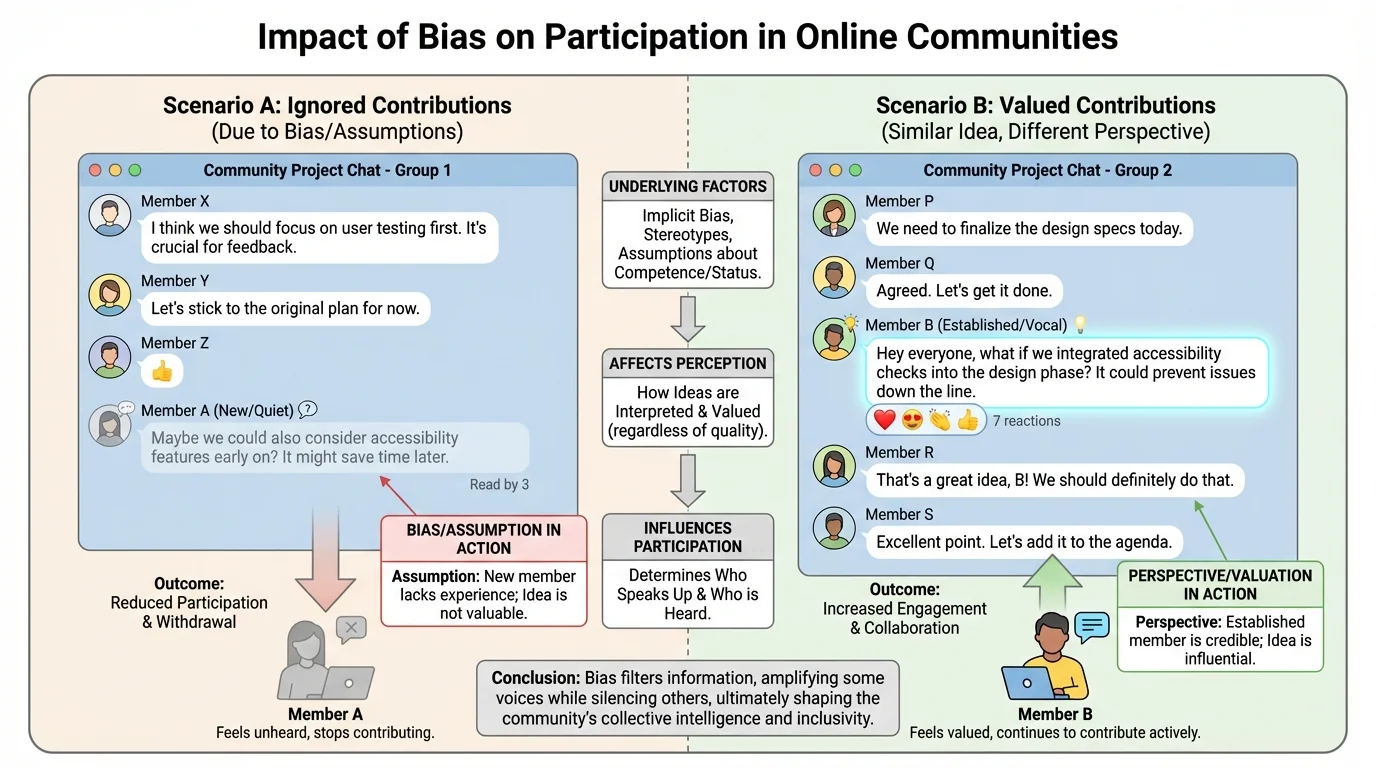
Bias can also create overtrust and undertrust. Overtrust happens when people assume someone is reliable just because they are popular, confident, or similar to the group majority. Undertrust happens when someone is watched more closely or doubted more quickly because they seem unfamiliar, different, or hard to read. Both are harmful. Overtrust can lead a group to miss warning signs. Undertrust can unfairly isolate people who might contribute valuable ideas.
A common example appears in volunteer or work settings. Suppose a new team member joins a neighborhood clean-up project and speaks very little on the first video call. One organizer assumes, without evidence, that the person is not committed. Another organizer considers other possibilities: maybe they are shy, new, hard of hearing, multitasking with family responsibilities, or still learning the group culture. The first response pushes the person out. The second makes room for participation.
As we saw earlier in [Figure 1], even small reactions in a group can train people on whether their voice matters. A quick dismissal, a joke at someone's expense, or repeated interruptions can send the message that belonging is conditional. People notice patterns long before leaders do.
Research on group decision-making often shows that diverse groups can make better decisions when different viewpoints are actually heard. Diversity by itself is not enough; participation has to be real, not symbolic.
Bias can be explicit, which means obvious and intentional, or implicit, which means automatic and harder to notice. Implicit bias is especially important because people often think, "I am a fair person, so I cannot be biased." But fairness is not something you declare once. It is something you practice by checking your reactions and adjusting your behavior.
Assumptions often move faster than evidence. In digital spaces, where tone is easy to misread, this is a major problem. A short message can sound cold. A delayed response can feel personal. A typo can be read as carelessness. Once you build a story in your head, you may start reacting to that story instead of the real person.
This changes community participation because communication is the doorway to nearly everything else. If people assume bad intent too quickly, conflicts grow. If people assume everyone understands unstated rules, newcomers get lost. If leaders assume silence means agreement, they may miss concerns from people who do not feel safe speaking up.
For example, think about an online youth advisory board planning an event. One member never turns on their camera and rarely speaks. Some members assume they do not care. Later, it turns out the student has unstable internet and feels embarrassed about people seeing their living situation. The assumption was not just incorrect; it affected whether the student felt respected enough to continue participating.
Case study: A misunderstanding in a group project outside school
A local teen volunteer team is organizing a donation drive through messaging apps and video meetings.
Step 1: A coordinator notices that one volunteer has missed two planning messages.
The coordinator assumes the volunteer is unreliable.
Step 2: Because of that assumption, the coordinator stops assigning important tasks.
The volunteer notices and pulls back even more.
Step 3: Later, the team learns the volunteer had been sharing one device with siblings and only checked messages at night.
The original judgment was based on missing information, not character.
Step 4: A better response would have been to ask, "I noticed you missed a few updates. Is there a communication method or schedule that works better for you?"
That question checks facts before assigning blame.
The practical lesson is simple: when information is missing, curiosity is usually better than certainty. That does not mean ignoring real patterns of harmful behavior. It means separating evidence from imagination before you decide what someone's actions mean.
People can witness the same event and honestly disagree about whether it was respectful, efficient, unfair, welcoming, or offensive. That is not always because one person is lying. Sometimes it is because fairness feels different depending on your history and needs.
Your lived experience affects what you notice. Someone who has been talked over repeatedly may notice interruption immediately. Someone who has never faced that pattern may barely register it. A person with social anxiety may experience a fast-moving video call as stressful and exclusionary. Someone else may see it as energetic and productive. A person with financial stress may not feel welcome in a group whose events always require transportation, supplies, or fees.
This is why perspective is not an excuse to avoid standards. It is a reason to look more carefully at how rules and habits affect different people. Saying "we treat everyone the same" sounds fair, but it can miss real differences in access, safety, and comfort. Sometimes equal treatment produces unequal outcomes because people are starting from different situations.
| Situation | One perspective | Another perspective | Why it matters for participation |
|---|---|---|---|
| Camera required on video calls | Shows engagement | May create privacy or anxiety concerns | Some people speak less or stop attending |
| Fast group chat decisions | Efficient and decisive | Excludes people who need more time or access | Important voices are left out |
| Direct feedback style | Honest and clear | Feels harsh or disrespectful | Misunderstandings and withdrawal increase |
| Inside jokes among regular members | Builds closeness | Makes newcomers feel like outsiders | Belonging decreases |
Table 1. Examples of how the same community practice can be experienced differently depending on perspective.
Understanding perspective does not mean agreeing with every reaction. It means recognizing that your own interpretation is not automatically the neutral one. Strong communities make space to ask, "How is this landing for different people?"
"The test of community is not whether everyone is the same. It is whether people can belong while being different."
That question becomes especially important when power is uneven. If a moderator, organizer, team captain, or adult mentor makes assumptions, their perspective can shape the whole group. People with less power usually carry more risk when speaking up about unfairness.
These issues are not limited to dramatic conflicts. They appear in ordinary situations you may already face.
In online communities, bias can affect moderation decisions, who gets warned, whose jokes are treated as harmless, and who gets labeled "difficult." In gaming communities, assumptions can affect whether players are seen as beginners, serious competitors, or outsiders. In neighborhood or volunteer groups, perspective affects whether meeting times, communication styles, and expectations work for everyone involved.
At a part-time job, a manager might assume a quiet employee lacks initiative, while missing the fact that the employee has not been given clear instructions or feels talked over by louder coworkers. In a social media activism group, some members may assume reposting is enough, while others see in-person or local action as more meaningful. Different perspectives can create tension unless people talk honestly about values, limits, and goals.
Even friend groups count as communities. If one person is repeatedly described as "too sensitive" whenever they raise a concern, the group may be using that label to avoid accountability. On the other hand, if every mistake is treated as proof of bad character, nobody has room to learn. Healthy participation requires both empathy and responsibility.
Empathy does not mean mind reading. It means trying to understand another person's experience while staying grounded in facts. Good boundaries still matter. You can be empathetic and still address harmful behavior clearly.
The key is to notice patterns. Ask yourself: Who speaks most? Who gets interrupted? Who gets praised? Who gets corrected publicly? Who is expected to explain themselves more than others? Those patterns reveal how bias and perspective are operating in the community.
[Figure 2] When you feel yourself making a quick judgment, use a simple self-check process. This does not make you weak or indecisive. It makes you more accurate, more respectful, and more effective in groups.
Step 1: Pause. Notice your first reaction before acting on it. Ask, "What story am I telling myself right now?"
Step 2: Name the assumption. Be specific. "I am assuming they are lazy." "I am assuming they meant that as disrespect." "I am assuming everyone else agrees with me." Naming it helps you see it clearly.
Step 3: Check the evidence. What do you actually know? What did you observe directly? What are you guessing? This is where many unfair judgments start to weaken.
Step 4: Ask or verify. If appropriate, ask a respectful question instead of making an accusation. For example: "I may be missing context. Can you tell me what happened?" or "What would help you participate more easily?"
Step 5: Adjust your response. Once you have more information, respond to the facts, not the assumption.
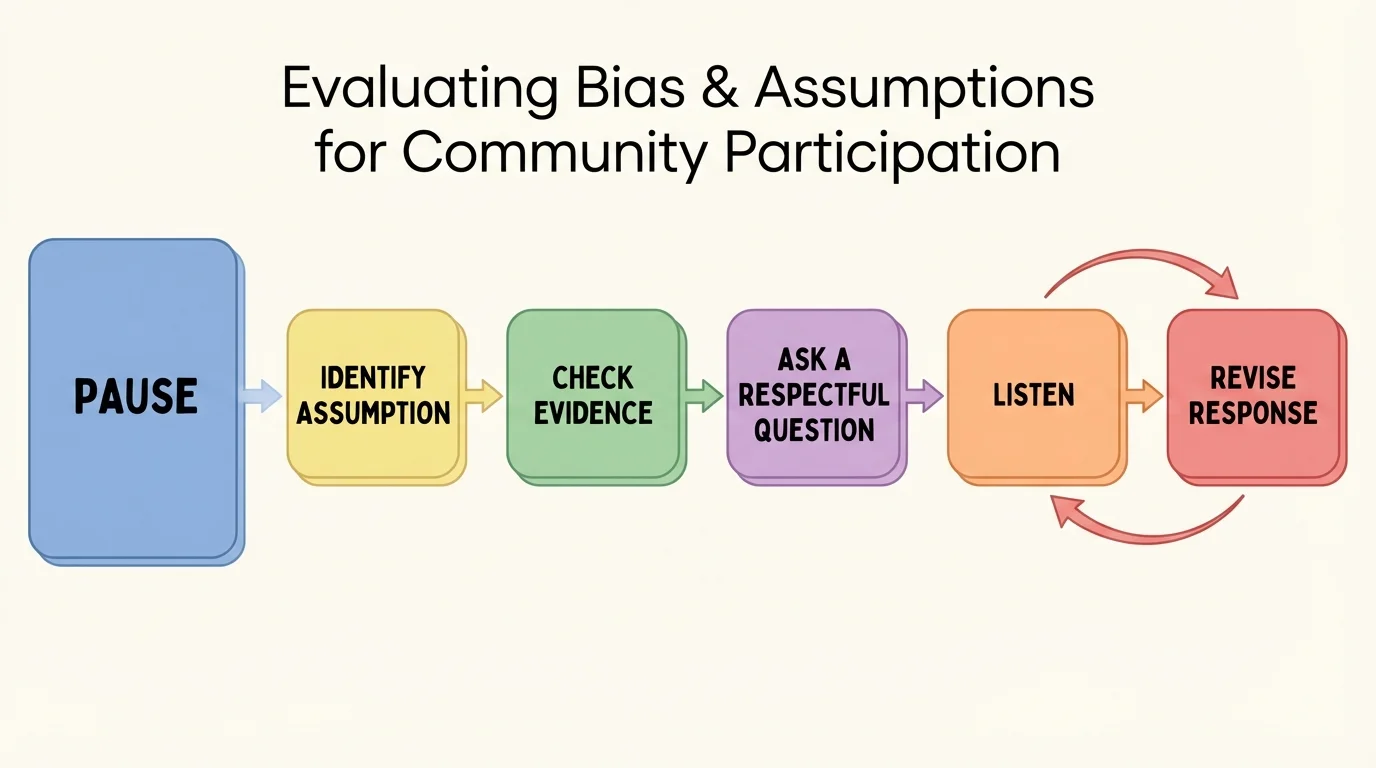
This process is especially useful online, where speed makes mistakes more likely. A delayed message, a clipped reply, or a misunderstood joke can escalate quickly when people respond instantly. Slowing down protects relationships and helps communities stay workable.
Try This: A five-minute reset before reacting
Step 1: When a message bothers you, wait five minutes before replying unless there is a true emergency.
Step 2: Write down two possible explanations for the message, not just the worst one.
Step 3: Reread the message as if it came from someone you trust.
Step 4: Reply with one clarifying question or one calm statement instead of an accusation.
This small habit can prevent a lot of unnecessary damage.
Later, when you are trying to improve a recurring conflict, the same process from [Figure 2] helps you move from reaction to reflection. That is how people grow from being impulsive participants into trustworthy community members.
If you want to make your communities healthier, start with your own behavior. You do not need to be perfect. You do need to be honest and willing to improve.
Listen for patterns, not just volume. The loudest voice is not always the clearest or most informed. Notice who has not spoken yet and whether they have had a real chance to contribute.
Use inclusive communication. Explain inside jokes, define expectations, and avoid treating unwritten rules like common sense. What feels obvious to long-time members may be invisible to new ones.
Ask before judging intent. You can address impact while still checking meaning. "That comment landed badly for me. What did you mean by it?" opens a better conversation than "You are disrespectful."
Be willing to repair harm. If you learn that your assumption was wrong or your words excluded someone, own it clearly. A useful apology sounds like: "I made a judgment before I had the facts. That was unfair. I am sorry. Next time I will ask first."
Notice access issues. If events, deadlines, or communication methods only work for some people, participation will stay uneven. Fairness includes practical design, not just good intentions.
Belonging grows through repeated signals
People decide whether they belong based on repeated experiences: being greeted, being answered, being credited, being corrected respectfully, and being taken seriously. One welcoming message helps, but long-term belonging comes from consistent treatment over time.
When people do this well, communities become more creative, more stable, and more honest. More people are willing to contribute. Problems are surfaced earlier. Leadership becomes less about status and more about responsibility.
Sometimes you are not the one making the unfair assumption. You are the one receiving it. That can be exhausting. It can make you question yourself, withdraw, or feel pressure to prove your value constantly.
You cannot control every other person's bias, but you can choose your response. If it feels safe, name the issue clearly: "I want to respond to the idea that I am not committed. I missed updates because of my work schedule, not because I do not care." Or: "I think my point was dismissed quickly. I would like to finish what I was saying."
It also helps to document patterns in spaces where roles or opportunities matter, such as work, volunteering, or formal community leadership. Save messages, note dates, and keep records if unfair treatment becomes a repeated issue. Documentation turns vague feelings into concrete evidence.
Seek allies when needed. A trusted mentor, organizer, supervisor, or peer can help you assess what is happening and decide whether to address it privately, publicly, or through a formal process. Asking for support is not overreacting. It is a smart way to protect your well-being and participation.
People are often more likely to speak up about unfairness when they know even one other person will back them up. Support changes what feels possible.
You also have permission to set boundaries. Not every community deserves unlimited access to you. If a space repeatedly ignores concerns, punishes honesty, or refuses to examine harmful patterns, leaving may be healthier than staying and shrinking yourself.
[Figure 3] Healthy communities are built through repeated choices. Trust grows when people check assumptions, make room for different perspectives, and respond to harm with accountability instead of defensiveness.
This does not mean communities become conflict-free. In fact, strong communities often handle more honest disagreement because people feel safer telling the truth. The goal is not perfect harmony. The goal is fairer participation, where people can contribute without constantly fighting bias or being reduced to other people's assumptions.
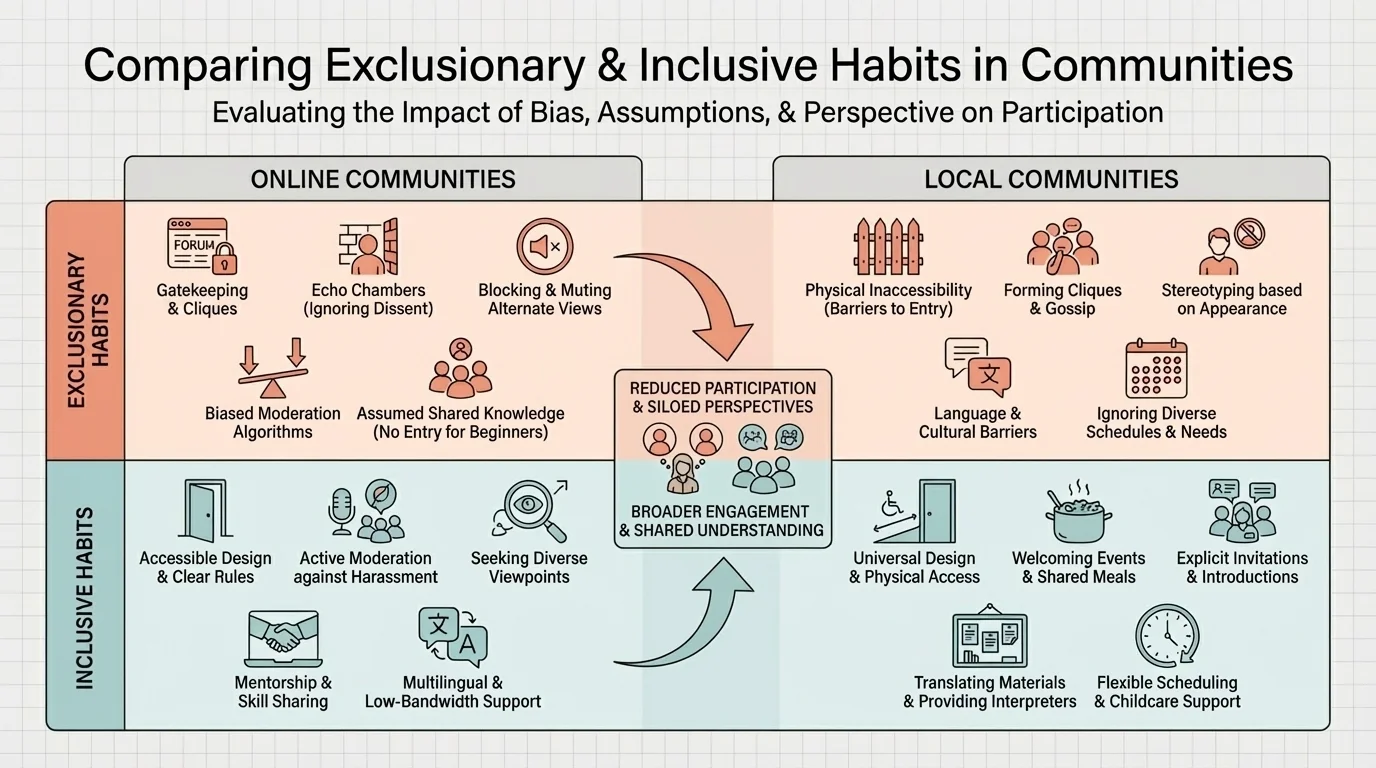
Leaders play a big role here, but regular members matter too. You help shape the culture every time you invite someone in, interrupt a harmful pattern, ask a better question, or reconsider your first reaction. Communities are not only defined by their rules. They are defined by what members repeatedly tolerate, reward, and repair.
Look again at the contrast in [Figure 3]: exclusion usually grows from quick judgment, narrow perspective, and unequal chances to contribute. Inclusion grows from curiosity, empathy, flexibility, and shared responsibility. Those are practical habits, not vague ideals.
If you learn to evaluate how bias, assumptions, and perspective affect participation, you become more than a participant. You become someone who helps create conditions where other people can participate too. That is a real form of leadership, and communities need it.
