Two people can have the same intelligence, the same amount of time, and the same goal, but one gets things done while the other keeps falling behind. The difference is often not motivation alone. It is executive functioning. These are the mental skills that help you plan, start, focus, adjust, and finish. If you have ever known exactly what you needed to do but still did not do it on time, you have already seen how powerful these skills are.
Executive functioning matters in online school, part-time jobs, family responsibilities, and everyday adult tasks. It affects whether you remember a deadline, reply to an email clearly, show up on time for work, keep track of your money, refill medication, or calm yourself down before making a bad decision. Strong executive functioning does not mean being perfect. It means having systems that help you manage real life consistently.
Executive functioning is the set of mental processes that help you manage yourself and your actions to reach a goal. These processes include planning, organizing, paying attention, controlling impulses, remembering important information, shifting strategies when needed, and checking your own progress.
Think of executive functioning as your brain's management system. It does not do the work for you, but it helps direct the work. In practice, that means breaking large tasks into smaller ones, choosing what matters first, noticing distractions before they take over, and recovering when your plan falls apart. That connected system is why executive functioning is so important across school, work, and independent life.
These skills are not only for students who want better grades. They matter any time you need to manage time, behavior, information, and goals. If you are applying for a job, executive functioning helps you track the application deadline, prepare your résumé, respond professionally, and show up on time for an interview. If you are taking care of younger siblings for an hour, executive functioning helps you remember instructions, stay calm, and shift when something unexpected happens.
When executive functioning is strong, daily life feels more manageable. You still have stress, but you can sort it, respond to it, and move forward. When it is weak or overloaded, everything starts to feel harder: simple tasks pile up, small mistakes create bigger problems, and avoidable stress increases. This is why improving executive functioning often leads to better performance without changing your intelligence at all.
Your brain continues developing through your teen years and into early adulthood, especially in areas connected to planning, judgment, and self-control. That means executive functioning can improve a lot with practice, routines, and support.
That is good news, because executive functioning is not fixed. You can build it by using tools, routines, and strategies that reduce chaos and make the next step easier to see.
The first important skill is planning, which means thinking ahead about what needs to happen and in what order. Planning is what helps you realize that a project due Friday really needs attention on Monday, Tuesday, and Wednesday, not just Thursday night.
The second skill is working memory, which is your ability to hold and use information in your mind for a short time. If your supervisor tells you three tasks to complete in order, working memory helps you keep track of them long enough to start. Another major skill is inhibitory control, which helps you stop yourself from doing the first thing you feel like doing. That includes not checking social media during a work shift, not interrupting during a video meeting, and not spending money impulsively.
Cognitive flexibility is the ability to shift when conditions change. If the internet goes out before a live session, flexibility helps you move to a backup plan instead of freezing. Self-monitoring means noticing how you are doing while you are doing it. It helps you catch a mistake in an email before sending it or realize you are spending too long on one part of an assignment.
These skills work together, not separately. For example, you use planning to decide what to do, working memory to hold the steps in mind, inhibitory control to resist distractions, and self-monitoring to check whether the plan is working.
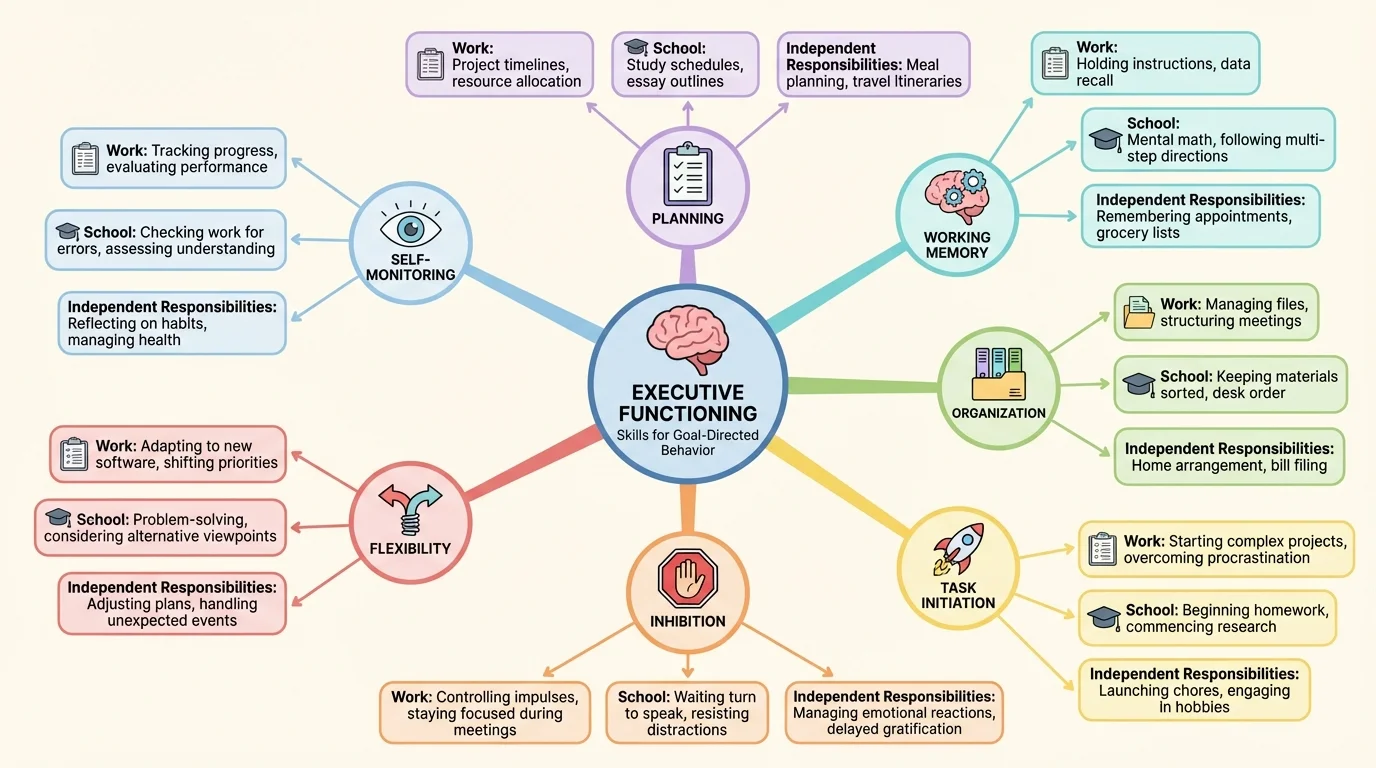
Another essential skill is task initiation, which means starting a task without waiting until the last possible moment. Many students assume starting is about motivation, but often it is about reducing friction. If a task feels huge, vague, or uncomfortable, your brain delays it. Breaking the task into a tiny first action helps you start.
Organization is also part of executive functioning. This includes physical organization, like keeping your workspace usable, and digital organization, like naming files clearly and storing school documents in the right folder. When your materials are disorganized, your brain wastes energy searching, remembering, and re-deciding.
Executive functioning also connects to emotional control, even though people do not always think of emotions when they hear the word "executive." If frustration, anxiety, or anger takes over, planning and focus get weaker. Emotional regulation supports the rest of the system.
Online school gives you flexibility, but it also demands more self-management. No one is physically beside you reminding you to open the right tab, submit the assignment, or stop scrolling. Executive functioning turns a flexible environment into a successful one by turning vague goals into visible actions.
Start with deadlines. A due date by itself is not a plan. If an essay is due in five days, strong executive functioning means reverse-planning: decide what needs to happen first, how long each part will take, and when each step fits into your week. For example, instead of "work on essay," a useful plan might be: choose topic Monday, gather sources Tuesday, make outline Wednesday, write draft Thursday, revise and submit Friday.
That is what students often miss. They keep the task too large. Large tasks are hard to start because there is no obvious first move. Smaller actions are easier to begin, easier to measure, and easier to finish.
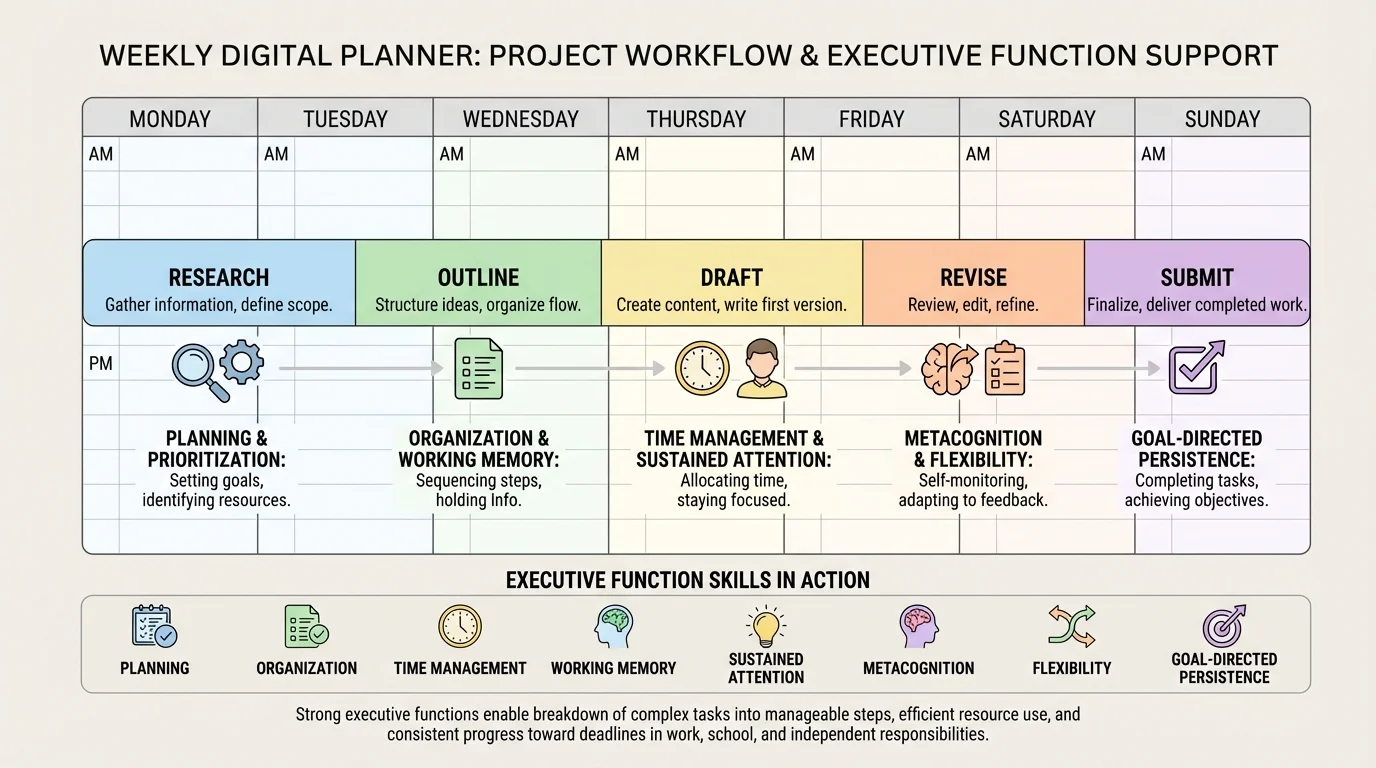
Executive functioning also supports study habits. If you are preparing for a test, planning helps you spread study time across several days instead of cramming. Working memory helps you hold directions and ideas while solving problems or writing responses. Inhibitory control helps you stay with the study session long enough to learn something instead of constantly switching tabs.
Digital organization matters even more in online school. If your downloads folder is full of random file names, you can lose time every day. A simple system helps: one folder for each course, subfolders for notes, assignments, and returned work, and file names that include the date or unit. That sounds small, but it reduces mental load.
Self-monitoring is what lets you ask, "Do I actually understand this, or am I just rereading?" It also helps you notice when your study method is not working. Maybe you need flashcards instead of passive review, a timer instead of open-ended studying, or a quiet room instead of your bed.
Practical school example: turning one deadline into a workable plan
Step 1: Name the final task clearly.
"Submit biology lab report by Friday at 7:00 p.m." is clearer than "finish lab."
Step 2: Break it into parts.
Parts might include reading instructions, organizing notes, writing the introduction, adding data, proofreading, and submitting.
Step 3: Estimate time honestly.
If each part takes about 30 to 45 minutes, the whole task may take around 3 hours, not the 45 minutes you first hoped.
Step 4: Put each part on your calendar.
Schedule the actual work sessions instead of relying on memory.
Step 5: Build in a backup block.
If one session gets interrupted, the task does not collapse.
Try this: Look at your next major assignment and write the first three actions, each small enough to finish in under 20 minutes. You are not waiting to feel ready. You are making it easier to start.
At work, executive functioning often shows up as reliability. Employers notice whether you follow directions, stay organized, manage time, solve problems calmly, and complete tasks without constant reminders. These are not minor details. They affect whether coworkers can trust you.
If you work in food service, retail, childcare, pet care, freelancing, or an internship, planning helps you prepare before your shift or task begins. Organization helps you keep supplies, information, or digital files in order. Inhibitory control helps you stay professional when a customer is rude or when you want to check your phone. Cognitive flexibility helps you adjust when priorities suddenly change.
Communication is part of executive functioning too. Before sending a message to a manager or client, self-monitoring helps you check the tone, spelling, and clarity. Working memory helps you remember instructions long enough to act on them or write them down. If you forget directions often, the answer is not "just try harder." The answer is to create an external system: notes, reminders, or a task list.
Good executive functioning also protects your reputation. Being five minutes late once is different from being late repeatedly because you never prepare the night before. Missing one email by accident is different from regularly forgetting to respond because your inbox is unmanaged. Small patterns become your reputation over time.
"You do not rise to the level of your goals. You fall to the level of your systems."
— James Clear
That idea matters because work success is often less about one big effort and more about repeatable habits. Showing up prepared, tracking responsibilities, and adjusting under pressure are executive functioning skills in action.
Independent life requires many small acts of self-management. You may need to remember appointments, refill toiletries before they run out, keep track of your debit card, plan meals, manage transportation, or save part of your paycheck. None of these tasks is extremely complex alone, but together they require strong executive functioning.
Money management is a clear example. Planning helps you decide how much money can be spent now versus saved for later. Inhibitory control helps you pause before making an impulse purchase. Self-monitoring helps you notice whether your spending matches your priorities. If you earn $120 from a weekend job and decide to save \(\dfrac{1}{4}\) of it, then your savings amount is \(120 \times \dfrac{1}{4} = 30\), so $30 goes to savings and $90 remains for spending.
Health routines also depend on executive functioning. Taking medication on time, going to sleep early enough, drinking water, and attending appointments require planning, memory, and follow-through. Safety is involved too. If you are cooking, doing laundry, or traveling alone, executive functioning helps you stay aware of steps, avoid risky shortcuts, and respond when something changes.
Even home responsibilities use the same skills. If you need to clean your room, help with dinner, and finish homework, prioritization helps you decide the order. Flexibility helps you switch when a family need becomes urgent. Emotional regulation helps you do what needs to be done even when you are irritated or tired.
Why small failures create big stress
Executive functioning problems often hurt through accumulation. One missed deadline becomes two. A messy backpack becomes missing materials. A forgotten bill becomes a late fee. A skipped bedtime becomes poor focus the next day. Strong systems stop small problems from turning into larger ones.
This is why executive functioning supports independence. Independence is not just freedom. It is the ability to manage freedom responsibly.
You can assess executive functioning by looking at patterns, not isolated moments. Everyone forgets things sometimes. Everyone procrastinates at times. The real question is whether these problems happen often enough to interfere with your responsibilities.
| Area | Stronger executive functioning | Weaker executive functioning |
|---|---|---|
| Planning | Breaks tasks into steps and starts early | Waits until pressure is high and tasks feel overwhelming |
| Time management | Uses calendars, alarms, and realistic estimates | Relies on memory and underestimates time |
| Organization | Keeps files, materials, and spaces easy to use | Loses items, mislabels files, and wastes time searching |
| Self-control | Resists distractions and pauses before reacting | Acts impulsively or switches attention constantly |
| Flexibility | Adjusts plans when needed | Gets stuck, shuts down, or gives up when plans change |
| Self-monitoring | Checks work and notices mistakes | Submits incomplete work or repeats the same errors |
Table 1. Comparison of stronger and weaker executive functioning in everyday responsibilities.
Notice that weaker executive functioning does not mean laziness. Sometimes the issue is missing skills, missing systems, overload, stress, poor sleep, mental health struggles, or an environment full of distractions. That does not remove responsibility, but it changes the solution. The solution is not shame. The solution is support plus strategy.
To assess yourself honestly, look for repeated friction points. Where do things keep going wrong? Starting? Remembering? Organizing? Finishing? Staying calm? Adjusting? Your patterns tell you more than your intentions do.
Ask yourself practical questions: Do I usually know the next step? Do I use a planner consistently or only when stressed? Do I forget verbal instructions unless I write them down? Do I lose time on my phone when I am avoiding something uncomfortable? Do I leave enough time to get ready, travel, upload, or revise? Do I notice mistakes before other people point them out?
You can also assess by consequences. If your executive functioning is strong in one area, you will usually see fewer avoidable problems there. For example, if you rarely miss shifts, regularly submit work on time, and can manage a weekly routine, that suggests some executive functioning strengths. If your room, files, schedule, and responsibilities feel constantly out of control, that may signal weak systems or overloaded skills.
Assessment is not about labeling yourself as "good" or "bad" at life. It is about noticing which skill is breaking down so you can choose the right support. A student who cannot start may need a smaller first step. A student who keeps forgetting may need stronger reminders. A student who reacts impulsively may need pause habits and emotional regulation tools.
Try This: For three days, keep a short note on your phone about when you get stuck. Write what the task was, what blocked you, and what you did next. Patterns appear quickly when you collect real evidence.
Improvement starts by externalizing what your brain is trying to hold alone. Put deadlines on a calendar. Use alarms for transitions. Write next actions on paper or in an app. Keep one trusted task list instead of five half-used systems. Good supports reduce the amount of remembering, guessing, and re-deciding you have to do.
Make tasks smaller. "Clean room" is too vague. "Pick up clothes for 10 minutes" is specific. "Study chemistry" is broad. "Answer questions 1–5 and review mistakes" is actionable. Smaller tasks lower resistance and improve task initiation.
Build routines around triggers. For example: after breakfast, check calendar; before bed, set out clothes and charge devices; after each online class, rename and file any downloaded documents. Routines matter because they reduce the number of decisions you must make.
Use environment design. Put your charger where you actually use it. Keep your planner visible. Silence notifications during work blocks. Leave your notebook open to the next unfinished task. Strong systems include a recovery path when focus slips.
Recovery plans are important because even good routines fail sometimes. If you get stuck, you need a short script: stop, identify the next step, remove one distraction, work for five minutes, then reassess. This is much more effective than waiting passively for motivation.
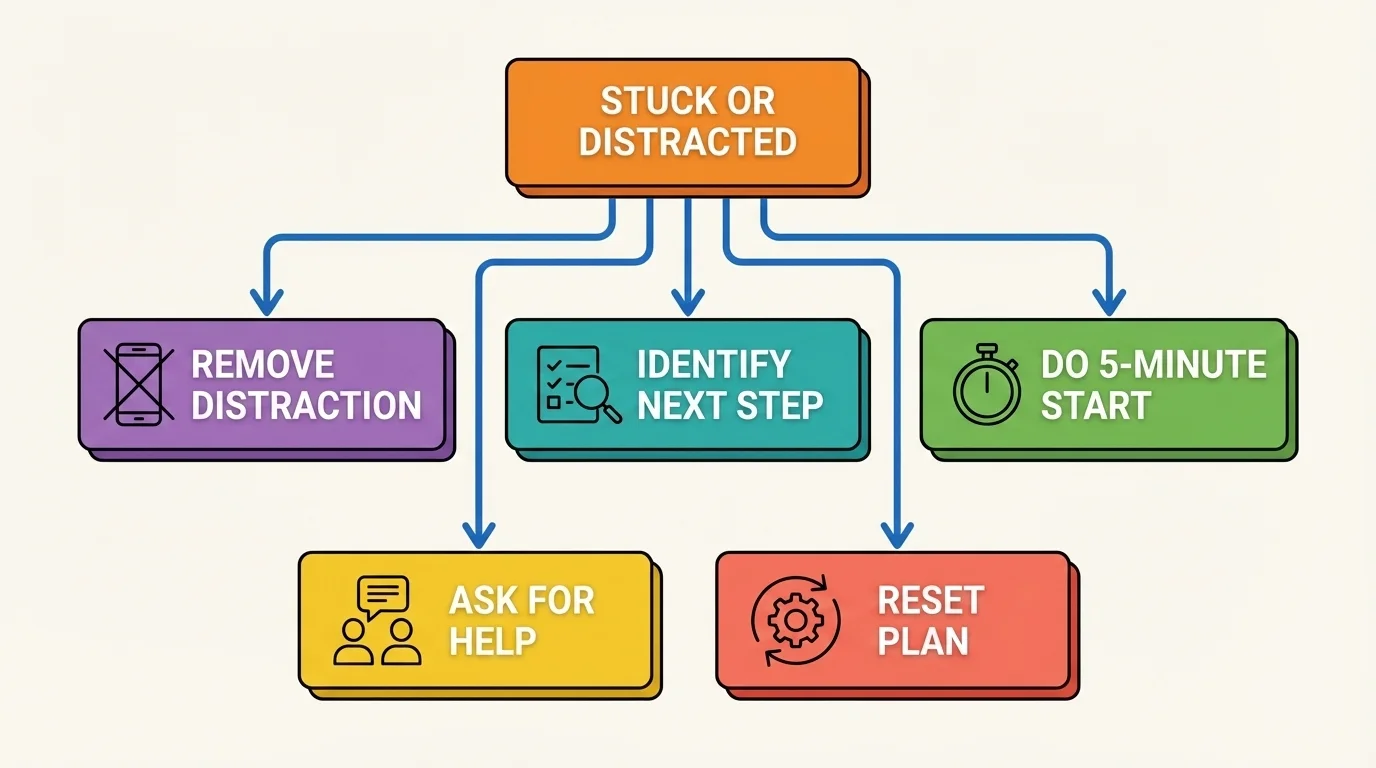
If emotional overload is part of the problem, calm your body first. Take slow breaths, stand up, get water, or step away from the screen for two minutes. Executive functioning improves when your stress level drops enough for thinking to come back online.
System upgrade example: fixing a missed-deadline pattern
Step 1: Identify the actual failure point.
The problem may not be the deadline itself. It may be that you never look at your calendar after writing the due date.
Step 2: Add a daily review time.
Choose one time each day, such as 8:00 a.m. or after lunch, to check your tasks.
Step 3: Turn each deadline into next actions.
Write the next visible action, not just the project name.
Step 4: Add reminders before the deadline.
Set alerts 2 days before and 1 hour before submission.
Step 5: Review what worked.
If you met the deadline, keep the system. If not, change one part and test again.
This matters here because strong executive functioning is not just about the ideal day. It is also about what you do on the messy day when you are behind, distracted, or frustrated.
Consider three quick situations. In online school, you have a discussion post due tonight, a quiz tomorrow, and a group message waiting for a response. Strong executive functioning helps you prioritize the due-today task first, then schedule quiz review, then send a short clear message. Weak executive functioning might lead you to answer the message, scroll for a while, feel stressed, and start the post too late.
At work, your manager sends an updated schedule and asks you to confirm. Strong executive functioning helps you read carefully, add the shift to your calendar, confirm promptly, and set an alarm for when to get ready. Weak executive functioning might mean reading the message, thinking "I'll do that later," then forgetting until it creates a problem.
At home, you need to buy toiletries, save money for gas, and remember a dentist appointment. Strong executive functioning helps you write a list, check your account, plan transportation, and set reminders. Weak executive functioning leaves everything in your head, where it competes with every other thought.
The point is not that one mistake ruins your life. The point is that executive functioning shapes how often avoidable mistakes happen, how quickly you recover, and how much trust others can place in you.
