A lot of relationship problems do not start with one dramatic moment. They start with small choices: replying when you feel pressured, sharing a password to avoid an argument, ignoring a gut feeling, sending a photo you do not really want to send, or saying yes when you actually mean no. These decisions can affect your emotions, your reputation, your safety, and your health. Learning how to evaluate them is not about being suspicious of everyone. It is about protecting your well-being while building relationships based on respect.
At your age, relationships may happen through text, social media, video calls, community activities, work, sports, clubs, or friend groups. Some are serious. Some are casual. Some are confusing. No matter what kind of relationship it is, good decision-making matters. A healthy relationship should not require you to ignore your boundaries, hide important facts, or risk your physical or emotional safety.
Every relationship choice sends a message to both people involved. It can say, "I respect you," "I respect myself," "I am being honest," or unfortunately, "I am ignoring warning signs." Strong relationship decisions are not only about feelings. They are also about judgment. Someone can be attractive, fun, and exciting, and still be a poor or unsafe choice if they pressure you, lie to you, violate your privacy, or ignore your limits.
Good choices usually protect four things at once: your autonomy, your future, your safety, and your health. If one decision threatens all four, that is a sign to slow down. This matters whether the decision is about dating, physical affection, sexual activity, sharing personal information, meeting up, or ending a relationship.
Healthy relationship means a relationship built on respect, honesty, trust, communication, and boundaries.
Boundary means a limit you set about what you are comfortable with physically, emotionally, digitally, and socially.
Autonomy means your right to make choices about your own body, time, feelings, and personal information.
A useful way to evaluate any relationship choice is to run it through four questions: Is there real agreement? Are both people acting responsibly? Is the choice safe? Do I have accurate health information? This four-part lens, shown in [Figure 1], helps you think clearly even when emotions are strong.
When people skip one of these areas, problems grow fast. A choice might feel romantic but fail the safety test. It might seem mutual but fail the consent test. It might feel private but involve major health risks that no one discussed. Smart relationship decisions look at the full picture, not just the mood of the moment.
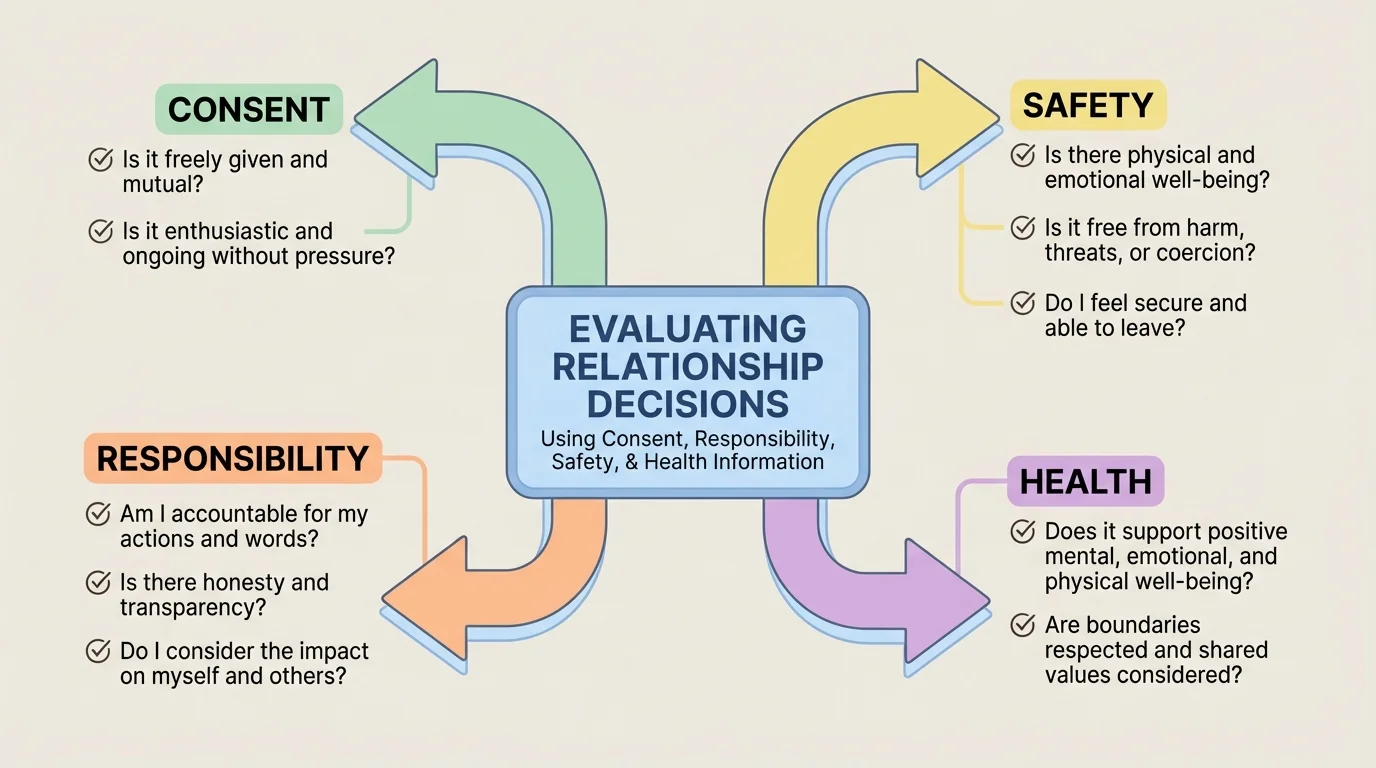
Consent asks: Has each person freely said yes? Can either person change their mind? Does everyone understand what they are agreeing to?
Responsibility asks: Are both people being honest, respectful, and accountable? Are they considering consequences for themselves and each other?
Safety asks: Could this choice put someone in danger physically, emotionally, sexually, or digitally? Are there warning signs of control, pressure, or abuse?
Health asks: Do you have reliable information about sexual health, pregnancy, sexually transmitted infections, testing, and prevention? Are you making decisions based on facts instead of guesses or rumors?
This lens works for many situations, not just sexual decisions. It can help you decide whether to share your location, whether to meet someone from online in person, whether to post about your relationship publicly, whether to keep talking to someone who makes you uncomfortable, or whether to stay in a relationship that drains your mental health.
[Figure 2] Consent means a clear, voluntary, informed, and ongoing yes. It is not silence. It is not "I guess." It is not giving in because someone keeps asking. It is not real if someone is scared, pressured, manipulated, asleep, impaired, or unable to make a clear decision.
As real consent looks very different from pressure. A good rule is this: if you are confused about whether someone wants something, that means you do not have a solid yes. Stop and ask. The same rule applies to your own feelings. If you feel unsure, rushed, guilty, frozen, or afraid of disappointing someone, that is a sign to pause. Your uncertainty matters.
Consent is also reversible. Saying yes once does not mean saying yes forever. Agreeing to one activity does not mean agreeing to another. Being in a relationship does not remove the need for consent. Even if two people have done something before, each new moment still requires respect and choice.
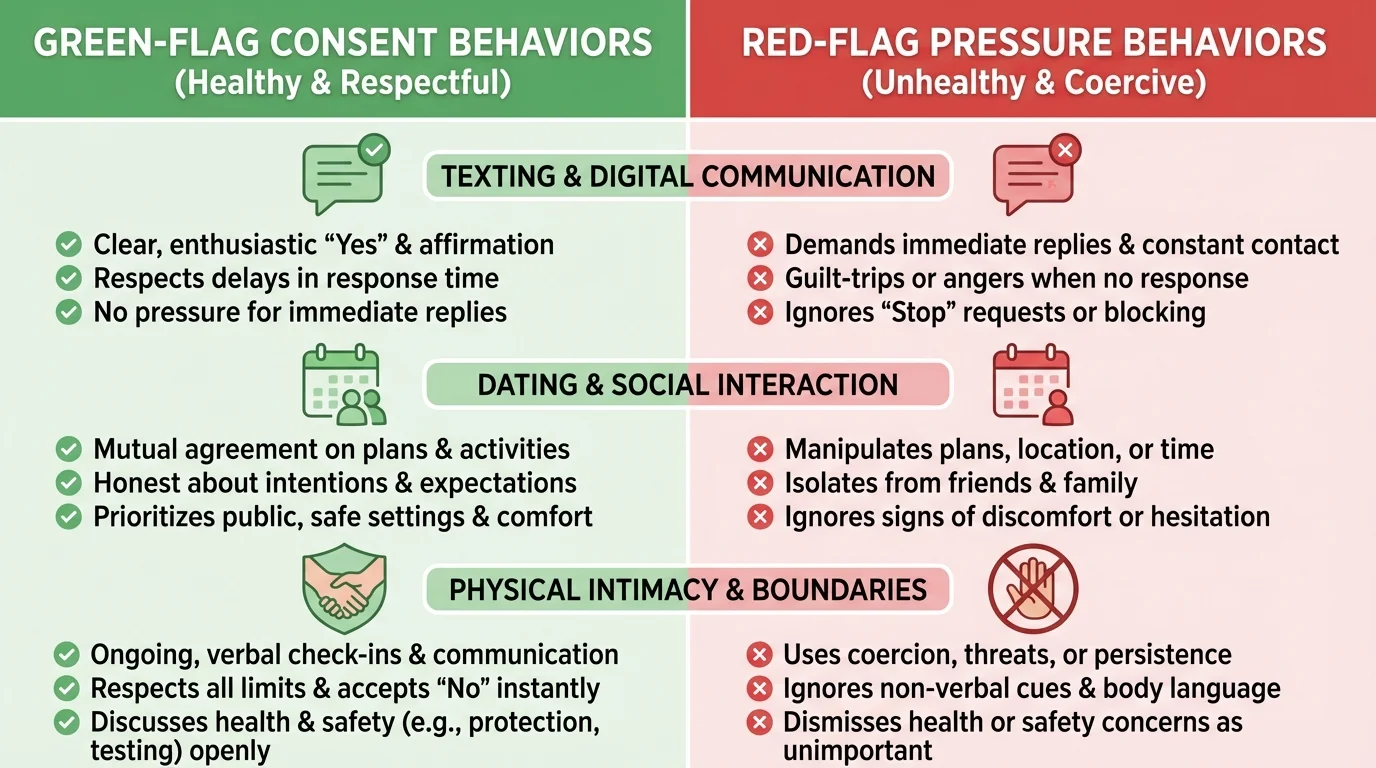
Digital situations count too. If someone pressures you to send sexual messages, photos, or videos, that is a consent issue. If they say, "If you loved me, you would send it," they are using manipulation, not respect. If they share private messages or images without permission, they have violated your trust and privacy. Digital actions can have long-term consequences that spread far beyond the original conversation.
Here are signs consent is not present: repeated pestering after a no, guilt trips, threats to break up, anger when boundaries are set, ignoring body language, touching without asking, or treating a relationship like automatic permission. These are not minor communication mistakes. They are serious warning signs.
How to check for real consent
Use clear words, pay attention to tone and body language, and leave room for a real no. Healthy communication sounds like: "Are you comfortable with this?" "Do you want to keep going?" "It is completely okay if not." Respect does not ruin the moment; it makes the moment safer and more trustworthy.
If someone respects you, they do not punish you for setting a boundary. They may feel disappointed, but they still accept your answer. That is one way to tell the difference between attraction and respect. Attraction says, "I want this." Respect says, "Your choice matters."
Responsibility in relationships means owning your actions and considering how they affect another person. It includes honesty, keeping agreements, communicating clearly, respecting privacy, and handling conflict without cruelty. It also means being truthful about things that could affect someone else's decisions, including your intentions, other relationships, and important health information.
Responsibility is not just about avoiding harm. It is about actively building trust. For example, if you tell someone you are not ready for a serious relationship, that honesty helps them make informed choices. If you hide important facts to keep their interest, that is irresponsible because it removes their ability to decide freely.
Responsible behavior also includes what you do online. You should not demand passwords, go through someone's private messages, post about them without permission, or pressure them to stay constantly available. Some controlling behaviors get normalized as "just caring," but monitoring is not the same as caring.
Conflict is another test. In healthy relationships, disagreements happen, but the way they are handled matters. Name-calling, public humiliation, revenge posting, silent treatment used as punishment, and threats are not mature problem-solving. Responsibility sounds more like: "I am upset, but I want to talk respectfully," or "I need a break and I will message you later."
| Behavior | Responsible choice | Irresponsible choice |
|---|---|---|
| Sharing personal information | Ask before posting or forwarding | Share screenshots without permission |
| Handling jealousy | Talk honestly about feelings | Track, accuse, or isolate |
| Making plans | Be clear and reliable | Manipulate or disappear repeatedly |
| Discussing intimacy | Be truthful and respectful | Lie, pressure, or avoid important facts |
Table 1. Comparison of responsible and irresponsible relationship choices.
The ideas in [Figure 1] still apply here: a choice can fail even if one part looks okay. Someone might ask for consent in one moment but still act irresponsibly by lying, cheating, sharing private content, or ignoring agreed boundaries later.
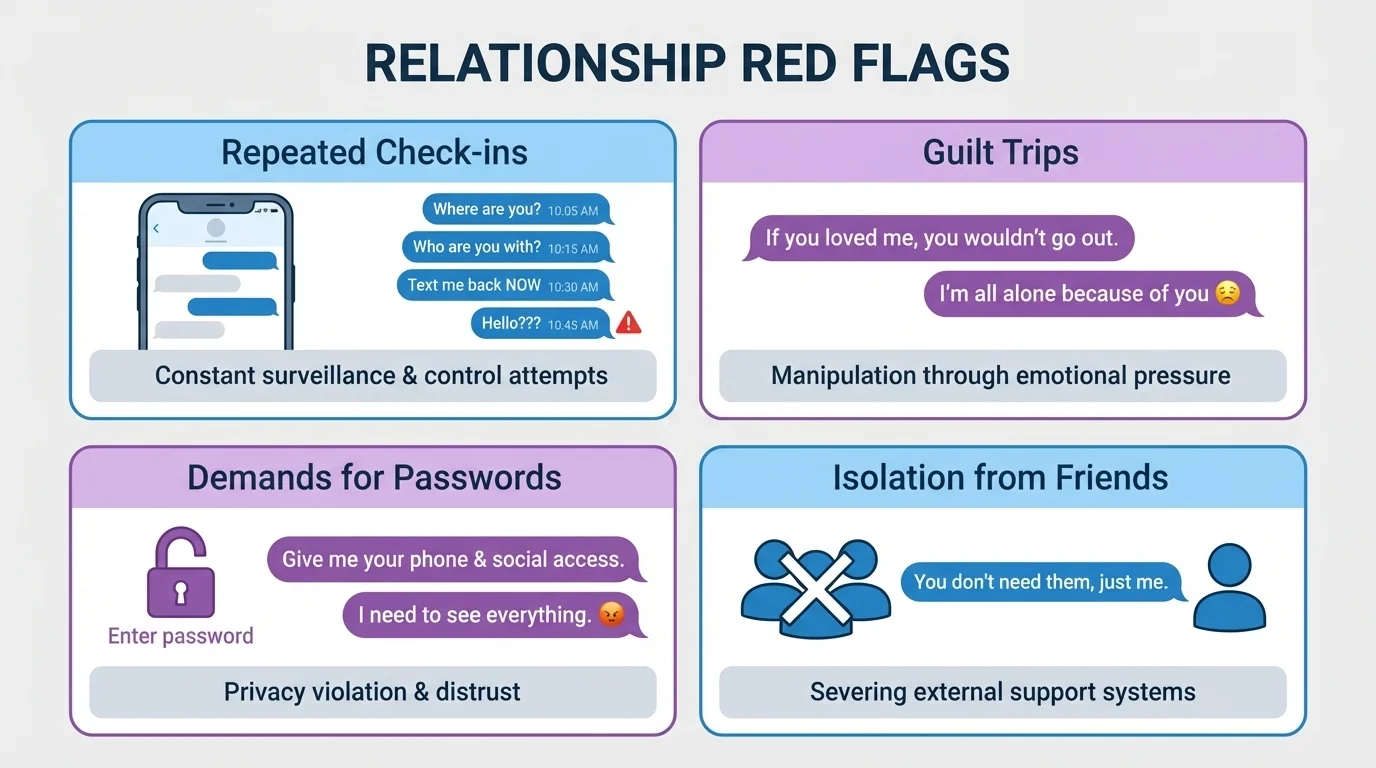
Safety is bigger than avoiding physical injury. It also includes emotional safety, sexual safety, and digital safety. A relationship should not leave you walking on eggshells, afraid to say no, or worried that your private information will be used against you. The warning signs in [Figure 3] highlight how unsafe behavior often begins with control, not with obvious violence.
Physical safety means paying attention to where you are, who you are with, whether anyone is impaired, and whether you can leave if needed. If you are meeting someone from online or from a new social circle, choose a public place, tell a trusted person where you are, keep your own transportation options if possible, and trust your instincts if something feels off.
Emotional safety means you are not being humiliated, threatened, isolated, or constantly manipulated. If someone uses your insecurities against you, threatens self-harm to control you, says no one else would want you, or keeps turning every disagreement into your fault, that is unsafe. It can wear down your confidence and make it harder to leave.
Digital safety matters because phones and apps can become tools of control. Demanding your location, insisting on instant replies, checking your online status, pressuring you for passwords, or threatening to leak messages or photos are all major warning signs.
You do not need proof that a situation is dangerous before taking it seriously. If a pattern makes you feel trapped, scared, or pressured, that is enough reason to step back and seek support. Sometimes the healthiest decision is not to explain your boundary over and over. It is to end the conversation, block contact, document threats, and talk to a trusted adult or professional.
Many abusive relationships begin with behaviors that are mistaken for intense caring, such as constant texting, jealousy, or wanting all of your attention. Control can look flattering at first, which is one reason red flags are easy to miss.
Later, when you evaluate scenarios, come back to the warning signs from [Figure 3]. Unsafe patterns usually become clearer when you stop asking, "Do they like me?" and start asking, "Do I feel respected, free, and secure?"
Health information is essential because feelings do not prevent consequences. If a relationship decision involves sexual activity, both people need accurate information about pregnancy risk, contraception, sexually transmitted infections, testing, and medical care. Guessing, trusting rumors, or assuming "it will probably be fine" is not good enough.
A sexually transmitted infection (STI) is an infection that can spread through sexual contact. Some STIs have obvious symptoms, but many do not. That means a person can have one without knowing it. Testing matters because "I feel fine" is not the same as "I know my status."
Contraception is a method used to reduce the chance of pregnancy. Different methods work in different ways, and no method should be chosen based on random social media advice. A medical professional or reliable health source can explain effectiveness, side effects, and proper use. Condoms are especially important because they can reduce the risk of both pregnancy and many STIs, while some other methods mainly address pregnancy risk.
Testing helps people make informed choices. Before sexual activity, responsible partners talk honestly about protection, testing, and boundaries. That conversation can feel awkward, but avoiding it does not make the risk disappear. In fact, being able to discuss health openly is a sign of maturity and respect.
When getting information or care, confidentiality means your personal health information is handled privately within legal limits. If you have questions about what services are private for teens where you live, a clinic, doctor, school nurse, telehealth service, or trusted adult can help you understand your options.
Reliable health information usually comes from doctors, licensed clinics, public health organizations, or reputable medical websites. It does not come from a partner saying "trust me," from rumors in group chats, or from viral posts that oversimplify serious issues. A healthy relationship supports fact-based choices, not pressure-based ones.
Real-world example: using health information responsibly
Suppose two people are thinking about becoming sexually active.
Step 1: They talk honestly about whether they both want that, without pressure.
Step 2: They discuss boundaries, protection, and what each person is and is not comfortable with.
Step 3: They get accurate information from a reliable source instead of relying on myths.
Step 4: If they cannot talk respectfully about health, they recognize they are not ready for that decision.
The responsible choice is not just about whether they proceed. It is about whether they can make the decision with honesty, consent, safety, and facts.
When emotions are intense, your brain can rush toward the fastest answer instead of the wisest one. That is why it helps to use a simple process. This tool gives you a repeatable way to slow down and evaluate what is happening before you act.
[Figure 4] Step 1: Pause. If you feel rushed, pressured, flattered, scared, or confused, do not decide instantly. You are allowed to take time.
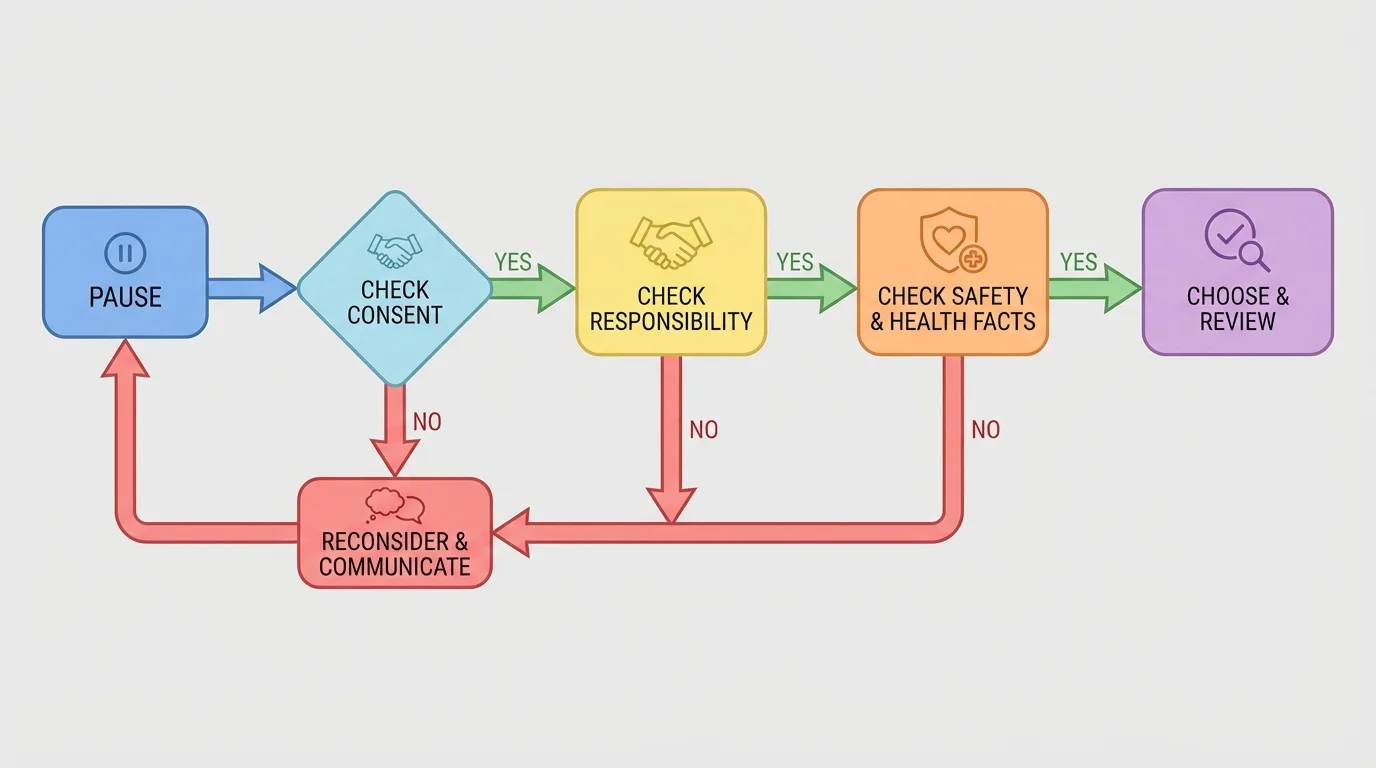
Step 2: Check consent. Has everyone clearly agreed? Is anyone unsure, impaired, scared, or being pressured? Can either person change their mind without punishment?
Step 3: Check responsibility. Is the communication honest? Are both people respecting privacy and boundaries? Is anyone hiding important information?
Step 4: Check safety and health facts. Could this choice create physical, emotional, digital, or sexual harm? Do you have accurate information, not just assumptions?
Step 5: Choose and review. Make the decision that protects your well-being. Afterward, ask yourself whether the choice matched your values. If not, adjust next time without shaming yourself.
This process works for big and small choices: responding to a pressure-filled message, deciding whether to meet someone, figuring out whether to keep dating a person with red flags, or deciding whether to be physically intimate. When you use a process instead of just a feeling, you usually make stronger decisions.
Scenario thinking is useful because relationship decisions often happen quickly. The more you practice spotting the pattern, the easier it is to act in real time.
Scenario 1: Pressure for a private image
A person you are dating online asks for a revealing photo and says, "Come on, you can trust me. I would never share it."
Check consent: If you do not genuinely want to send it, there is no consent.
Check responsibility: A respectful partner does not pressure you or ask you to prove your feelings this way.
Check safety: Once shared, digital content can be copied, saved, or used for blackmail.
Best choice: Say no clearly, stop engaging if pressure continues, and seek help if they threaten or harass you.
Notice how this scenario fails all four parts of the lens. It is not just a privacy issue. It is also a consent and safety issue. The red flags from [Figure 3] apply directly here.
Scenario 2: Changing your mind during physical affection
You agreed to kiss someone, but then you start feeling uncomfortable and want to stop.
Check consent: You can change your mind at any point.
Check responsibility: The other person should stop immediately and respect your boundary.
Check safety: If they ignore your words or body language, the situation is unsafe.
Best choice: Say stop, move away, contact support if needed, and do not minimize what happened.
This is where understanding that consent is reversible matters. A previous yes does not cancel a current no. The contrast in [Figure 2] makes that difference clear.
Scenario 3: A partner wants all your passwords
They say sharing passwords proves loyalty and that couples should have "no secrets."
Check consent: You have a right to your digital privacy.
Check responsibility: Trust is built through honesty, not surveillance.
Check safety: This can become controlling behavior and increase the risk of harassment or impersonation.
Best choice: Keep your accounts private and treat the demand as a serious boundary issue.
Healthy closeness does not require giving up your independence. If someone equates control with love, that relationship needs careful reevaluation.
If something feels wrong, you do not have to solve it alone. A trusted adult, parent or guardian, counselor, doctor, nurse, coach, youth leader, or helpline can help you think clearly and stay safe. Asking for help is not overreacting. It is a responsible action.
If a situation may be unsafe, protect yourself first. Save evidence of threats or harassment, adjust privacy settings, block contact if needed, tell a trusted person what is happening, and seek medical care or crisis support when appropriate. If sexual contact happened without consent, immediate medical and emotional support can matter a lot.
One more important point: making one poor decision does not define your future. What matters is what you do next. You can learn, set stronger boundaries, get accurate health information, and choose relationships that treat you with dignity. The goal is not perfection. The goal is making choices that align with respect, safety, and your long-term well-being.
"A healthy relationship never requires you to give up your voice in order to keep the peace."
When you are unsure, return to the framework in [Figure 4]: pause, check consent, check responsibility, check safety and health facts, then choose. That habit can protect you in moments when pressure, attraction, or fear make it hard to think clearly.
