One of the biggest surprises about adulthood is this: most serious problems do not begin as serious problems. A missed alarm turns into being late. Being late turns into a warning at work. An unpaid bill becomes a fee. A messy room becomes lost paperwork. Independent living is not mainly about being fearless or perfectly mature. It is about building systems that keep your life steady even when you are tired, stressed, busy, or distracted.
That matters whether you plan to move out soon, live with family for a while, share an apartment later, or eventually manage a place on your own. The goal is not to know everything today. The goal is to learn how to make good everyday decisions about where you live, how you use your time, how you get where you need to go, and how you take care of yourself.
Independence works like a system
Housing, time, logistics, and personal upkeep affect each other. If your schedule is disorganized, you may miss rent deadlines or appointments. If your room is chaotic, you may lose documents or clothes you need. If your transportation plan is weak, you may be late and damage trust. Strong independent living means creating routines that support all four areas at once.
A good way to think about adult responsibility is this: make the next necessary thing easier. Set out clothes the night before. Save important phone numbers. Check your calendar daily. Refill soap before it runs out. Charge your phone before your battery reaches almost zero. These are small actions, but they protect your energy and help you stay reliable.
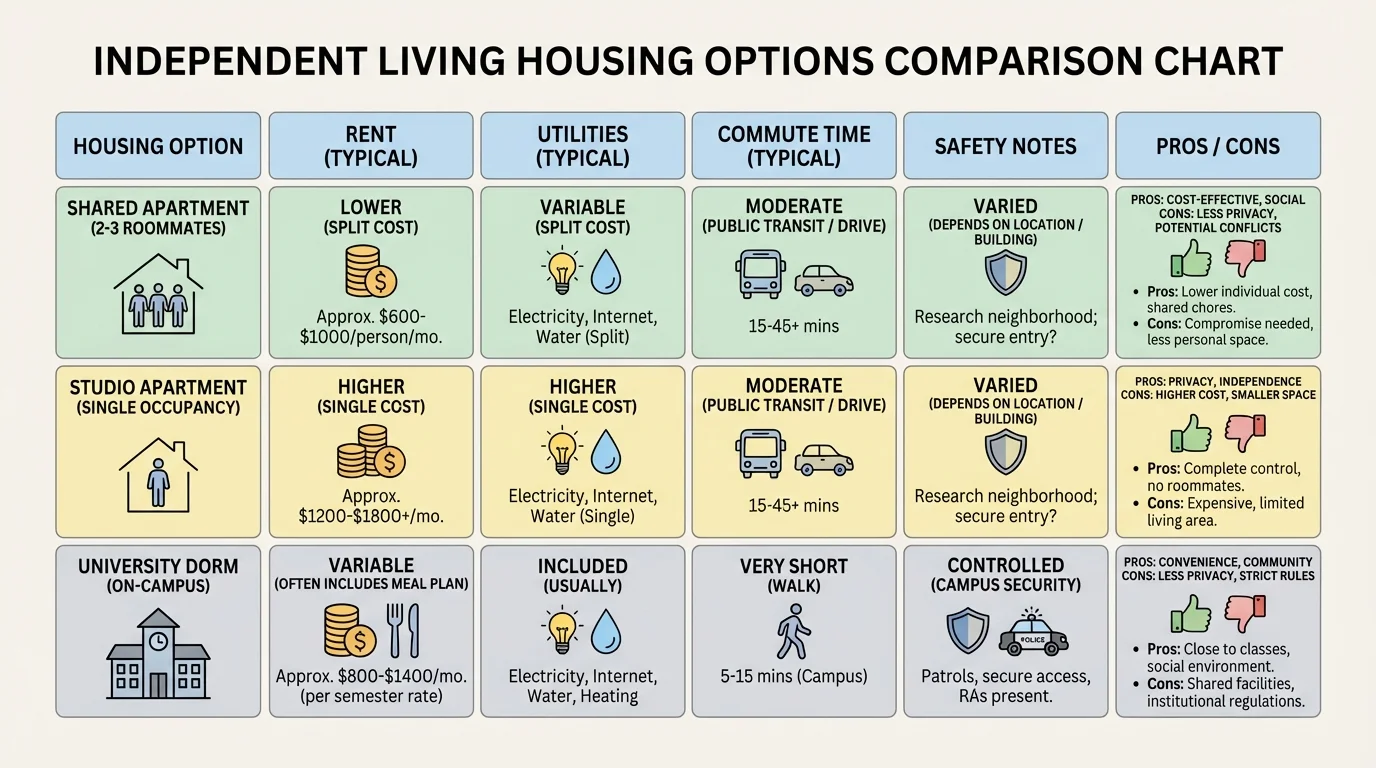
Housing stability means having a living situation that is safe, predictable, and financially manageable. A place is not truly a good fit just because it looks nice online. You need to think about cost, rules, location, transportation, safety, privacy, and what responsibilities come with living there.
Start with needs before wants. Needs include safety, affordability, access to transportation, internet access, enough space to sleep and study, and basic cleanliness. Wants might include a trendy neighborhood, more space, newer appliances, or extra amenities. Wants matter, but if they make housing too expensive or unstable, they stop being helpful.
[Figure 1] shows how a simple decision grid can help when you compare places. Instead of asking only, "Do I like this place?" ask better questions: Can I get to work, appointments, and stores? Are utilities included? How loud is it? Who else lives there? What happens if something breaks? A smart housing choice is one that still works on a stressful week, not just on a good day.
If you may live with roommates one day, understand that shared housing saves money but increases the need for communication. Talk about bills, cleaning, overnight guests, shared food, quiet hours, and what happens if someone wants to move out. Many conflicts happen because people assume instead of agreeing.
A lease is a legal agreement, not just a formality. Read it carefully. Notice the rent amount, due date, late fee, security deposit rules, maintenance process, guest rules, pet rules, and the length of the agreement. If rent is $800 and the late fee is $50, paying on time saves more than money; it protects your record as a tenant.
Remember that rent is often not the full cost of housing. Utilities may include electricity, water, gas, trash, and internet. If rent is $800 and utilities average $140, your housing total is $940, not $800. If you also spend $60 on transportation to get there each month, the practical cost becomes $1,000. Thinking this way prevents bad surprises.
| Housing Factor | What to Check | Why It Matters |
|---|---|---|
| Rent | Monthly amount and due date | Late or unaffordable rent risks eviction |
| Utilities | Included or separate | Changes the real monthly cost |
| Location | Distance from work, stores, support | Affects time, fuel, and stress |
| Safety | Locks, lighting, neighborhood, emergency contacts | Protects you and your belongings |
| Rules | Guests, pets, noise, move-out terms | Prevents conflict and penalties |
| Maintenance | Who fixes problems and how to report them | Keeps the home livable |
Table 1. Key housing factors to review before agreeing to live somewhere.
Keeping housing is as important as finding it. That means paying on time, reporting problems early, respecting shared spaces, following rules, and communicating professionally with landlords or property managers. If a sink leaks and you ignore it, the damage gets worse. If you report it quickly and clearly, you show responsibility.
Documentation matters too. Save copies of leases, payment confirmations, photos of the condition of a place when you move in, and written communication about repairs. Organized records can protect you if there is a disagreement later.
Try This: Make a housing checklist in your notes app with categories for cost, safety, commute, utilities, rules, and roommate expectations. Even if you are not moving now, building the habit of evaluating a place carefully is a real adult skill.
Comparing real monthly housing cost
You are looking at two possible places.
Step 1: Add the visible monthly costs for Place A.
Place A has rent of $750, utilities of $130, and transportation costs of $90.
The total is \(750 + 130 + 90 = 970\).
Step 2: Add the visible monthly costs for Place B.
Place B has rent of $840, utilities included, and transportation costs of $40.
The total is \(840 + 40 = 880\).
Step 3: Compare the practical cost.
Even though Place B has higher rent, it costs less overall because transportation and utilities are lower.
The difference is \(970 - 880 = 90\).
Place B saves $90 per month in real living cost.
Time blocking is the practice of assigning specific parts of your day to specific tasks. It sounds simple, but it changes everything. Instead of hoping you will "find time," you decide where your time goes before the day gets noisy.
[Figure 2] shows what a realistic week can look like. One mistake many people make is treating all time as flexible. It is not. Sleep, meals, classes, work shifts, transportation, appointments, and deadlines already use part of your week. If you ignore those fixed parts, you create a schedule based on fantasy. A realistic week includes both required tasks and breathing room.
Use one main calendar. It can be digital or paper, but avoid scattering important information across random messages, screenshots, and memory. Put in assignment deadlines, work shifts, bill dates, family obligations, appointments, and reminders. Check it in the morning and at night.
Then build a basic routine. Morning routines do not need to be impressive. A useful one might include getting up, washing up, getting dressed, eating something, checking the calendar, and making a top-three list for the day. Evening routines might include setting out clothes, plugging in devices, tidying your space for five minutes, and reviewing tomorrow.
Prioritizing helps when everything feels urgent. Try three categories: must do today, should do soon, and can wait. A bill due tonight belongs in the first group. Laundry you still have enough clothes to postpone for two days belongs in the second. Reorganizing your playlist belongs in the third.
Give yourself buffer time. If a video call starts at noon, do not plan another task until exactly noon. Leave space to transition, fix tech issues, or recover from delays. People who seem "naturally on top of things" often are not faster; they just leave more margin.
Another smart move is task capture. The moment you remember something important, write it down. Your brain is good at noticing tasks, but not great at storing them reliably under stress. Notes apps, calendars, and checklists are tools, not signs of weakness.
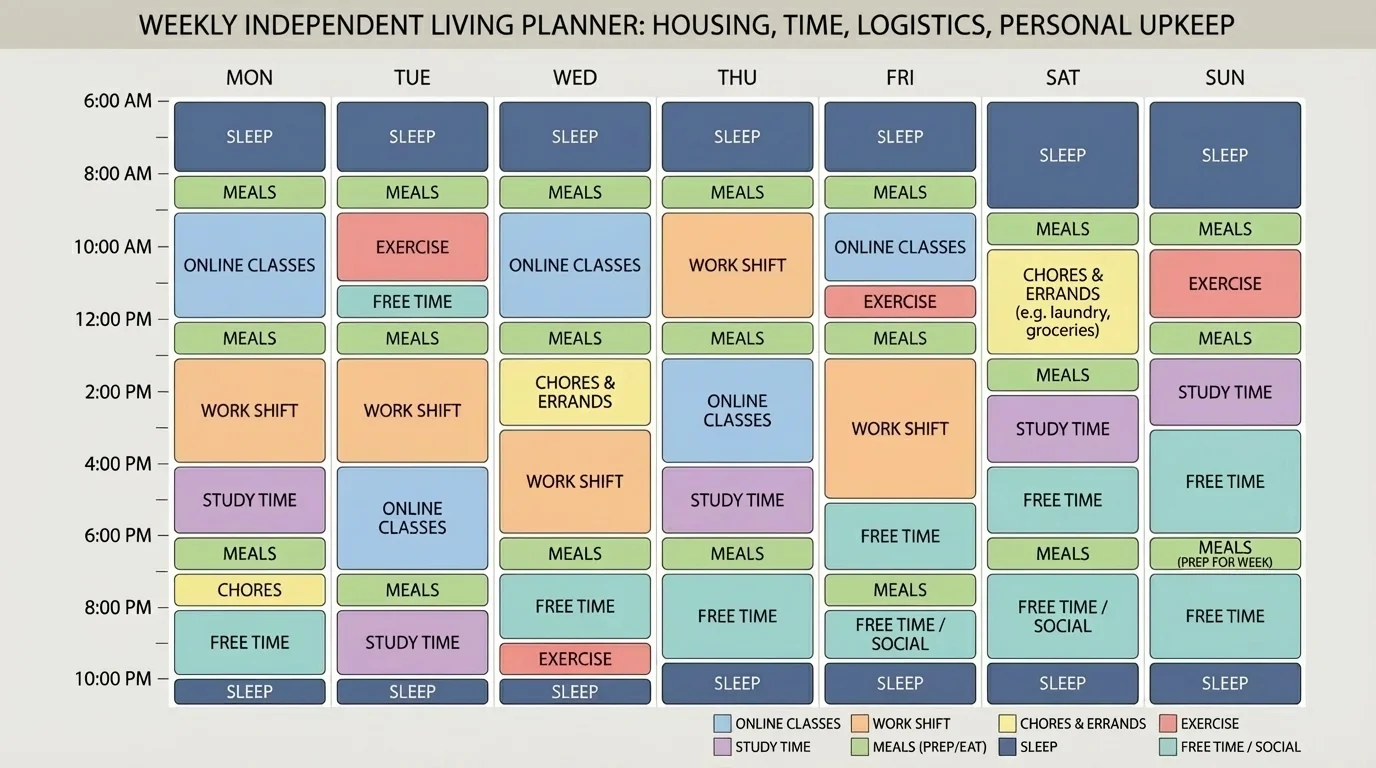
Notice how a strong weekly plan includes chores and rest, not just productivity. If you wait until you "have time" to clean, shop, or recover, those tasks usually pile up. Later, when you build a weekly reset system, that idea connects directly to this one: planned maintenance beats emergency cleanup.
People often underestimate how long tasks will take, especially when the task includes setup, travel, waiting, or cleanup. Planning for the full task instead of just the main action makes your schedule far more accurate.
Try This: For one week, track how long common tasks really take: showering, getting ready, cooking, laundry, grocery runs, school assignments, and travel. Your future plans will get smarter fast.
Logistics means organizing the practical details that help life run smoothly. In everyday life, that includes transportation, documents, scheduling, errands, charging devices, knowing where your keys are, and having what you need before you leave.
A trip is not just the travel itself. It includes preparation. If you have an appointment at \(3{:}00\) p.m., ask: How long does the trip take? What if there is traffic or a delay? What do I need to bring? Is my phone charged? Do I know the address? Good logistics means thinking one step ahead.
Always have a backup plan. If your main ride falls through, what is option two? If your phone dies, do you know the address another way? If weather changes, how does that affect travel time? Independence means not being shocked by common disruptions.
Errands are easier when grouped. Instead of making three separate trips in one week, combine tasks by location or type. If the pharmacy, grocery store, and bank are near each other, planning one trip saves time, fuel, and stress.
Keep essential documents in one secure place: identification, health insurance information if you have it, bank details, lease copies, school records, job paperwork, and emergency contacts. Physical copies should be protected from damage. Digital copies should be stored securely with passwords. Lost documents can create huge delays in moments when you need them fast.
Communication is part of logistics too. If you will be late, tell the person early instead of after the scheduled time. If you do not understand instructions, ask before the deadline. Short, respectful messages protect trust. For example: Hello, I am on my way but delayed by traffic. My arrival time is now about 4:15 p.m. Thank you for your patience.
Planning a realistic appointment trip
You have an appointment at 2:30 p.m. The drive usually takes \(25\) minutes, but parking and walking in take about \(10\) more minutes.
Step 1: Add travel and arrival time.
The total preparation time is \(25 + 10 = 35\) minutes.
Step 2: Add a buffer.
If you add a \(15\)-minute buffer for delays, the total becomes \(35 + 15 = 50\) minutes.
Step 3: Count backward from the appointment time.
Leaving \(50\) minutes early means you should leave by 1:40 p.m.
Planning backward reduces the chance of arriving stressed or late.
Good logistics also includes home logistics. Keep a launch spot near the door for keys, wallet, bag, charger, and anything you must take out with you. Searching for essentials every morning wastes time and raises stress before your day even starts.
Personal upkeep means the ongoing habits that keep your body, clothes, space, and appearance in workable condition. It is not about looking perfect. It is about health, comfort, self-respect, and being ready for normal life demands.
Start with the basics: hygiene, sleep, food, hydration, clean clothes, and regular cleaning. These habits affect mood, focus, energy, and how other people experience you. If you are sleep-deprived, wearing wrinkled clothes, skipping meals, and living in a messy room, everything feels harder than it needs to.
Hygiene includes bathing or showering regularly, brushing and flossing teeth, washing hands, using deodorant, and wearing clean clothes. The exact routine may vary by your body, climate, activity level, culture, and hair type, but the principle is the same: care for your body before there is a problem, not only after.
Laundry is one of the easiest tasks to procrastinate and one of the fastest to create chaos. Wait too long, and suddenly you have no socks, no clean towel, and no outfit that feels acceptable for a video interview or shift at work. A regular laundry day is much easier than a clothing emergency.
Food management matters too. You do not need chef-level skills to live well, but you do need a few reliable meals and snacks. Learn how to keep basic groceries on hand, store food safely, and notice when supplies are getting low. Skipping meals often looks small in the moment but leads to low energy, irritability, and bad decisions later.
Cleaning is not just cosmetic. Dishes prevent odors and pests. Trash removal prevents buildup. Wiping surfaces reduces germs. Changing sheets and towels improves comfort and hygiene. Vacuuming or sweeping improves the space you have to think, rest, and work in.
Your appearance also sends messages. Clean, appropriate clothes, basic grooming, and a put-together look tell employers, clients, and other adults that you can manage yourself. This does not mean expensive brands. It means clothes that fit the situation, are clean, and do not distract from what you want to communicate.
"You do not rise to the level of your goals. You fall to the level of your systems."
— Common productivity principle
Health maintenance belongs here too. Refill medications on time if needed. Keep track of appointments. Rest when you are sick. If stress, anxiety, or low mood are interfering with your daily life, ask for support early. Independence does not mean handling everything alone. It means knowing how to get help before a problem grows.
Try This: Create a "minimum upkeep list" for difficult days: shower or wash face, brush teeth, drink water, eat something with protein, put on clean clothes, and do a five-minute room reset. Even a reduced routine keeps you from sliding backward.
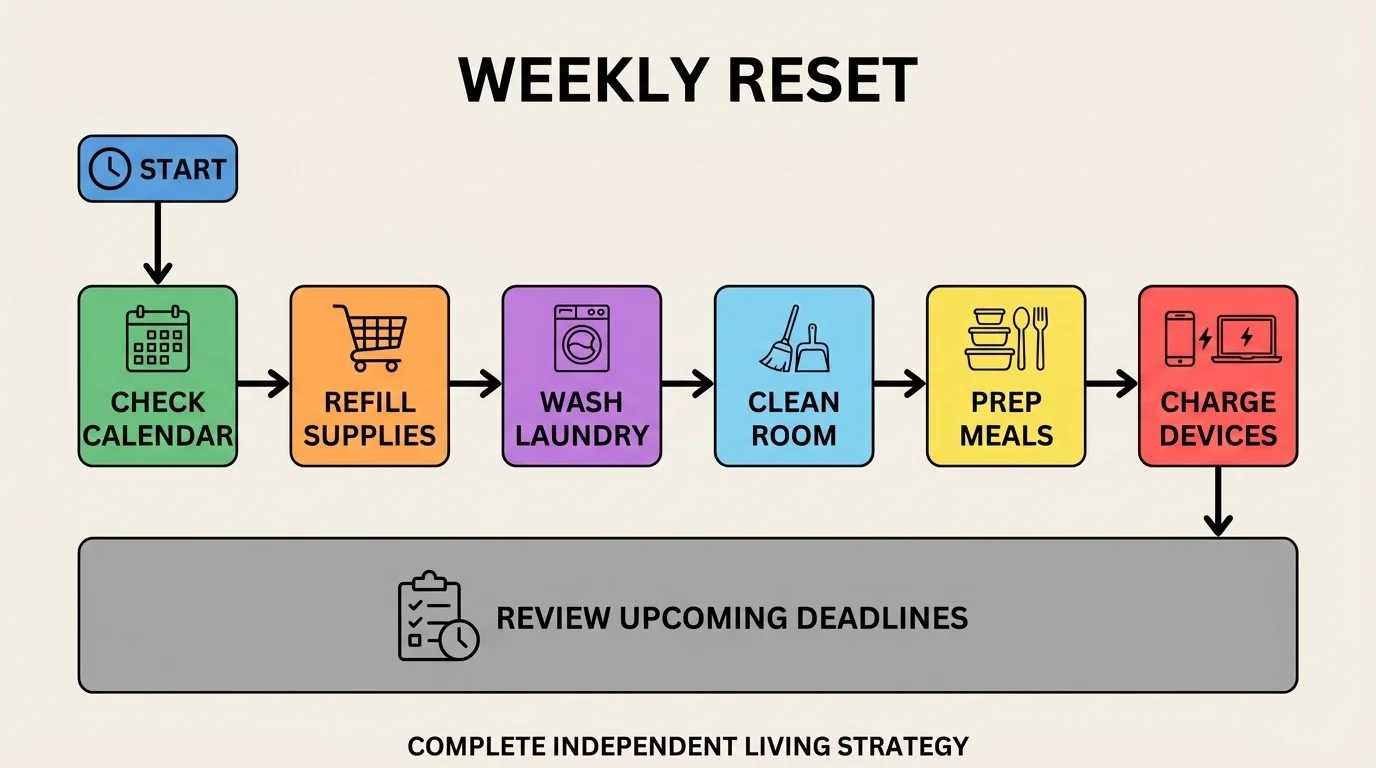
The most effective independent living skill is not reacting well in emergencies. It is preventing unnecessary emergencies. A repeatable weekly reset is a scheduled time to get your life back into order before the next week starts pulling on you. It does not need to be long. It needs to be consistent.
[Figure 3] A weekly reset can include checking your calendar, washing clothes, cleaning your room, charging devices, taking out trash, refilling toiletries, reviewing deadlines, and making sure you have what you need for the next few days. This is where small prevention saves large amounts of stress.
You also need emergency planning. Keep a short contact list of trusted people. Know your important account information and passwords securely. Have basic supplies at home: soap, toilet paper, menstrual products if needed, laundry detergent, a few foods that last, chargers, and first-aid basics. Running out of essentials at the worst moment is a systems problem.
Use checklists for repeated tasks. Pilots, medical workers, and event planners use checklists because memory is unreliable under pressure. You can use the same strategy for packing a bag, getting ready for work, cleaning a bathroom, or preparing to travel.
When your systems are strong, you spend less energy deciding the same things over and over. That is one reason [Figure 2] matters beyond scheduling alone: time structure supports home care, and home care protects your schedule in return.
Building a simple weekly reset
You have \(90\) minutes on Sunday evening.
Step 1: Divide the time by category.
Calendar review \(15\) minutes, laundry setup \(10\) minutes, room cleaning \(20\) minutes, meal prep \(20\) minutes, supplies check \(10\) minutes, and device charging plus bag prep \(15\) minutes.
Step 2: Check the total.
The total is \(15 + 10 + 20 + 20 + 10 + 15 = 90\) minutes.
Step 3: Repeat weekly.
Because the routine is predictable, you spend less time catching up during the week.
A short reset done consistently is more useful than an occasional massive cleanup.
No system prevents every problem. You will oversleep, forget something, get overwhelmed, or make a bad call. What matters is recovery. Independent living includes knowing how to respond without making the situation worse.
If you miss a deadline, communicate immediately and honestly. If you forgot a bill, pay it as soon as possible and note the due date system that failed. If your room became chaotic, do not wait for motivation. Start with trash, dishes, laundry, and surfaces. If you are in conflict with a roommate or family member, focus on specific behavior instead of attacking character.
Use this recovery pattern: stop the damage, communicate, correct, and prevent. For example, if you missed transportation, first arrange the next available option, then notify the person waiting, then review why it happened, then adjust your routine. This keeps one mistake from turning into a chain of problems.
Watch for warning signs that your systems are slipping: constantly losing items, skipping hygiene, piles of dishes, missed messages, unopened mail, low food at home, poor sleep, and always feeling rushed. These signs are useful feedback. They tell you which system needs attention.
You do not need to become perfectly organized overnight. In fact, trying to overhaul everything at once usually fails. Start with one high-impact area and build from there.
If time is your biggest problem, begin with a calendar and a morning check-in. If your space is the main issue, start with a nightly ten-minute reset. If you are often late, improve transportation planning and buffer time. If you struggle with self-care, create a minimum upkeep routine that happens even on hard days.
Then stack habits. Once one routine feels stable, connect it to another. For example, after dinner you wash dishes and check tomorrow's calendar. After your evening shower, you set out clothes and charge your phone. After laundry, you restock your bag. Systems become powerful when one useful action triggers the next.
The real goal of independent living is not to impress anyone. It is to build a life that is stable, healthy, and manageable. When you know how to protect your housing, run your schedule, handle logistics, and maintain yourself, you gain more than skills. You gain freedom, trust, and room to grow.
