A lot of students say they want to "go to college" or "figure it out later," but those two ideas lead to very different futures. A goal without a plan often turns into missed deadlines, rushed decisions, and unnecessary stress. A clear plan does not guarantee that everything goes perfectly, but it gives you direction, options, and a way to act when life gets busy.
Your postsecondary plan is not just about one application. It is a practical roadmap for what you will do after high school, how you will get there, who can help you, and what happens if your first option changes. That could mean a four-year college, community college, trade or technical schools, apprenticeship, military path, certificate program, full-time work with training, or a gap year with a purpose. The important part is that your plan includes real dates, real people, and real actions.
Postsecondary means any education, training, or career pathway you pursue after high school. An action plan is a written plan that names your goal, the steps to reach it, when each step must happen, and who or what will support you along the way.
When you build this kind of plan, you move from wishing to doing. That matters because many opportunities have deadlines you cannot fix later. If a scholarship closes on November 1, missing it by even one day can mean losing money you needed. If you ask for a recommendation letter too late, a teacher or mentor may not have enough time to help. Good planning protects your future choices.
A strong plan helps you manage three things at once: time, decisions, and stress. Time matters because applications, essays, financial aid forms, and program requirements often stack up quickly. Decisions matter because you may have several possible paths, and each one requires different steps. Stress matters because it is easier to think clearly when you are not trying to do everything at the last minute.
Think about the difference between these two students. One student says, "I'll apply somewhere later." By fall of senior year, they are scrambling to research programs, write essays, cover application fees, and ask for references all at once. Another student spends grade 11 building a checklist, saving deadlines in a calendar, and reaching out for help early. That student still works hard, but they are much less likely to miss an important opportunity.
Your plan also gives you a way to explain your future to other people. When a parent, mentor, employer, or advisor asks what you are doing after graduation, you can answer clearly: "My first choice is a nursing program at a community college. I need to finish program research by September, submit my application in October, complete financial aid forms in January, and keep my grades strong. My aunt is helping me compare costs, and I'm meeting with an advisor online next month." That sounds organized because it is organized.
Students often think planning is only for high-achievers, but planning is actually most powerful when you are still unsure. A written process helps you make decisions even if you are choosing between several good options.
You do not need to have your entire life decided right now. You do need a workable next-step plan. A plan can change. In fact, good plans are designed to be updated.
[Figure 1] Before you can set deadlines, you need a direction. That direction begins with your interests, strengths, values, and practical reality. Ask yourself a few honest questions: What kind of work interests me? Do I want training that leads quickly to a job, or do I want a longer college path? How far from home am I willing to go? What can I realistically afford? Do I learn best in a hands-on setting, a technical program, an online environment, or a traditional academic setting?
One useful way to think is to sort your options into categories rather than trying to pick a single perfect answer immediately. For example, you might list: four-year colleges, two-year colleges, trade programs, apprenticeships, military options, or direct employment with advancement training. Then narrow from there.
As you research, look for each program's admission requirements. These are the exact conditions you must meet to apply or enroll. A college may require transcripts, test scores, essays, and recommendation letters. A welding program may require a basic application and proof of graduation. An apprenticeship may require an interview, age requirements, and transportation. Different pathways mean different checklists.
Fit matters more than image. A good postsecondary choice is not the one that sounds most impressive online. It is the one that matches your goals, your learning style, your finances, and the kind of daily life you actually want. A program that is affordable, supportive, and connected to real opportunities may serve you better than a more famous option that does not fit your needs.
You should also think about lifestyle. If you plan to work part-time, support family, or stay local, that affects what kind of schedule is realistic. If you want to enter a field quickly, a certificate program might make more sense than a degree that takes several years. There is no single "best" path for everyone.
A big future goal becomes manageable when you turn it into smaller tasks. Instead of writing "go to college," write tasks like "research five programs," "create application account," "draft personal statement," "request recommendation letter," and "submit financial aid forms."
This is where a deadline matters. A deadline is the exact date by which something must be completed. Some deadlines are fixed, like an application due date. Others are self-set, like your personal date to finish a first essay draft. Self-set deadlines are powerful because they give you buffer time if something takes longer than expected.
One smart strategy is the backward plan. Start with the final due date, then work backward. If an application is due on November 1, you might set these dates: finish college list by September 1, ask for recommendations by September 10, complete essay draft by October 1, revise by October 15, and submit by October 25. That last step gives you a cushion before the final deadline.
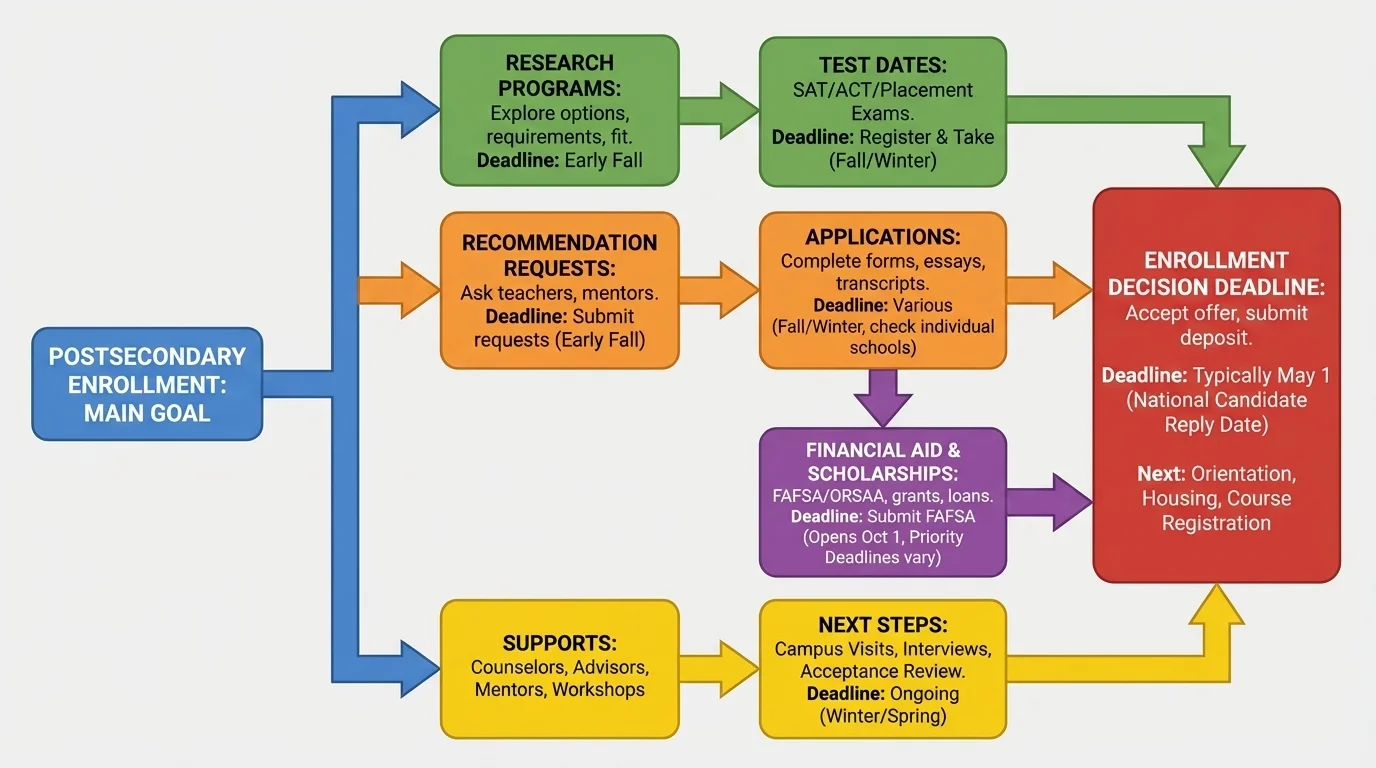
Another useful tool is the "next action" question. At any point, ask yourself: What is the next specific thing I need to do? Not "work on my future." Not "be responsible." Something concrete, like "email the admissions office," "make a spreadsheet of tuition costs," or "upload my transcript request." Specific actions are easier to start.
Keep your deadlines in one place. You can use a digital calendar, notes app, spreadsheet, or planner. What matters is that you review it regularly. If your deadlines live in five different apps and text threads, they are much easier to forget.
Turning a goal into an action plan
Goal: Apply to two community colleges and one medical assistant certificate program.
Step 1: Name the final goals.
Final targets: submit three applications, complete financial aid forms, and compare total cost before choosing.
Step 2: Break the goal into tasks.
Tasks: research program details, request transcript, write a short personal statement, contact one recommender, fill out application forms, and check financial aid requirements.
Step 3: Add dates.
Example dates: research by August 20, transcript request by September 5, personal statement by September 18, applications by October 10, financial aid forms by January 15.
Step 4: Add accountability.
Share the timeline with a trusted adult or mentor and schedule one check-in each month.
This plan works because each task is visible, dated, and connected to one clear outcome.
If you have multiple deadlines in the same month, rank them by urgency and importance. A scholarship due first may come before an essay revision. A required transcript request may matter more than optional program browsing. Good planning is not just listing tasks; it is deciding what gets done first.
[Figure 2] Strong plans are rarely solo projects. Your support system matters. Support can come from a parent or guardian, counselor, teacher, coach, employer, sibling, mentor, community leader, financial aid advisor, or trusted family friend.
The key is to match the right support to the right task. One person may help you edit an essay. Another may help you compare costs. Someone else may be the best person to explain forms, deadlines, or transportation issues. If you simply write "get help," that is too vague. Write names and roles.
This is also where financial aid becomes important. Financial aid is money that helps pay for education or training, such as grants, scholarships, work-study, or loans. Even if you are unsure where you will go, learning the financial aid process early can make more options possible.
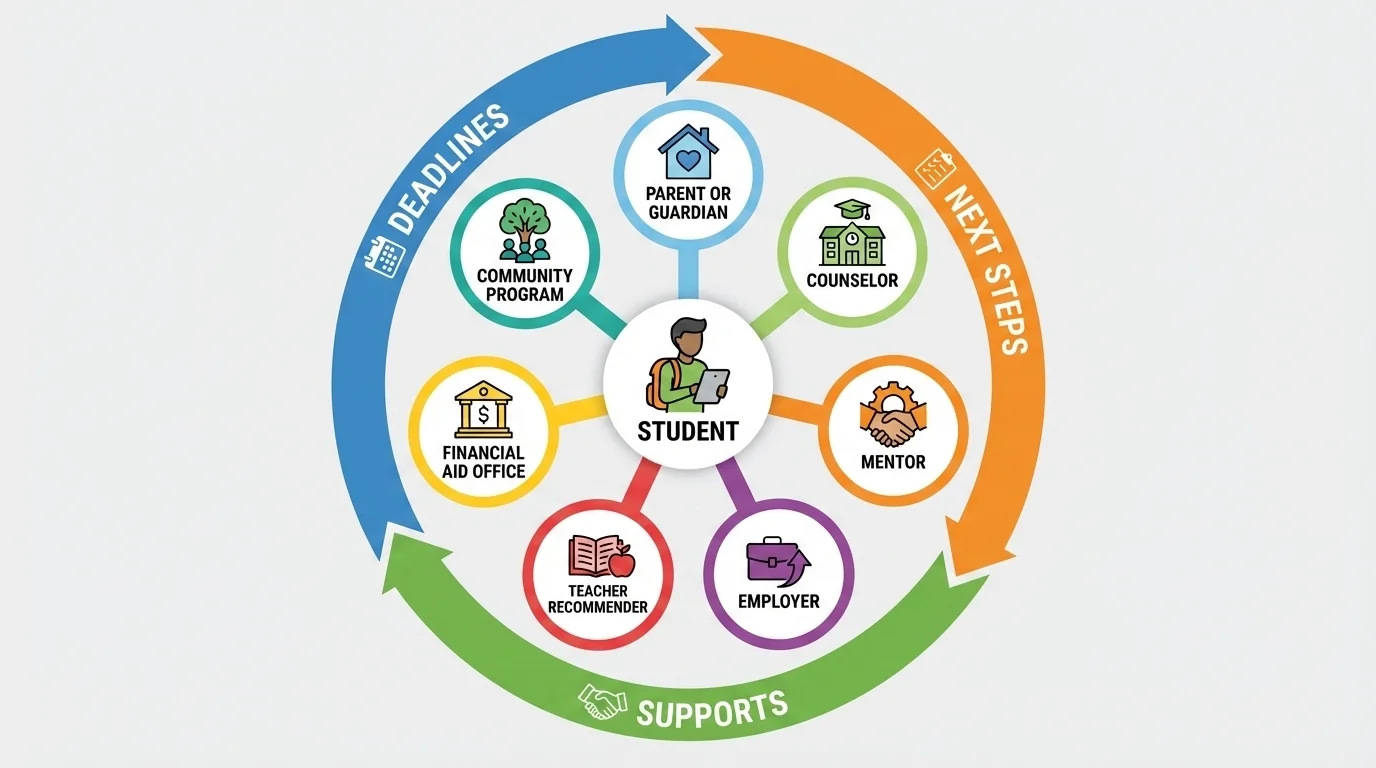
You should build a support list with contact details and responsibilities. For example, a parent might gather tax documents for forms, a mentor might review your resume, and a recommender might write a letter if you ask early and respectfully. If no one in your immediate family has gone through this process before, that does not mean you are stuck. Community organizations, library programs, admissions offices, and online advising events can fill gaps.
| Support | What they can help with | When to contact |
|---|---|---|
| Parent or guardian | Budget, forms, transportation, decision support | As soon as you start planning |
| Counselor or advisor | Program options, transcripts, application steps | Early in research stage |
| Teacher or mentor | Recommendation letters, essay feedback | Several weeks before needed |
| Admissions office | Requirements, deadlines, missing documents | Any time questions come up |
| Financial aid office | Costs, scholarships, forms, verification | Before and after applying |
| Employer or coach | References, schedule planning, career advice | When applications or work plans affect your schedule |
Table 1. Common support people, what they can help with, and when to contact them.
Support is stronger when it is spread across several people rather than placed on one person alone. That makes your plan more reliable if someone is busy or unavailable.
"You do not have to figure out your future alone, but you do have to take the lead in building the help you need."
One practical habit is to create a contact list in your phone or notes app called "Postsecondary Support." Include names, roles, email addresses, and what you need from each person. That simple step can save a lot of confusion later.
[Figure 3] A written timeline helps you see the whole process from a distance. Instead of reacting to one surprise after another, you can plan month by month. It can show a sample schedule from grade 11 through the summer after graduation, which is useful because many students forget that important tasks continue even after they choose a school or program.
Your timeline should include research, applications, tests if needed, recommendation requests, essay drafting, scholarship searches, financial aid tasks, follow-up emails, decision dates, and enrollment steps. After acceptance, the process is not over. You may still need to register, submit records, attend online orientation, set up housing or transportation, and confirm payment plans.
Be realistic about your actual week. If you have a job, family responsibilities, sports, or volunteer work, your schedule is already full. A good timeline fits your life. For example, instead of planning to do everything on weekends, you might schedule two short work sessions during the week and one longer session on Saturday.
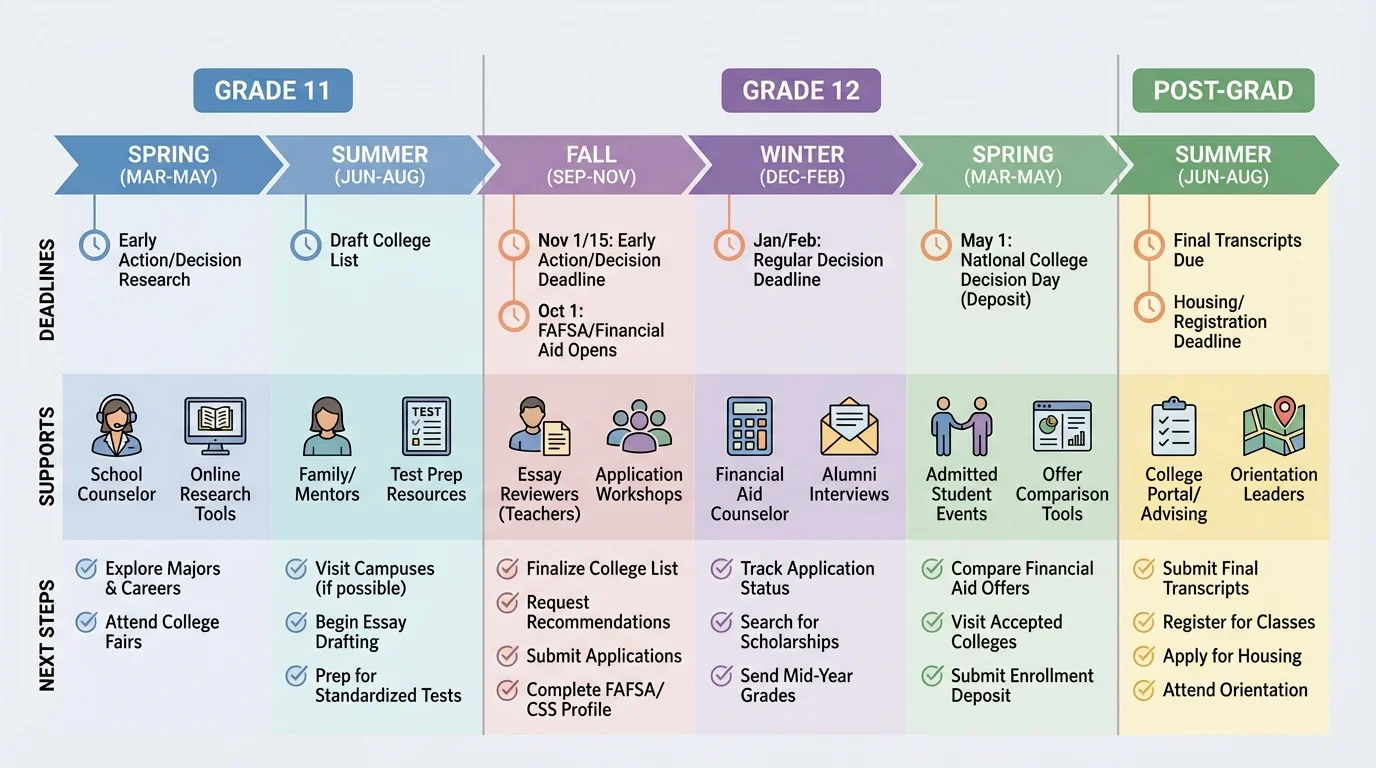
Here is one sample approach for a student in grade 11: spring can be used for self-assessment and research, summer for resume updates and essay planning, early fall of grade 12 for applications, winter for financial aid and scholarship forms, spring for comparing offers, and summer after graduation for final enrollment tasks. Your exact dates will differ, but the structure stays useful.
Sample month-by-month planning outline
Step 1: Spring of grade 11
List possible pathways, attend virtual information sessions, and compare at least three programs.
Step 2: Summer
Update your resume, draft a personal statement, and organize account logins and documents.
Step 3: Early fall of grade 12
Submit applications, request recommendations, and track confirmations.
Step 4: Winter
Complete financial aid steps and apply for scholarships.
Step 5: Spring and summer after graduation
Compare final choices, accept one offer, and complete all enrollment tasks.
This kind of outline prevents the common mistake of doing only the application part and forgetting the follow-through.
When you review your calendar, look for bottlenecks. If three major tasks land in the same week, move one earlier. If a support person needs notice, build in extra time. Plans fail when they depend on perfect timing. Better plans include margin.
One of the smartest things you can do is build a primary plan and at least one backup. This does not mean you lack confidence. It means you understand real life. Programs can be competitive, costs can change, family situations can shift, and your own goals may evolve.
Create a simple structure: Plan A, Plan B, and Plan C. Plan A might be your top-choice university. Plan B might be a community college pathway with transfer options. Plan C might be a job-training program or certificate option that still leads toward your career interest. These are not random backups. They should all move you forward.
A backup plan is especially important for money. If one program costs too much, what is your affordable option? If you are waiting on scholarship results, what will you do if they do not come through? If transportation is a challenge, what local or online alternatives are available?
Backup planning is strategic, not negative. Students sometimes avoid backup plans because they think it weakens commitment to their first choice. In reality, a backup plan protects your momentum. It keeps one disappointment from becoming a complete stop.
You can also set decision points. For example: "If I have not completed two applications by October 15, I will ask for help that week." Or: "If my first-choice program does not meet my budget, I will compare my top two lower-cost options within three days." Decision points help you respond quickly instead of freezing.
Later, when you compare your options, the timeline still matters because some backup choices may have different enrollment dates. A late switch is easier when your overall calendar is already organized.
Your plan becomes real when you communicate with people clearly and respectfully. That includes emailing admissions offices, requesting recommendation letters, asking about financial aid, following up on missing documents, and thanking people who help you. Professional communication can open doors. Sloppy communication can close them.
Use a clear subject line in emails, state your purpose early, include your full name, and ask specific questions. For example: "Hello, my name is Jordan Lee, and I am applying to the respiratory therapy program. I want to confirm whether my transcript was received and whether there are any additional required documents. Thank you for your time." That is much stronger than "Hey, did you get my stuff?"
When asking for a recommendation, ask early, explain what you are applying for, give the deadline, and provide helpful information such as your resume or a list of goals. People are more likely to write strong letters when you give them time and context.
Simple message template for asking for help
Hello [Name],
I am applying to [program or school], and I am working on my next steps after high school. I would appreciate your help with [specific task]. The deadline is [date], and I can send any information you need. Thank you for considering it.
Sincerely,
Your full name
Keep records of what you send and receive. Save confirmation emails, application logins, passwords in a secure place, and screenshots of submissions if needed. If a problem comes up later, documentation helps you solve it faster.
An action plan is not something you write once and forget. Review it often. A good rhythm is a quick weekly check and a deeper monthly check. Weekly, ask: What did I finish? What is due next? Who do I need to contact? Monthly, ask: Is my main path still the best fit? Do my dates need updating? Do I need more support?
This is where contingency plan thinking helps. A contingency plan is your prepared response if something changes or goes wrong. If a deadline is moved, a transcript is delayed, or you decide to change programs, your contingency plan keeps you moving instead of starting over from zero.
Try this: choose one day each week to be your "future check-in" day. Spend even 15 to 20 minutes reviewing deadlines, replying to messages, and updating your plan. Small actions done consistently are more powerful than one giant burst of effort.
Another useful habit is to track progress in simple categories: done, in progress, waiting, and next. If an item sits in "waiting" too long, follow up. If something stays in "next" for weeks, break it into a smaller action. Progress usually improves when tasks become more specific.
Remember that your plan should reflect your life, not someone else's expectations. You may want a direct career path, a transfer route, a technical certification, or a combination of work and education. What matters is that your plan is intentional, realistic, and active.
You have probably already used planning skills in other parts of life: meeting work shifts, preparing for a driving test, managing assignments online, or saving for a purchase. Postsecondary planning uses the same core habits: know the goal, break it into steps, track the dates, and ask for help early.
The most important next step is not perfection. It is movement. A strong postsecondary action plan gives you direction, deadlines, support, and options. Once those are written down, your future stops feeling like a huge unknown and starts becoming a series of manageable choices.
