Most people do not ruin their future with one dramatic decision. They drift into it through repeated small choices: staying up too late, avoiding difficult tasks, spending impulsively, ignoring stress, or reacting without thinking. The good news is that the opposite is also true. A stable life is usually built the same way: through small habits that protect your energy, strengthen your judgment, and make it easier to keep going when life gets hard.
At your age, long-term habits matter because you are getting closer to full independence. The routines you build now can affect your work ethic, health, relationships, finances, and reputation. A habit is not just "something you do a lot." It is a repeated behavior that starts shaping what feels normal. Once something feels normal, you stop debating it every time. That is why good habits reduce stress: they save decision-making energy for things that actually require thought.
Long-term habits support three areas that are deeply connected: well-being, persistence, and responsible choices. Well-being means more than "feeling happy." It includes sleep, physical health, emotional steadiness, stress levels, and the quality of your relationships. Persistence means continuing through boredom, setbacks, and delayed results. Responsible choices mean thinking beyond the current moment and considering consequences for yourself and others.
If one of those areas weakens, the others usually weaken too. For example, if you sleep badly for a week, you may become more irritable, less focused, more likely to procrastinate, and more likely to make careless decisions online or at work. On the other hand, when you build healthy routines, you often improve several parts of life at once.
Well-being is your overall physical, mental, and emotional health over time.
Persistence is the ability to keep working toward a goal even when progress is slow, uncomfortable, or frustrating.
Responsible choices are decisions made with awareness of consequences, values, and the impact on other people.
One useful way to assess a habit is to ask: What does this behavior make easier in my life, and what does it make harder? A habit that feels good in the moment is not always good for your future. A habit that feels slightly inconvenient now may save you major stress later.
A helpful habit is not necessarily dramatic or impressive. It is usually repeatable, realistic, and connected to your values. Helpful habits often look ordinary: charging your phone away from your bed, checking your bank balance weekly, replying respectfully when frustrated, preparing food before you are starving, taking a walk when stressed, starting assignments before they feel urgent, and pausing before posting online.
In everyday life, helpful habits are often more powerful than intense bursts of motivation. Motivation changes from day to day. Systems stay. That is why self-management matters: if you only do the right thing when you feel inspired, your behavior will always be unstable.
Stable habits beat intense moods. A lot of poor choices happen when people assume they should feel ready before they begin. In real life, many strong habits are designed for days when you feel tired, distracted, or discouraged. The goal is not perfect discipline. The goal is to make good choices easier to repeat.
That does not mean every routine needs to be strict. It means your habits should reliably move you toward the kind of person you want to be: steady, trustworthy, healthy, and capable.
Your body and mind are not separate systems. If you regularly ignore one, the other usually shows it. Helpful well-being habits include consistent sleep, regular movement, balanced meals, hydration, emotional check-ins, and limits around digital overload. None of these are glamorous, but they affect almost everything else.
Sleep is one of the clearest examples. A person who gets enough sleep usually has better focus, more patience, stronger memory, and better emotional control. A person who stays up scrolling until late at night may tell themselves they are "just relaxing," but the next day they often pay for it through low energy, irritability, poor concentration, and weaker decision-making. That is a long-term trade you should notice.
Movement matters for similar reasons. You do not need an extreme fitness routine. A walk, stretching, bodyweight exercise, sports practice, or a short workout can reduce stress and improve your mood. The point is not appearance. The point is regulation. Movement helps your nervous system process pressure instead of storing it all day.
Nutrition also affects self-management. If you regularly skip meals and then suddenly eat whatever is easiest, you may feel physically bad and emotionally off-balance. Planning simple meals or snacks is a form of self-respect, not perfection. The same goes for water: low hydration can make fatigue and headaches worse, which then affects your focus and patience.
Another important habit is creating recovery time that actually restores you. Not all breaks are equal. Some activities calm you down and help you reset. Others leave you more drained. Watching content for two hours because you feel stuck may feel easier than taking a shower, going outside, or talking to someone, but the easier option is not always the more restorative one.
When stress builds up, emotional regulation becomes essential. Emotional regulation is not pretending you have no feelings. It means noticing what you feel and responding in a way that does not make the situation worse. That can sound like: "I am angry right now, so I'm not going to reply immediately," or "I feel overwhelmed, so I need to break this task into smaller pieces."
Real-life check: one habit, two outcomes
You have an early video meeting for orientation at a part-time job.
Step 1: Unhelpful pattern
You stay up late scrolling, sleep through alarms, join the meeting flustered, and forget what was said.
Step 2: Helpful pattern
You set a shutdown time, place your phone across the room, prepare what you need the night before, and wake up with enough time to get settled.
Step 3: Long-term result
The second pattern protects your mood, performance, and reputation. It also makes future responsible choices easier because you are not starting the day in recovery mode.
A final well-being habit that many students overlook is asking for support early. If your stress, sleep problems, anxiety, sadness, or anger are becoming hard to manage alone, reaching out is a strength. Waiting until everything becomes a crisis usually makes the situation harder.
Persistence is often misunderstood. It does not mean never struggling, never resting, or always feeling confident. It means returning to the task, goal, or responsibility even when the process is inconvenient. People who seem persistent are usually not powered by endless motivation. They rely on routines, structure, and recovery.
A habit that builds persistence is starting before you feel fully ready. If you always wait for the perfect mood, you may delay things until pressure forces you to act. A better habit is using a low-pressure starting rule, such as working for the first ten minutes, opening the document, reviewing the instructions, or listing the first three steps. Starting reduces avoidance.
Another powerful habit is breaking big tasks into smaller parts. "Finish everything" is vague and intimidating. "Draft the introduction," "email the supervisor," or "review notes for twenty minutes" is concrete. Smaller steps create momentum and give your brain proof that progress is happening.
Delayed gratification is also part of persistence. This means choosing a benefit later over immediate comfort now. Studying before entertainment, saving part of your paycheck, practicing a skill even when you are not great at it yet, and sticking to a training schedule are all examples. Long-term goals usually require tolerating some short-term discomfort.
Persistence also depends on your response to failure. If one bad day turns into "I guess I'm just bad at this," you are not evaluating the situation clearly. One missed workout, one weak assignment, one awkward conversation, or one budgeting mistake does not define you. A more resilient habit is asking: What happened, what can I learn, and what is the next useful action?
"You do not rise to the level of your goals. You fall to the level of your systems."
— James Clear
This idea matters because many students judge themselves by intentions instead of patterns. Wanting to be reliable is not the same as practicing reliability. Wanting to be healthy is not the same as protecting your routines. Persistence grows when your daily behavior keeps reconnecting you to your goals.
Responsible decision-making means thinking ahead, not just reacting. One of the strongest habits behind responsible choices is pausing. A short pause gives you time to consider consequences, values, safety, and whether your current emotion is driving the decision.
This pause matters in online communication. A careless message, rude comment, dishonest excuse, or impulsive post can damage trust quickly. Digital actions feel temporary, but screenshots, patterns, and reputations can last. A responsible habit is to reread before sending, especially when angry, defensive, or trying to impress people.
Money habits also reveal responsibility. A person does not need a huge income to practice good judgment. Responsible habits can include checking account balances, tracking subscriptions, avoiding impulse buying when emotional, saving part of earnings, and asking whether a purchase solves a real need or just a temporary feeling. Spending everything because "it's my money" may feel independent, but real independence includes planning for future needs.
Safety is another area. Responsible habits include locking accounts with strong passwords, not sharing private information carelessly, avoiding risky driving behavior, thinking carefully before meeting online contacts in person, and staying aware of substance-related pressure. A harmful choice does not become safe just because other people normalize it.
Integrity belongs here too. Responsible people build habits of honesty, following through, apologizing clearly when wrong, and respecting boundaries. These habits protect relationships and help others trust you. Trust is easier to keep than rebuild.
| Habit | Short-term feeling | Long-term effect |
|---|---|---|
| Ignoring messages you owe a reply to | Temporary relief | More stress, damaged trust |
| Checking your calendar daily | Small effort | Better reliability, fewer missed commitments |
| Impulse spending | Brief excitement | Less savings, more regret |
| Pausing before posting | Slight delay | Better judgment, safer reputation |
| Admitting a mistake early | Discomfort | More respect, easier repair |
Table 1. Comparison of short-term feelings and long-term effects of common habits.
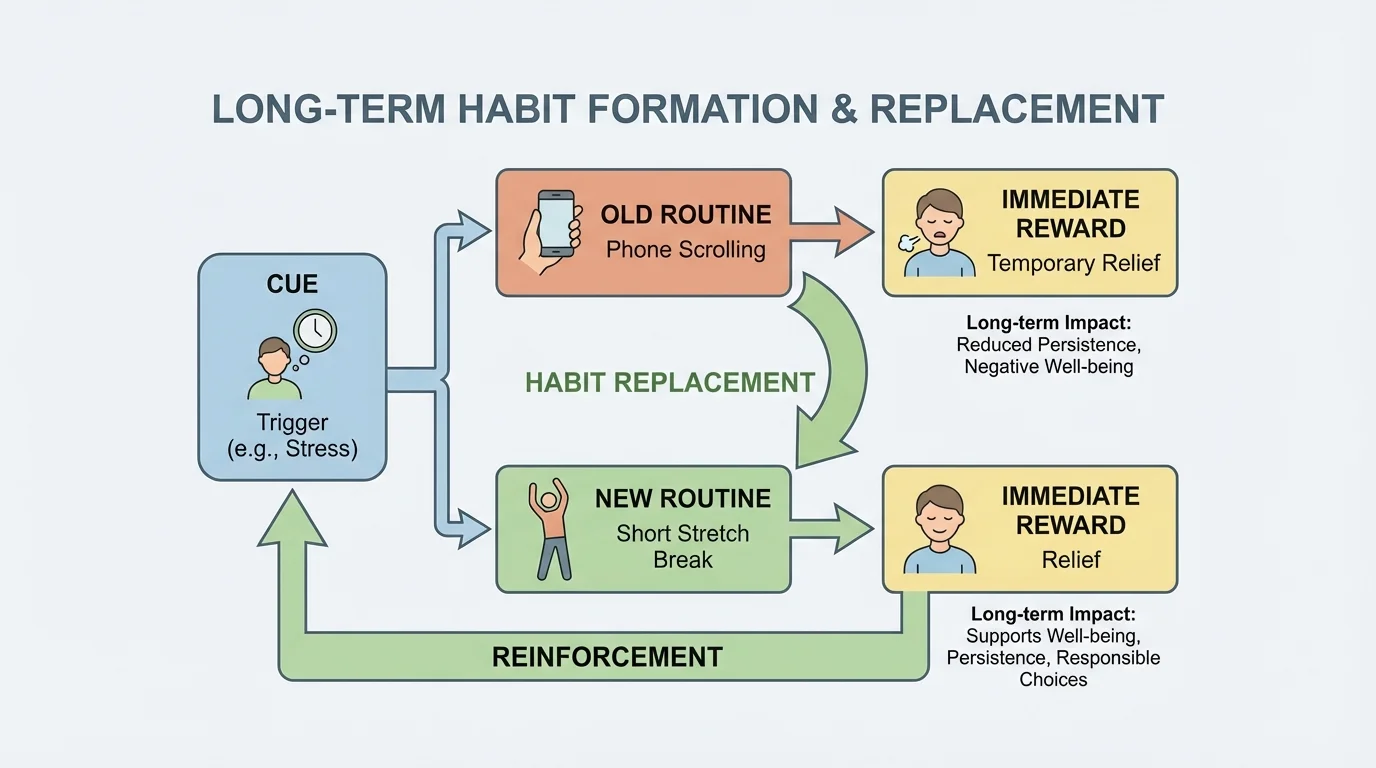
Habits often follow a repeated habit loop, as [Figure 1] shows: something triggers you, you do a behavior, and your brain connects that behavior to some kind of reward. The reward might be comfort, distraction, control, pleasure, relief, or a sense of progress.
For example, stress after a difficult assignment might trigger automatic scrolling. The routine is checking your phone for forty minutes. The reward is temporary relief. The problem is that the relief is short, while the stress often gets worse because the task is still there. That is why habits are not just about willpower. They are tied to cues and rewards.
A smarter strategy is not always to remove the reward. It is often to replace the routine. If the cue is stress and the reward is relief, you might replace doom-scrolling with a ten-minute walk, music without multitasking, journaling, stretching, or texting someone supportive. The goal is to meet the need in a healthier way.
Your environment also shapes habits. If your workspace is full of distractions, your phone is next to your bed, your schedule exists only in your head, and your food choices depend entirely on convenience, you are making self-management harder. Good systems reduce friction for helpful actions and increase friction for unhelpful ones.
Reducing friction can mean laying out workout clothes the night before, saving important deadlines in one calendar, preparing simple meals in advance, using website blockers during work time, or keeping water nearby. Increasing friction can mean logging out of distracting apps, moving your charger away from your bed, deleting saved payment details to slow down impulse spending, or muting notifications.
Your brain likes efficiency. The more often you repeat a behavior in a similar context, the less mental effort it can take to start that behavior again, which is why repeated small actions often become automatic more quickly than people expect.
Later, when you assess whether a routine is helping you, the loop in [Figure 1] is still useful because it reminds you to ask three questions: What triggers this? What do I actually do? What reward am I chasing?
It is easier to judge your patterns when you compare short-term payoff with long-term cost across energy, money, relationships, and goals. A habit can feel harmless because each individual moment seems small. But repeated over weeks or months, small behaviors become patterns, and patterns create outcomes.
[Figure 2] To assess a habit, look for evidence. Does it improve your sleep, energy, mood, reliability, or self-respect? Or does it leave you more anxious, scattered, broke, behind, secretive, or dependent on avoidance? Helpful habits tend to make life steadier. Harmful habits often create repeated recovery problems.
Ask yourself questions like these:
Another way to assess habits is to track a few signs for one or two weeks. You might note your sleep time, mood, focus, spending, unfinished tasks, or screen time. You do not need perfect data. You just need enough honesty to spot patterns.
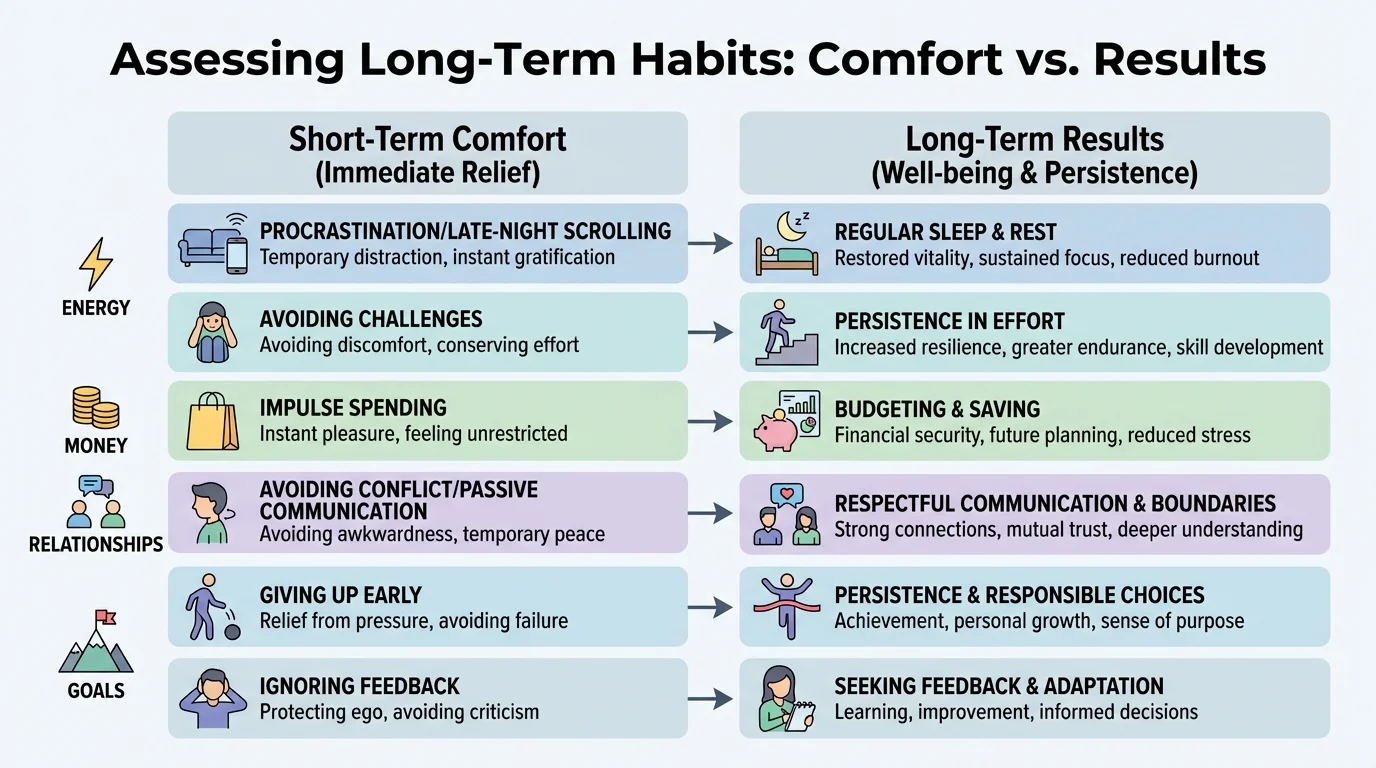
For example, if you tell yourself that late-night scrolling "doesn't really affect anything," but your tracked notes show lower energy, slower mornings, skipped responsibilities, and more irritability, then you have evidence. Assessment means facing patterns without making excuses or attacking yourself.
Quick self-assessment example
A student notices that after every stressful week, they buy takeout and small online purchases far more often than usual.
Step 1: Identify the cue
The trigger is not boredom alone; it is stress and mental overload.
Step 2: Identify the reward
The reward is comfort and convenience.
Step 3: Assess the long-term effect
The pattern brings short relief but weakens budgeting goals and does not actually solve the stress.
Step 4: Adjust the habit
The student keeps one comfort meal in the weekly plan and replaces random stress spending with a cheaper recovery routine, such as a walk, a playlist, and a planned snack at home.
That kind of assessment is practical and realistic. It does not require becoming a different person overnight. It requires honesty about what your habits are doing.
Long-term change works best when broken into clear steps, as [Figure 3] shows. Instead of trying to fix your entire life at once, choose one or two habits that would improve several areas at the same time. Good starting habits often include sleep routines, planning your day, regular movement, spending checks, or beginning tasks earlier.
Make the habit specific. "Be healthier" is too vague. "Put my phone across the room by 11:00 p.m." is specific. "Manage money better" is vague. "Check my balance every Sunday and move $20 into savings" is specific. Specific habits are easier to repeat and measure.
Next, connect the habit to a cue. This is often called habit stacking: attaching a new behavior to something you already do. After brushing your teeth, fill your water bottle. After breakfast, check your calendar. After logging off work, write tomorrow's top three tasks. Existing routines give new habits a place to land.
Then make the first version small. If the habit is too ambitious, you will avoid it on hard days. Small does not mean meaningless. Small means realistic enough to survive stress. Five minutes of planning is better than no planning. A short workout is better than waiting for a perfect hour. Saving a small amount regularly builds identity and consistency.
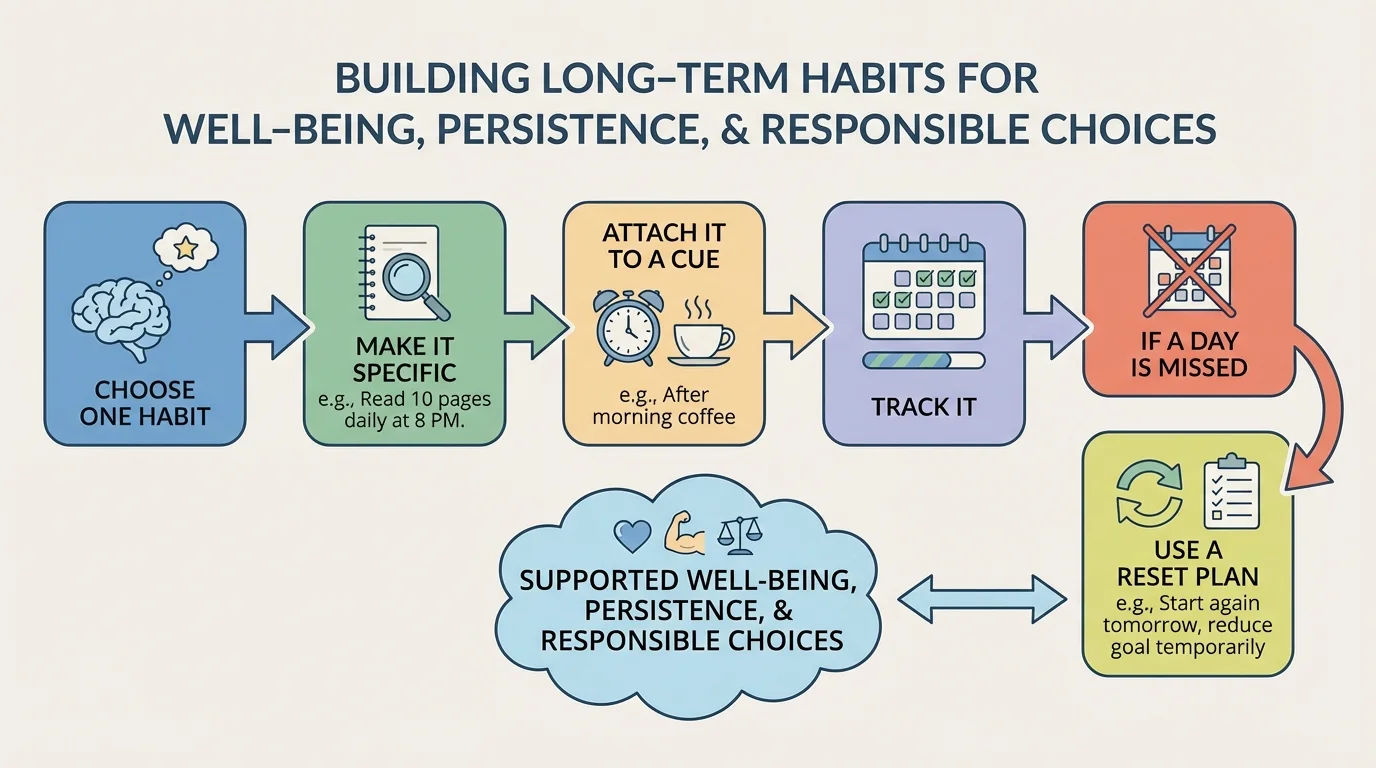
Tracking helps too. You can use a note app, calendar check marks, or a simple checklist. Tracking is not about guilt; it is about awareness. If you miss a day, your main job is not self-criticism. Your main job is restarting quickly. Missing once is normal. Repeating the miss because you decided the streak is ruined is the bigger problem.
A strong reset rule is: Never miss twice when you can help it. That rule protects you from all-or-nothing thinking. Life will interrupt your systems sometimes. A useful habit plan expects that and includes recovery.
Identity-based habit building works when your actions match the person you want to become. Instead of only saying, "I want better grades," you might say, "I am becoming someone who starts tasks before panic starts." Instead of "I should save money," you might say, "I am becoming someone who handles money on purpose." Repeated actions make that identity more believable.
Months later, the planning system in [Figure 3] still matters because habit change usually fails at the same places: the habit was too vague, too large, or not connected to a cue.
One common trap is perfectionism. If you believe a habit only "counts" when done flawlessly, you are more likely to quit after imperfect days. Real persistence requires flexibility. Another trap is comparison. Watching other people online can make your progress feel slow or unimpressive, but comparison often hides reality. You do not see their whole situation, only what is presented.
Another trap is using entertainment as your only coping skill. There is nothing wrong with enjoying games, shows, music, or social media in moderation. The problem starts when every uncomfortable feeling gets pushed into distraction. Then you lose the chance to build stronger coping habits.
Avoidance is also expensive. The longer you delay something uncomfortable, the more mental energy it can consume. A habit of facing small problems early often prevents large problems later. Answering the email, admitting the mistake, checking the balance, starting the assignment, or making the appointment may be uncomfortable, but avoidance usually charges interest.
You have likely already seen this pattern in other areas of life: short-term relief can create long-term stress, while short-term effort can create long-term stability. That same pattern applies to emotional regulation, time management, finances, and relationships.
Burnout is different from laziness. If you are overloaded for too long, your habits may collapse because you need actual rest, support, or a more realistic schedule. Assessing habits honestly means recognizing when the problem is poor discipline and when the problem is unsustainable pressure.
Resilience is built through repeated recovery, not through avoiding difficulty forever. Each time you pause instead of reacting, restart after a setback, follow through on a commitment, or choose long-term stability over short-term relief, you are building evidence that you can trust yourself.
That trust matters. Employers notice reliability. Friends notice whether you keep your word. Future roommates notice whether you manage responsibilities. Your future self notices whether you create peace or chaos. Long-term habits are not just about productivity. They are about becoming someone who can handle freedom well.
You do not need a perfect life plan right now. But you do need enough awareness to assess your patterns honestly. Ask yourself which habits make your life steadier, healthier, and more aligned with your values. Then protect those habits on ordinary days, not just crisis days. That is where long-term well-being, persistence, and responsible choices are really built.
