Many relationships do not end because two people never cared about each other. They end because care without skills is not enough. You can like someone, trust them, or even love them, and still have a relationship that becomes exhausting if there are no clear limits, no honesty about mistakes, and no way to talk through hard things. Long-term relationship well-being is less about grand romantic moments and more about the small habits that make daily life feel safe, respectful, and real.
Whether you are thinking about dating, close friendships, family connections, or future long-term partnerships, three habits matter again and again: personal boundaries, mutual accountability, and open communication. These are not buzzwords. They are practical tools. They help you protect your energy, speak up when something feels wrong, repair conflict without constant drama, and decide whether a relationship is actually healthy rather than just intense.
Personal boundaries are the limits you set around what you are comfortable with emotionally, physically, digitally, socially, and with your time.
Mutual accountability means both people take responsibility for their actions, follow through on agreements, and repair harm when they cause it.
Open communication means expressing thoughts, feelings, needs, and concerns clearly and respectfully while also listening honestly to the other person.
These three habits support each other. If you set boundaries but never communicate them, people have to guess. If you communicate clearly but nobody takes responsibility for their behavior, the same problems keep repeating. If you are accountable but have no boundaries, you may start overgiving, people-pleasing, or staying in situations that wear you down. Healthy relationships need all three working together.
Feelings can start a relationship, but skills are what help it last. Early on, people often assume, If this is meant to work, it should feel easy all the time. That idea sounds nice, but real relationships involve stress, scheduling, misunderstandings, changing needs, and moments when one person messes up. The goal is not zero conflict. The goal is handling conflict in ways that protect dignity and trust.
This matters even more in a world where so much interaction happens through texts, social media, video calls, and group chats. Digital communication can make closeness easier, but it can also create confusion. A delayed reply can trigger insecurity. A joke can sound harsher on a screen. Someone can share private information fast and regret it later. Without clear habits, small issues grow quickly.
Many relationship problems are not caused by one huge betrayal but by repeated small moments of disrespect, avoidance, or broken trust. Tiny patterns often predict whether a relationship becomes stable or stressful.
So when people talk about a "good relationship," it is useful to ask practical questions: Can you say no without being punished? Can both people admit when they are wrong? Can uncomfortable topics be discussed without threats, guilt, or silent treatment? Those questions tell you more than surface-level chemistry.
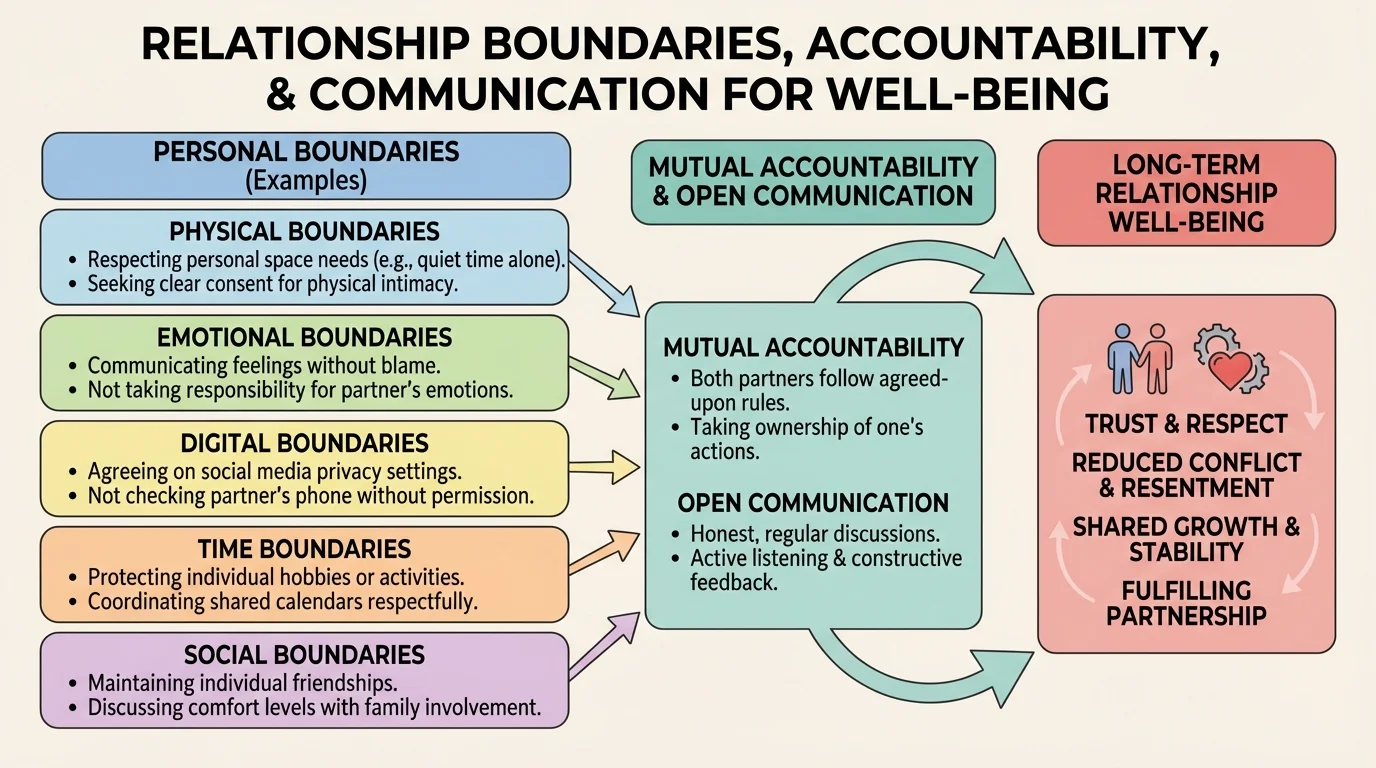
A boundary is not a wall that shuts everyone out. It is a clear line that shows what helps you feel respected and what does not. Boundaries differ across situations, as [Figure 1] shows through physical, emotional, digital, time, and social categories. Knowing your boundaries helps you make choices based on self-respect instead of pressure, fear, or confusion.
Some boundaries are about physical space and touch. Some are about privacy, like whether you want someone reading your messages or posting photos of you. Some are about time, like needing uninterrupted hours for work, rest, family, or hobbies. Some are emotional, such as not wanting to be pressured into sharing personal experiences before you are ready. Others are social, like whether you want a partner involved in every friend group conversation.
Boundaries are not selfish. They prevent resentment. When you say yes to things you actually do not want, you may look cooperative in the moment, but over time you can start feeling trapped, irritated, or unseen. Clear boundaries make relationships more honest because they replace guessing with clarity.
For example, suppose someone you are dating expects immediate replies at all hours. If you never say anything, they may assume constant access is normal. If you communicate a boundary such as, "I am usually offline after 10 p.m., so if I reply in the morning that does not mean I am upset," you reduce confusion and protect your sleep and peace. The relationship becomes more stable because the expectation is clear.
Boundaries also matter for consent. Consent is not just the absence of a no. It is a clear, voluntary, ongoing yes. Pressure, guilt, fear, or repeated pushing weakens consent. In healthy relationships, people respect limits the first time. They do not argue someone out of their comfort zone or act offended because a boundary exists.
If someone responds to your boundary with respect, that builds trust. If they respond with mockery, anger, guilt trips, or repeated testing, that tells you something important. A boundary does not create the problem; it reveals it. This is one reason boundaries protect long-term well-being. They help you see whether the relationship can support mutual respect.
Boundary-setting in everyday language
Step 1: Name the specific issue.
"I need a heads-up before plans change at the last minute."
Step 2: State your limit clearly.
"I am not okay with you sharing screenshots of our private messages."
Step 3: Say what you will do if the boundary is ignored.
"If that keeps happening, I am going to stop sharing personal things by text."
Step 4: Follow through calmly.
Boundaries only work when your actions match your words.
A common mistake is turning a boundary into a hidden hope. For example, "I wish you would stop doing that" is a preference, not a clear limit. A stronger version is: "I do not want jokes about my body. If it happens again, I will end the call." Direct language may feel awkward at first, but it is kinder than staying silent and building anger.
Mutual accountability means both people understand that their actions affect each other. It is not about keeping score or acting morally superior. It is about being trustworthy enough to say, "Yes, I did that," "I understand the impact," and "I am going to change something so this does not keep happening."
In a healthy relationship, accountability goes both ways. One person should not always be the only one acting maturely by communicating, forgiving, adjusting, and repairing while the other avoids responsibility. Over time, that creates imbalance and burnout. Long-term well-being depends on shared effort.
Real accountability includes several parts: recognizing harm, listening without instantly becoming defensive, apologizing specifically, making a realistic plan to change, and then actually changing behavior. A real apology sounds like, "I interrupted you and then joked about it when you were upset. That was disrespectful. Next time I will let you finish and I will not brush it off." A weak apology sounds like, "Sorry you felt that way." The second one avoids ownership.
Accountability also means keeping agreements. If you say you will call, show up, send something, stop doing something, or check in after a conflict, follow through. Reliability might seem boring compared to intense emotions, but reliability is one of the strongest signs that a relationship can stay healthy over time.
Impact matters more than intent
You can mean well and still cause harm. Intent answers, "What was I trying to do?" Impact answers, "What actually happened to the other person?" Healthy accountability takes both seriously. Good intentions do not erase harmful results, but they can support honest repair if the person is willing to learn and change.
Here is a realistic example. A friend repeatedly cancels video calls at the last minute. They may not be trying to hurt you. Maybe they are overwhelmed or disorganized. But if this happens over and over, the impact is that you feel unimportant and stop trusting their word. Accountability means they do not just say, "I have been busy." They say, "I keep canceling late, and that wastes your time. I need to stop making plans I cannot keep."
Patterns matter more than promises. Anybody can say the right thing once. Accountability shows up when the behavior actually shifts. If someone keeps apologizing but nothing changes, the issue is not misunderstanding. It is unwillingness or inability to act differently.
Open communication means you tell the truth about what is happening instead of forcing the other person to decode hints, mood shifts, or passive-aggressive comments. It also means listening carefully enough to understand, not just preparing your defense while they talk.
Clear communication is not the same as saying everything impulsively. Healthy communication includes timing, tone, and self-control. If you are furious, exhausted, or in the middle of a public online argument, you are less likely to communicate well. Sometimes the most mature move is pausing and saying, "I want to talk about this, but I need an hour so I can say it clearly."
One of the most useful communication skills is using I-statements. An I-statement focuses on your experience instead of attacking the other person's character. Compare these two versions: "You never care about me" versus "I felt ignored when you were scrolling during our call after saying you wanted to catch up." The second version gives useful information instead of inviting an argument about whether "never" is true.
Listening is the other half. Good listening means not interrupting, not mocking, not changing the subject to escape discomfort, and not turning every concern into a debate. Sometimes the most helpful response is, "Let me make sure I understand you," followed by a short summary of what you heard.
Communication is not only about speaking confidently. It is also about checking assumptions. A delayed message, short reply, or awkward tone online does not always mean anger, rejection, or disrespect. Asking for clarification is often wiser than inventing a story in your head.
Digital communication deserves extra care. Screens remove body language and immediate feedback. If you are discussing something serious, it may be better to move from text to voice or video. Texting can work for simple check-ins or brief clarifications, but complex emotions often need more context. A message like "We need to talk" with no explanation can create panic. A better version is, "I want to talk later about something that bothered me. It is important, but I am not ending the relationship. Are you free tonight?"
Open communication also includes asking questions before making accusations. "Can you help me understand what happened?" is usually more productive than "So you just do not care?" Curiosity keeps the door open for honesty. Accusation often pushes people into defense mode.
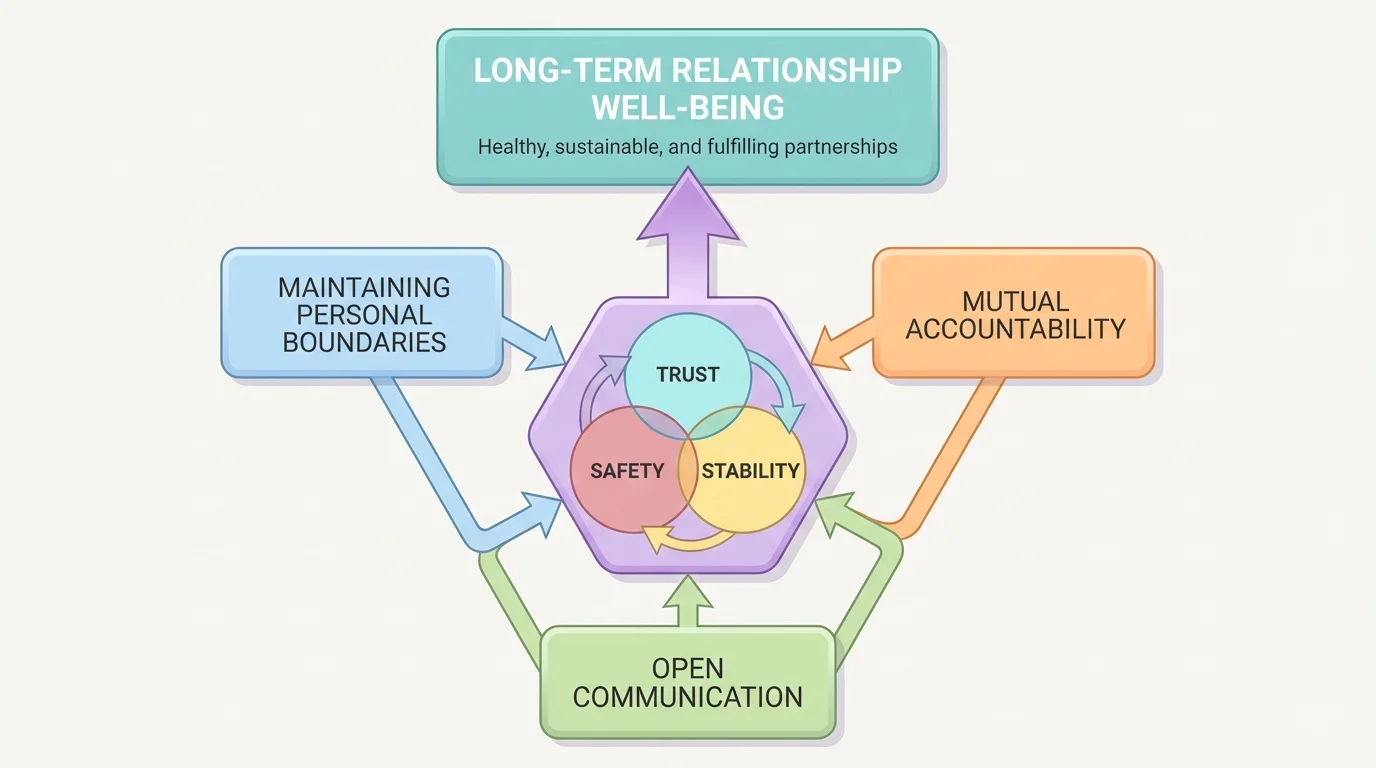
These skills reinforce one another, as [Figure 2] illustrates: boundaries create clarity, accountability creates reliability, and communication keeps both of those visible and usable. When all three are present, relationships tend to feel safer, steadier, and less confusing.
Think of them as a system. Boundaries answer, "What is okay and not okay?" Communication answers, "How do we say that out loud and keep understanding each other?" Accountability answers, "What happens after the conversation? Do our actions match our words?" If any one part is missing, the system weakens.
For example, a couple may communicate often, but if one person keeps violating agreed limits around privacy, there is no accountability. Or two friends may be accountable and reliable, but if neither ever shares honest feelings, resentment can build under the surface. Or someone may have strong boundaries internally but never express them, which leaves the other person confused and conflict-prone.
This system is especially important during transitions: starting to date, becoming more serious, managing long distance, balancing work and family schedules, or deciding how public to be on social media. Those moments create new expectations. If expectations stay unspoken, people often assume they are on the same page when they are not.
The categories in [Figure 1] become useful here too. Maybe your digital boundary is private messaging stays private, your time boundary is one night a week reserved for yourself, and your social boundary is not posting the relationship publicly yet. None of those automatically mean a lack of commitment. They simply define what respect looks like for you.
| Skill | When it is present | When it is missing |
|---|---|---|
| Boundaries | People know limits and expectations | Confusion, pressure, resentment |
| Accountability | Mistakes lead to repair and change | Repeated harm, empty apologies |
| Open communication | Concerns are discussed early and clearly | Mind-reading, avoidance, blowups |
Table 1. Comparison of relationship patterns when key healthy habits are present versus missing.
Not every problem can be solved with better wording. Some issues are not communication problems; they are respect problems. If someone repeatedly ignores your no, mocks your boundaries, pressures you for access to your body, your time, your passwords, or your location, or makes you feel afraid to be honest, the relationship is not supporting your well-being.
A dynamic of coercion can sound like, "If you loved me, you would," "Everyone else would do this," "You are overreacting," or "I guess I will just be miserable then." These statements are designed to control your decision through guilt, fear, or pressure rather than respect. Consent and agreement given under pressure are not healthy signs.
Another red flag is repeated reversal, where the person who caused harm immediately makes themselves the victim whenever they are confronted. That can leave you spending the entire conversation comforting them instead of addressing the issue. Accountability requires staying with the impact of your actions long enough to repair it.
"A healthy relationship is not one where nobody makes mistakes. It is one where respect stays present, even during mistakes."
Repair is possible when both people are willing. Repair means naming what happened, understanding the impact, agreeing on a change, and checking whether the change actually happened. But if the same disrespect keeps repeating, stepping back may be the healthiest choice. Leaving or limiting contact is not failure. Sometimes it is the clearest form of self-respect.
If a relationship ever becomes threatening, controlling, or unsafe, the priority is not perfect communication. The priority is safety. That may mean documenting messages, blocking contact, reaching out to a trusted adult, counselor, family member, helpline, or community support resource, and making a plan that protects your physical and emotional well-being.
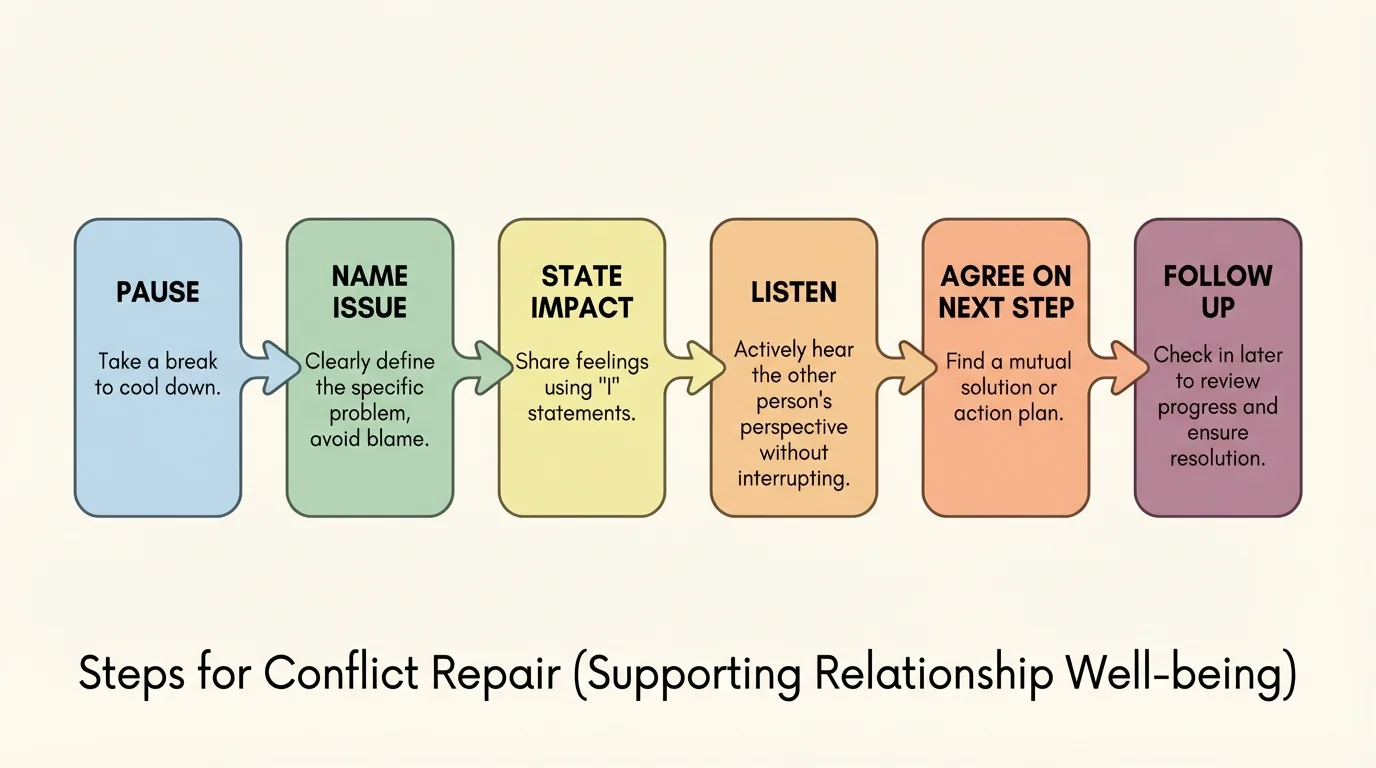
Hard conversations become easier when you have a repeatable structure, as shown in a simple repair sequence. You do not need to memorize perfect lines. You need a clear pattern: pause, name the issue, explain the impact, listen, decide on a next step, and then follow up.
Here are some practical scripts you can adapt to your own voice:
To set a boundary: "I am not comfortable sharing my location all the time."
To protect your time: "I want to talk, but I cannot be on call during work. I am free after 7 p.m."
To name impact: "When you joked about that in the group chat, I felt embarrassed."
To ask for clarity: "I am not sure what you meant by that message. Can you explain?"
To repair after a mistake: "I interrupted you and got defensive. That was not fair. I want to hear the full concern now."
To resist pressure: "I said no. I am not discussing it again tonight."
A useful habit is the check-in. This is a short, intentional conversation that asks: "How are we doing? Is anything feeling off? Is there anything we need to adjust?" Check-ins prevent small problems from turning into huge arguments. They also make honest conversation feel normal instead of alarming.
You can also use a simple decision test when a relationship feels confusing. Ask yourself: Do I feel respected? Can I be honest without fear? Do words and actions match? Are my boundaries treated as valid? Do conflicts lead to repair or repetition? If the answers are mostly no, pay attention. Confusion is often a signal.
Try This: a five-minute relationship reset
Step 1: Write down one boundary that matters to you right now.
Example: "I need private conversations to stay private."
Step 2: Write one sentence that communicates it clearly.
Example: "Please do not share screenshots of our chats without asking me."
Step 3: Write one sign of accountability you would expect.
Example: "If it happened, they would admit it, apologize clearly, and stop."
Step 4: Write one communication move you can practice.
Example: "I will ask for clarification instead of assuming the worst."
As relationships grow, the details may change, but the core habits remain the same. Long-term well-being comes from being able to trust the process of the relationship, not just the mood of the moment. You should not have to earn basic respect by staying silent, overexplaining your limits, or accepting repeated harm.
Healthy relationships feel human, not perfect. There can be disagreement, stress, and awkward moments. But there is also room for honesty, repair, and choice. Boundaries tell people how to treat you. Accountability shows whether they can be trusted with that information. Open communication keeps the relationship real instead of performative. Together, those habits support the kind of connection that can actually last.
