Some adults lose opportunities not because they lack talent, but because other people decide they cannot be trusted. A job offer can disappear after careless online behavior. A friendship can weaken after one lie too many. A family member may stop depending on someone who keeps making excuses. Your character is not just a private trait hidden inside you. It shows up in what you choose, what you avoid, how you treat people, and what you do when nobody is checking.
As you move toward adulthood, people will give you more freedom. They may also give you more responsibility: a work schedule, a bank account, a car, younger siblings to help, bills to pay, or a relationship that requires maturity. The freedom sounds exciting, but freedom and responsibility are connected. The kind of person you are becoming affects what you do with both.
Character is the set of inner qualities that guides your behavior, especially when a choice is hard, inconvenient, or unseen. Adult life often gives fewer direct reminders and more chances to choose for yourself. That means character matters more, not less, as you get older.
When people think about success, they often focus on skills: writing well, driving safely, interviewing confidently, managing money, or solving problems. Those matter. But skills can only take you so far if your character is weak. A smart employee who lies on timesheets causes problems. A talented roommate who never cleans up creates stress. A charming partner who avoids responsibility damages relationships. Character affects whether your strengths actually help people or create harm.
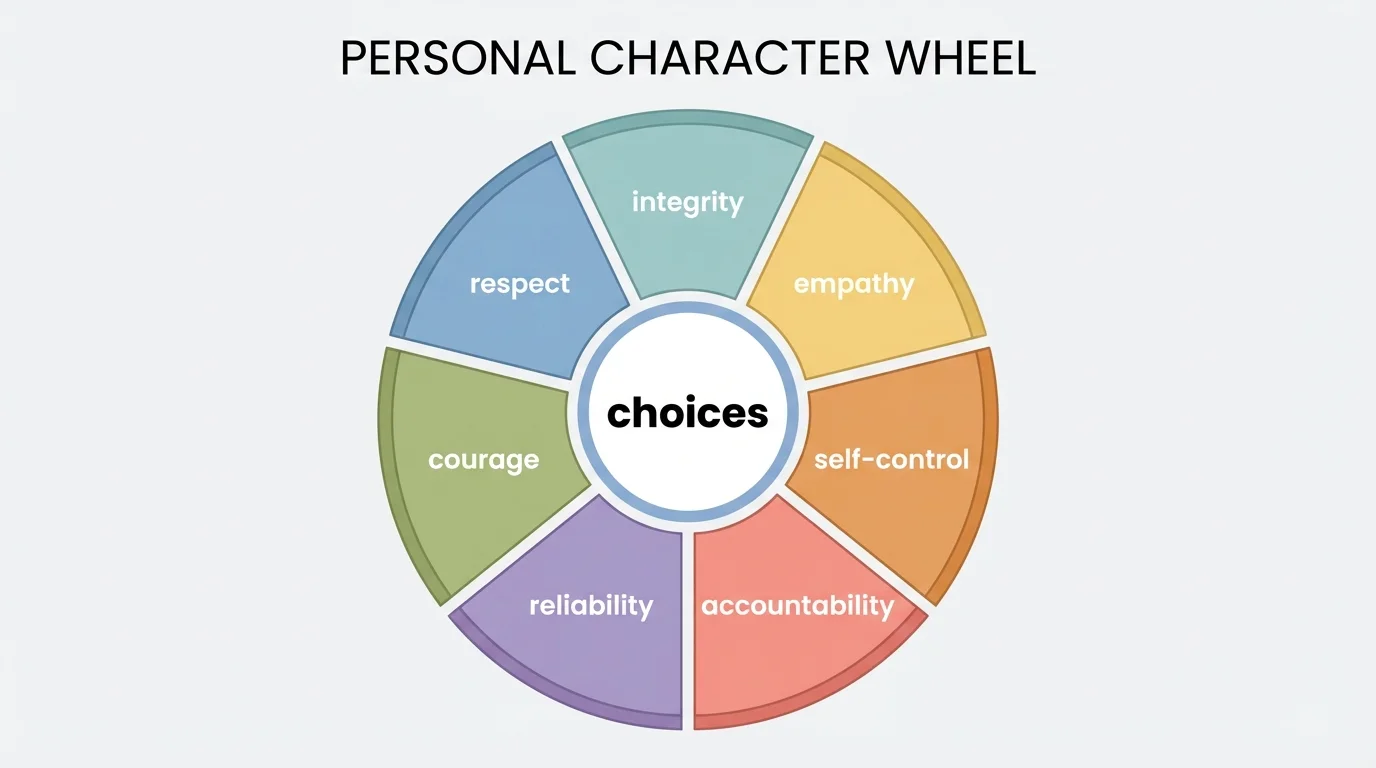
Personal character is the pattern of values and habits that shapes how you act. It includes qualities such as honesty, self-control, empathy, courage, respect, and reliability.
Trust is confidence that someone will act honestly, dependably, and responsibly.
Responsibility is the willingness to own your duties, choices, and consequences without constant supervision or excuses.
In practical life, character influences whether you return money that is not yours, whether you tell the truth after making a mistake, whether you keep a promise when it becomes inconvenient, and whether you think beyond your own comfort. These moments may seem small, but repeated small choices shape your reputation.
[Figure 1] Character is not one trait. It is a group of qualities working together in daily life. For example, honesty without empathy can become harshness, while empathy without self-control can become people-pleasing. Strong character usually means your values are balanced and consistent.
Several qualities matter especially in adult choices. Integrity means your actions match your values, even when no one would know otherwise. Accountability means you own your actions instead of blaming everyone else. Self-control helps you pause before reacting. Empathy helps you consider how your choice affects another person. Reliability means people can count on you to do what you said you would do.
You do not need to be perfect to have strong character. In fact, part of good character is being honest about your weaknesses. Someone with strong character might still struggle with procrastination, temper, or fear of conflict. The difference is that they notice the problem, take responsibility, and work to improve rather than pretending it does not matter.
Research and everyday experience both point to the same idea: people usually decide whether to trust you more by your pattern of behavior over time than by what you say about yourself.
That matters because many adult opportunities are based on reputation. If you become known as dependable, people recommend you, include you, and give you chances. If you become known as careless, dishonest, or disruptive, opportunities narrow. Character quietly opens or closes doors.
Everyday choices reveal character. Consider money. If you borrow $40 from a relative and promise to pay it back on Friday, your character affects what happens next. A person with integrity and responsibility plans ahead, repays it, or communicates early if there is a real problem. A person with weak accountability avoids the message, makes excuses, or spends the money on something fun and hopes the issue fades away.
The same thing happens with work. If your shift starts at a certain time, character affects whether you prepare early or rush in late with an excuse. If you make a mistake on an application, character affects whether you correct it honestly or hide it. If you are working remotely and no manager is watching every minute, character affects whether you actually do the work or pretend to.
Relationships also depend heavily on character. When a disagreement happens over text or on a call, self-control matters. Do you pause before sending something cruel? Do you listen before defending yourself? Do you keep private information private, or share screenshots to get attention from others? Much of the damage in relationships comes from weak character in heated moments, not from a lack of intelligence.
Case study: two responses to the same mistake
A student helping with a local volunteer event forgets to submit an important online form.
Step 1: Weak-character response
The student ignores messages, blames the website, and claims nobody explained the task clearly. The event coordinator now has to solve the problem under pressure and becomes less likely to trust that student again.
Step 2: Strong-character response
The student replies quickly, admits the mistake, apologizes, asks how to fix it, and completes the correction the same day. The error still matters, but the response shows responsibility and maturity.
The same mistake leads to very different outcomes because character changes the response.
When you evaluate your own decisions, ask a simple question: What kind of person does this choice train me to become? That question goes deeper than "Can I get away with it?" Adult life is shaped by patterns, not just isolated moments.
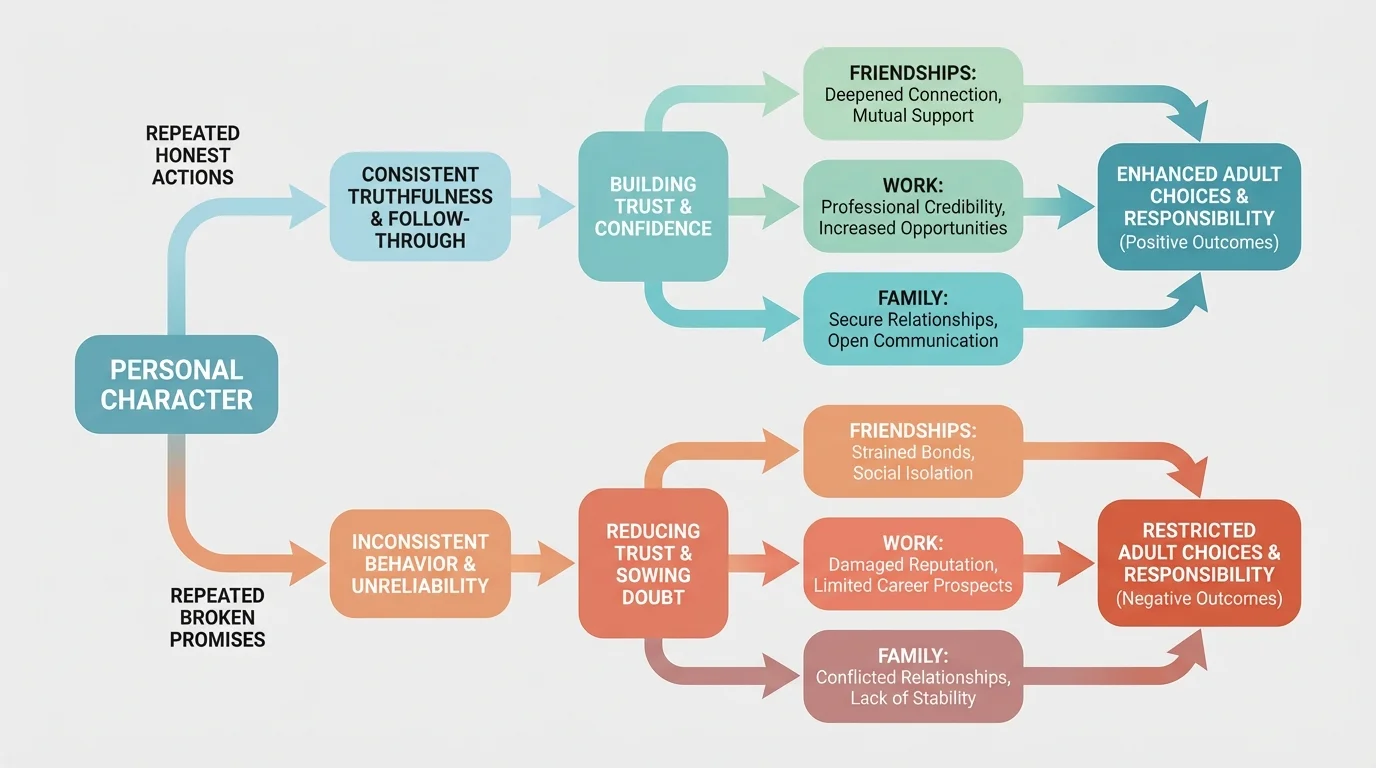
[Figure 2] Trustworthiness grows through repeated behavior. People trust you when your words and actions match over time. One promise means little if promises are often broken. One apology means little if the same harm keeps happening.
Trust usually grows through consistency. You answer when you say you will. You show up on time. You admit mistakes. You respect boundaries. You do not change your values depending on who is watching. These behaviors may look ordinary, but they are powerful because they reduce uncertainty for other people.
Trust gets tested when honesty costs something. Maybe admitting a mistake could embarrass you. Maybe telling the truth could lead to consequences. Maybe keeping your word is inconvenient. Those are the moments when character becomes visible. Anyone can look responsible when responsibility is easy.
If trust is damaged, it can sometimes be repaired, but not with words alone. A real rebuilding process usually includes four parts: telling the truth, acknowledging the impact, making a change, and staying consistent long enough for the other person to believe the change is real. That process can take time. Trust returns more slowly than it breaks.
Trust is a pattern, not a claim. Saying "trust me" does not create trust. Trust forms when people repeatedly see honesty, dependability, respect, and follow-through. In adult life, your reputation often comes from dozens of small interactions rather than one dramatic event.
This is why online behavior matters too. If you gossip in group chats, post impulsively, reveal private details, or switch personalities depending on the audience, people notice. Even when content disappears quickly, impressions often last. Character applies online just as much as offline.
Later, when you want someone to believe you after a mistake, the earlier pattern matters. That is the point shown in [Figure 2]: trust either strengthens through repeated responsible choices or weakens through repeated carelessness. You are always building a record.
Responsibility is more than doing chores or meeting deadlines. It means accepting that your choices have effects on other people, your future, and your own self-respect. Responsible adults do not need constant reminders for basic obligations. They make plans, follow through, and deal with consequences directly.
One sign of responsibility is ownership. If you miss a deadline, own it. If you overspend, own it. If you spoke unfairly, own it. Ownership does not mean self-hatred. It means honesty. Without honesty, improvement is nearly impossible because you are always rewriting the story to avoid discomfort.
Another sign is follow-through. Many people have good intentions. Fewer people turn intentions into action. Responsibility means handling the boring, repetitive, unglamorous parts of life: answering emails, cleaning shared spaces, renewing documents, saving money, showing up prepared, and doing what you promised even when the mood is gone.
| Situation | Responsible response | Irresponsible response |
|---|---|---|
| You agreed to help a family member | Confirm the time, show up, communicate if a problem comes up | Ignore messages and cancel at the last second |
| You overspend part of your paycheck | Adjust your budget and cut back the next week | Pretend it is fine and keep spending |
| You damage someone else's property | Admit it, apologize, and help pay or replace it | Deny it or hope they never find out |
| You are overwhelmed by tasks | Prioritize, ask for help early, make a plan | Wait until everything becomes urgent |
Table 1. Comparison of responsible and irresponsible responses in common adult situations.
Responsibility also includes preparation. If you know you struggle with lateness, the responsible choice is not to keep promising you will "try harder." It is to set alarms, leave earlier, prepare the night before, and build margin into your schedule. Responsibility is not just about good intentions. It is about systems that support good behavior.
"Character is what you do when no one is watching."
— Common ethical principle
This idea matters because many adult settings involve freedom. Remote work, independent study, commuting, managing your own sleep schedule, and handling your own money all depend on what you choose without immediate supervision. Freedom reveals character.
Most people do not fail responsibility because they planned to become unreliable. More often, they drift. They act on impulse, avoid discomfort, rationalize, or follow pressure. That is why evaluating character honestly matters. You need to know your weak spots.
A common trap is short-term thinking. You might skip a commitment because relaxing feels better right now. You might lie because the truth feels awkward right now. You might spend money meant for gas or food because the purchase feels exciting right now. Weak character often chooses immediate relief over long-term stability.
Another trap is rationalization, which means inventing excuses that make a poor choice feel acceptable. "Everybody does it." "It is not a big deal." "They will get over it." "I deserve this." These thoughts can make irresponsible behavior feel normal even when it clearly harms trust or creates future problems.
Peer influence also matters. Even in online spaces, people pressure one another to mock someone, hide the truth, pile onto conflict, cheat, or act reckless for approval. Character gives you the strength to say no when a crowd says yes. That takes courage, especially when doing the right thing makes you less popular for a while.
You already know that actions have consequences. This topic goes one step further: repeated actions shape identity. What you repeatedly do becomes part of the kind of person others experience you to be.
[Figure 3] Stress can expose character too. When people are tired, embarrassed, angry, or overwhelmed, their default habits show. That does not excuse harmful behavior, but it explains why practicing strong habits early matters. Under pressure, people often fall to the level of their habits rather than rise to the level of their intentions.
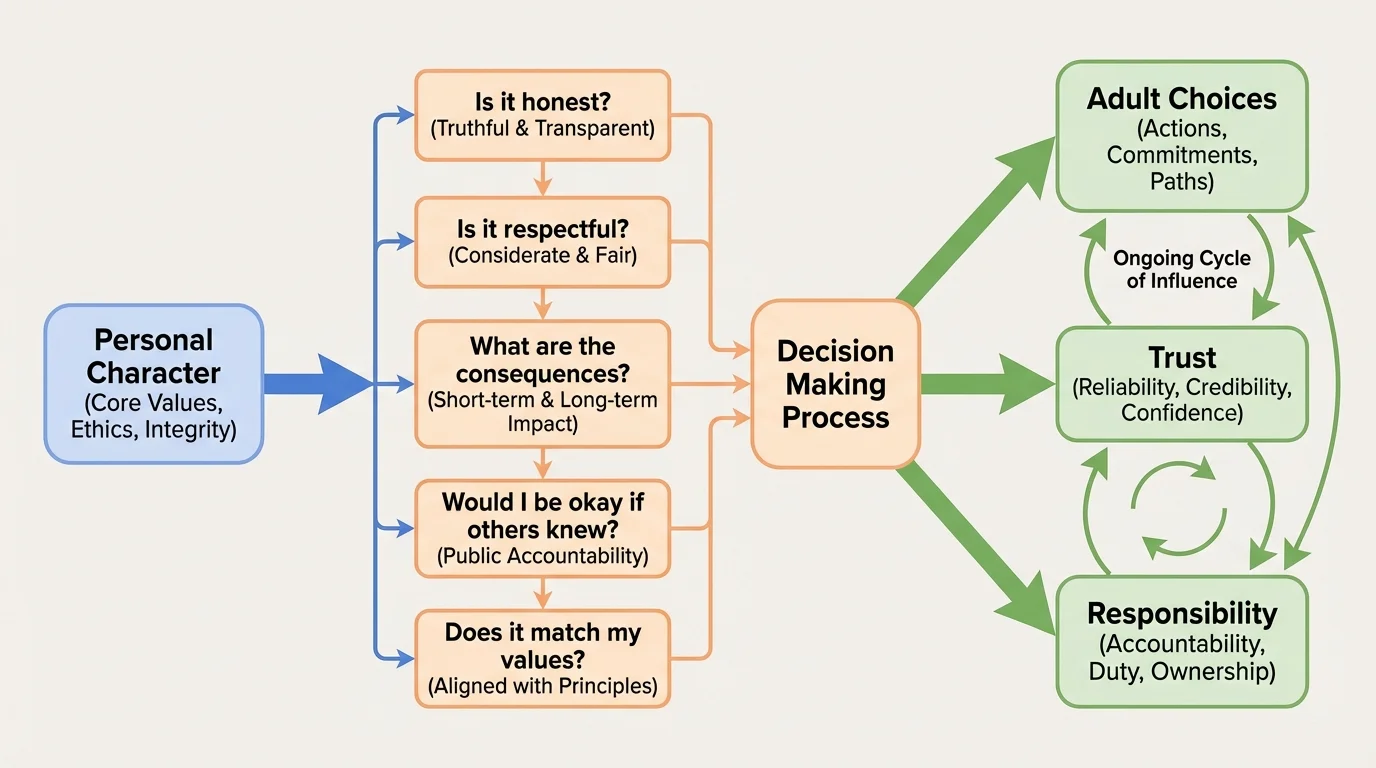
Character is not fixed. You can strengthen it through repeated choices. One helpful method is using a decision filter before acting in high-stakes moments. This is especially useful before sending a message, making a purchase, accepting a commitment, or reacting while emotional.
Ask yourself five questions: Is it honest? Is it respectful? What are the likely consequences? Would I be okay if this became public? Does it match the kind of person I want to be? If a choice fails several of those questions, that is a warning sign.
Another strategy is to build habits that make responsibility easier. Prepare before you are pressured. Save emergency money before an emergency. Charge your phone before you need directions. Write down deadlines before you forget them. Strong character is supported by practical systems, not just motivation.
How to respond responsibly after a mistake
Step 1: Name the mistake clearly
Say what happened without minimizing it. Example: "I said I would send that document yesterday, and I did not."
Step 2: Acknowledge the impact
Show that you understand how it affected the other person. Example: "That slowed down your planning and created stress."
Step 3: Offer a concrete repair
Do something specific. Example: "I have sent it now, and next time I will set a reminder the night before."
Step 4: Stay consistent
The real proof is not the apology. The proof is better behavior over time.
Boundaries also strengthen character. If certain people pull you toward dishonesty, cruelty, reckless spending, or unhealthy drama, limiting access is a responsible choice. Good character is not just resisting bad influences in the moment. It is designing your life so bad influences have less power.
Self-reflection matters too. At the end of the week, ask: Where was I dependable? Where did I avoid responsibility? Did I tell the truth even when it was uncomfortable? Did my online behavior match my values? What do I need to repair? Reflection turns vague guilt into useful growth.
The decision process in [Figure 3] becomes more powerful when you practice it before small choices, not only huge ones. The more often you pause and evaluate, the more natural wise choices become.
If you start a job, character affects whether supervisors see you as ready for promotion. They usually notice reliability, honesty, problem-solving, and accountability faster than they notice confidence. A person who admits an error and fixes it is often more valuable than a person who looks polished but hides problems.
If you live with roommates someday, character affects peace in the home. Shared expenses, noise, cleanliness, privacy, and chores all depend on responsibility and trust. Roommate conflict often grows not from one giant issue, but from repeated small failures to communicate and follow through.
In dating, character matters even more. Attraction may create interest, but trust sustains a relationship. Respecting boundaries, keeping private matters private, being honest about intentions, and handling conflict without manipulation are all signs of maturity. Charm without character is dangerous.
If you drive, character affects safety. Responsibility means not texting while driving, not driving under the influence, not showing off, and not pretending rules only matter for other people. A reckless decision can change many lives in seconds.
Money is another major test. Character affects whether you budget, avoid unnecessary debt, repay what you owe, and resist lifestyle pressure. It also affects whether you are generous and fair, not just self-protective. Financial responsibility is partly about numbers, but it is also about values and discipline.
Try This: a one-week character reset
Choose one area where you want to be more trustworthy or responsible this week.
Step 1: Pick one behavior
Examples: replying within a day, arriving early, cleaning up immediately, or telling the truth faster.
Step 2: Make it measurable
For example, "I will be ready for every shift 10 minutes early" is clearer than "I will do better."
Step 3: Track it daily
Notice what helps and what gets in your way.
Step 4: Repair one unfinished responsibility
Send the message, return the item, apologize, or complete the task you have been avoiding.
Adult choices are not only about what is possible. They are about what is wise, ethical, and dependable. Your character shapes how you use freedom, how others experience you, and what kind of future you are building. When your choices line up with honesty, empathy, and responsibility, trust grows and your life becomes more stable.
