A surprising number of students do the hardest part first: they get accepted somewhere, then realize they do not actually know whether they can afford it, manage the schedule, or see themselves succeeding there. Postsecondary readiness is not just about getting in. It is about choosing well, following through, and building a realistic plan for what happens next.
If you are in grade 12, you are close to a major shift. That shift may be college, trade school, a certificate program, an apprenticeship, military service, or a job that includes training. The exact path can differ, but the readiness skills are similar: responsibility, communication, decision-making, planning, and self-awareness. These are the skills that help you avoid last-minute panic, missed deadlines, bad-fit choices, and preventable financial stress.
The goal is not to pick the "perfect" path. The goal is to make a strong, informed choice and prepare yourself to handle the transition like an adult. That means knowing what you need, asking smart questions, reading details carefully, and making plans that work in real life, not just in your head.
Postsecondary readiness means you can move from high school into your next step with the skills to manage responsibilities, solve problems, and make informed decisions. Acceptance is only one piece. Real readiness includes showing up on time, checking email, completing forms, asking for help early, budgeting money, and balancing freedom with responsibility.
Postsecondary education includes any education or training after high school, such as colleges, universities, trade schools, certificate programs, apprenticeships, and career training programs.
Transition planning is the process of preparing for what happens before, during, and after you start your next step so that important tasks, supports, and responsibilities are not missed.
Think about two students. One chooses a program because friends are going there, ignores the cost, forgets a housing deadline, and never checks the portal where the school sends updates. The other compares options carefully, tracks deadlines, asks financial questions, and creates a first-month plan. Both may be capable, but the second student is using readiness skills. That difference affects stress, money, and success.
Being ready also means understanding yourself. Some students thrive in a large university with lots of independence. Others do better in a smaller program, a career-focused training path, or a setting where classes connect directly to hands-on work. There is nothing weak about choosing the path that fits you best. In fact, that is a sign of maturity.
One of the biggest mistakes students make is treating postsecondary education like there is only one "real" path. There are many options, and each can lead to stability, skill growth, and meaningful work. Your job is to understand the landscape before committing.
Common options include four-year colleges or universities, two-year community colleges, trade or technical schools, certification programs, apprenticeships, military pathways, and direct employment with built-in training. Each option has trade-offs in cost, length, flexibility, earning potential, and daily routine.
| Pathway | Typical Focus | Duration | Best For |
|---|---|---|---|
| Four-year college | Academic degree and broad study | About 4 years | Students seeking a bachelor's degree or certain professional careers |
| Community college | Associate degree, transfer, or career training | About 2 years | Students wanting lower initial cost or flexible planning |
| Trade school | Hands-on technical skills | About 6 months to 2 years | Students seeking direct career preparation |
| Apprenticeship | Paid learning on the job | Varies | Students who want to earn while training |
| Certificate program | Specific career skill | Short-term | Students entering a focused field quickly |
| Military | Service, training, education benefits | Varies | Students ready for structure and service commitment |
Table 1. Comparison of common postsecondary pathway options and what each usually offers.
Do not choose based only on title or reputation. Instead, ask practical questions: What will my daily life look like? How much structure do I need? Do I want to start earning sooner? Am I prepared for the cost? Does this path match the kind of work I may want later?
Many strong careers do not require a four-year degree right away. Some students begin with a certificate, apprenticeship, or community college program and continue their education later when they have more income, clarity, or employer support.
That matters because your first choice does not have to lock your entire future. It should simply be a smart next step.
[Figure 1] A good decision is not based on pressure, fear, or image. It is based on evidence. A personal framework helps you compare options using the things that actually affect your life: cost, career fit, support, location, flexibility, and your own habits. This makes the decision less emotional and more grounded.
Start by identifying your priorities. For example, one student may care most about low cost and staying close to family. Another may care most about a specific program and campus resources. Another may need a schedule that allows part-time work. There is no universal ranking; your framework should reflect your reality.
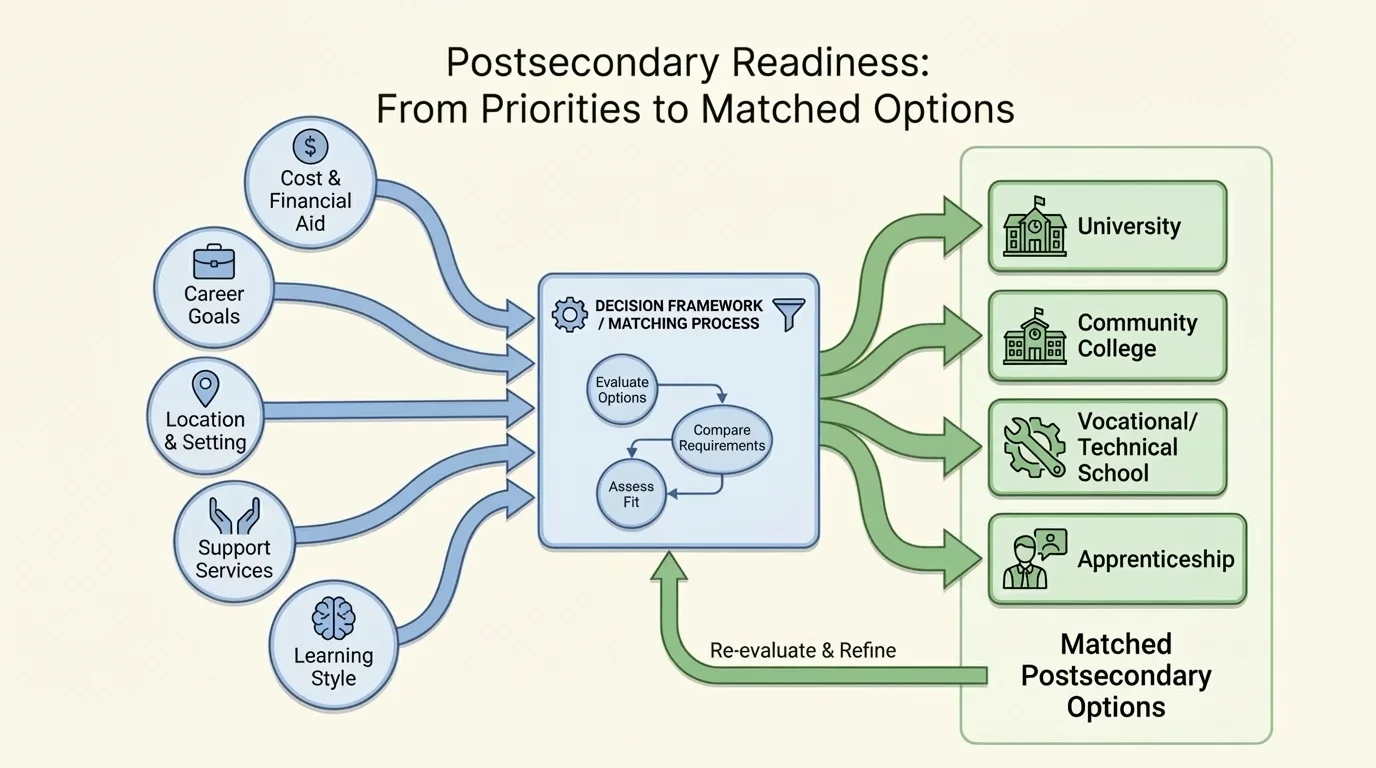
One simple method is to score each option in a few categories from 1 to 5. You are not doing advanced math here; you are creating a clearer picture. Suppose Option A scores 4 for cost, 5 for program fit, 3 for location, and 4 for support. Its total would be \(4 + 5 + 3 + 4 = 16\). A second option might score \(5 + 4 + 2 + 4 = 15\). The numbers do not make the decision for you, but they reveal patterns.
The deeper value of a framework is that it helps you notice trade-offs. A school may look exciting online but have poor support for your intended major. A local program may not seem glamorous but may reduce debt, commuting stress, and housing problems. Later, when you compare final offers, the same logic from [Figure 1] still helps: you are not choosing the option that looks best on social media; you are choosing the option that works best in your life.
Good fit beats outside pressure. A strong postsecondary choice fits your academic goals, emotional needs, financial reality, and daily routine. A path that looks impressive but constantly strains your money, energy, or focus can become a poor fit very quickly.
When building your framework, include these categories:
Cost: tuition, housing, books, transportation, technology, and hidden fees.
Program quality: Does the school or program actually offer what you want to study or train for?
Support: tutoring, advising, mental health services, disability support, career services.
Environment: online, hybrid, local, far from home, large, small, structured, independent.
Career path: What happens after completion? Is there job placement support, transfer potential, or licensing preparation?
Your responsibilities: work hours, family obligations, transportation access, health needs.
[Figure 2] Strong students still miss opportunities because they handle applications casually. A system matters more than motivation alone. When you apply to programs, scholarships, or housing, small missed steps can turn into major problems.
Create one master list for every application. Include deadlines, fees, essays, transcript requests, recommendation requests, account logins, test score policies, and confirmation steps. If you are applying to several places, this list keeps your brain from trying to hold everything at once.
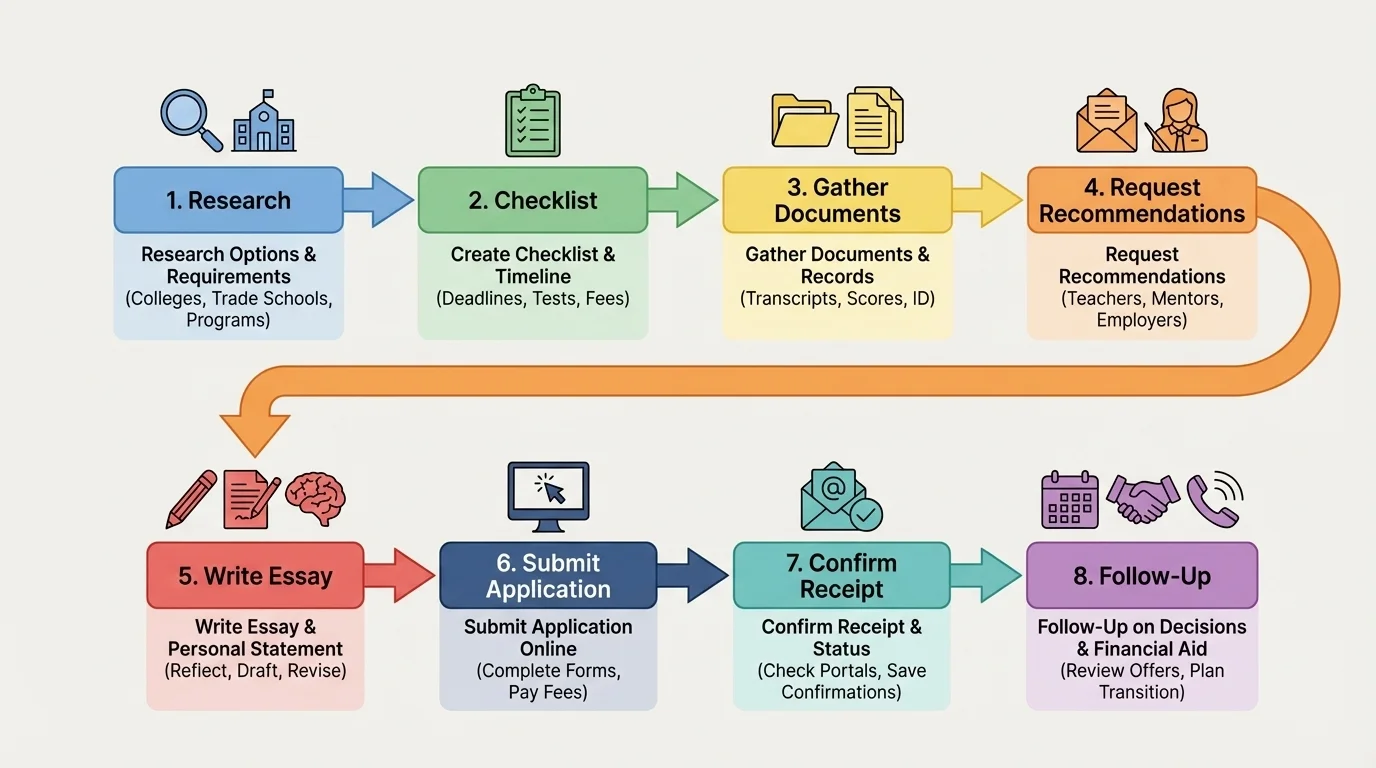
Here is a practical application workflow:
Step 1: Read all requirements slowly. Do not assume all schools or programs want the same materials.
Step 2: Set personal deadlines earlier than official deadlines. If the application is due on the 21st, aim to finish by the 16th or 17th.
Step 3: Gather documents in one digital folder. Label files clearly, such as "Resume_Final," "Essay_StateCollege," or "Transcript_Request."
Step 4: Ask for recommendations professionally and early. Give the person enough time and any information they need.
Step 5: Review everything before submitting. Check spelling, dates, names, and uploaded files.
Step 6: Confirm that the application was received. Save emails, screenshots, or portal confirmations.
Step 7: Monitor your email and portal. Schools often ask for follow-up forms, identity verification, or next steps.
Your communication during this process matters. A short, professional email can make a strong impression. Use a clear subject line, proper greeting, and complete sentences. For example: "Hello Ms. Alvarez, I am applying to the health sciences program and wanted to confirm whether my transcript has been received. Thank you for your time." That is much stronger than "hey did u get it."
Case study: organizing three applications
Jordan is applying to a university, a scholarship, and a local technical program. Instead of guessing, Jordan sets up a simple tracking system.
Step 1: Make a list of deadlines
The university application is due on October 21, the scholarship on November 15, and the technical program on December 1.
Step 2: Subtract a safety buffer
Jordan creates personal deadlines 15 days earlier for each one, so October 6, October 31, and November 16 become the target dates.
Step 3: Separate required materials
Jordan lists which items overlap and which do not: transcript, resume, essay, recommendation, and proof of residency.
Step 4: Schedule follow-up checks
Two days after each submission, Jordan logs in to verify that every item shows as received.
This system reduces stress and lowers the chance of losing an opportunity because of a preventable mistake.
Another readiness skill is honesty. Never exaggerate experiences, copy essays, or submit something you did not write. Shortcuts can damage your application and your reputation. Your goal is not to sound perfect. Your goal is to show maturity, effort, and fit.
[Figure 3] The cheapest-looking option is not always the lowest real cost when you compare sticker price with aid, fees, housing, and transportation. A smart postsecondary decision includes financial readiness, not just excitement.
Sticker price is the listed cost before aid. Net cost is what you are more likely to pay after grants, scholarships, and other aid are applied. Two schools can look very different at first and end up costing nearly the same, or the "dream school" may still leave a gap that is not realistic for your family.
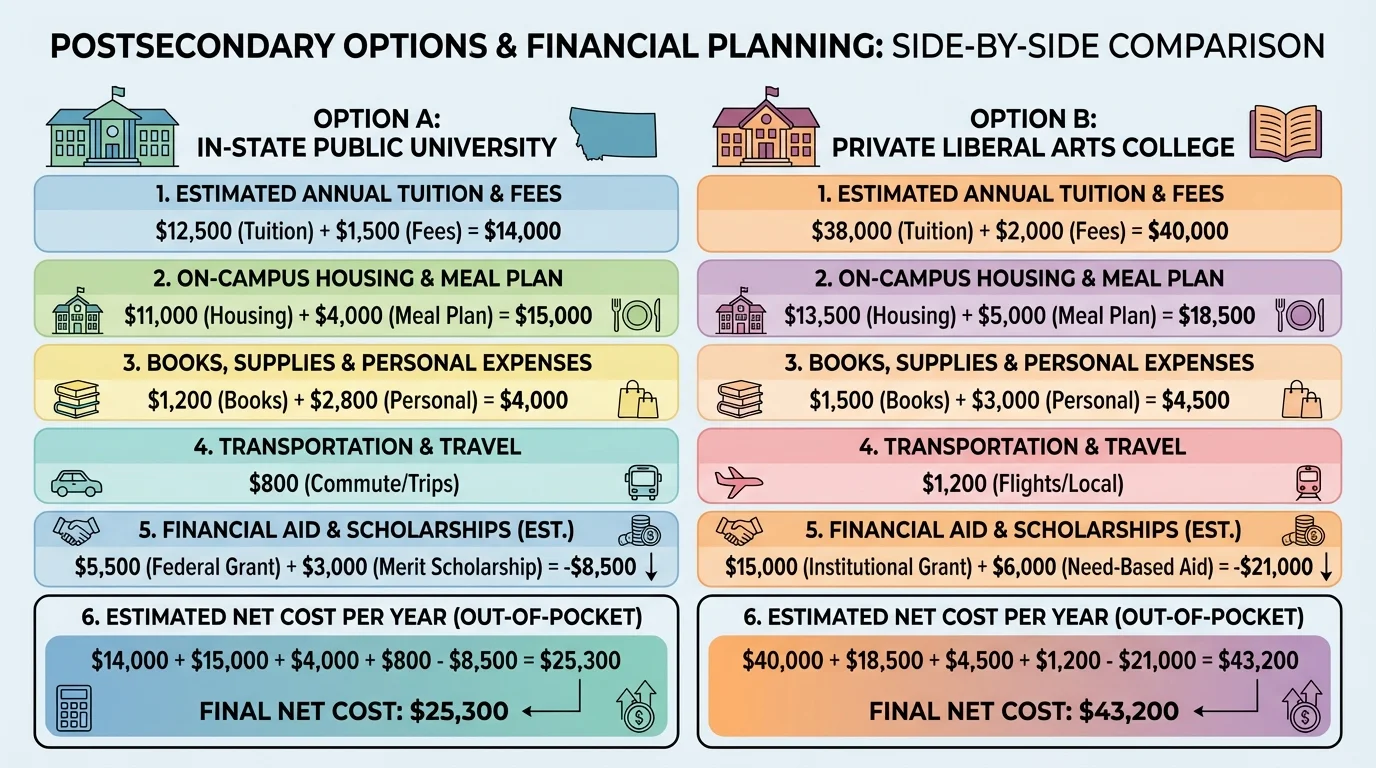
When comparing offers, include more than tuition. Add fees, books, supplies, transportation, food, internet, work clothing if needed, and housing. If one option allows you to live at home, that changes the total. If another requires a car, parking, or public transit every day, that matters too.
Use simple calculations. For example, suppose Program A costs $18,000 and offers $7,000 in grants and scholarships. The remaining amount is found by subtracting: \(18{,}000 - 7{,}000 = 11{,}000\). If transportation and books add another $1,800, then the annual total becomes \(11{,}000 + 1{,}800 = 12{,}800\). Program B might cost $12,500 with $2,000 in aid, giving \(12{,}500 - 2{,}000 = 10{,}500\). If commuting adds $3,000, the annual total becomes \(10{,}500 + 3{,}000 = 13{,}500\). In that case, the option with the lower sticker price actually costs more in your real life.
Budgeting matters too. If you know your monthly income from a part-time job is $700 and your monthly expenses for gas, phone, food, and school supplies are $520, then your remaining amount is \(700 - 520 = 180\). That tells you how much room you have before adding new school-related costs. This kind of math is not complicated, but it is powerful because it keeps your decisions honest.
Financial readiness means planning for stability, not just survival. You want a path that allows you to keep up with school or training without constant crisis. If your plan only works when nothing goes wrong, it is probably too fragile.
Ask direct questions when reviewing financial aid or payment details: Is this aid renewable each year? What grades must I keep? Are housing costs included? What fees are not listed? When are payments due? What happens if I need to reduce my course load?
Later, when you make a final decision, the comparison pattern in [Figure 3] helps you look beyond labels and focus on actual affordability.
At some point, researching has to become deciding. This is where many students freeze. They keep comparing forever, ask ten people for opinions, and become more confused. A better strategy is to narrow your options, review your framework, and choose using evidence.
Start by eliminating options that clearly do not work. If a program is unaffordable even after aid, lacks your intended area of study, or creates a daily schedule you cannot realistically manage, it should not stay in the final round just because it sounds impressive.
Then compare your top choices across the same categories. Ask yourself: Which option gives me the best mix of opportunity, support, and sustainability? Which one matches my current goals while still leaving room to grow? Which one am I choosing because it fits me, not because I want to impress someone?
"Your future is built more by consistent choices than by dramatic moments."
It is also wise to make a backup plan. If your first choice falls through because of cost, waitlists, or personal circumstances, what is your second path? Mature planning includes flexibility. A backup plan is not failure; it is responsibility.
Once you choose, commit fully. Complete the enrollment steps, decline other offers respectfully if needed, and shift your energy from deciding to preparing.
[Figure 4] The transition into postsecondary life often feels harder than the application process because now the responsibilities are real. A checklist reduces stress by turning a big life change into manageable actions. This is where transition planning becomes practical, not abstract.
Your first 90 days matter because habits form quickly. If you begin disorganized, behind on forms, unsure of your schedule, and isolated from support, stress grows fast. If you begin with routines, information, and backup plans, you give yourself a steadier start.
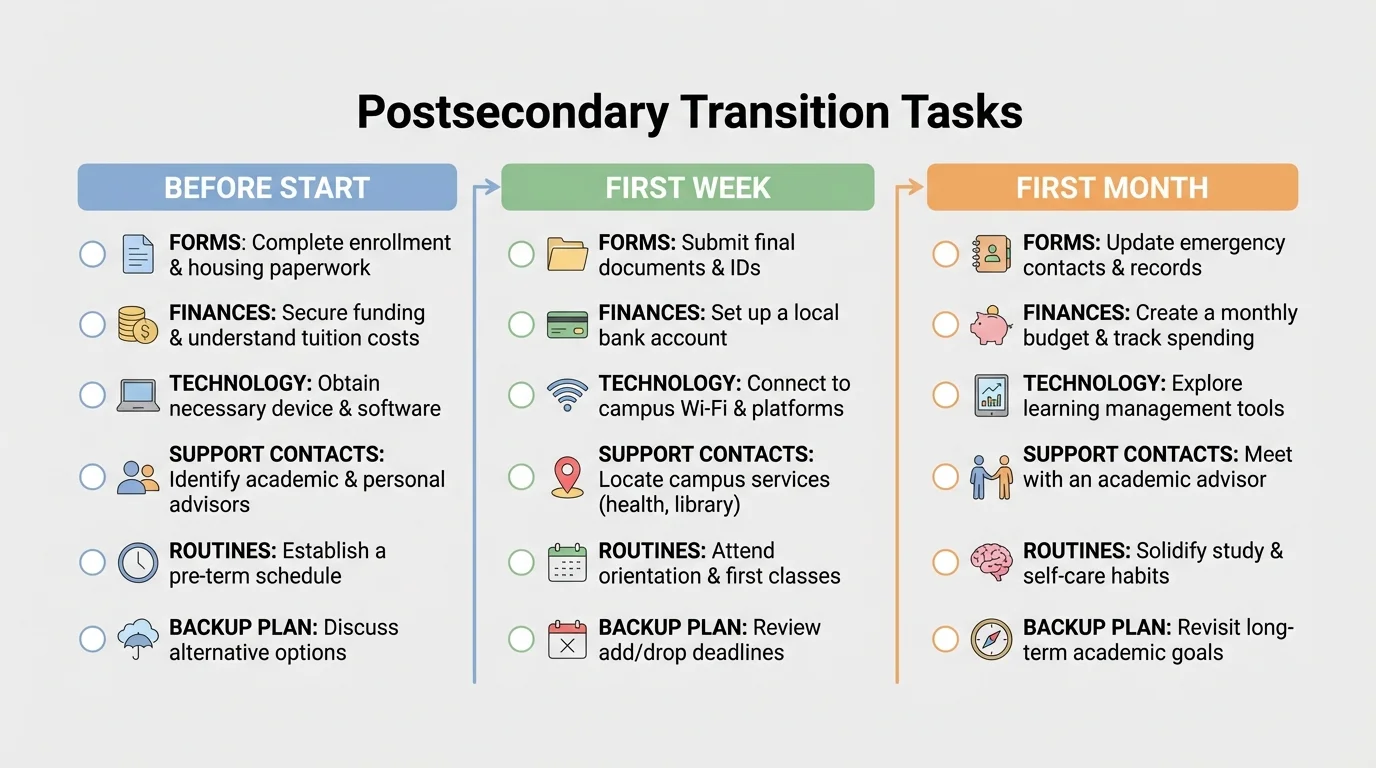
Before your start date, make sure you complete the basics:
Administrative tasks: enrollment forms, financial aid verification, account setup, health records if required, placement tasks, housing forms, payment deadlines.
Technology tasks: school email, portal login, learning platform access, password manager, device readiness, file backup.
Schedule tasks: class times, work schedule, commute plan, sleep routine, calendar reminders.
Financial tasks: payment plan, transportation budget, emergency savings, supply list, monthly spending limit.
Support tasks: advisor contact, family communication plan, one trusted adult, counseling information, tutoring access, employer communication if you work.
A first-90-days plan should also include your weekly routine. Decide when you will study, work, rest, handle chores, and respond to messages. Freedom feels good until everything piles up. Structure protects your time.
Transition plan example
Maya will attend a community college while working 15 hours each week.
Step 1: Map fixed commitments
Maya enters class times, work shifts, and commute time into a digital calendar.
Step 2: Add support routines
Maya schedules two weekly study blocks, one financial check-in every Sunday, and one email check each morning and evening.
Step 3: Prepare a backup plan
If work hours increase unexpectedly, Maya will speak with a supervisor within 4 hours and contact an academic advisor before missing assignments.
Step 4: Build a safety net
Maya saves emergency contacts, transportation alternatives, and account login information in one secure place.
This plan does not guarantee a stress-free semester, but it makes problems easier to manage before they become crises.
If you look again at the sequence in [Figure 4], the main idea is simple: preparation lowers chaos. You do not need to control everything. You do need to know your next move.
Some mistakes are so common that you can prepare for them now. One is assuming someone else will remind you. In postsecondary settings, many responsibilities shift onto you. If you miss an email, deadline, or payment, the consequences are often yours.
Another mistake is choosing based on image. A school, program, or career path can look exciting online and still be a poor fit for your finances, attention style, or responsibilities at home. The decision framework from [Figure 1] helps protect you from that trap because it forces you to compare what matters in daily life.
A third mistake is underestimating small tasks. A missing document, an unanswered portal message, or a forgotten placement appointment can delay enrollment or financial aid. That is why the application workflow in [Figure 2] matters so much. Big goals are often helped or harmed by small habits.
Students also get into trouble by making a plan with no margin. If your budget only works when every paycheck is exactly on time and no surprise expense appears, your plan is unstable. Build a little cushion where possible, even if it is small.
You already use many readiness skills in everyday life: managing your time, responding to messages, meeting commitments, and adjusting when plans change. Postsecondary success grows from those same habits, just with higher stakes and more independence.
Finally, avoid silence when something goes wrong. If you are confused, behind, or worried, contact the right person early. Waiting rarely improves the situation. Reaching out is not weakness; it is problem-solving.
Your next step after high school is not just a destination. It is a test of how you handle responsibility. The students who adjust best are not always the smartest or most confident at the beginning. They are often the ones who read carefully, plan ahead, ask questions, and keep going when the process feels messy.
Self-advocacy is one of the most important skills in this transition. It means speaking up for what you need, asking for clarification, and using available support. Net cost should matter as much as the name of a school. Your enrollment steps matter as much as your acceptance. A good decision matrix can protect you from rushed choices, and solid transition planning can protect you from first-month chaos.
Take your future seriously, but do not treat it like one decision defines your entire life. What matters most is that you use readiness skills well: gather information, compare honestly, communicate professionally, prepare carefully, and follow through. Those habits will help you in college, training, work, and adult life far beyond this year.
Try this today: start one document called "My Next Step Plan." Add your top options, deadlines, likely costs, questions to ask, and first-month needs. A plan on paper is easier to improve than a plan that stays vague in your mind.
