Have you ever finished a job, felt proud, and then noticed you forgot one important part? That happens to lots of kids. The good news is that you can use a simple routine to help your brain remember what to do. When you plan, organize, and check, your work becomes easier to start, easier to finish, and more likely to be complete.
A routine is something you do in the same way again and again. A good routine helps your brain know, "First I do this. Next I do that." That means you do not have to guess every time you start a task.
Routines are helpful in online school, at home, and in everyday life. You can use them when you are doing an assignment on a computer, cleaning your room, putting away groceries, or getting ready for a video call activity. When you have a routine, you are less likely to lose things, skip steps, or rush through your work.
Complete means all the needed parts are done. Routine means a set way of doing something. Checklist means a short list you use to make sure every part is finished.
When work is not complete, problems can happen. You might turn in an online task without your name, forget to answer one question, or leave art supplies all over the table. When work is complete, things go more smoothly. You save time because you do not have to go back and fix as many mistakes.
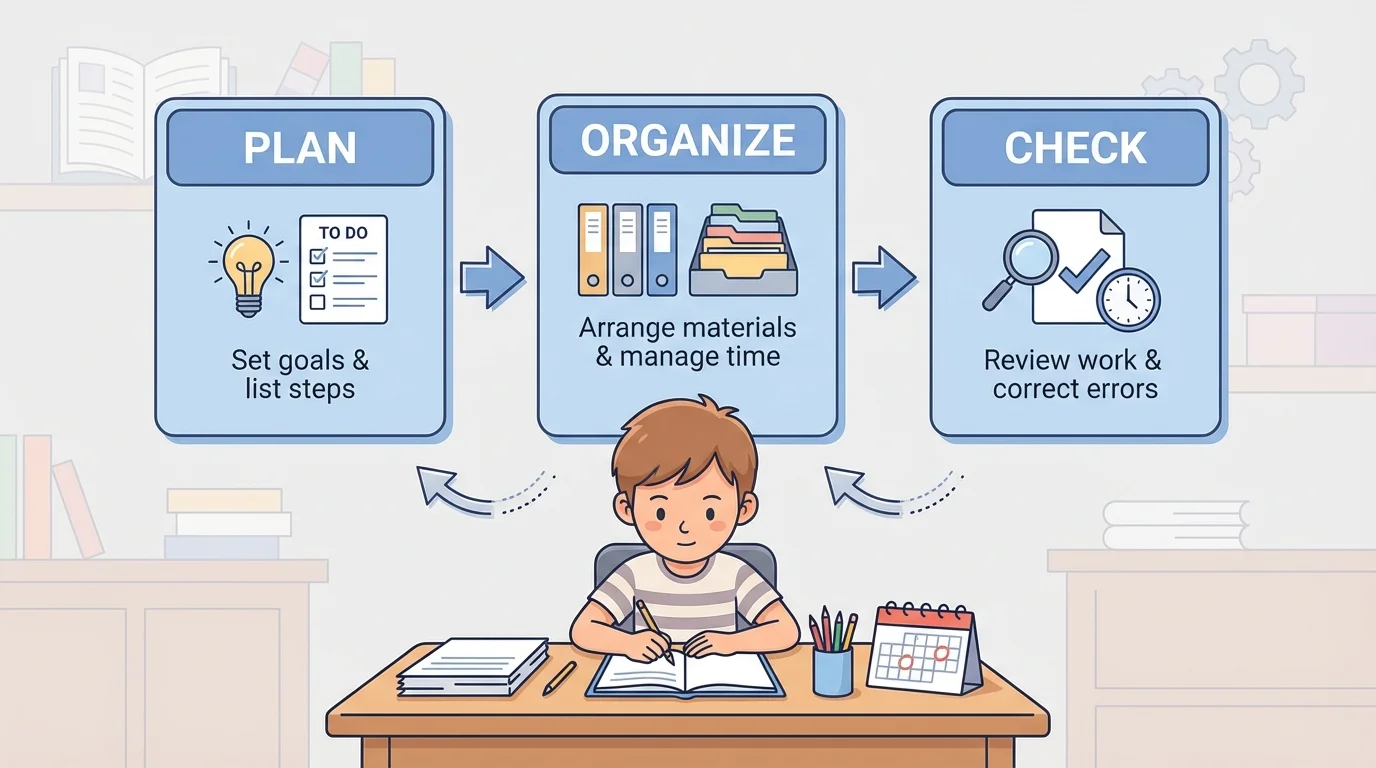
As [Figure 1] shows, your routine can have three simple parts: plan, organize, and check. This is a strong habit for many kinds of work.
Plan means you stop and think before you begin. Organize means you keep your things and your steps in order while you work. Check means you look back at the end to make sure the task is really finished.
You do not need a fancy system. Even a short routine can help. You can whisper the steps to yourself: "Plan it. Do it in order. Check it." That quick reminder can keep you on track.
"Slow down at the start, so you can finish strong."
That saying is useful because rushing at the beginning often causes mistakes later. A tiny bit of planning can save a lot of fixing.
Before you begin a task, take a moment to make a plan. Planning means asking yourself a few smart questions.
As [Figure 2] illustrates with a simple first-next-last chart, ask: What am I supposed to do? What do I need? How much time do I have? What should I do first? If you know those answers, you are much more ready to begin.
One easy way to plan is to think in three parts: first, next, and last. For example, if you need to do an online reading task, your plan might be: first open the lesson, next read and answer, last submit the work.
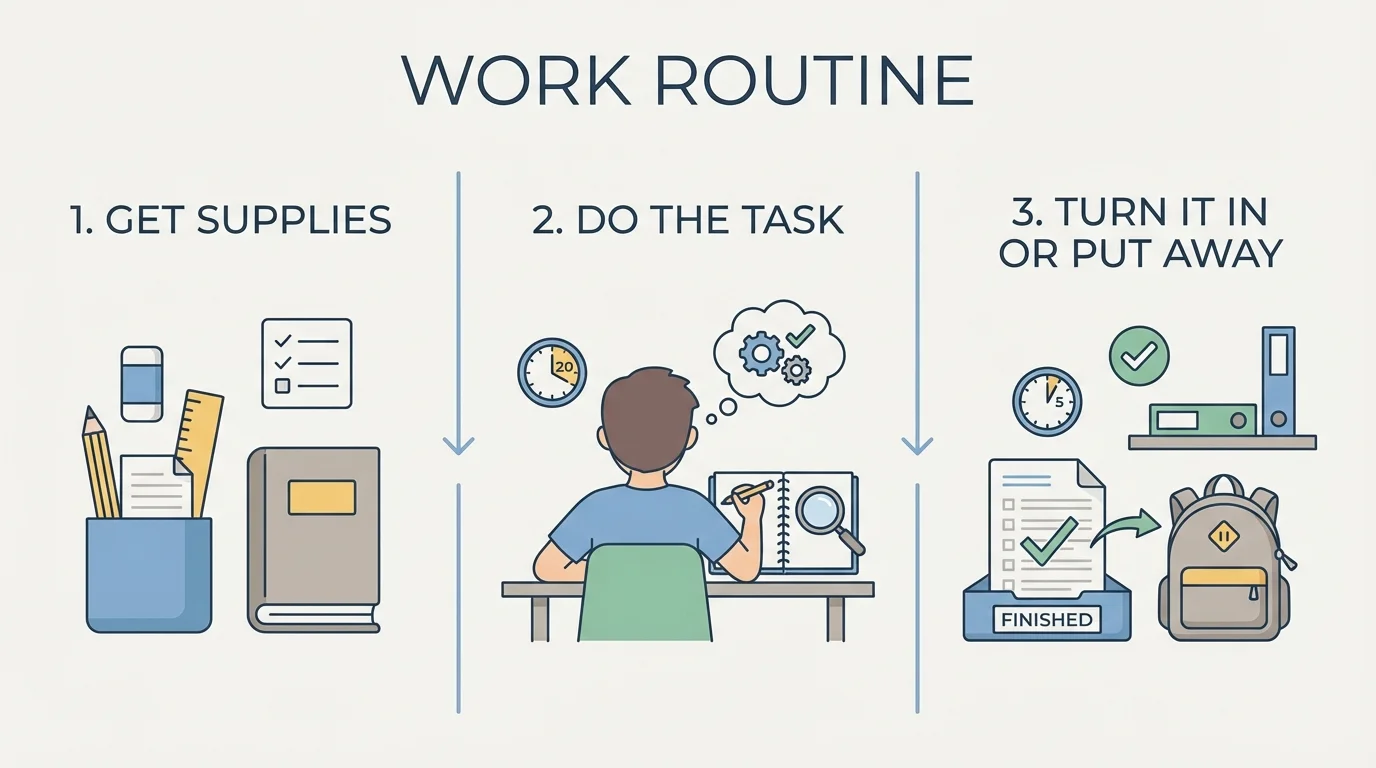
You can also gather your materials before you start. If you need paper, a pencil, headphones, and your device, get them ready first. This helps you avoid getting up again and again.
Planning does not have to take long. Sometimes it takes less than a minute. But that minute helps your brain feel calm and ready.
Example: Planning before a drawing assignment
Step 1: Read the directions.
You notice you need to draw a pet and color the background.
Step 2: Gather materials.
You get paper, crayons, and a pencil.
Step 3: Make a small plan.
First sketch the pet, next add details, last color and upload the picture.
Now you are ready to begin without guessing what to do.
A good plan is simple, clear, and easy to follow. It is not about making a huge list. It is about knowing your next steps.
After you plan, it is time to organize. Organizing means keeping your space, tools, and steps in order while you work. This helps you stay focused.
Try to keep only the things you need in your work area. If you are writing, keep your pencil and paper nearby. If you are working online, keep only the lesson tab open if possible. Too many toys, tabs, or supplies can pull your attention away.
It also helps to do one step at a time. If your task has many parts, do not try to think about all of them at once. Finish one part, then move to the next. This keeps your brain from feeling too full.
You can use a short list to stay organized. A list might say: read directions, do part one, do part two, review, submit. As you finish each part, you can mark it off. That gives you a clear path forward.
Organizing is putting things and steps where they belong. You can organize objects, like pencils in a cup or papers in a folder. You can also organize actions, like doing step one before step two. Both kinds of organizing help work feel easier.
Being organized also means putting things away when you are done with them. If you finish using scissors, return them to their spot. If you finish a digital task, save it in the correct folder. These small actions prevent future problems.
Online work needs organizing too. You might keep one folder for finished work, one spot for headphones, and one place for login information that a trusted adult helps you store safely. Good organization protects your time and your energy.
Many kids stop when they think they are done. Careful workers take one more step: they check their work. Checking means looking back carefully to see if every needed part is there.
As [Figure 3] shows with a simple list, when you check, ask yourself: Did I do every part? Did I follow the directions? Did I skip anything? Is my work neat enough to understand? Did I turn it in or put it where it belongs?
A checklist is very helpful here. You can compare your finished work to the list. If one box is not checked, you know what still needs attention.
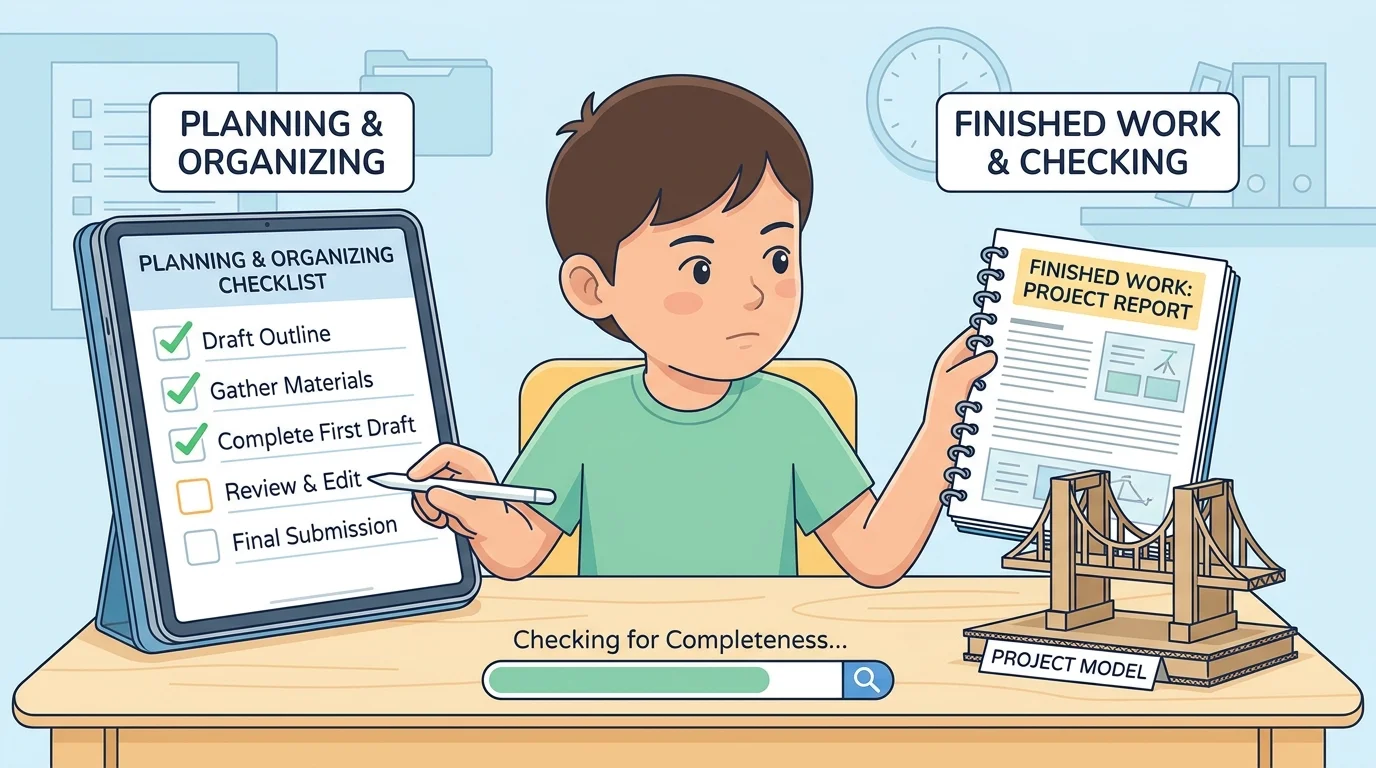
Checking is not the same as starting all over. It is a quick review. Maybe you notice your name is missing. Maybe you forgot one answer. Maybe the task is done, but you still need to click submit. A short check can catch all of those things.
This is where being complete matters. Work is not complete just because you worked hard on it. Work is complete when all the needed parts are finished. Just like [Figure 1] reminds us, the last part of the routine is important too.
Many mistakes happen at the very end of a task, not the beginning. A quick final check often fixes small problems before they become bigger ones.
If you check your work often, you start noticing patterns. Maybe you often forget to answer the last question. Maybe you sometimes leave materials out on the table. Once you notice the pattern, you can make a better checklist for yourself.
You can use this routine in many parts of your day, not just schoolwork. These habits help with real jobs you do at home and in your community activities.
Online assignment: Plan by reading directions and getting supplies. Organize by doing one part at a time and keeping the screen on the lesson. Check by rereading and making sure you uploaded or submitted your work.
Cleaning your room: Plan by deciding what to clean first. Organize by putting toys in one bin, books on a shelf, and clothes in the hamper. Check by looking around for anything left on the floor or bed.
Getting ready for a sports practice or club: Plan by thinking about what you need. Organize by putting your shoes, water bottle, and bag in one place. Check by making sure nothing is missing before it is time to leave.
Helping make a snack: Plan by asking what ingredients and tools you need. Organize by putting items on the counter in order. Check by making sure the food is ready and the kitchen area is cleaned up.
Example: Using the routine for an online reading task
Step 1: Plan.
Open the lesson, get your notebook, and read the directions all the way through.
Step 2: Organize.
Read one page, answer one question, then move on to the next page.
Step 3: Check.
Look back to make sure every question has an answer and the task was submitted.
This routine helps you finish without missing a step.
The same idea works again and again. As we saw in [Figure 3], checking at the end helps you spot anything missing before the task is truly finished.
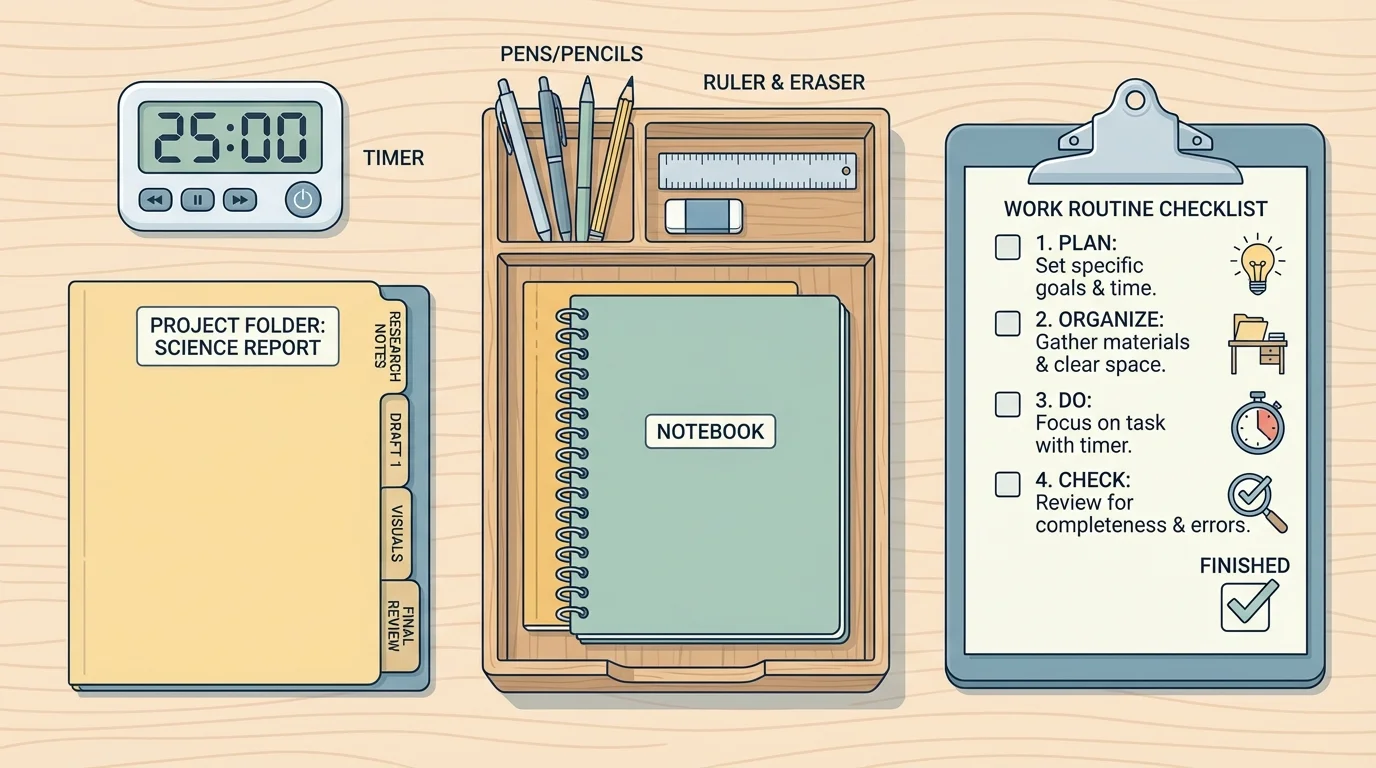
As [Figure 4] shows in a home learning space, some tools make routines easier. You do not need all of them. Pick the ones that help you most.
A timer can help you stay on one task for a set amount of time. A folder can keep papers together. A tray or small box can hold supplies. A checklist can remind you what "done" looks like.
You might also create a finishing habit. When you are done, always do the same things: save your work, put away tools, and check the space. This turns the end of your task into a routine too.
| Tool or Habit | How It Helps |
|---|---|
| Timer | Helps you focus for a short time. |
| Checklist | Helps you remember every part. |
| Folder | Keeps papers or files in one place. |
| Supply spot | Makes it easy to find what you need. |
| First-next-last plan | Helps you know what to do in order. |
Table 1. Simple tools and habits that support planning, organizing, and checking work.
Good habits develop when you repeat them. The organized workspace in [Figure 4] reminds you that small tools can make a big difference.
Sometimes you forget your routine. That is okay. Everyone does. The important thing is to notice it and try again.
If you feel stuck, stop and go back to planning. Ask, "What is the job?" and "What is the first step?" If your space feels messy, pause and organize it. If you rush and make mistakes, slow down and check before you finish.
If a task feels too big, break it into smaller parts. You can say, "I will do this one part first." Small steps feel easier than one giant job.
You do not have to do everything perfectly. The goal is to make your work more complete and less stressful, one routine at a time.
It can also help to ask a trusted adult for support. They might help you make a checklist, set up a workspace, or remind you to check before you submit. Support is part of learning a habit.
The more you use this routine, the stronger it gets. At first, you may need reminders. Later, your brain starts doing the steps more automatically.
Try using the same words each time: plan, organize, check. Those three words are easy to remember. They guide you from the beginning of a task to the end.
When you use a strong routine, you show responsibility. You take care of your work, your time, and your tools. That is a skill that helps in online learning now and in many jobs you will do as you grow.
