Why do some adults love fixing bikes, while others love baking bread, caring for animals, making videos, or helping sick people feel better? People do not all enjoy the same things, and they are not all good at the same things. That is actually wonderful, because the world needs many kinds of workers. When you start noticing what you like and what you do well, you begin learning about jobs that may fit you someday.
Work means the jobs and tasks people do to help others, earn money, and keep communities running. Some work happens in stores, some at home, some online, some outdoors, and some in hospitals, offices, kitchens, farms, or workshops. A person who loves solving problems may enjoy one kind of work. A person who loves caring for others may enjoy another.
No one job is the "best" job for everyone. A job that feels exciting to one person may feel hard or boring to another person. That is why it helps to know yourself. When you know yourself better, you can make smarter choices later.
Interests are things you like, enjoy, or want to learn more about.
Strengths are things you do well, or skills that come more easily to you.
Work is a job or task people do to help meet needs, solve problems, create things, or earn money.
Sometimes your interests and strengths match right away. Sometimes they do not. You might love music but still be learning how to keep a beat. You might be very good at organizing toys, games, or supplies, even if organizing is not your favorite thing. Both kinds of information matter.
Your interest is what pulls your attention. Your strength is what helps you do something well. As [Figure 1] shows, these are connected, but they are not the same thing. If you like drawing, that is an interest. If you can notice tiny details and keep practicing carefully, those can be strengths.
Think about your day. What do you choose to do when you have free time? Maybe you read facts about space, build with blocks, care for a pet, tell funny stories, help a younger child, or use a tablet to make art. Those choices give clues about your interests.
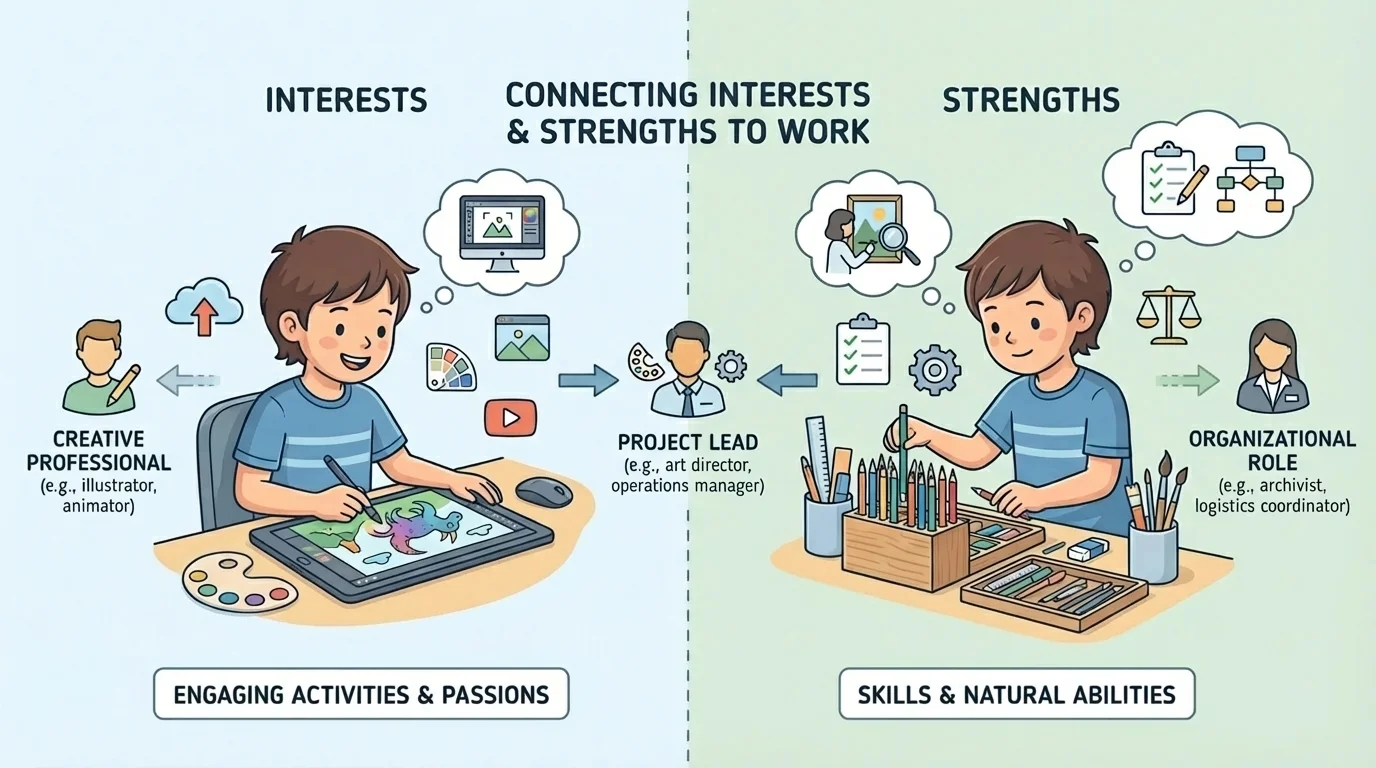
Now think about what people often ask you to help with. Do they ask you to explain game rules, find missing items, comfort someone who is upset, water plants, clean carefully, or remember instructions? Those moments can show your strengths.
It is okay if you are still growing. Seven-year-olds are not supposed to know their future job yet. Right now, the goal is to notice patterns. When you notice, "I like helping," or "I am good at building," you are learning important things about yourself.
Many adults use more than one strength at work. A baker may need creativity, patience, math, and clean-up skills all in one day.
Sometimes people think a strength only means being the fastest or smartest. That is not true. Being kind, steady, brave, careful, curious, and responsible are also strengths. These strengths matter a lot in real life.
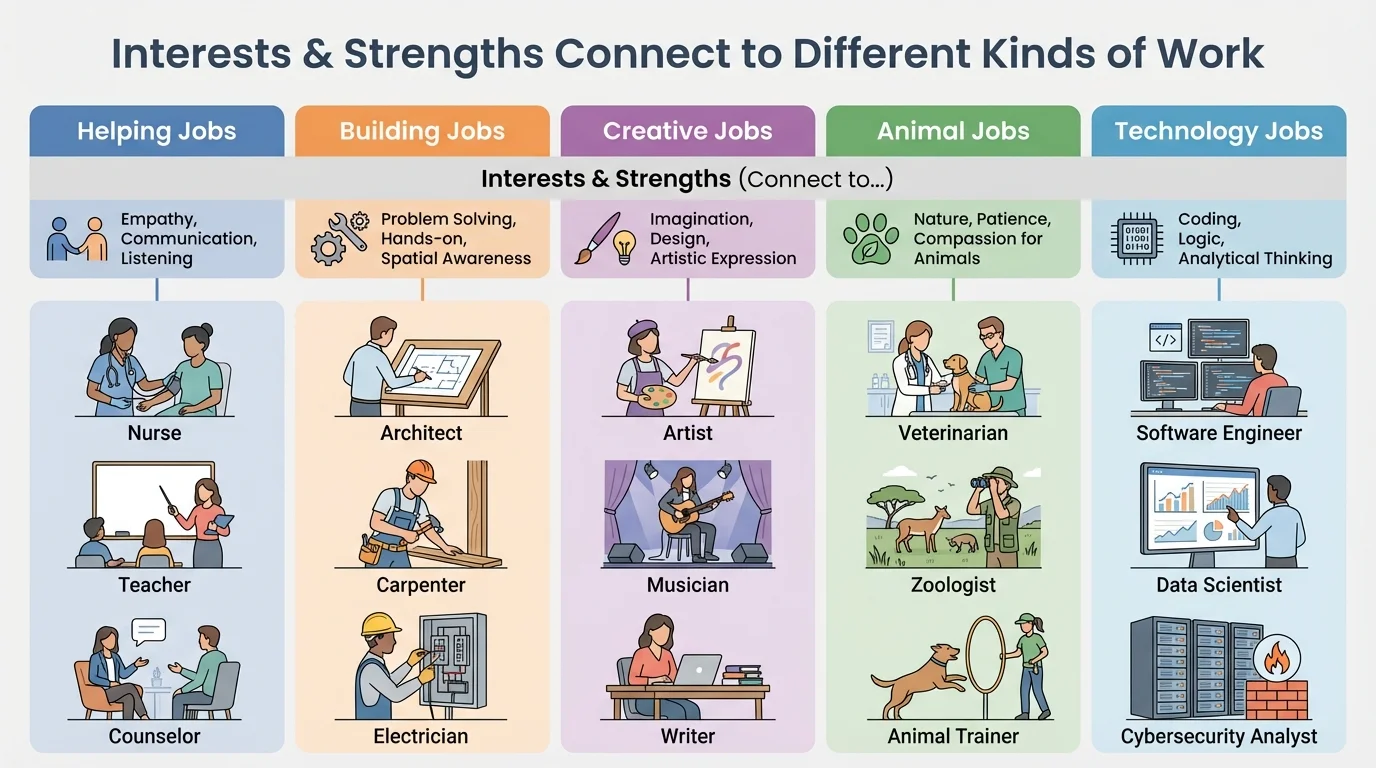
There are many kinds of jobs in the world, and they need different talents. Some jobs focus on helping people, some on making things, some on caring for animals, some on using technology, and some on keeping places safe and clean. [Figure 2] organizes some simple job groups so you can see how wide the world of work really is.
Here are a few big groups of work: helping jobs, building jobs, creative jobs, science and nature jobs, animal jobs, food jobs, and technology jobs. These groups overlap, which means one job can fit in more than one group.
| Job group | What people often do | Examples |
|---|---|---|
| Helping jobs | Care for, teach, or support others | nurse, teacher, counselor, childcare worker |
| Building jobs | Make, fix, or construct things | carpenter, mechanic, plumber, builder |
| Creative jobs | Design, perform, or make art | artist, writer, musician, game designer |
| Animal jobs | Care for or study animals | veterinarian, pet groomer, dog trainer, farmer |
| Food jobs | Cook, bake, or serve food | chef, baker, farmer, food truck owner |
| Technology jobs | Use computers and digital tools to solve problems | coder, video editor, website designer, robotics worker |
Table 1. Examples of job groups and the kinds of tasks workers may do.
You can probably think of adults in your family or community who do some of these jobs. Some adults work from home online. Some travel to a workplace. Some work with their hands. Some work mostly with words, numbers, tools, animals, or ideas.
When you notice the different kinds of work around you, you start to see that jobs connect to real needs. People need food, homes, clean water, health care, transportation, technology, stories, art, and care. Work helps meet those needs.
A simple job match means a job that fits what a person likes and what a person does well. There is not only one right match. One person can fit many jobs. [Figure 3] shows how the same interests and strengths can lead to several possible kinds of work.
For example, if you love animals, that interest might connect to being a pet sitter, dog trainer, veterinarian, zookeeper, or animal shelter worker. If you are patient and gentle, those strengths make those jobs fit even better.
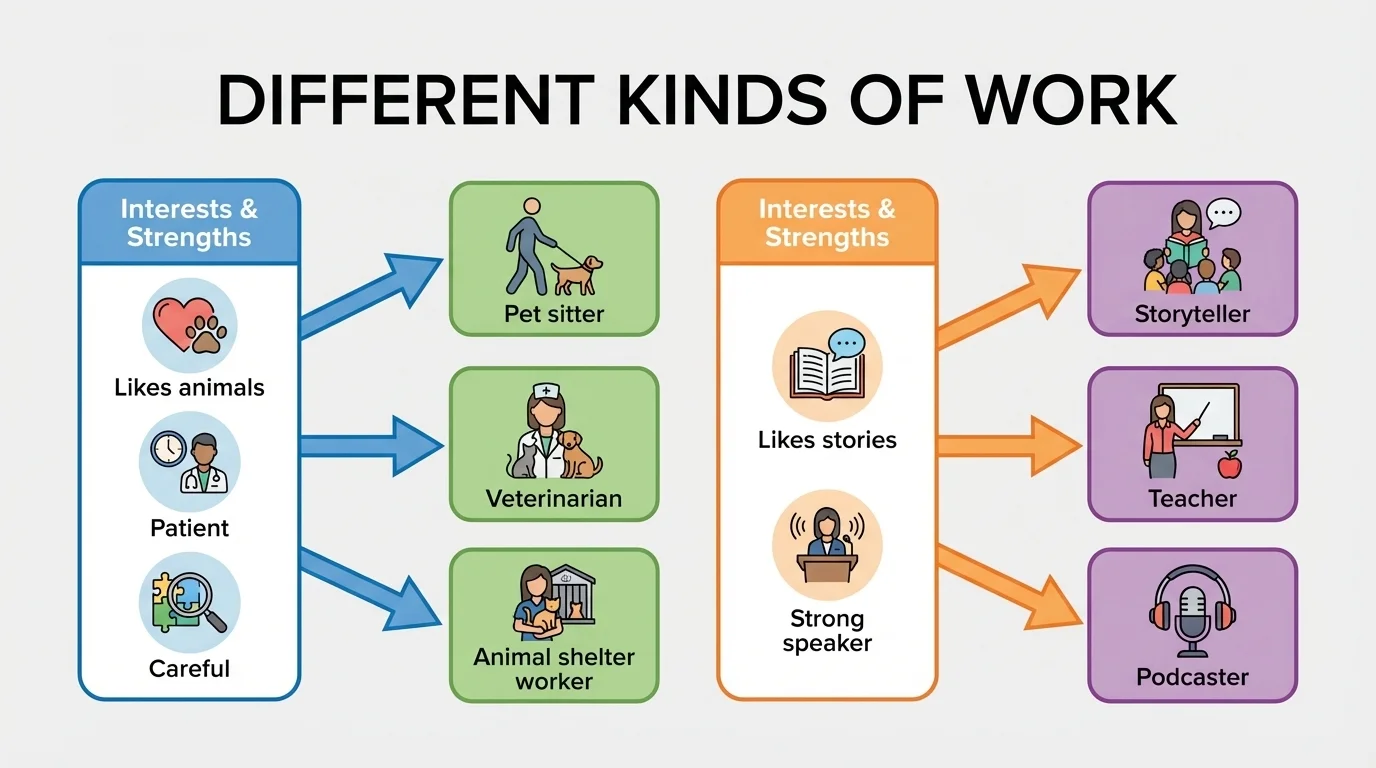
If you love stories and speak clearly, you might enjoy being a teacher, actor, podcaster, librarian, or tour guide. If you enjoy building things and can keep trying when something falls apart, you might like engineering, construction, repairing machines, or designing toys.
Notice that one interest can connect to many jobs, and one job can need many strengths. That is why it helps to think in groups, not just in one exact answer.
Real-life matching examples
Step 1: Start with an interest.
Jada loves cooking pretend meals and helping stir real food in the kitchen.
Step 2: Add strengths.
She is careful, follows directions, and cleans up after herself.
Step 3: Connect to work.
Those clues connect to jobs like baker, chef, food helper, or someone who plans meals.
Jada is not choosing a job now. She is learning about possible directions.
Here are more examples. A child who loves solving puzzles and notices mistakes may someday enjoy coding, fixing machines, or checking work carefully. A child who loves plants and does not mind dirt may enjoy gardening, farming, landscaping, or science jobs that study nature.
[Figure 4] As with the pathways in [Figure 3], the goal is not to force yourself into one future. The goal is to see connections. That helps you understand why your daily choices matter.
You do not need a test to begin. A simple way is to make three lists: "I like," "I am good at," and "I want to learn." These lists can help you discover clues about work that may fit you later.
Under "I like," write or say things like drawing, reading animal facts, helping cook, fixing toys, dancing, making videos, sorting cards, or caring for a pet. Under "I am good at," write or say things like listening, building, remembering steps, making people laugh, noticing details, or staying calm.
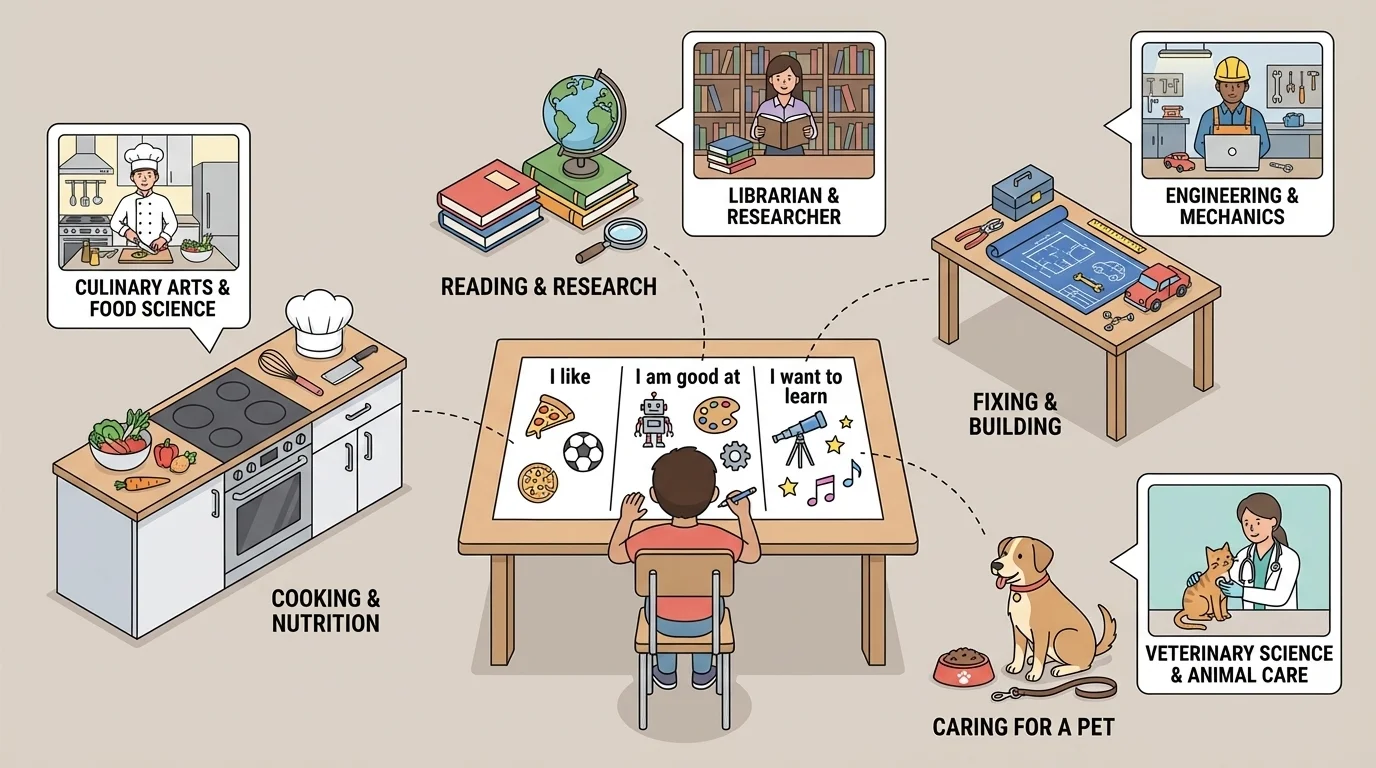
Under "I want to learn," add things you are curious about. Maybe you want to learn how to sew, code, bake, plant vegetables, edit videos, or help babies. Wanting to learn something is important because interests can grow into future strengths.
You can also ask trusted adults what strengths they notice in you. A parent or caregiver might say, "You are very responsible with feeding the cat," or "You explain things clearly on video calls with family." Those comments can teach you a lot.
Clues come from everyday life
Your future work ideas do not come only from big moments. They often come from little moments: finishing a chore without being reminded, helping someone online, practicing a hobby, or staying patient when a task takes time.
Pay attention to how tasks make you feel. If a task gives you energy, joy, or excitement, that may point to an interest. If a task feels easy to understand or people thank you for doing it well, that may point to a strength.
You can explore kinds of work in small, safe ways right now. You can help with age-appropriate chores, try hobbies, join community clubs, watch kid-friendly career videos with a trusted adult, or talk to adults about what they do. These are simple ways to learn more.
Try This: Help with one real task at home this week. You might sort laundry, measure ingredients, water plants, organize books, wipe a table, or help pack snacks. Then ask yourself, "Did I enjoy that?" and "Was I good at that?"
Try This: If you like technology, make a short digital slideshow about an animal, a recipe, or a place you want to visit. If you like helping, assist a younger child with a game or story. If you like fixing things, help tighten loose toy parts with an adult nearby. Small actions teach you a lot.
When people try new things, they sometimes discover surprises. You may think you love one kind of activity, but then find out you like another even more. Or you may find something hard at first and become good at it later through practice.
You do not have to be perfect at something for it to matter. Learning, practicing, and improving are part of building strengths.
If a person never tries anything new, it is harder to learn what fits them. If a person tries many things, they gather more clues. That makes future choices easier.
Some children worry and think, "What if I like too many things?" That is not a problem. It is a strength. A person can love animals and art. A person can love cooking and science. A person can be kind, organized, and creative all at once.
For example, someone who likes art and computers might design websites or games. Someone who likes helping and science might become a nurse or another health care professional. Someone who likes stories and technology might record videos, write books, or create learning programs online.
Your interests can change as you grow. Your strengths can grow too. A child who feels shy now may become a strong speaker later. A child who struggles with drawing now may improve with lots of practice. Future work is not locked in place.
"The more you learn about yourself, the better choices you can make."
This is why exploring matters more than choosing one final answer right away. You are building self-knowledge. That self-knowledge helps you in schoolwork, hobbies, teamwork, and later jobs.
When people know their interests and strengths, they can make better choices about activities, goals, and learning. They may feel more confident because they understand why something fits them. They may also ask for the right kind of help when something does not come easily.
If someone ignores what they enjoy and what they do well, they may feel bored, frustrated, or lost. If someone notices these clues, they can move toward work that feels meaningful and useful. That does not mean every workday is easy, but it does mean the job can be a better fit.
As you saw earlier in [Figure 1], interests and strengths are different pieces of the same puzzle. And as the job groups in [Figure 2] show, there are many paths in the world of work. Your job right now is to keep noticing, keep trying, and keep learning about yourself.
