A small problem can become a big problem if nobody knows about it. If your throat suddenly feels tight, if you fall and your ankle hurts a lot, or if someone online makes you feel scared, the smartest thing you can do is tell a grown-up you trust right away. Asking for help is not tattling, bothering, or being weak. It is a strong safety skill.
Sometimes your body gives you clues. Sometimes a place or a person gives you clues. You may feel pain, dizziness, fear, confusion, or worry. These feelings can be signs that you need help now. A warning sign is a clue that something may not be safe or healthy.
You do not have to solve every problem by yourself. Grown-ups help with things that are too big, too risky, or too confusing for kids to handle alone. If you are not sure whether something is serious, it is still okay to ask. It is better to ask early than wait too long.
Health help means getting adult support when your body or mind does not feel right. Safety help means getting adult support when a person, place, object, or situation might hurt you. A problem can be about health, safety, or both.
For example, if you touch a hot pan and get burned, that is a health problem because your body is hurt, and a safety problem because something dangerous caused the injury. If a stranger keeps messaging you online, that may start as a safety problem and can also make you feel upset inside.
[Figure 1] A trusted adult is a grown-up who helps keep you safe, listens seriously, and takes action. Trusted adults may be a parent, grandparent, aunt, uncle, caregiver, doctor, nurse, counselor, coach, troop leader, neighbor your family knows well, or a teacher from your online school whom your family knows how to contact.
A trusted adult should do things like listen, stay calm, believe you, and help fix the problem. If an adult laughs, ignores you, or tells you to keep an unsafe secret, that person is not acting like a trusted adult in that moment. You should tell another safe grown-up.
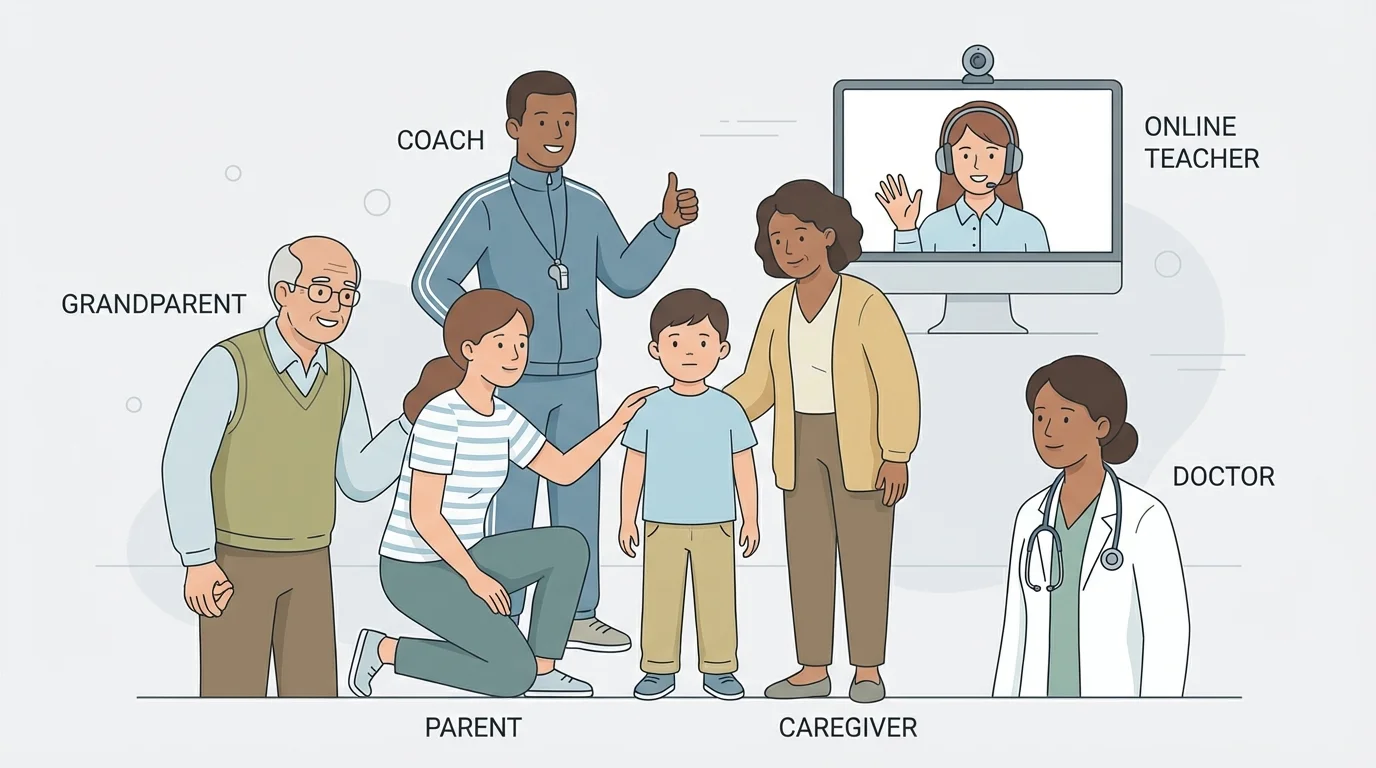
It helps to know more than one trusted adult. Sometimes one adult is busy, asleep, driving, in another room, or not nearby. Having a short list gives you a backup plan.
Try This: Make your help circle
Step 1: Think of three adults you know well and feel safe with.
Step 2: Ask a family member if these adults are good choices.
Step 3: Practice saying their names and how to reach them.
Your help circle might include one person at home, one family member, and one community helper.
Later, if you feel nervous about speaking up, remembering your help circle can make it easier to act quickly. The adults around the child in [Figure 1] show that trusted help can come from more than one place.
[Figure 2] Some health problems need an adult immediately. Tell a trusted adult right away if you have trouble breathing, strong pain, lots of bleeding, a bad fall, a burn, a head injury, a fever that makes you feel very sick, repeated vomiting, a rash after eating or touching something, or if you think you took the wrong medicine.
You should also get help if your body feels strange in a scary way. Maybe your lips feel swollen, your chest hurts, your vision gets blurry, or you feel so dizzy you might fall. You do not need to know the exact name of the problem. You only need to say what you feel.
Your feelings matter too. If you feel very scared, very sad, unsafe, or like you might hurt yourself, tell a trusted adult right away. Mental and emotional health are real health needs.
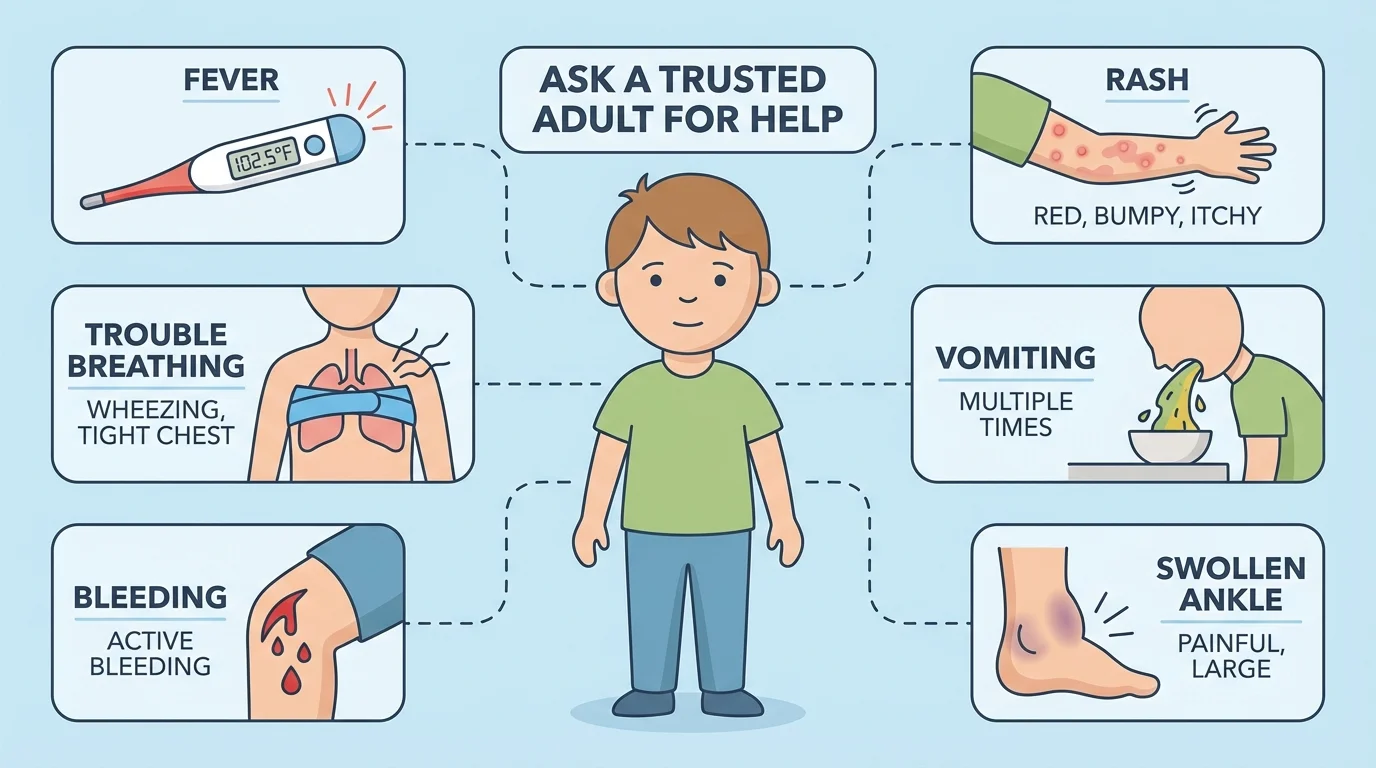
Children sometimes wait to ask for help because they worry they will get in trouble. But adults would rather know quickly so they can help sooner and keep a small problem from becoming bigger.
Here are some everyday examples. If you scrape your knee a little, you still tell an adult so it can be cleaned. If you fall off playground equipment at the park and cannot stand well, you tell an adult immediately. If you eat a food and then your tongue feels funny or your skin gets bumpy, get help fast because it may be an allergic reaction.
Example: What to say for a health problem
Step 1: Get the adult's attention.
Say, "I need help now."
Step 2: Name the problem.
Say, "I fell and my ankle really hurts," or "I cannot breathe well."
Step 3: Tell where you are or what happened.
Say, "I am in the kitchen," or "I took medicine, but I think it was the wrong one."
Short, clear words help adults act fast.
The body clues in [Figure 2] remind you that serious problems do not all look the same. Some are easy to see, like blood. Some are harder to see, like trouble breathing or feeling very dizzy.
[Figure 3] Danger can happen fast, and there is a simple order for what to do: get to safety, find help, and keep telling. Ask a trusted adult right away if you smell smoke, see fire, find a weapon, see broken glass, are near a loose dog that seems dangerous, get lost, or notice a person acting in a way that scares you.
Safety help also matters online. If a person sends mean, scary, or confusing messages, asks for your address, asks for photos, tells you to keep a secret from your family, or wants to meet in person, tell a trusted adult right away. Do not answer by yourself.
If someone touches you in a way that feels wrong, asks you to touch them, or tells you to keep that a secret, tell a trusted adult immediately. Your body belongs to you. Safe adults help protect your body and privacy.
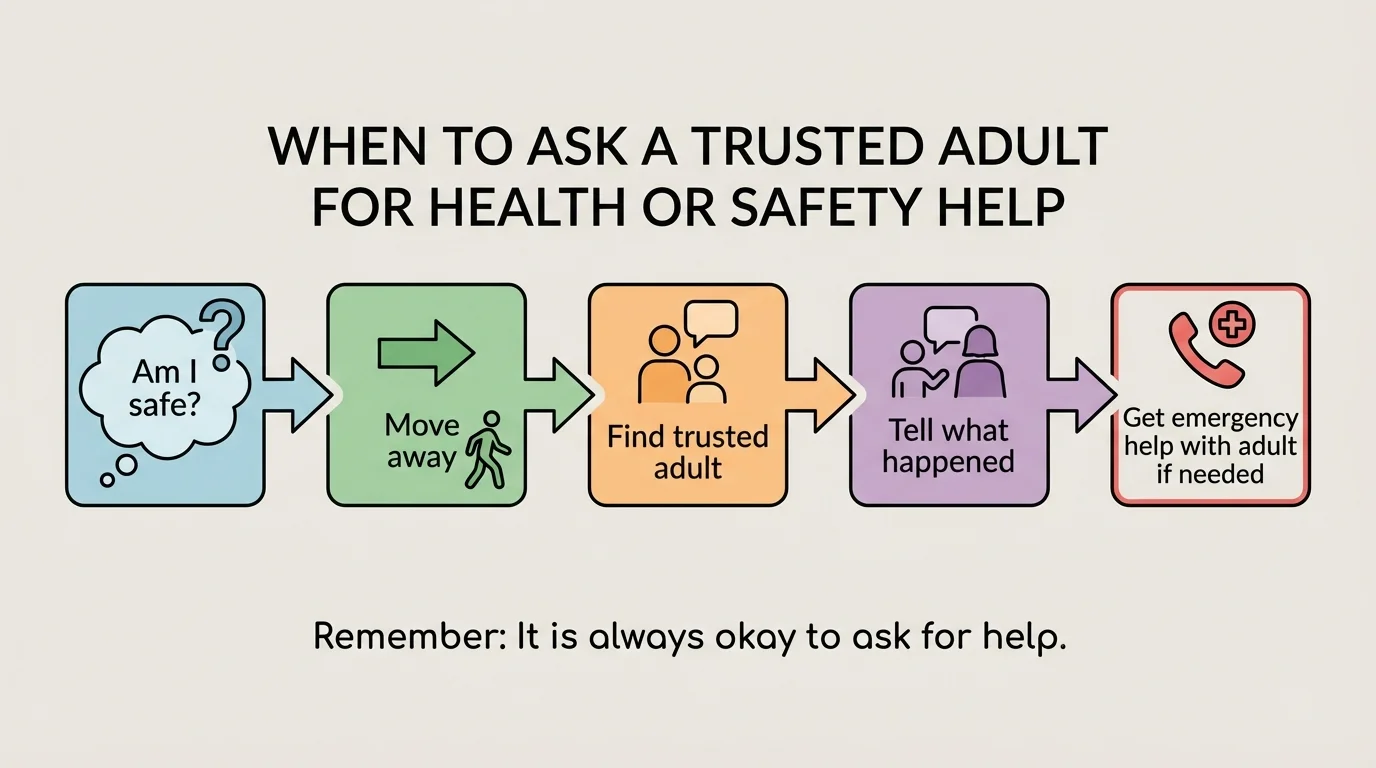
Sometimes kids freeze because they are surprised. That happens to many people. If you freeze, remember one simple plan: move away if you can, get to a safer place, and tell a trusted adult as soon as possible.
| Situation | What you do | Who you tell |
|---|---|---|
| Smoke or fire | Leave the area fast and go to a safe adult | Parent, caregiver, neighbor, emergency responder |
| Unsafe or scary online message | Stop replying and show the message | Parent, caregiver, family-approved adult |
| Lost in a store or park | Stay where you are and ask a nearby safe adult for help | Parent, caregiver, store worker, police officer |
Quick actions for common safety problems and which adults can help.
The steps in [Figure 3] work in many kinds of danger, not just one. You do not have to figure out everything first. Safety comes before perfect explanations.
[Figure 4] When you are upset, it can be hard to find the right words. A simple emergency help script makes it easier. First, get the adult's attention. Next, say the problem. Then, tell where you are or what you need.
You can use one of these simple sentences: "I need help now." "My body hurts." "I do not feel safe." "Someone is scaring me." "I think this is an emergency." "Please stay with me."
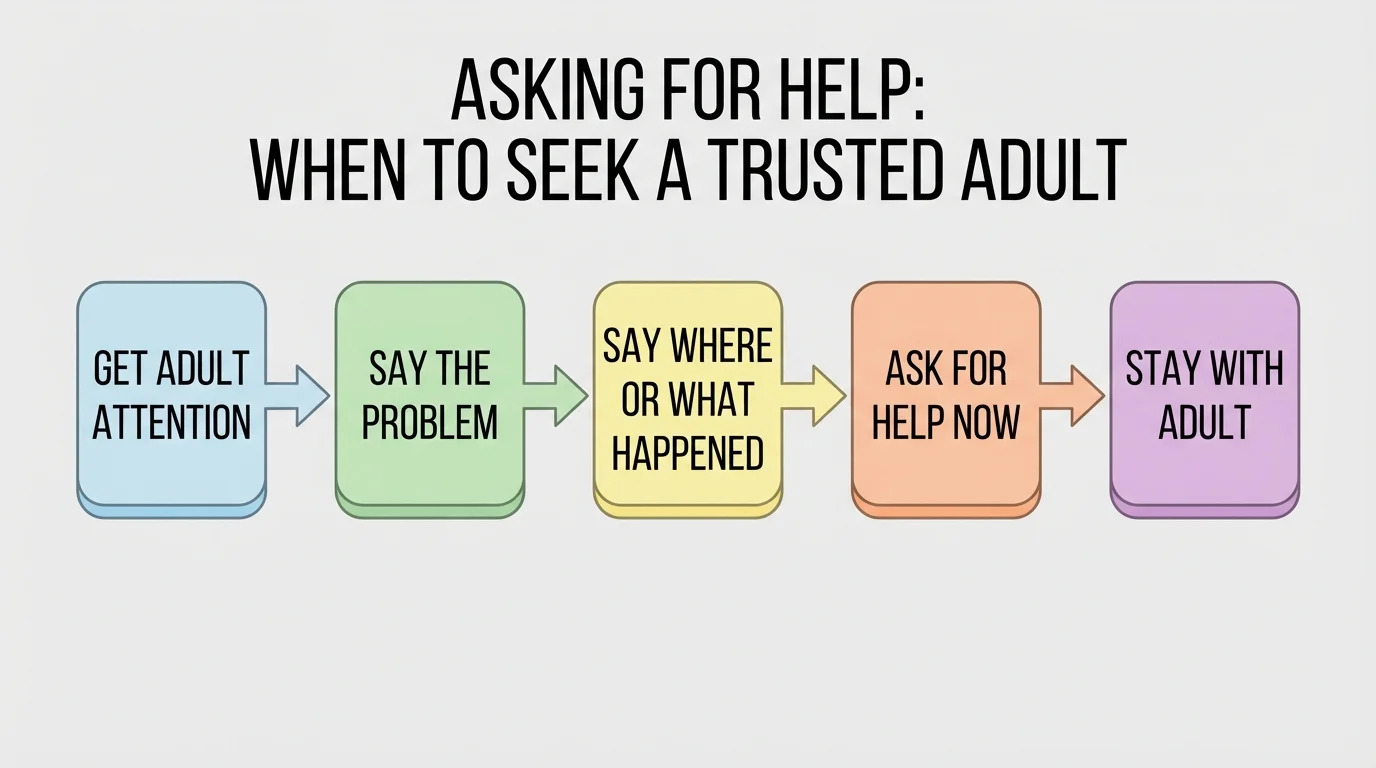
A good help message is short and clear. You do not need a long story first. Start with the most important part. Adults can ask more questions after they know it is serious.
Here is a strong pattern to remember: Name it. Place it. Need it. Name the problem. Say where you are or where it happened. Say what help you need. For example: "I cut my finger in the kitchen. I need help now." Or: "A person online asked for my address. I do not feel safe."
If talking feels hard, you can still act. Go stand near the adult, point to the hurt place, hand them the device with the message on it, or say only, "Help now." The script in [Figure 4] reminds you that even a few words are enough to begin.
Sometimes the first adult you tell may not answer right away or may not understand how serious the problem is. If that happens, tell another trusted adult. Keep telling until someone helps. This is especially important for unsafe touch, online dangers, strong pain, trouble breathing, or scary situations.
You can say, "I still need help," or "This is serious," or "Please call another adult." You are not being rude. You are protecting yourself.
"When something feels unsafe, keep telling until a safe adult helps."
If there is an immediate danger and a trusted adult is not right there, call emergency help with an adult if possible, or follow your family's emergency plan. Many families teach children how to call local emergency services. If you know your address and phone number, that can help too.
You can build this skill before a problem happens. Practice noticing how your body feels when you are okay, hungry, tired, sick, or scared. The better you know your own signals, the faster you can notice when something changes.
Practice simple safety habits too. Tell an adult when something hurts. Show them strange online messages. Learn your full name, your caregivers' names, your address, and a phone number. Keep your list of trusted adults somewhere easy to find.
Remember: Safe kids are not kids who never need help. Safe kids are kids who know when to get help and who to go to.
When you ask for help quickly, adults can clean a cut before it gets worse, get medicine when you are sick, block a bad online contact, move you away from danger, or call emergency helpers if needed. Asking early can stop bigger problems.
