Sometimes kids have big questions: "Why is my body changing?" "Is this private?" "What if someone asks me to keep a secret?" Knowing who to ask is a life skill that helps you stay healthy and safe. You do not have to figure these things out by yourself. Children stay safer when they know how to find help from safe adults.
Your body grows and changes over time. You may notice new things about how your body looks, feels, or works. You may also wonder about privacy, such as when to close the bathroom door, when to change clothes in a private place, or what information should stay private online. These questions are normal.
Sometimes a question is small, like "Why might I need deodorant when I am older?" Sometimes it is serious, like "What should I do if someone wants to touch me in a way I do not like?" In both kinds of situations, the smartest move is to talk to a safe adult.
Trusted support is a person you can go to for help, honest answers, and protection. A trusted support listens, cares about your safety, and takes your worries seriously.
Privacy means some parts of your body, your space, and your personal information are just for you and the adults who help care for you.
Safety means staying protected from harm, getting help when something feels wrong, and speaking up when you need support.
You deserve answers that are clear, calm, and respectful. If one person is busy or does not help, you can ask another trusted support. Keep telling until someone helps you.
Body changes are the ways bodies grow and develop. For a second grader, that might mean losing teeth, growing taller, noticing different body shapes, or asking questions about how bodies work. It is okay to be curious.
Privacy means your body belongs to you. Private parts are the parts covered by a swimsuit. These parts are not for other people to look at, touch, photograph, or talk about in a silly or unsafe way, except for health or caregiving reasons with a safe caregiver, doctor, or parent helping you.
Safety also includes how people treat you. Safe people respect your "no." Safe people do not ask you to keep secrets about touching, pictures, or unsafe games involving bodies. Safe people do not try to trick you online or in person.
Your body can give you clues when something is not right. You might feel a tummy ache, a shaky feeling, a fast heartbeat, or a strong wish to move away. Those body clues are important and worth telling a trusted adult about.
When you understand these words, it gets easier to know when you need help. A good rule is this: if you feel confused, embarrassed, scared, or pressured, talk to a trusted support.
As shown in [Figure 1], a trusted support can be an adult or older helper who keeps you safe, listens carefully, and gives honest help. You may have more than one trusted support, and that is a great idea.
Trusted supports can include a parent, grandparent, aunt, uncle, older sibling, doctor, nurse, counselor, family friend chosen by your caregiver, coach, activity leader, or another safe caregiver in your home or community. Some helpers may talk with you in person, on a phone call, or on a video call.
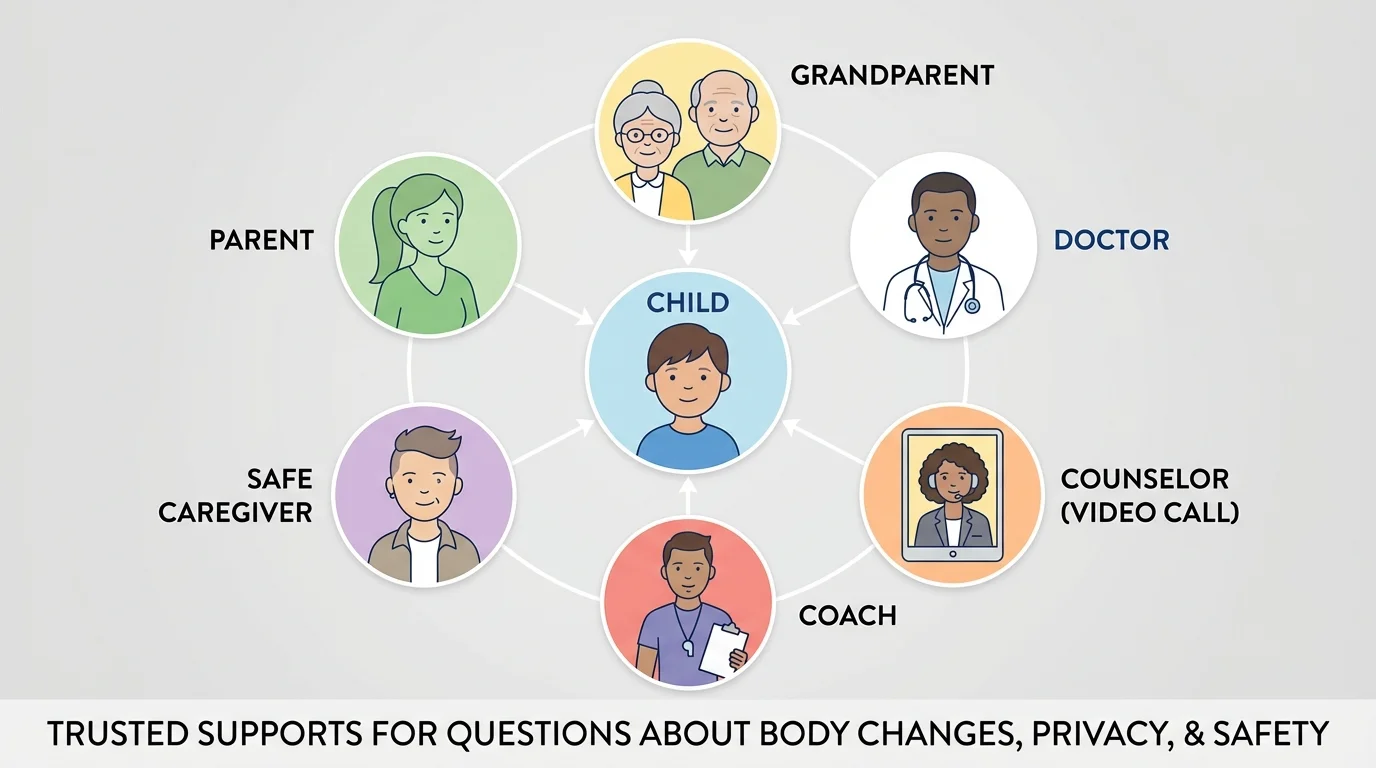
You do not need a huge list. Even having two or three trusted adults is a strong and helpful start. One adult may know about health. Another may help with online safety. Another may help when you feel nervous or upset.
If you are not sure whom to ask first, start with the adult who usually takes care of you and listens kindly. If that person is not available, choose another trusted support from your list.
A trusted support does certain things again and again. They listen without making fun of you. They stay calm. They try to help. They tell the truth in words you can understand. They want you to be safe more than they want you to be quiet.
They also respect your boundaries. A boundary is a rule about your body, space, and feelings. For example, you can say, "I do not want a hug right now," and a safe person listens.
Clues that someone is trustworthy
Look for people who help you feel safer, not smaller. Trustworthy helpers listen, answer questions honestly, get more help when needed, and never blame you for asking. They do not ask you to keep unsafe secrets, and they do not break privacy rules just for fun or curiosity.
Watch out for warning signs too. A person is not acting safely if they tell you to keep a touching secret, ask for private pictures, try to be alone with you in a way that feels wrong, laugh at your questions, or say, "Do not tell your grown-up." Those are times to leave and tell a trusted adult right away.
As you saw in [Figure 1], trusted supports are usually part of your safety circle. They are people connected to your care, health, or well-being, not random people online.
You can ask trusted supports questions like: "Why does my body do that?" "What parts are private?" "Who is allowed to help me in the bathroom?" "What should I do if someone wants a picture of me?" "What if someone breaks my privacy?" These are smart questions.
Some situations need help fast. Get a trusted adult right away if someone touches your private parts, asks you to touch theirs, asks for private photos, shows you private pictures, tells you to keep a body secret, hurts your body, or makes you feel scared and unsafe.
You also need help fast if something happens online. If a person in a game, chat, app, or video call asks where you live, asks to meet you, asks for pictures, or talks about private body parts, stop talking, leave if you can, and tell a trusted adult.
What getting help fast can sound like
Step 1: Find a trusted adult.
Go to a parent, caregiver, or another adult on your safe list.
Step 2: Use clear words.
Say, "I need help now. Someone said something about private parts," or "Someone asked me for a picture, and I do not feel safe."
Step 3: Keep telling until someone helps you.
If the first person does not understand, tell another trusted support right away.
You will never get in trouble for asking for help about safety. Even if you clicked something, answered a message, or felt too scared to speak at first, it is still right to tell.
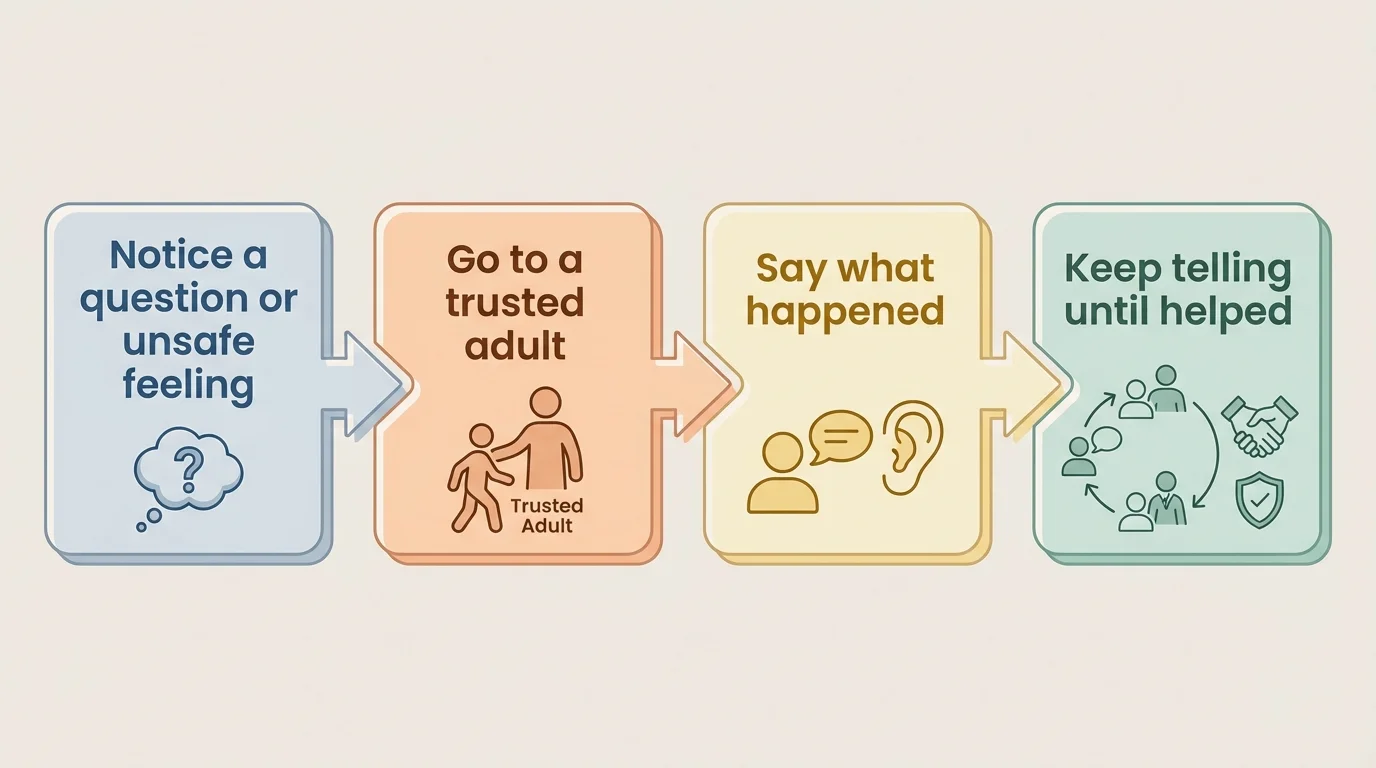
As shown in [Figure 2], when you have a question or a worried feeling, use this plan. Having a plan helps you act quickly instead of freezing.
Step 1: Notice the feeling. If your body feels worried, confused, or uncomfortable, pay attention.
Step 2: Go to a trusted support. Choose an adult from your safety circle.
Step 3: Say what happened. You can use simple words: "I have a body question," "I think my privacy was not respected," or "I do not feel safe."
Step 4: Keep telling until someone helps. If one adult is busy or does not understand, tell another trusted support.
This plan works for many situations. It works for body questions. It works when someone invades your privacy. It works for online safety too. The important part is that you do not stay alone with the problem.
You already know how to ask for help when you are sick, hurt, or lost. Safety questions work the same way: notice the problem, go to a safe adult, and use clear words.
Later, if you forget what to do, think back to [Figure 2]. First notice, then go, then say, then keep telling. Simple plans are powerful.
Here are some everyday situations. If you are changing clothes for sports or an activity at home or in a community center, you should use a private place like a bathroom or changing area. If someone tries to come in, asks to watch, or jokes about your body, tell a trusted adult.
If you are on a tablet or computer and a person asks, "Send me a picture," do not send it. Show the message to a trusted adult. It does not matter if the person says they are a child, a friend, or someone from a game. Safe adults help with online messages too.
If you have a body question, such as why your chest, skin, teeth, or hair is changing, ask a caregiver, doctor, or nurse. Asking questions about health is part of taking care of yourself.
Three quick scenarios
Scenario 1: You feel confused about a body change.
Say, "Can I ask you a health question about my body?"
Scenario 2: Someone says, "Do not tell."
Say, "I am telling my adult," and leave if you can.
Scenario 3: Someone online asks for private information.
Stop replying, close the chat if possible, and show a trusted adult right away.
Good safety skills help in real life. When kids know whom to ask, problems get solved faster. When kids stay quiet because they are scared or confused, unsafe situations can continue. Speaking up protects you.
Your body belongs to you. You can ask questions about it. You can expect privacy. You can say no to unwanted touch, even to hugs or tickling. You can move away from unsafe behavior. You can tell a trusted support.
A surprise and a secret are not the same. A happy surprise, like a birthday card, is meant to be told later. An unsafe secret about touching, private parts, pictures, or fear should be told right away.
If someone breaks a boundary, it is never your fault. Your job is not to fix it alone. Your job is to get help from safe adults who know how to protect you.
"If something feels wrong, tell a trusted adult right away."
You are strongest when you know your safe people, trust your feelings, and use your words. Questions about body changes, privacy, and safety are important, and you always deserve real help.
