Have you ever been upset about something, then found out later that part of what you believed was not actually true? That happens to everyone. A small problem can grow bigger when you mix up what you know, what you feel, and what you think might be true. Learning to separate these helps you stay calm, make fair choices, and solve problems more clearly.
This skill matters in real life. Maybe a friend does not answer your message right away. Maybe a family plan changes. Maybe you think someone is upset with you on a video call. If you treat a guess like a fact, you might react too fast. If you ignore your feelings, you might make a choice that does not feel safe or fair. Good problem solvers learn to notice all three: facts, feelings, and guesses.
When a problem happens, your brain starts collecting information. Some of that information is solid and checkable. Some comes from your emotions. Some is a guess you make because you do not know everything yet. Knowing which is which helps you avoid confusion.
Think about this: your sibling says, "We are leaving in ten minutes." You feel frustrated because you were still building something. Then you guess, "Nobody cares about what I am doing." The first statement may be true if you can check the time. The second is a feeling. The third is a guess. If you mix them together, the problem feels bigger than it really is.
Your brain often makes quick guesses to fill in missing information. That can be helpful in emergencies, but in everyday problems it can also lead to mistakes if you do not stop and check.
Strong decision-making does not mean you stop having feelings. It means you learn how to listen to feelings, respect them, and still check what is actually true.
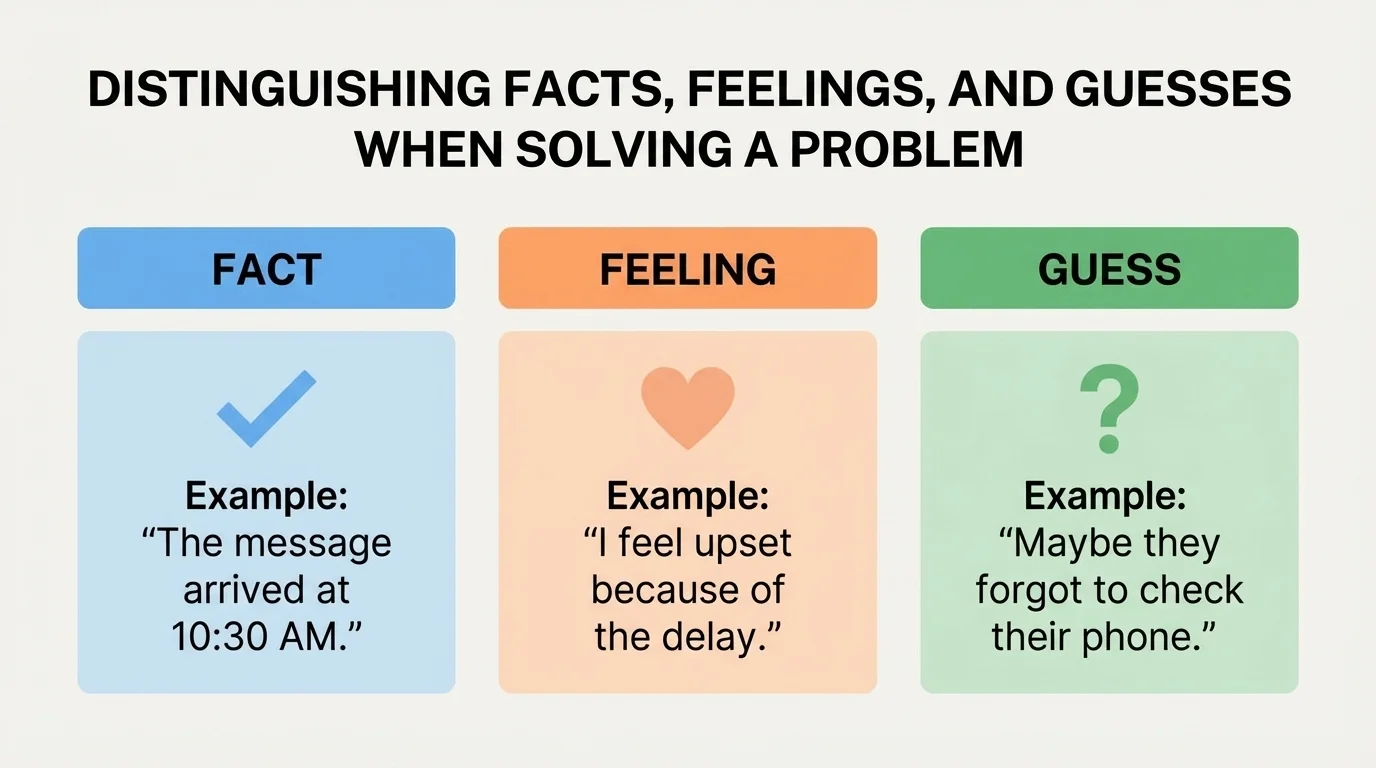
When you solve a problem, it helps to sort information into three groups, as [Figure 1] shows. This makes the problem easier to understand because you can see what is known, what is felt, and what is still uncertain.
A fact is something that is true and can be checked. You can often prove a fact by looking, listening carefully, reading a message again, asking a trusted adult, or finding the information another way. For example: "The meeting starts at 8:00." "The milk is gone." "It is raining outside." Those are things you can check.
A feeling is an emotion or how someone feels inside. Feelings are real, even though they are not the same as facts. If you say, "I feel disappointed," that is important information. It tells what is happening inside you. But it does not always explain what caused the problem.
A guess is something you think might be true, but you are not sure yet. Guesses often begin with thoughts like "maybe," "I think," "probably," or "it seems like." A guess is not bad. In fact, guesses can help you think. But a guess needs to be checked before you treat it like a fact.
| Type | What it means | Example |
|---|---|---|
| Fact | Something you can check | "The package has not arrived yet." |
| Feeling | An emotion inside a person | "I feel worried." |
| Guess | Something you think might be true | "Maybe it got lost." |
Table 1. A simple comparison of facts, feelings, and guesses.
Sometimes one sentence can contain more than one kind of information. "I feel left out because nobody invited me" starts with a feeling, but the second part may be a guess unless you know for sure what happened.
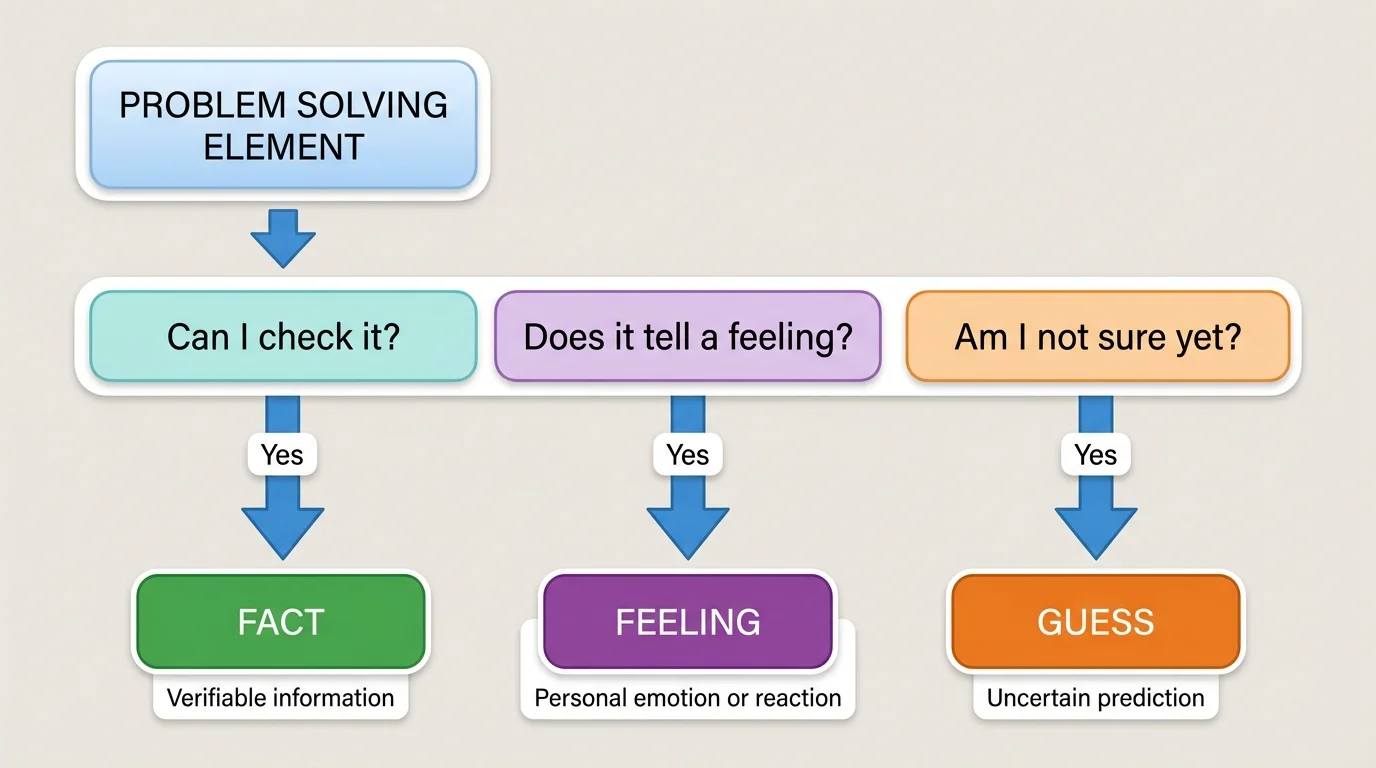
You do not need a complicated system. A simple decision-making process can help. You can sort almost any statement by asking three checking questions before you act.
Step 1: Ask, "Can I check this?" If the answer is yes, it may be a fact. As [Figure 2] illustrates, you might check a time, a message, a rule, a photo, a list, or what someone actually said.
Step 2: Ask, "Is this telling how someone feels?" If yes, it is a feeling. Feelings can give clues about what matters, what hurts, or what feels unsafe.
Step 3: Ask, "Am I filling in missing information?" If yes, it is probably a guess. That means you need more information before making a big choice.
Here is a helpful sentence frame: "The fact is ____. The feeling is ____. My guess is ____." This slows your thinking down in a good way.
Example: A changed plan
You were supposed to have a game night with your cousin online, but it gets canceled.
Step 1: Find the fact.
The fact is: "The game night was canceled." You can check that in the message.
Step 2: Notice the feeling.
The feeling might be: "I feel sad and annoyed." That feeling is real and important.
Step 3: Spot the guess.
The guess might be: "They canceled because they do not like spending time with me." That might be true, but you do not know yet.
Step 4: Make a better choice.
Instead of sending an angry message, you could ask, "Is everything okay? Do you want to reschedule?"
That brief pause can protect a relationship and help you solve the real problem instead of reacting to a guess.
Real life often mixes all three together, and the more you practice sorting, the easier it becomes to see what belongs in each group.
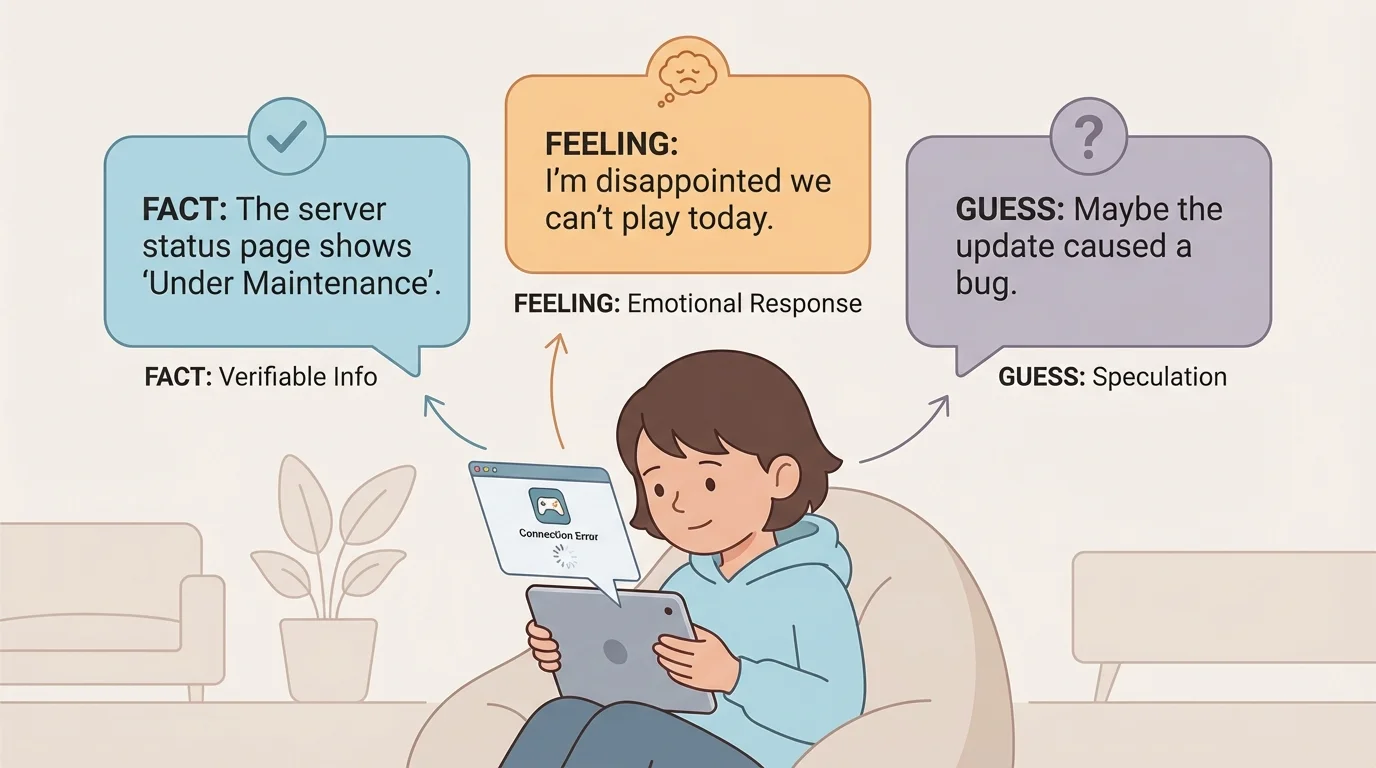
Online message example: As [Figure 3] shows, you send a message and do not get an answer for an hour. The fact is: "There is no reply yet." The feeling is: "I feel nervous." The guess is: "They must be mad at me." If you wait, you may learn they were just busy.
Family plan example: An adult says the trip to the park is canceled. The fact is: "We are not going today." The feeling is: "I feel disappointed." The guess is: "Nothing fun ever happens." That guess sounds huge, but it is usually not true.
Buying choice example: You want to spend your money on a toy or game item. The fact is: "It costs $12." Another fact is: "I have $15." The feeling is: "I feel excited." The guess is: "If I buy this, I will never want anything else." Excitement matters, but good choices also use facts.
Safety example: You hear a strange noise outside at night. The fact is: "I heard a noise." The feeling is: "I feel scared." The guess is: "Someone dangerous is outside." Instead of deciding the guess is true, you can tell a trusted adult and check safely.
Friendship example: Someone leaves your group video call early. The fact is: "They left the call." The feeling is: "I feel confused." The guess is: "They left because of me." But later you might find out their device battery died.
Why all three matter
Facts help you know what is real. Feelings help you know what matters and what support you may need. Guesses help you form ideas, but those ideas should be checked. Good problem solving uses all three in the right way.
Notice that feelings are never "wrong" just because a guess turns out false. You might still feel hurt, worried, or upset. The important part is making choices based on what is true, not only on what you fear.
Problems get worse when people treat guesses like facts. If you think, "They ignored me on purpose," you may send a rude message. If your guess is wrong, now there is a new problem to fix.
Problems also grow when people ignore feelings. Suppose you say, "It is just a fact that the schedule changed, so I should not be upset." But if you are upset, that feeling still needs care. Maybe you need a break, a calm voice, or help making a new plan.
Another mistake is using only facts and forgetting people. For example, "The rule says no more screen time" may be a fact, but the feeling "I am frustrated because I was in the middle of something" still matters. Good solutions can be honest and kind at the same time.
"Check what is true, notice what you feel, and be careful with what you assume."
If you remember that line, you will avoid many unnecessary arguments and misunderstandings.
When you feel stuck, ask yourself these questions:
These questions support problem solving because they slow you down just enough to think clearly. They are especially useful when a problem feels big, fast, or emotional.
Example: Solving a homework-tech problem
You cannot join your online lesson.
Step 1: State the fact.
"The lesson page is not loading."
Step 2: State the feeling.
"I feel stressed."
Step 3: State the guess.
"Maybe I clicked the wrong link."
Step 4: Check the guess.
Look at the link again, refresh the page, or ask an adult for help.
Step 5: Choose the next step.
Send a message explaining the problem instead of giving up or panicking.
This kind of thinking helps you act instead of freezing, blaming, or assuming the worst.
Sometimes your feelings are so big that sorting seems hard. That is normal. In those moments, first try to calm your body. Take a few slow breaths. Get a drink of water. Sit quietly for a minute. Then return to the problem.
When you calm down, facts become easier to see. You may notice that the situation in [Figure 1] works like many real problems: one part is checkable, one part is emotional, and one part is uncertain. Sorting them helps keep the problem from feeling bigger than it is.
If you still feel overwhelmed, ask a trusted adult to help you sort. You can say, "Here is the fact. Here is how I feel. Here is what I think might be happening." That is a very strong and mature thing to do.
Being calm does not mean pretending you are fine. It means giving your brain enough space to think clearly and make a safe choice.
Asking for help is especially important in safety problems, online worries, or situations that involve bullying, threats, or secrets that do not feel right.
You can use this skill today in small ways. When a plan changes, say the fact out loud first. When you are upset, name the feeling. When your mind jumps to a story about why something happened, label it as a guess until you can check it.
You can also use this skill during conversations. If someone sounds upset, you might say, "The fact is the meeting changed. It seems like you feel frustrated. Am I guessing right?" That shows care and avoids acting like you know something you have not checked.
Later, when you make a choice, use the facts to guide your action, let feelings tell you what matters, and let guesses remind you to ask questions. That is how thoughtful people solve problems.
