Have you ever had a moment when someone took your things without asking, read a message that was not meant for them, or kept bothering you after you said, "Please stop"? Small moments like these can make a big difference in how a relationship feels. Healthy relationships are not only about having fun together. They are also about feeling safe, calm, and respected.
Three big ideas help relationships stay healthy: respect, privacy, and boundaries. These ideas matter with friends, family members, teammates, neighbors, and people you talk to online. When people use them well, trust grows. When they ignore them, feelings can get hurt and problems can grow.
Healthy relationship means a connection with another person where people feel safe, cared for, and treated fairly.
Respect means treating people kindly and taking their feelings, choices, and needs seriously.
Privacy means some information, spaces, thoughts, and belongings belong to a person and should not be shared or used without permission.
Boundary is a limit that helps protect a person's body, feelings, time, and personal space.
A healthy relationship does not mean people always agree. Friends can like different games. Siblings can want different amounts of quiet time. Family members can have different feelings. What matters is how people treat each other when those differences happen.
Respect, privacy, and boundaries are everyday life skills. You use them when you text a cousin, join an online game, spend time with a friend in your neighborhood, talk with a sibling at home, or chat during an activity like sports, music, or a club. These skills help you know what is okay, what is not okay, and what to do next.
When these skills are missing, people may feel worried, embarrassed, angry, or unsafe. For example, if someone shares your picture without asking, you may feel exposed. If someone keeps tickling after you say stop, you may feel upset or trapped. If someone reads your messages without permission, trust can break. Healthy relationships protect trust instead of damaging it.
Your body often gives you clues before your words do. A tight stomach, crossed arms, wanting to step back, or feeling suddenly quiet can be signs that a boundary is needed.
Learning these skills does not mean being mean or bossy. It means being clear, kind, and safe. You can care about someone and still say, "I don't like that," or "Please ask first."
Respect starts with how you act and how you speak. Respectful people listen when others are talking. They do not laugh at private feelings. They do not force others to join in. They notice when someone looks uncomfortable, and they care enough to stop and check in.
Respect can sound like this: "Do you want to play?" "Is it okay if I tell this story?" "Thanks for telling me." "I'll stop." "You can have some space." These simple words show that the other person matters.
Respect also means being honest and gentle. If you borrow something, return it. If you make a mistake, admit it. If a friend says they are sad, do not tease them or tell others just for attention. A respectful relationship is not about winning all the time. It is about treating people with care.
Everyday example: Respect in action
Step 1: Your friend is drawing and looks very focused.
Step 2: Instead of grabbing the markers, you say, "Can I use one when you're done?"
Step 3: Your friend says, "Yes, in a minute." You wait.
This shows respect because you notice the other person's activity, ask first, and accept the answer.
Respect works both ways. You should respect others, and others should respect you. If a person only wants their own way and ignores your feelings again and again, that relationship may not be healthy.
Privacy is about what belongs to you and what belongs to someone else. Some things are personal, such as your journal, your messages, your passwords, your body, your bedroom space, or a private talk with a trusted adult. People deserve to choose who knows certain things about them.
Privacy is especially important online. If you are on a game, app, or video call, you should not share your full name, address, password, or personal pictures without permission from a trusted adult. You should also never share someone else's private information. Even if it seems funny or harmless, it can be unsafe and hurtful.
Respecting privacy means asking before you post a photo, forward a message, or tell a story that belongs to someone else. It also means understanding that "private" does not mean "secret from safe adults forever." If someone is being hurt, threatened, or made unsafe, telling a trusted adult is the right choice.
Private is not the same as unsafe secrecy
Privacy protects a person's dignity and personal space. Unsafe secrecy tries to hide something harmful. If someone says, "Don't tell any trusted adult," and the situation feels scary, confusing, or wrong, that is a sign to get help right away.
You can think of privacy like a backpack with a zipper. What is inside is not for others to open whenever they want. They should ask first. In healthy relationships, people do not snoop, spy, or pressure others to share.
Boundaries are the limits that help people feel safe and comfortable. Boundaries can be about your body, your feelings, your online life, and your time. Boundaries are not walls that keep everyone away. They are guides that help people know how to treat one another, as shown in [Figure 1].
There are different kinds of boundaries. Physical boundaries are about your body and personal space, like whether you want a hug, a high-five, or more room. Emotional boundaries are about feelings, such as not wanting to be teased about something personal. Digital boundaries are about technology, like who can message you, tag you, or share your photo. Time boundaries are about needing rest, quiet, or time to finish something.
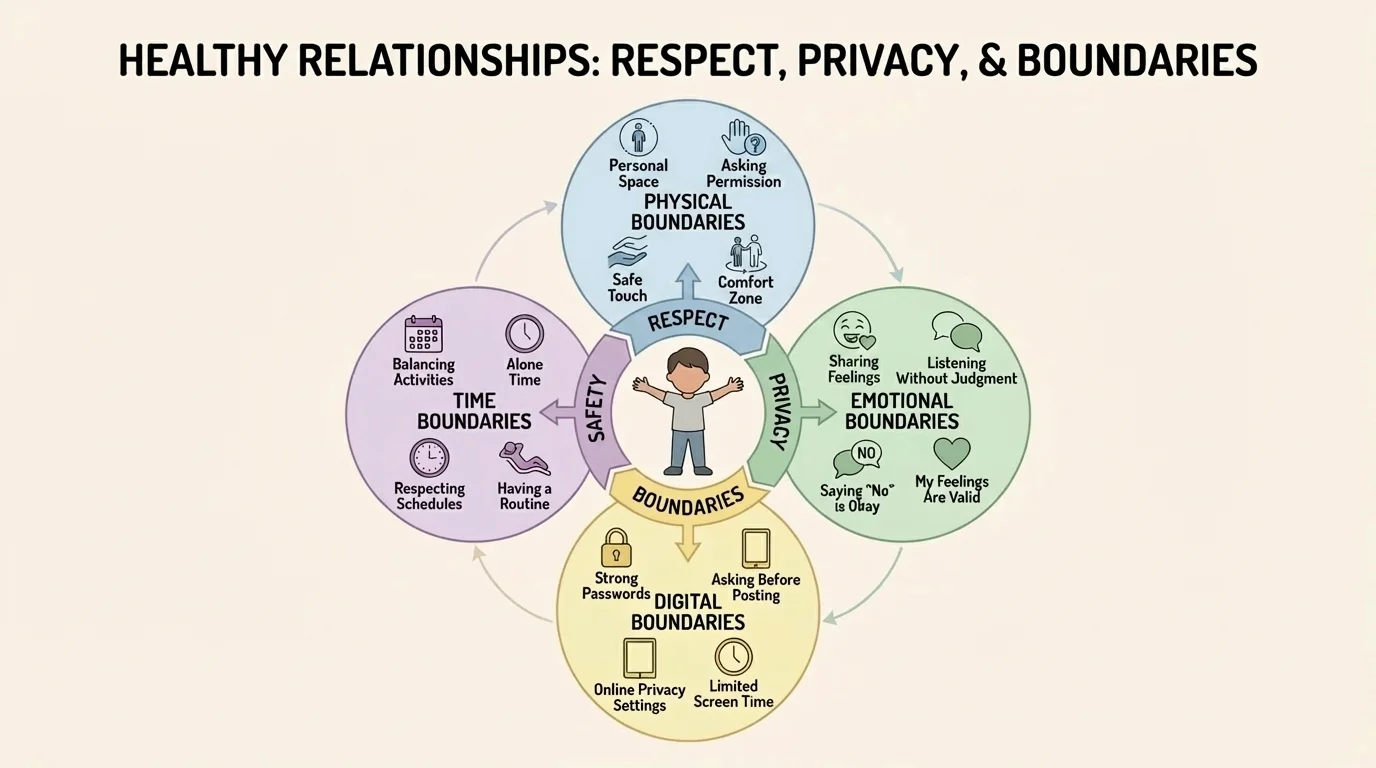
Everyone's boundaries can be a little different. One child may love surprise hugs from family members, and another may prefer a wave or a smile. One friend may enjoy chatting every day online, while another may want less screen time. Different does not mean wrong. It means people are unique.
Boundaries can change depending on the situation too. You might want quiet while reading but enjoy talking during a game. You might feel okay sharing a joke with one friend but not during a group call. Healthy relationships leave room for these differences.
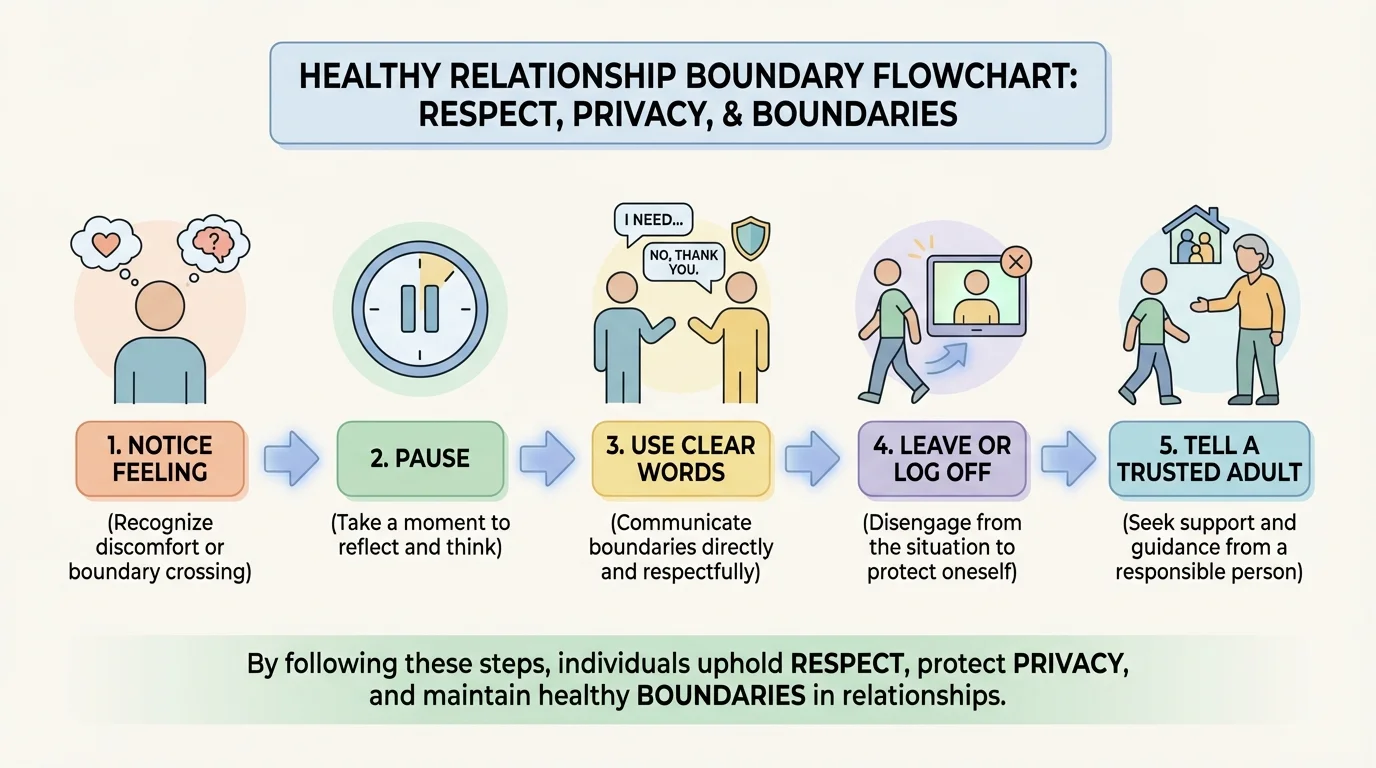
Sometimes you know right away when something does not feel okay. Sometimes you only notice after your body gives clues. In the step-by-step process in [Figure 2], you can see how noticing a feeling, pausing, using clear words, and getting help work together. You do not have to wait until you are very upset to speak up.
Common clues are stepping back, feeling tense, wanting to hide your screen, feeling embarrassed, or thinking, "I wish this would stop." Those clues matter. They are signals to pay attention.
How to say a boundary clearly
Step 1: Notice the feeling. Ask yourself, "Do I feel safe and comfortable?"
Step 2: Use short, clear words. Try: "No, thank you." "Please stop." "I'm not sharing that." "Ask first." "I need space."
Step 3: If the person does not stop, leave, log off, block, or move closer to a trusted adult.
Step 4: Tell a trusted adult what happened.
Clear words are strong words. You do not need a long speech to protect a boundary.
Here are some boundary sentence starters you can use right away: "I don't like that." "Please give that back." "Do not read my messages." "I'm not ready to talk about that." "You may not share my picture." "I want to play something else."
Your voice does not have to sound angry to be strong. You can be calm and firm. Saying a boundary is not rude when it protects your body, feelings, privacy, or safety.
When someone tells you a boundary, the respectful response is simple: listen and stop. Do not roll your eyes, laugh, argue, or try to change their mind. If someone says, "Please don't do that," the kind response is, "Okay."
Sometimes you may not understand why the person feels that way. You still need to respect the boundary. You do not have to agree with every feeling to honor it. Respect means taking the other person seriously.
You can also apologize if needed. An apology can sound like this: "I'm sorry. I didn't know. I'll stop." Then really stop. A real apology is followed by changed behavior.
"No" is a complete answer.
— A simple rule for respecting boundaries
This rule matters online too. If a friend says they do not want to be on camera, do not pressure them. If they do not want a picture posted, do not post it. If they want to end a chat, let them go. The same care you show in person should also show up on screens.
Just as the boundary types in [Figure 1] include digital and time boundaries, respecting someone may mean giving them quiet time, not messaging over and over, or not demanding an answer right away.
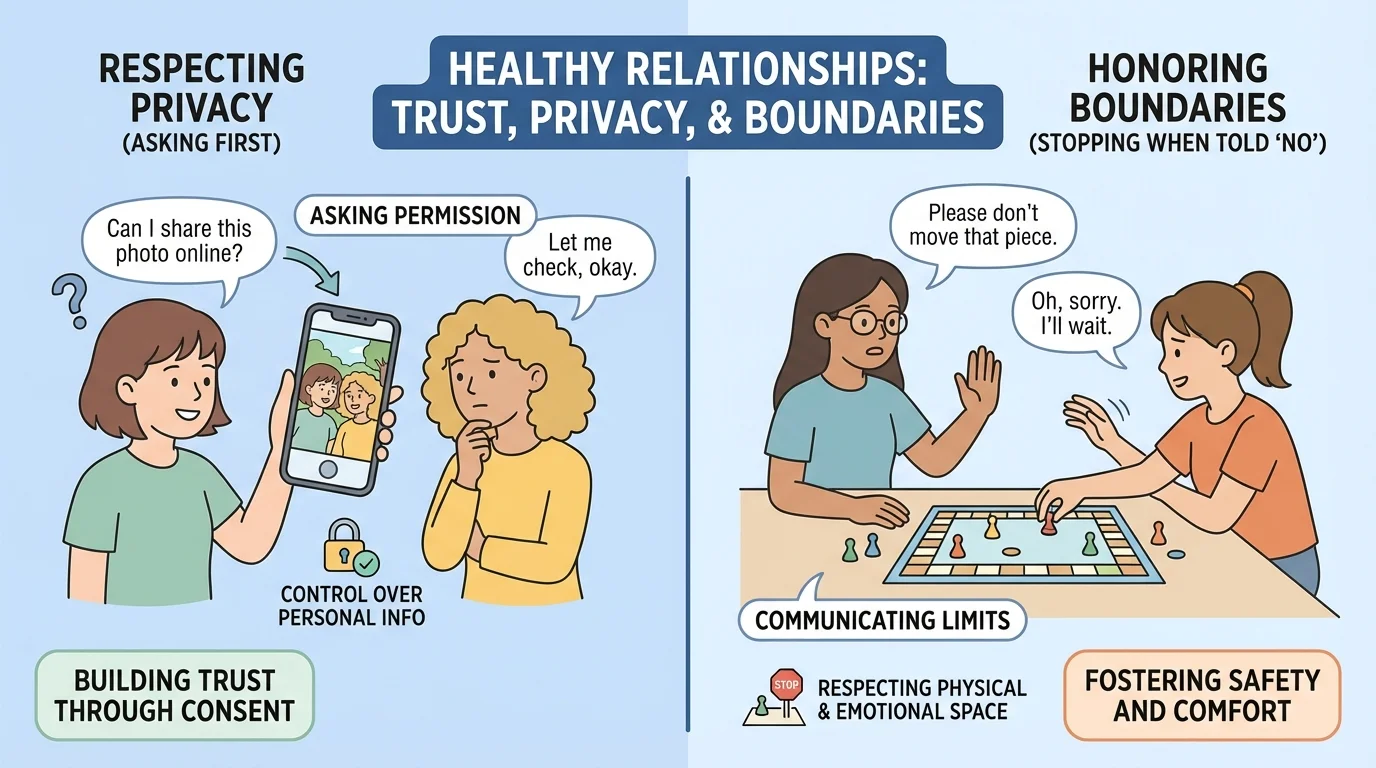
Healthy choices look a little different in different situations. The important question is always the same: "Does this choice protect the other person's comfort, privacy, and safety?" [Figure 3] illustrates how respect can look both at home and online.
Situation 1: Your sibling is using a tablet. You want to see what they are doing. A respectful choice is to ask, "Can I look?" An unhealthy choice is grabbing the tablet or peeking over and reading private messages.
Situation 2: A friend sends you a silly photo and says, "Only for you." A respectful choice is keeping it private unless they later say it is okay to share. An unhealthy choice is forwarding it to others for laughs.
Situation 3: During a game, someone keeps calling you a nickname you do not like. A healthy boundary is, "Please use my real name." If they stop, they are showing respect. If they keep doing it, you may need to leave the game and tell a trusted adult.
Situation 4: A neighbor wants a hug goodbye, but you do not want one. You can say, "No thank you, I'll wave instead." Safe adults should respect that choice.
Situation 5: In a group chat, someone keeps asking where you live. A safe response is not to share personal information. Leave the chat, block if needed, and tell a trusted adult.
These situations may seem small, but they build trust or break it. Respectful actions often begin with asking first and stopping when someone says no.
Sometimes a person does not listen the first time. That is not your fault. If a boundary is ignored, your next job is safety, not convincing the other person forever.
Step 1: Say the boundary again if you can: "Stop." "Back up." "Do not touch that." "I'm leaving the chat." Step 2: Move away, log off, or block the person if possible. Step 3: Tell a trusted adult what happened. Trusted adults can include a parent, guardian, counselor, coach, activity leader, or another safe grown-up who helps you.
If something feels unsafe, confusing, or too big to handle alone, getting help is a strong choice. You are not tattling when you are trying to keep yourself or someone else safe.
If someone threatens you, tells you to keep a harmful secret, asks for private pictures, touches you in a way you do not want, or keeps bothering you after you say no, get help right away. You deserve support.
You do not need to prove your feelings with a perfect explanation. "I felt uncomfortable" is enough to start the conversation with a trusted adult.
Healthy relationships are built by small actions over time. Ask before borrowing. Knock before entering. Listen without interrupting. Keep private things private. Accept "no" the first time. Check in by asking, "Is this okay?" These habits make other people feel safe with you.
You can also practice noticing what helps you feel safe and comfortable. Maybe you like people to ask before hugging. Maybe you want private time after a busy day. Maybe you do not want your face shown on a video call. Knowing your own boundaries helps you protect them.
Healthy relationships feel kind, safe, and fair. They make room for choice. They protect privacy. They respect limits. Whether you are talking with a friend, a family member, a teammate, or someone online, these three skills help you build trust that lasts.
