Have you ever noticed that one school task feels easy, while another feels tricky, even on the same day? You might be great at sharing ideas during a video class but forget where you saved your homework file. That does not mean something is wrong with you. It means you are learning an important life skill: understanding yourself.
When you know what you do well, what feels hard, and what helps you, you can make smarter choices. You can ask for the right help, use tools that work, and feel more confident. This is called self-awareness. It means knowing yourself in a clear and honest way.
Self-awareness is useful in online school because you do many jobs on your own. You may need to log in on time, listen carefully on a screen, follow directions, manage your materials at home, send messages, and finish work without a teacher standing nearby. Managing these responsibilities uses real-life skills, not just school skills.
Strengths are things you do well right now.
Challenges are things that feel harder for you right now.
Supports are tools, people, routines, or strategies that help you do better.
Here is an important truth: a challenge is not the same as a weakness forever. It is simply an area where you need more practice, a better system, or extra help. A support is not cheating or taking the easy way out. It is a smart way to help yourself succeed.
Online school includes many different responsibilities, and they can be compared side by side, as [Figure 1] shows. A responsibility is a job you are expected to do. Some responsibilities are about managing time. Some are about staying organized. Some are about communicating clearly.
For a grade 4 student learning from home, school responsibilities may include logging in on time, checking your schedule, listening during a live lesson, reading directions, finishing assignments, uploading work, keeping digital files organized, staying focused when distractions pop up, and asking for help when you need it.
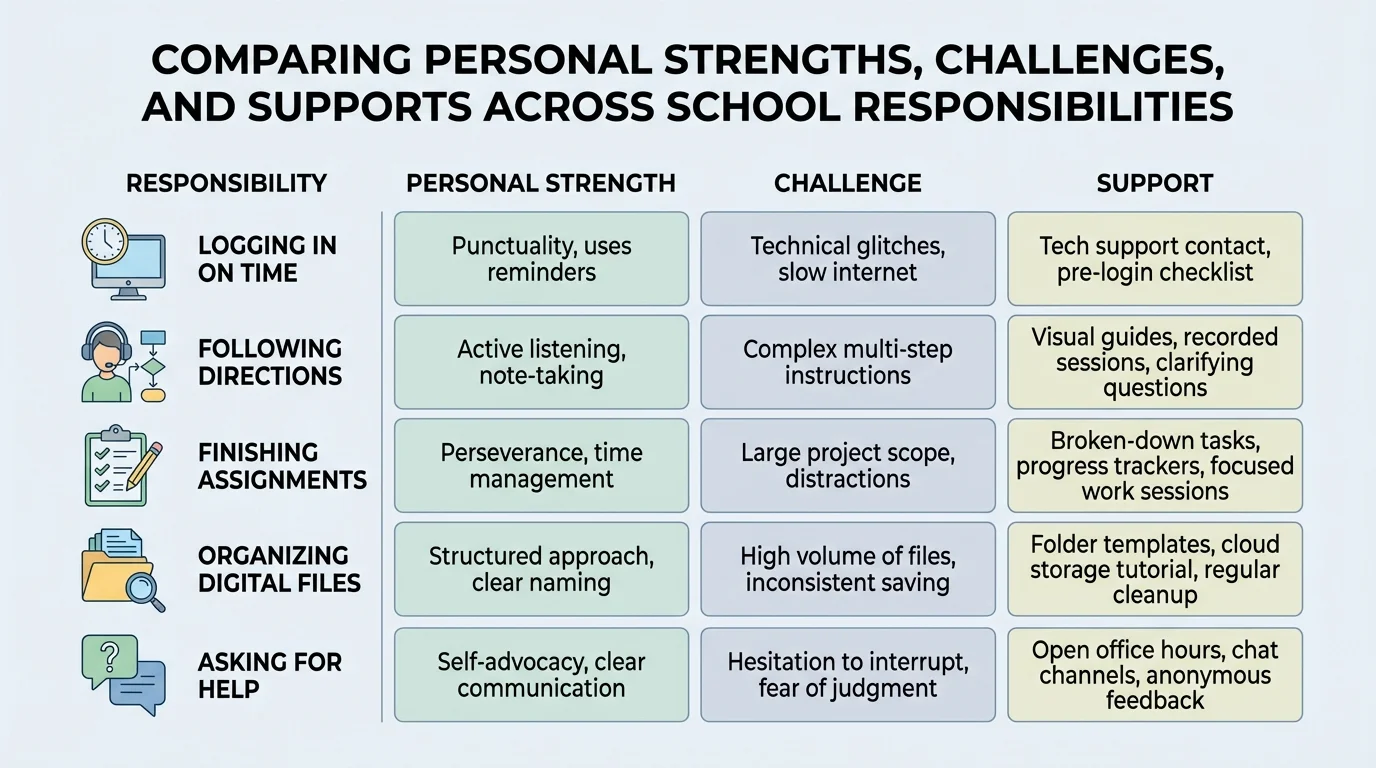
These jobs are not all the same. A student might be strong in one area and need more support in another. For example, you might remember lesson times easily but have trouble staying calm when technology stops working. Another student might be very organized but feel hesitant to message the teacher.
That is why comparing responsibilities matters. You are not just asking, "Am I good at school?" You are asking better questions like, "Which school jobs feel easier for me?" and "Which ones need more support?"
A strength is not only something you are the best at. It is anything you can do fairly well and with growing confidence. Your strengths may show up in schoolwork, behavior, communication, or problem-solving.
You might have strengths like these:
Sometimes strengths are easy to notice because they feel natural. Other times, you miss them because they seem normal to you. If you think, "I just always check my schedule," that may be a strength in responsibility and planning.
Real-life example: noticing a hidden strength
Step 1: Think about one school job you do often.
Ari thinks about joining live classes.
Step 2: Notice what goes well.
Ari charges the device the night before and joins on time.
Step 3: Name the strength clearly.
Ari's strength is being prepared.
This helps Ari understand, "I am good at planning ahead for class."
Strengths can also connect to your personality. Maybe you are patient, curious, creative, or determined. Those personal traits can help with school responsibilities too.
A challenge is an area that feels harder, takes longer, or causes stress. Everyone has challenges. Even adults do.
The goal is not to judge yourself. The goal is to notice patterns. Maybe you often forget to click "turn in." Maybe you start strong but lose focus after a few minutes. Maybe reading long directions feels confusing unless someone explains them out loud.
Challenges can happen for many reasons. You may still be learning the skill. Your home might have distractions. The directions may be unclear. The task may require several steps, which uses executive functioning skills like planning, organizing, remembering, and controlling attention.
Challenges are clues
When something keeps going wrong, it gives you information. If you miss deadlines, that may be a clue that you need a better routine. If you avoid asking questions, that may be a clue that you need practice using brave communication. Challenges point you toward the support that can help.
Here are a few common challenges in online school:
If one of these sounds familiar, you are not alone. A challenge is simply something you can work on with the right support.
A support is anything that helps you succeed. Supports can come from people, tools, routines, or strategies. The most helpful support depends on the responsibility you are trying to handle.
For example, if your challenge is forgetting assignments, a support might be using a checklist. If your challenge is getting distracted, a support might be working in a quieter space or closing extra tabs. If your challenge is feeling shy, a support might be writing your question before class so you are ready to send it.
| School responsibility | Possible challenge | Helpful support |
|---|---|---|
| Logging in on time | Forgetting the start time | Set an alarm and check the schedule the night before |
| Following directions | Missing steps | Read directions twice and underline key words on paper or a note |
| Finishing assignments | Task feels too big | Break it into small parts |
| Staying focused | Too many distractions | Use headphones or move away from noise |
| Asking for help | Feeling nervous | Type a short message starter like "Can you explain step 2?" |
Table 1. Examples of how different supports can match different school responsibilities and challenges.
Notice that the same support does not fix every problem. A timer might help with focus, but it will not organize your files for you. That is why it is important to match the support to the situation.
Many successful students do not succeed because everything is easy for them. They succeed because they learn which supports help them most and actually use them.
Supports can also change over time. A reminder from a caregiver may help now, but later you may use your own checklist instead. That is growth.
A comparison chart helps you notice patterns across tasks, as [Figure 2] illustrates. You may be strong in communication, challenged in organization, and supported by routines. Or you may be strong in creativity, challenged in time management, and supported by timers and checklists.
Comparing means looking at more than one responsibility and asking how you do in each one. This is more useful than giving yourself one label like "good student" or "bad at school." People are much more detailed than that.
For example, Mia speaks confidently during live lessons and shares thoughtful ideas. That is a strength in participation. But Mia often forgets where she saved her documents. That is a challenge in organization. Her support might be keeping one folder for each subject and naming files clearly.
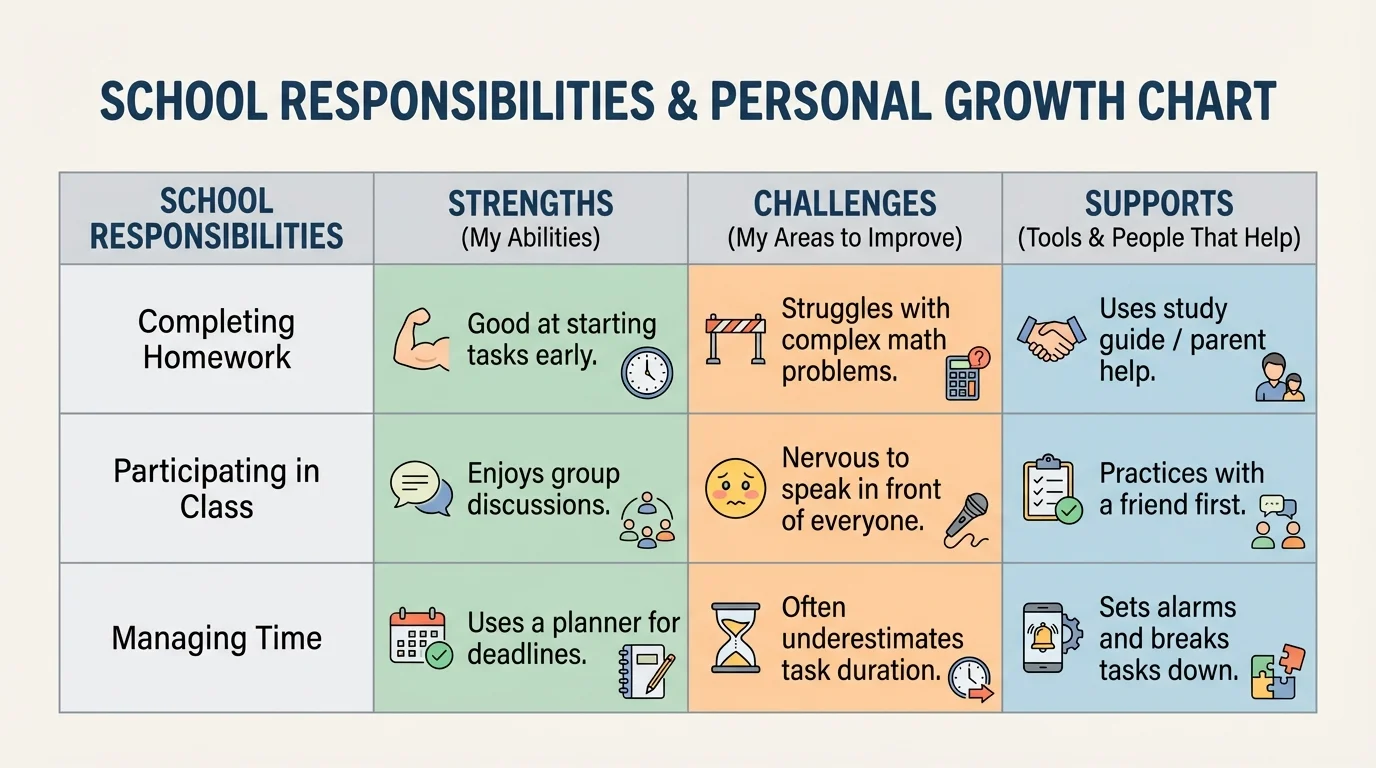
Now compare that with Jordan. Jordan keeps digital folders neat and turns in work on time. That is a strength in organization. But Jordan feels nervous sending messages when confused. A helpful support could be a sentence starter such as, "I understand the first part, but I need help with the next step."
As you compare different tasks, look for questions like these:
These comparisons help you become more independent. Instead of saying, "I can't do this," you can say, "This kind of task is harder for me, and this support helps." That is a strong and mature way to think.
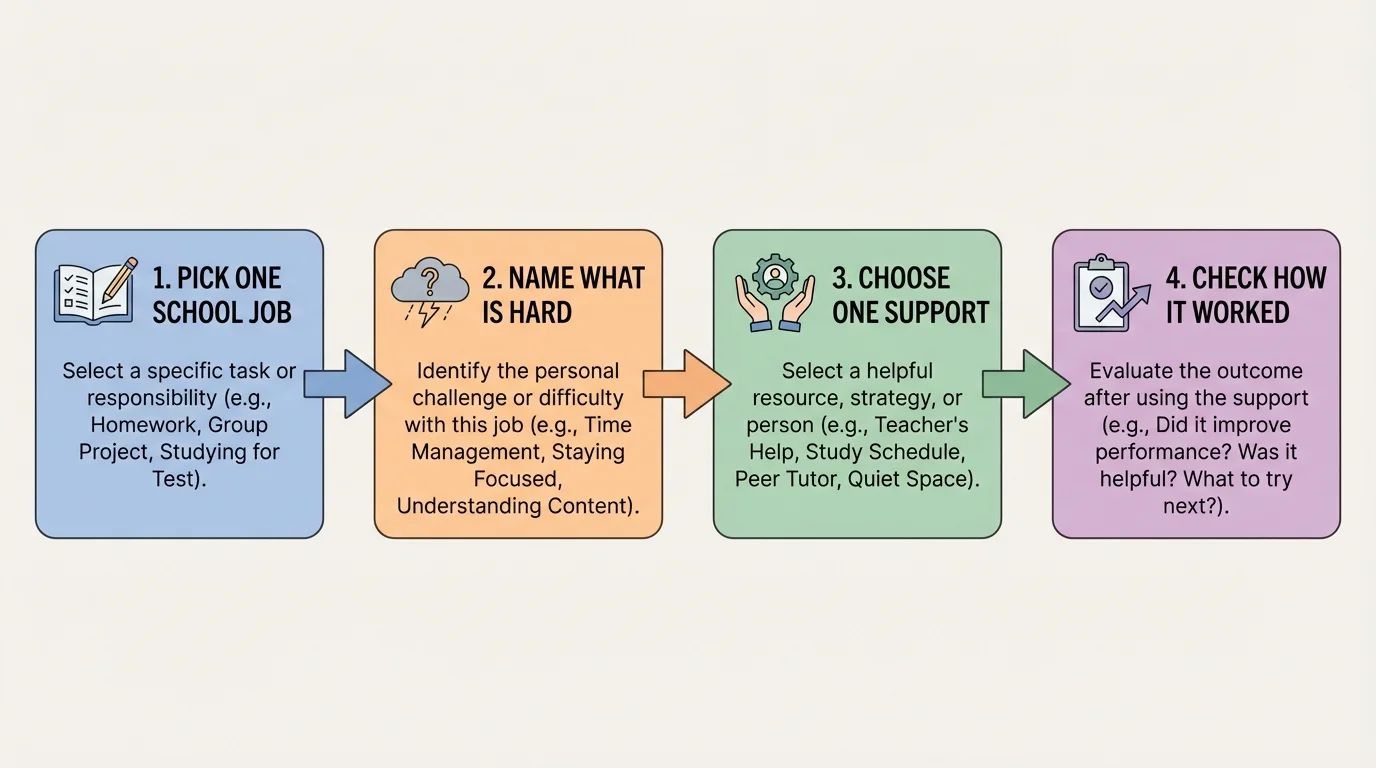
You do not need a giant system to start improving. A simple plan works well, as [Figure 3] shows: pick one school job, name what is hard, choose one support, and check how it worked.
Keep your plan small. If you try to fix everything at once, it can feel overwhelming. Choose one responsibility first.
Personal plan example
Step 1: Pick one responsibility.
"I want to improve turning in assignments."
Step 2: Name the challenge.
"I finish the work, but I forget to upload it."
Step 3: Choose one support.
"I will use a sticky note on my desk that says, 'Finish, upload, check.'"
Step 4: Check the result.
After a few days, ask, "Did this help me remember?"
This kind of plan is simple, clear, and possible to use right away.
When the support works, keep using it. When it does not work, change it. Maybe the note is too easy to ignore, so a digital reminder works better. Supports are tools, and tools should fit the job.
As you saw earlier in [Figure 2], comparing different responsibilities helps you choose the right plan. If your challenge is focus, choose a focus support. If your challenge is communication, choose a communication support.
Part of self-awareness is being able to explain your needs to others. This is a useful strategy for school and for life. A strategy is a plan or method you use on purpose.
You might tell a caregiver, "I do better when I have a quiet place during reading." You might message a teacher, "I understand the math part, but I need help understanding the directions." You might tell yourself, "I need to write down the steps before I start."
Here are some useful sentence starters:
Speaking up is not complaining. It is solving problems. When you explain your challenge and support clearly, other people can help you better.
"Knowing yourself helps you help yourself."
This is also part of individuality. Individuality means that each person has their own mix of strengths, needs, habits, and ways of learning. What helps your friend may not be what helps you, and that is okay.
Your strengths, challenges, and supports are not frozen. They can change as you grow. A task that feels hard now may become easier later. A support that worked last year may not be needed forever. New challenges may appear when work gets harder, and new strengths may appear when you practice.
This is why it helps to check in with yourself once in a while. You can ask, "What is going better than before?" "What still feels hard?" "What support should I keep, change, or add?"
Think of yourself as a learner who is growing, not as a label. You are not "just messy" or "just shy" or "just bad at directions." You are a person learning skills. With practice and support, skills improve.
For example, a student who used to need help logging in may later do that independently. Then the next growth area might be staying focused for the whole lesson. As shown earlier in [Figure 3], a simple plan can be used again and again for new challenges.
Try This: At the end of your school day, name one strength, one challenge, and one support. Keep it short. Example: "My strength was joining class on time. My challenge was staying focused during reading. My support tomorrow will be moving away from the TV."
Try This: Before a live lesson, ask yourself, "What usually helps me do well in this class?" Use that support before the lesson starts, not after you are already stuck.
Try This: If a task feels hard, change your self-talk from "I'm bad at this" to "This is a challenge for me right now, and I can use support." That small sentence change can help you stay calm and keep trying.
