Have you ever finished a quiz, a chore, or a conversation and thought, "Why did that go so well?" or "Why did that go badly?" That small moment of thinking back is powerful. It can help you do better next time. Reflection is like pressing a replay button in your mind so you can learn from what happened instead of just moving on and forgetting it.
Reflection matters because growing does not happen by accident. You get better when you notice your choices, your feelings, and your patterns. That is true in academic situations like finishing online assignments, staying focused during lessons, or studying for a test. It is also true in social situations like texting a friend, joining a video call, working with a team in a club, or solving a disagreement with a sibling.
When you reflect, you become more aware of yourself. You start to notice things like, "I do better when I start early," or "I interrupt people when I am excited," or "I get stuck when directions have many steps." These are not signs that something is wrong with you. They are clues that help you grow.
Without reflection, the same problems can happen again and again. You may rush through work, forget important details, or say something unkind online without meaning to. With reflection, you can make smarter choices. You can repeat what works and fix what does not.
Reflection means thinking carefully about an experience so you can understand it better and learn from it.
Strengths are things you already do well.
Areas for growth are skills or habits you can improve with practice.
Everyone has strengths and areas for growth at the same time. A student might be great at reading but need to improve time management. Another student might be kind and friendly but need to get better at listening during group conversations. Reflection helps you see the whole picture.
Reflection is not the same as blaming yourself. It is not saying, "I messed up, so I am bad at this." It is saying, "Something did not go the way I wanted. What can I learn from it?" That is a much stronger and healthier way to think.
Reflection is also not only for mistakes. It helps with success too. If you got a good score on an assignment, reflection can help you figure out why. Maybe you studied in a quiet place, asked a helpful question, or checked your work before turning it in. If you know what worked, you can do it again.
You can reflect on three simple things: what happened, why it happened, and what to do next. Those three ideas can help you in almost any situation.
In schoolwork, patterns matter. As [Figure 1] shows, one hard day may just be a rough day, but the same struggle over and over is a clue. Maybe you often forget to upload assignments. Maybe you understand a lesson during class but feel confused when working alone. Maybe you keep waiting until the last minute and then feel stressed.
Start by asking yourself simple questions after academic tasks. Did I understand the directions? Did I stay focused? Did I use my time well? Did I ask for help when I needed it? Did I check my work? These questions help you look at your habits, not just your final grade.
Suppose you take an online quiz and do worse than expected. Reflection can help you look deeper. Maybe you did not study enough. Maybe you studied, but you only reviewed the easy parts. Maybe you felt nervous and rushed. Maybe you were distracted by notifications or noise. When you identify the real reason, you can make a better plan.
Now think about a different example. You finish a writing assignment early and feel proud. Reflection still helps. You might realize that making a short outline first kept your ideas organized. You might notice that taking a short break after drafting helped you catch mistakes when you came back. These are strengths you can keep using.
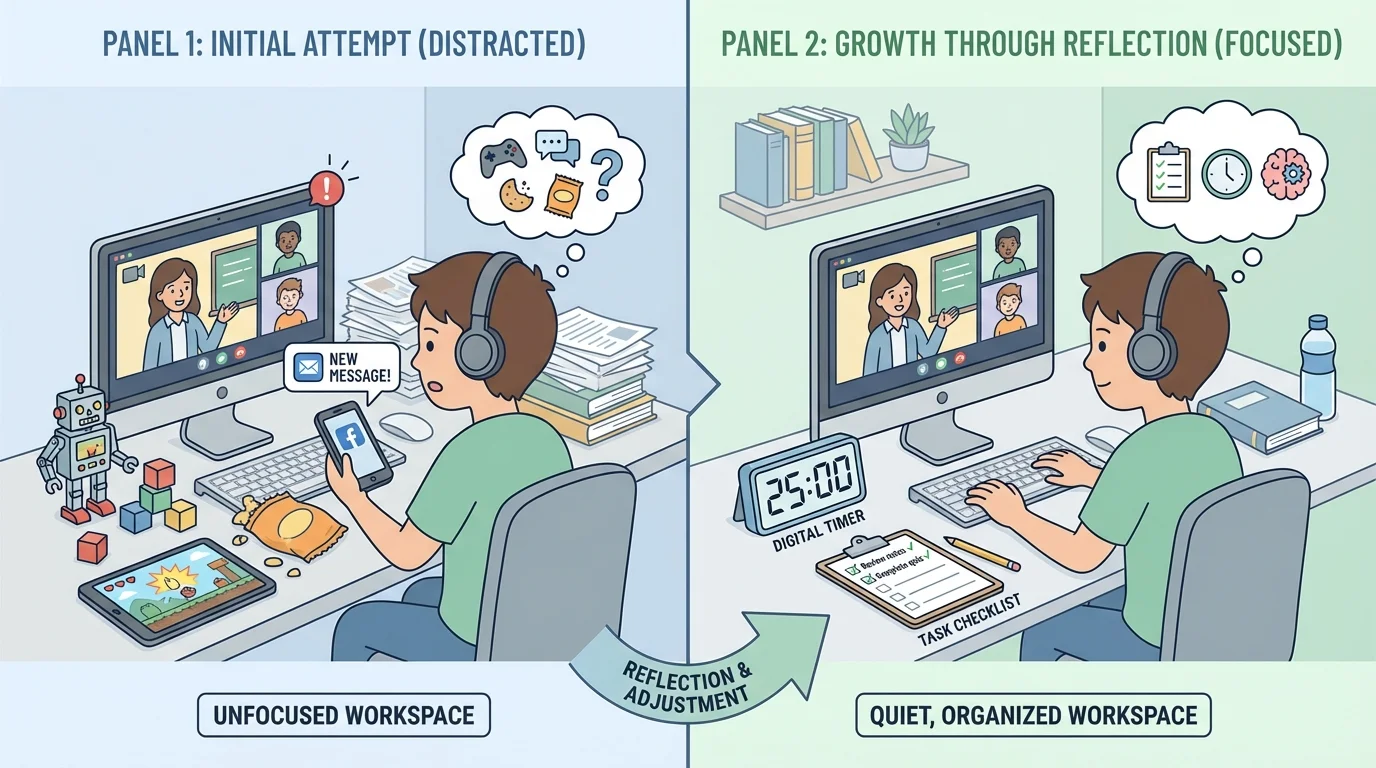
Academic reflection can help you improve many skills: paying attention, following directions, planning ahead, organizing materials, studying, and asking questions. It can even help with confidence. When you understand your own learning habits, school feels less confusing.
One helpful idea is to focus on what you can control. You may not control how hard a quiz is, but you can control whether you studied, slept well, and gave yourself enough time. Focusing on controllable choices gives you power to improve.
Academic reflection example
You missed the deadline for a science assignment in your online course.
Step 1: Describe what happened.
You started late and forgot that the assignment had two parts.
Step 2: Notice what made it hard.
You did not write the due date on your calendar, and you tried to do everything at once.
Step 3: Find one strength.
You did finish the first part carefully, which shows you can do strong work when you focus.
Step 4: Choose one next step.
Next time, you will check the full directions, list both parts, and begin one day earlier.
That kind of reflection is useful because it is specific. "I need to do better" is too vague. "I will write the due date down and check that I completed all parts" is something you can actually do.
Social growth matters too. In online school, you may interact through messages, discussion boards, video calls, games, clubs, sports, or community activities. Reflection helps you become a better friend, teammate, listener, and communicator. As [Figure 2] illustrates, a short pause before you respond can change the whole direction of a conversation.
After a social situation, ask yourself questions like these: Was I respectful? Did I listen? Did I give others a turn? Did I understand how the other person felt? Did my words help or hurt? Was I brave enough to speak up if something felt wrong?
Sometimes social reflection is about conflict. Maybe a friend sent a message that felt rude, and you answered quickly because you were upset. Later, you might realize the message was confusing, not mean. Reflection helps you slow down and consider other possibilities.
Sometimes social reflection is about kindness. Maybe someone on a group call was quiet. You might reflect and realize that inviting them to share would have helped them feel included. This kind of thinking builds stronger relationships.
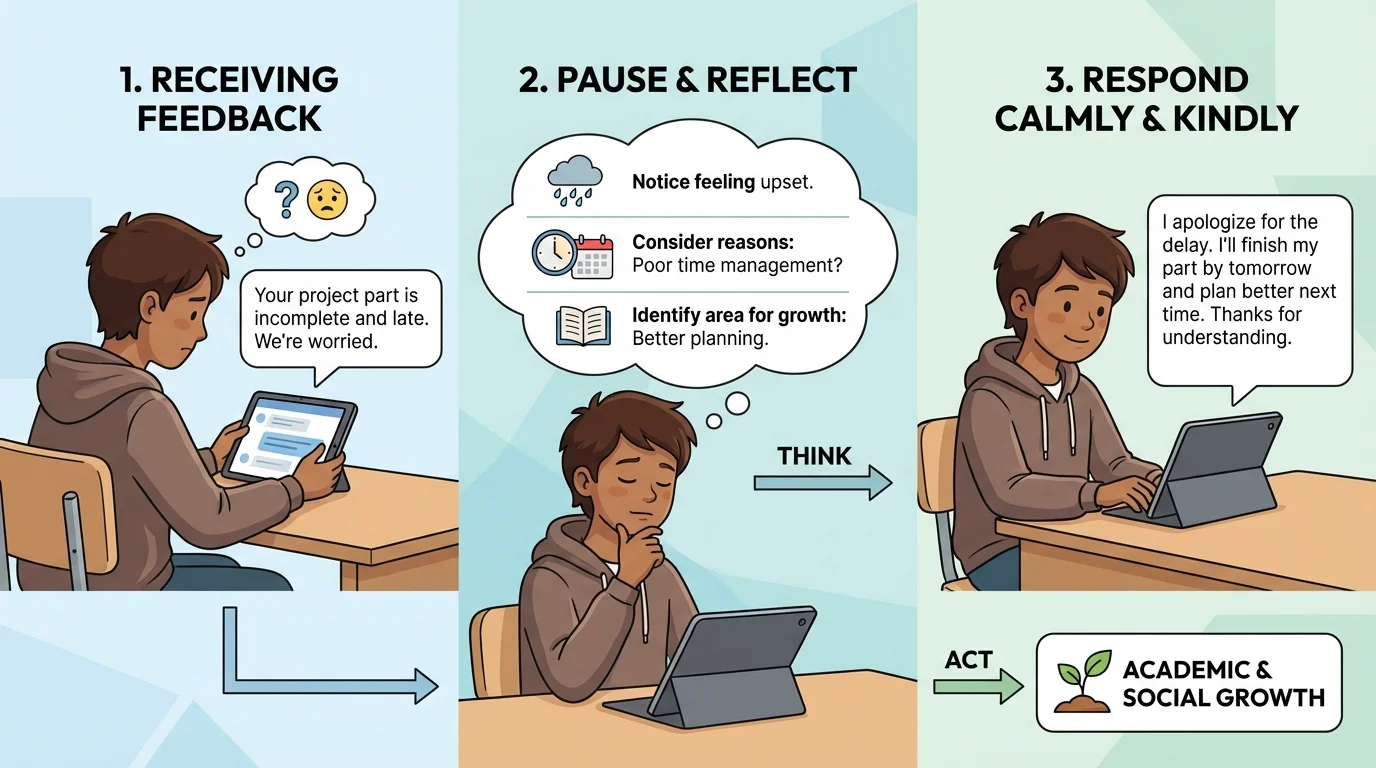
Reflection can also help with boundaries. A boundary is a limit that protects your feelings, time, or safety. If a conversation makes you uncomfortable, reflection can help you notice that and decide what to do next, such as telling a trusted adult, leaving the chat, or using respectful words to say no.
When you reflect on social situations, try to think about both yourself and the other person. You do not have to guess everything they feel, but it helps to imagine their point of view. This skill is called perspective. It helps you be fair, not just reactive.
Reflection helps relationships grow. Strong relationships are not built by being perfect. They are built by noticing how your actions affect others and making changes when needed. If you interrupt less, listen more, and choose calm words, people are more likely to trust you and enjoy being around you.
Being reflective does not mean overthinking every text or every conversation. It means noticing important moments, especially when something felt great, confusing, hurtful, or uncomfortable. Those moments have lessons inside them.
You do not need a long speech in your head to reflect well. A short routine works. This reflection process, shown in [Figure 3], helps build self-awareness by helping you notice your actions and feelings clearly enough to make a better choice next time.
Here is a simple reflection process you can use for schoolwork and social situations.
Step 1: Notice what happened. Say what happened in a simple, true way. "I forgot to turn in my work." "I got frustrated during math." "I sent a message when I was angry." Keep it honest and clear.
Step 2: Name your feelings. Were you proud, worried, distracted, embarrassed, excited, bored, or upset? Feelings give clues. If you know how you felt, you can understand your actions better.
Step 3: Find one thing that went well. Even when something is hard, there is often a strength to notice. Maybe you kept trying. Maybe you asked for help. Maybe you apologized after being unkind.
Step 4: Find one area for growth. What needs work? Be specific. "I need to slow down when reading directions." "I need to wait my turn in conversations."
Step 5: Choose one next step. Pick a small action. Not ten actions. Just one. Small steps are easier to remember and easier to practice.
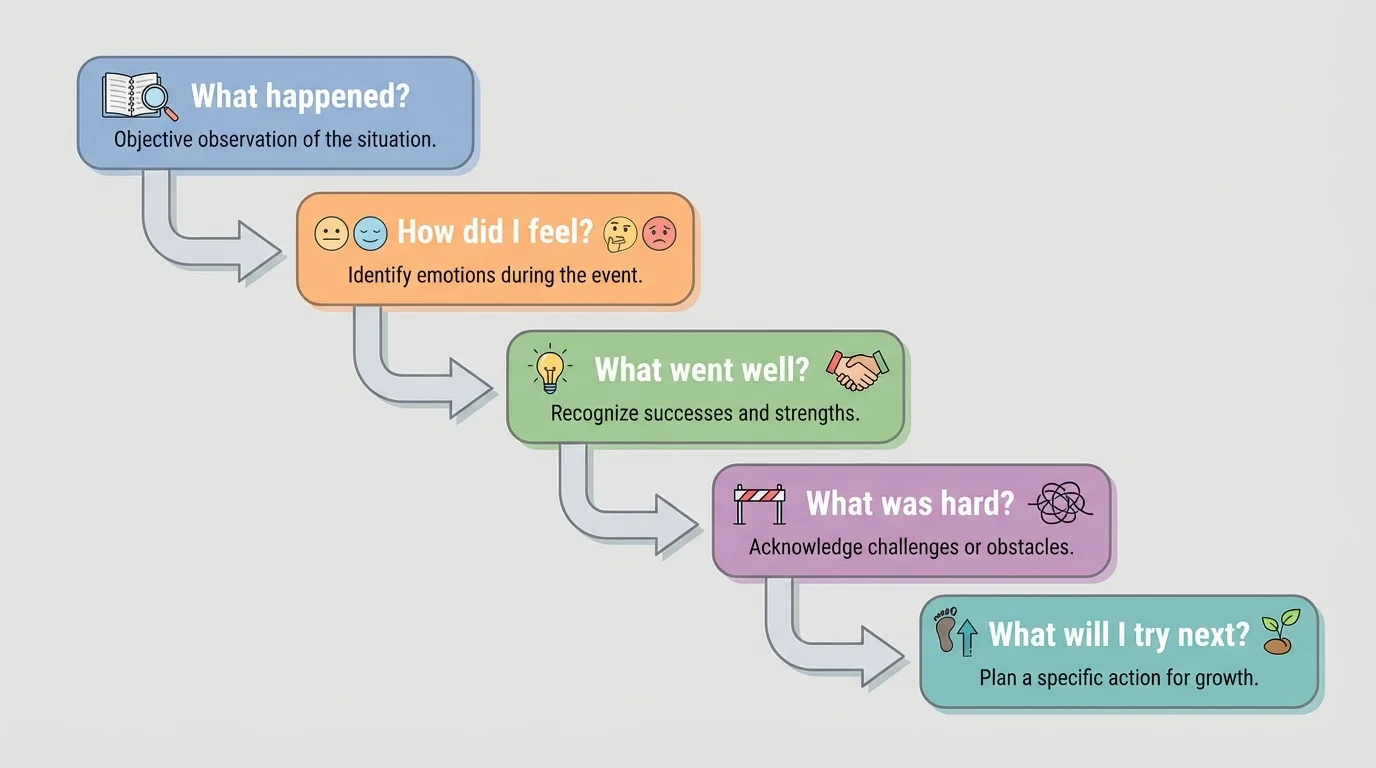
This process is useful because it turns a big messy situation into small clear parts. Later, when you reflect again, you can return to [Figure 3] and ask whether your next step actually helped.
Sometimes students avoid reflection because they think it will make them feel bad. That can happen if reflection turns into harsh self-talk. Harsh self-talk sounds like, "I am terrible at this," or "I always ruin everything." Those thoughts are not helpful because they are too extreme and they make it harder to improve.
A better way is to use honest, kind language. You might say, "I had trouble focusing today," or "I spoke too quickly when I was upset," or "I need a better system for remembering due dates." These statements are truthful, but they also leave room for growth.
"I can learn from this, even if it was hard."
This kind of thinking is called a growth mindset. It means you believe skills can improve with effort, feedback, and practice. It does not mean everything is easy. It means improvement is possible.
If you ever feel stuck, try adding the word yet. "I do not understand this yet." "I am not good at staying calm in arguments yet." That one word reminds your brain that growth takes time.
You do not need fancy materials to reflect. You just need a simple way to notice and remember what you learn about yourself.
One tool is a journal. You can write a few sentences after a lesson, quiz, project, or important conversation. Another tool is a voice note if you prefer speaking to writing. You can also use a checklist with short questions.
A rating scale can help too. For example, after an online class, you might rate your focus from 1 to 5, where 1 means very distracted and 5 means very focused. Over time, the numbers can help you notice a pattern. If your focus is often around 2 when your phone is nearby but around 4 when it is in another room, that tells you something useful.
| Tool | How It Helps | Best Time to Use It |
|---|---|---|
| Journal | Lets you explain details and feelings | After a big task or event |
| Checklist | Keeps reflection short and simple | After daily schoolwork |
| Voice note | Good if writing feels slow | Right after something happens |
| Rating scale | Helps you notice patterns over time | At the end of each day or class |
| Talk with an adult | Gives you support and a second view | When you feel stuck or upset |
Table 1. Reflection tools and how they can support growth in everyday situations.
You can also talk to a trusted adult, such as a parent, guardian, coach, mentor, or teacher. Sometimes another person can help you notice something you missed. They may see a strength in you that you did not see in yourself.
Reflection works best when it leads to one clear action. If you reflect but never change anything, the same problems may continue. Action turns learning into progress.
Good action steps are small, specific, and realistic. "I will be better at school" is too big. "I will check the directions twice before starting" is better. "I will be nicer" is too broad. "I will wait until the other person finishes talking before I answer" is better.
You can make your action step even stronger by choosing when you will do it. For example: "Before I click submit, I will reread my answers," or "Before I reply to a message that upsets me, I will wait two minutes."
Turning reflection into action
You noticed that you often feel rushed in the morning and then fall behind in your online classes.
Step 1: State the pattern.
You log in late on several days each week.
Step 2: Find the likely cause.
You pack your materials at the last minute and forget what you need.
Step 3: Choose one action.
Each evening, place your notebook, charger, and water bottle in one spot.
Step 4: Check the result.
After a few days, ask yourself if mornings feel calmer and if you are logging in on time.
That final check matters. Reflection is not only "What will I try?" It is also "Did it help?" If not, you can adjust and try a different strategy.
One common mistake is being too general. Saying "I need to improve everything" does not help. A better choice is to pick one skill at a time.
Another mistake is only noticing mistakes and never noticing strengths. If you only look for problems, reflection starts to feel heavy. A better choice is to ask, "What did I do well that I should keep doing?"
A third mistake is blaming only other people. Sometimes others do make situations harder, and that matters. But reflection is strongest when you also ask, "What part could I control?"
A fourth mistake is choosing goals that are too big. Huge goals can feel exciting at first, but they are hard to keep. Better goals are small enough to practice every day.
Your brain gets stronger at skills you practice often. That means repeated reflection can actually help you get better at noticing your feelings, choices, and habits more quickly.
One more mistake is reflecting only when things go wrong. Reflection after success is just as important. It helps you protect your good habits and understand your strengths.
Here are some quick examples of reflection in real life.
Schoolwork example: You kept losing focus during a recorded lesson. After reflecting, you realized you were trying to watch while also opening other tabs. Your growth step is to keep only the lesson tab open and take notes by hand.
Study example: You studied for a spelling test but still missed several words. Reflection helped you notice that you only read the words, but you did not practice writing them. Your next step is to say, spell, and write each word.
Friendship example: A friend stopped replying to your messages. Reflection helped you remember that you sent many messages in a row when they had already said they were busy. Your next step is to send one message and wait.
Family example: You argued with a sibling over a game. Reflection helped you notice that you were tired and snapped quickly. Your next step is to pause and use a calm voice before answering.
Team example: In an activity group, you had a strong idea and shared it, but you did not listen to anyone else. Reflection helped you realize that teamwork means sharing space, not just speaking. Your next step is to invite another person to share their idea first.
All of these examples have the same pattern: notice, learn, adjust, try again. That is how growth happens.
The more often you reflect, the easier it becomes. At first, you may need help from an adult or a checklist. Later, you may start doing it on your own without even noticing. You will catch yourself thinking, "This worked because..." or "Next time I should..." That is a sign that your self-awareness is growing.
And that growth matters. It helps you become a stronger learner, a kinder communicator, and a more confident person. Reflection does not make you perfect. It helps you keep improving, one choice at a time.
