Have you ever started something feeling excited, but a few days later thought, "This is taking forever"? That happens to almost everyone. A long reading project, learning a dance, practicing an instrument, cleaning and organizing your room, or finishing a big online assignment can feel easy at the beginning and hard in the middle. The middle is where strong habits matter most.
Keeping effort going over time is not about being perfect. It is about learning how to keep moving, even when a task feels slow, boring, or tricky. That skill helps you in schoolwork, hobbies, chores, sports, and personal goals. When you know how to stay steady, you are more likely to finish what you start.
Short tasks often give you a quick reward. You finish, and you feel a sense of completion. Long tasks are different. They may take days or weeks, and the reward comes later. You may start wondering, "Why am I still doing this?" That does not mean you are lazy or bad at the task. It means you are doing something that takes time.
Long assignments and goals can also bring up strong feelings. You might feel bored because the work repeats. You might feel frustrated because one part is confusing. You might feel worried that you will not do it well. These feelings are normal. The important part is learning what to do next instead of quitting right away.
Persistence means continuing to work toward something even when it is hard or takes a long time.
Self-management means noticing what you need and making choices that help you stay on track.
Resilience means recovering after a mistake, problem, or disappointment and trying again.
Think of a plant growing. You do not see a huge change every hour, but with care over time, it grows. Your effort works in a similar way. Small actions repeated again and again can lead to big results.
One helpful word for this is persistence. Persistence does not mean forcing yourself to work without breaks. It means you keep returning to the goal. Some days you may do a lot. Some days you may do a little. What matters is that you do not let one hard moment decide everything.
Effort over time also means being flexible. If one plan is not working, you can try another. If you miss a day, you can restart the next day. Sustained effort is not stiff like a statue. It bends and adjusts like a tree branch in the wind.
Steady beats speedy. For long tasks, doing a little bit regularly often works better than doing a huge amount once and then stopping. A student who reads for 15 minutes each day is often more successful than a student who tries to read everything at the last minute.
This applies in everyday life. If you practice a skill a little at a time, you remember more. If you wait until the end, you may feel rushed, stressed, and less proud of your work. Habits help protect your energy.
[Figure 1] Big goals feel less scary when you break them into parts. Instead of thinking, "I have to finish my whole project," think, "What is the first small step?" A small step is easier to start, and starting is often the hardest part.
A helpful tool is a checklist. A checklist turns a giant job into smaller jobs you can actually see. For example, if your online assignment is to make a slide presentation about animals, your list could be: choose one animal, find three facts, find two pictures, write slide titles, make slides, check spelling, practice speaking, and submit.
Another smart habit is to decide when and where you will work. Saying "I'll do it later" is too fuzzy. Saying "I will work on this at 4:00 in the afternoon at the kitchen table for 20 minutes" gives your brain a clearer plan.
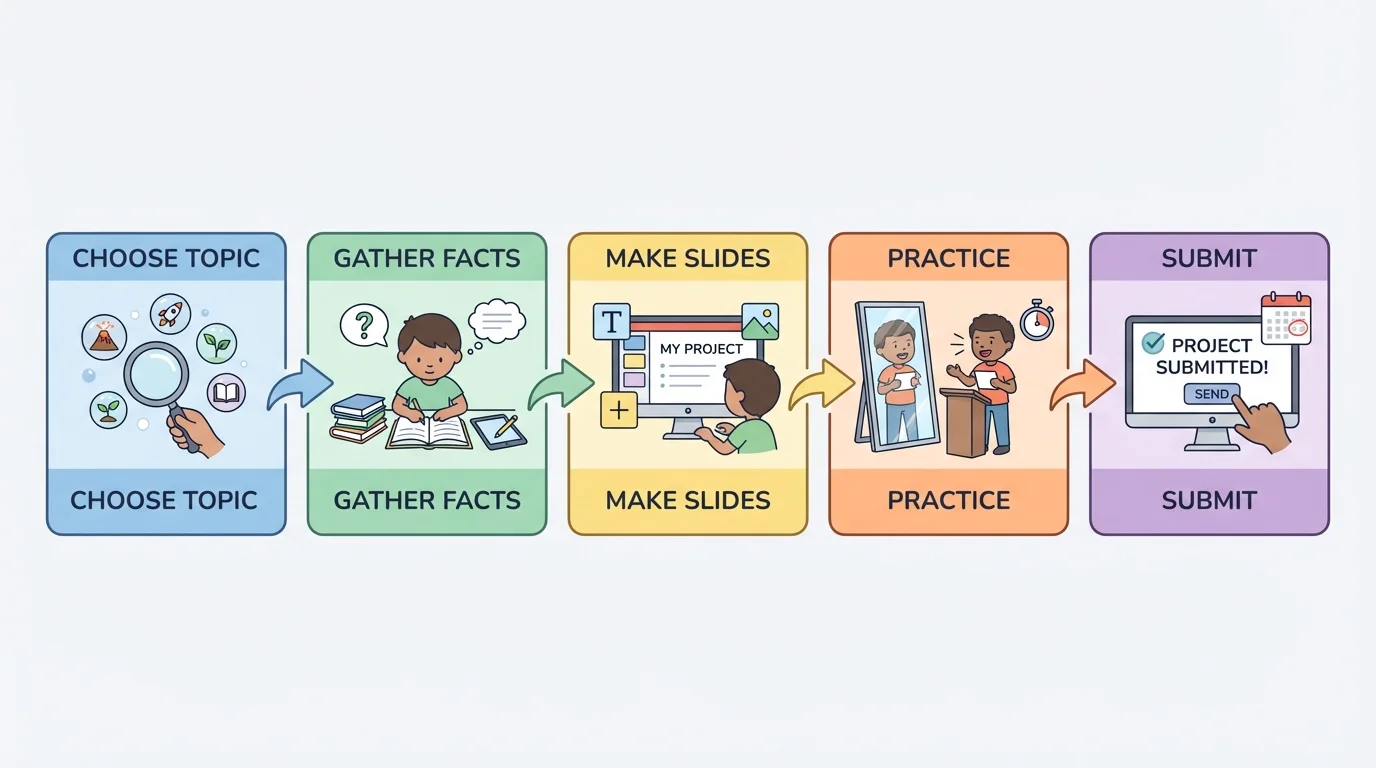
You do not need a fancy planner. A sheet of paper, a whiteboard, or a notes app can work. The key is to make your steps visible. When steps are visible, they are easier to follow.
Example: Turning a big job into small steps
Goal: finish a book report by next week.
Step 1: Break the job into parts.
Read the book, write notes, draft the report, edit it, and submit it.
Step 2: Break one part even smaller.
Instead of "read the book," plan to read one chapter each day.
Step 3: Choose a time.
Read after lunch for 15 minutes each day.
Step 4: Check off each part.
Every checked box helps you see that you are moving forward.
This makes the assignment feel more doable and less overwhelming.
Try This: Pick one goal you already have. Write the very first tiny step. If the step still feels too big, make it smaller.
[Figure 2] Your routine matters a lot. A routine is something you do in a regular way. When you use the same work time and place often, your brain starts to expect, "This is my focus time." That can make starting easier.
Set up your space before you begin. Put your supplies nearby. Charge your device if needed. Get water. Use headphones if they help you focus. Close tabs or apps that pull your attention away. You are not just preparing your desk. You are preparing your mind.
Another useful habit is to work in short chunks. For a fourth grader, that might be 10 to 20 minutes of focused work, then a short break. During the break, stand up, stretch, or get a drink. Then come back. Breaks help your brain stay fresh.
It also helps to protect your attention from distractions. If a game, video, or message pops up while you are working, your brain has to switch back and forth. That makes the task feel harder. One strong habit is to finish your work chunk first and save fun screen time for later.
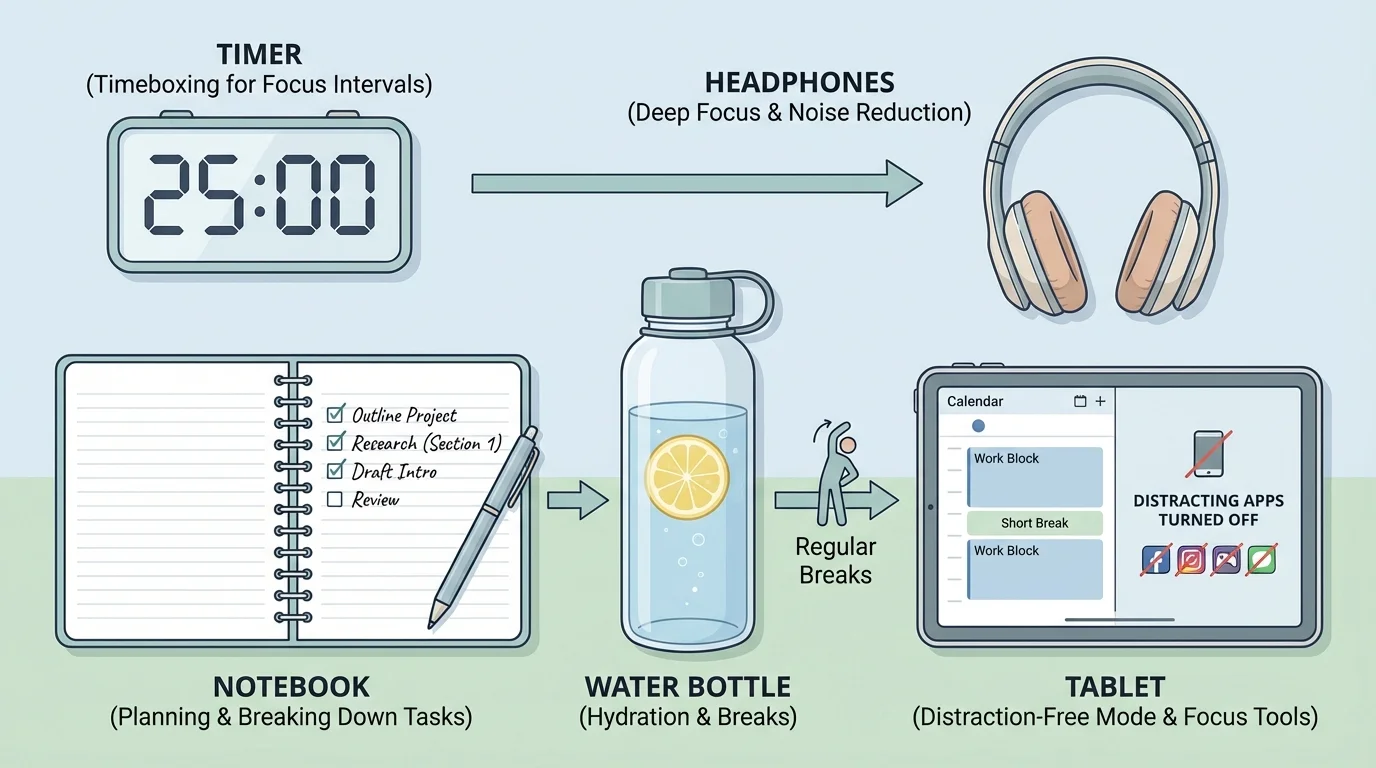
Some students like a timer. A timer can say, "For the next 15 minutes, I only need to focus on this one thing." That feels more manageable than thinking about the whole assignment.
Your brain often resists starting more than it resists doing. Once you begin and work for a few minutes, the task may feel easier than it did before you started.
Try This: Create a simple starting routine. For example: sit down, get supplies, set a timer, take one deep breath, and begin the first step on your list.
Long tasks often bring up feelings. That is where emotional regulation helps. Emotional regulation means noticing your feelings and choosing a helpful response instead of letting the feeling take over.
If you feel bored, your clue may be, "I need a smaller goal." Instead of saying, "This is boring, I quit," try, "I will finish just this one paragraph." If you feel frustrated, your clue may be, "I need help or a new strategy." If you feel tired, your clue may be, "I need a short break, water, or rest."
How you talk to yourself matters too. Self-talk can push you down or lift you up. "I'll never finish" makes the task feel heavier. "This is hard, but I can do one step" helps you continue. You do not have to pretend everything is easy. Honest and hopeful self-talk works best.
"You do not have to do everything at once. You just have to keep going one step at a time."
When your feelings get strong, pause before reacting. You can take a deep breath, stretch your hands, look away from the screen for a moment, or quietly name the feeling: "I feel frustrated." Naming a feeling can help it feel less powerful.
Try This: The next time a task feels hard, say, "What is this feeling telling me I need?" Then choose one helpful action.
[Figure 3] Progress can be hard to notice in long assignments, which is why a progress tracker can help so much. A progress tracker is a simple way to see what you have already done. It might be a chart, a row of boxes to check, a sticker chart, or a list with parts crossed off.
When you can see progress, you are reminded that your effort counts. You may not be finished yet, but you are not at the beginning anymore. That can build motivation.
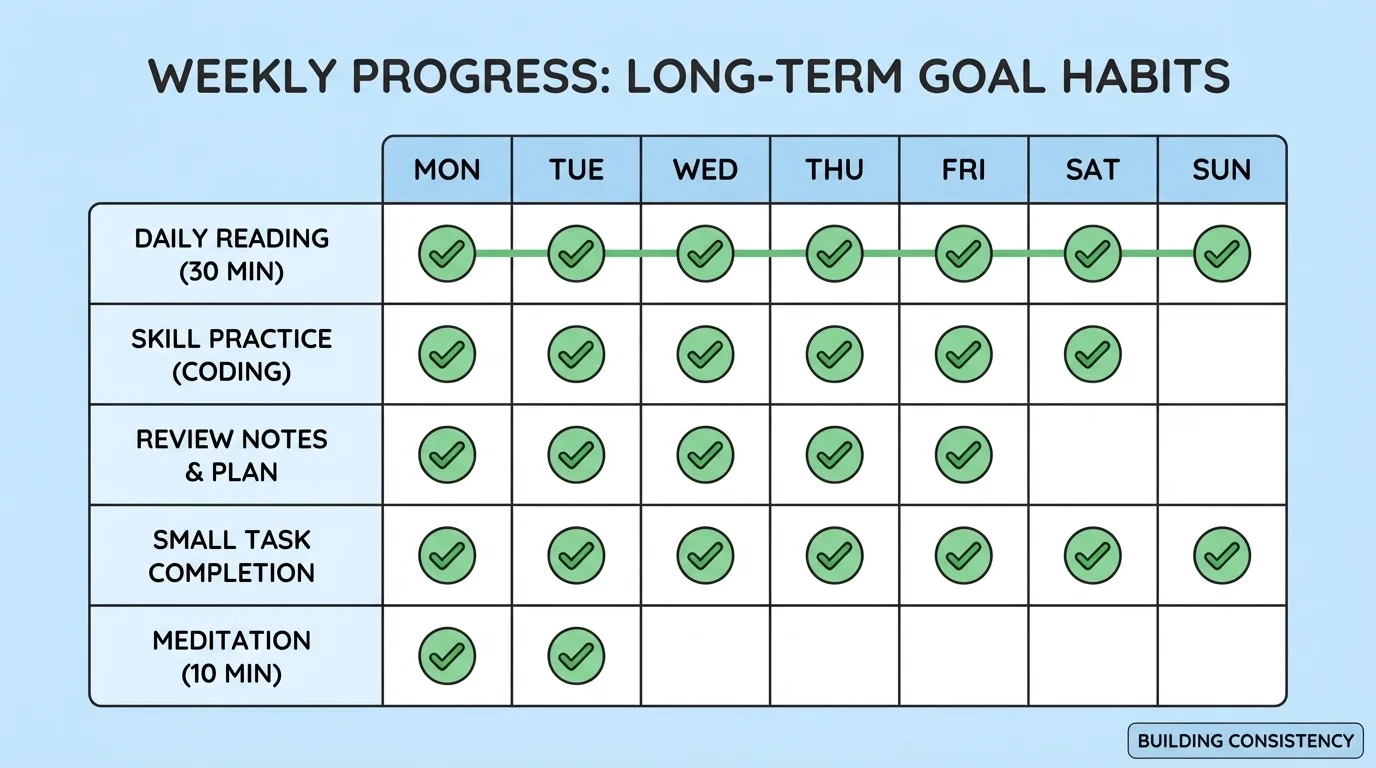
Tracking progress also helps you notice patterns. Maybe you focus better in the morning. Maybe 15-minute work times help more than 30-minute ones. Maybe you get stuck on the same part each time. These clues help you adjust your plan.
Later, when a new long task comes up, you can remember what worked before. Just as the broken-into-steps plan in [Figure 1] makes starting easier, a tracker helps you keep going after you start.
| Habit | How it helps | What it might look like |
|---|---|---|
| Break tasks into steps | Makes a big job feel smaller | Write 5 small jobs instead of 1 giant one |
| Use a routine | Makes starting easier | Work at the same time each day |
| Take short breaks | Protects your energy | Work 15 minutes, then stretch |
| Use helpful self-talk | Keeps you calm and steady | Say, "One step at a time" |
| Track progress | Builds motivation | Check off completed steps |
Table 1. Habits that support steady effort on longer tasks and goals.
Try This: Make a tracker with seven boxes for the next seven days. Each day you work on your goal, color in one box.
Sometimes students think asking for help means they are failing. Actually, asking for help is a strong habit when you do it well. It shows that you want to keep going.
Good help is specific. Instead of saying, "I can't do this," try, "Can you help me understand step two?" or "Can you watch me practice and tell me one thing I did well and one thing I can improve?" This works with a parent, guardian, coach, tutor, or teacher through online messages or during video calls.
You are still responsible for your work. Help should support your effort, not replace it. For example, someone can explain directions or help you make a plan, but you still do the reading, writing, building, or practicing.
Example: Asking for useful help online
You are working on a digital poster and feel stuck.
Step 1: Name the exact problem.
"I know my topic, but I do not know how to organize my facts."
Step 2: Ask a clear question.
Send a message: "Can you help me decide which facts should go first, middle, and last?"
Step 3: Use the help and keep working.
After you get advice, return to your checklist and finish the next step.
Specific help saves time and keeps the work in your hands.
The workspace habits from [Figure 2] also make it easier to ask for help well, because when your materials are ready and your plan is clear, you can explain your problem better.
No one follows a plan perfectly every time. You may forget, get sick, feel upset, or simply have a day when you do not want to do the task. One missed day is not the end of the goal. The important thing is what you do next.
A strong habit is to restart quickly. Do not waste lots of time telling yourself, "I ruined everything." Instead, say, "I missed yesterday, so I will do my next small step today." Resilience means returning, not pretending mistakes never happened.
If you keep slipping on the same goal, the plan may need to change. Maybe the steps are too big. Maybe the work time is too long. Maybe your workspace is too distracting. Maybe you need more support. Changing the plan is not quitting. It is problem-solving.
When something is not working, ask three questions: What is the problem? What small change can I make? Who can help if I need support?
Think of riding a bike or learning to swim. A wobble or a mistake does not mean you stop forever. It means you adjust and try again. Long assignments and goals work the same way.
Here are a few ways these habits work in everyday life.
Reading a long book: Instead of trying to finish everything at once, read one chapter each evening, track the chapters, and talk kindly to yourself when a chapter feels hard.
Practicing piano or another instrument: Practice one short song section each day. If you keep making the same mistake, slow down and ask for help. The progress chart in [Figure 3] works very well for this kind of steady practice.
Cleaning and organizing your room: Break the job into zones such as bookshelf, desk, floor, and clothes. Finish one zone at a time instead of staring at the whole room and feeling overwhelmed.
Finishing an online science or social studies project: Use a checklist, prepare your workspace, work in short chunks, and send one clear message if you need help understanding directions.
When these habits are used well, tasks get done with less stress, and you feel more confident. When these habits are not used, people often feel rushed, distracted, and frustrated.
You do not need to change everything in one day. Pick one or two habits and practice them until they start to feel normal.
Try This: Choose one long task you already have. Write three small steps for it. Pick a regular time to work. Make a simple tracker. Then notice which feeling shows up most often for you: boredom, frustration, worry, or tiredness. Plan one response for that feeling before it appears.
The goal is not to become someone who never struggles. The goal is to become someone who knows what to do when a struggle shows up. That is a powerful life skill.
