Have you ever been in a group where one person picked everything, one person did all the work, and someone else felt left out? That can happen in a family group chat, an online club, a gaming team, or a neighborhood project. Group decisions can feel tricky because different people want different things. The good news is that two powerful skills can help: empathy and fairness. When you use both, people feel heard, jobs get shared better, and the whole group works more smoothly.
These skills matter in real life, not just in schoolwork. You might help choose a game for a video call, decide how to divide chores at home, plan a community event, or work with others in an online activity. In all of these situations, you are more likely to solve problems well if you stop and think about how others feel and what is fair for everyone.
Groups are stronger when people trust each other. Trust grows when people notice feelings, listen carefully, and try to make choices that are respectful. If a group ignores empathy, someone may feel hurt, frustrated, or invisible. If a group ignores fairness, one person may get stuck doing too much while someone else does very little.
Think about two different group chats. In one chat, a few people decide everything fast, and no one asks quieter members what they think. In the other chat, someone says, "Let's hear everyone's idea first." The second group may take a little longer, but it often makes a better choice because more people feel included. That is one of the biggest benefits of empathy and fairness: they help groups work well and keep relationships strong.
Empathy means understanding or trying to understand how another person feels and what they may need.
Fairness means making choices in a way that is respectful, balanced, and considerate of everyone's situation.
Empathy and fairness are connected. Empathy helps you notice what people may be feeling. Fairness helps you decide what to do with that information. If you only use empathy, you may understand feelings but not solve the problem. If you only use fairness without empathy, you might follow rules in a way that feels cold or unkind.
Sometimes people think that fair means "everyone gets exactly the same thing." But that is not always true. If three people share a job, fairness may mean giving different tasks based on time, age, energy, or ability. For example, if one child is caring for a younger sibling, another person might take a bigger part of a group task that day. That is not favoritism if the group agrees it matches what people can realistically do.
You also need to remember that people do not always show feelings in the same way. Someone may be quiet because they are shy, tired, or unsure if their opinion matters. Another person may sound bossy because they are excited or worried about finishing on time. Empathy means you do not jump to conclusions too quickly.
Empathy plus fairness leads to better choices
When you pause to ask, "How might each person feel?" and "What would be fair for this group?" you are more likely to make a decision that works. This does not mean everyone always gets their first choice. It means the process is respectful, honest, and balanced.
A fair group decision often includes these ideas: everyone gets a chance to speak, the group considers different needs, and the final choice is explained clearly. Even if the answer is not perfect for everyone, people are more likely to accept it when they know they were heard.
Before making a group decision, take a short pause. This pause is powerful. It gives you time to think beyond your own first idea. Ask yourself a few simple questions: Who might be excited? Who might be worried? Who might feel left out? Who has not spoken yet? What does each person need right now?
This skill is called perspective-taking. Perspective means trying to see a situation from someone else's point of view. You do not have to agree with them to understand them. For example, if your friend wants to leave a group call early, you might first think they are not helping. But if you learn they have family responsibilities, your view may change.
Listening is a big part of empathy. Good listening means you are not only waiting for your turn to talk. You are paying attention. You can show this by saying, "So you're saying…" or "I heard that you're worried about…" These words help others feel understood.
Body language matters too, even online. On a video call, a person may look down, stay silent, or turn their camera off because they feel uncomfortable. In a text chat, very short answers or no response may mean someone is upset, distracted, or unsure. Empathy means noticing clues without making harsh guesses.
Groups often make smarter decisions when more voices are included. People notice different problems and different solutions, so listening to everyone can protect the group from missing something important.
It is also important to notice your own feelings. If you are angry, disappointed, or super excited, you may rush to decide before thinking clearly. Taking a breath, getting a drink of water, or counting slowly to 10 can help you calm down enough to listen better.
[Figure 1] Making a choice together is easier when you use a clear process. Instead of arguing in circles, you can follow a few simple steps that help everyone feel respected.
Step 1: Pause and name the decision. Say exactly what the group is deciding. For example: "We are choosing which game to play tonight," or "We are deciding who will handle each part of the pet-care routine." A clear question keeps the group focused.
Step 2: Hear every voice. Let each person share an idea before the group chooses. This is especially important if one person talks a lot and another person is usually quiet. You can say, "Let's go one at a time," or "We haven't heard from Maya yet."
Step 3: Name the options. List the choices in simple words. If there are many ideas, narrow them to a short list. That helps the group think more clearly.
Step 4: Check for empathy and fairness. Ask: "How does each choice affect different people?" and "Does one choice put too much burden on one person?" This is where the group thinks about feelings, needs, and balance.
Step 5: Choose a plan. The group may vote, take turns, combine ideas, or agree on the option that best meets the group's needs. Sometimes taking turns is the fairest answer. For example, one person chooses the movie this time, and another person chooses next time.
Step 6: Review later. After the choice, ask, "Did this work well?" Good groups learn from experience and make adjustments.
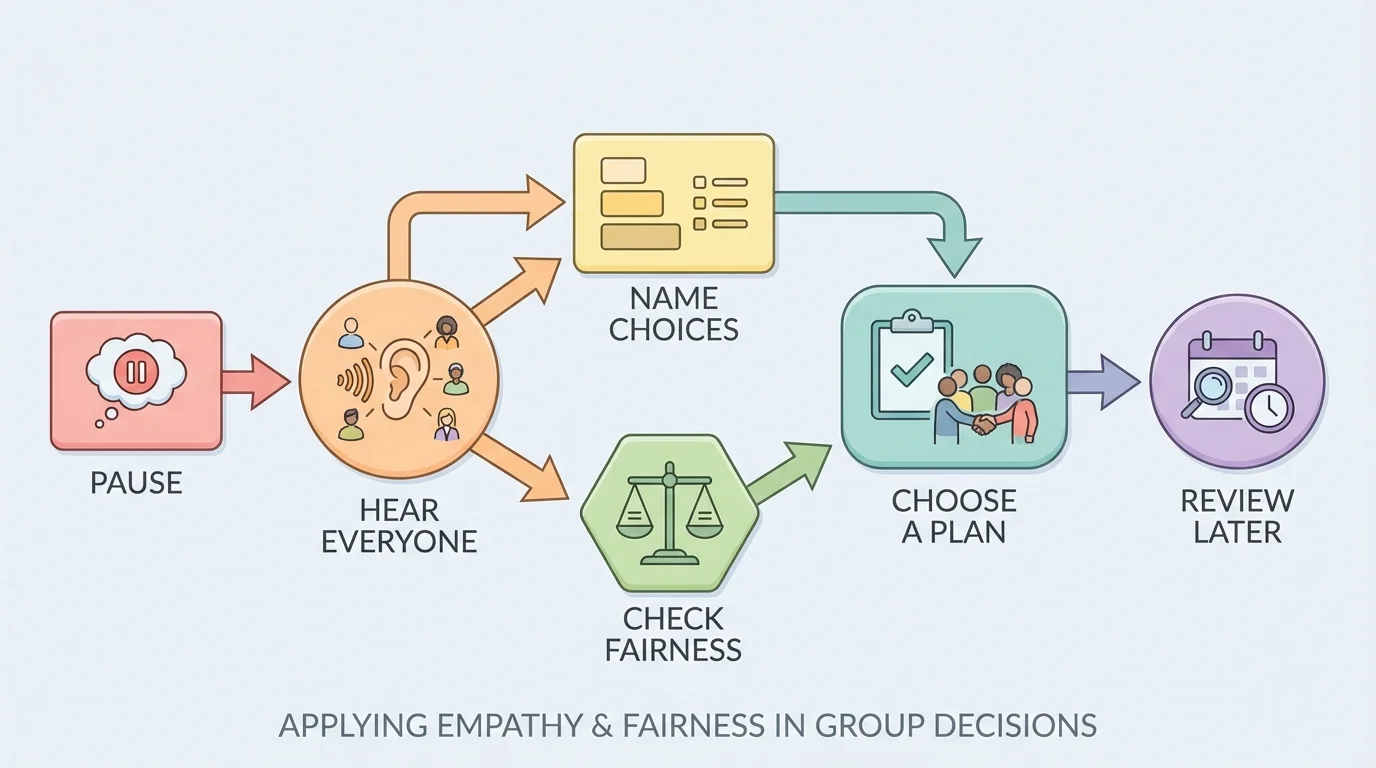
If your group often argues, this process can make a big difference. It slows down the rush to "win" and helps people focus on solving the problem together. Later, when you use this process again, you can remember the steps and move through them more calmly.
Example: Choosing an activity for a weekend call
Four cousins want to do something together online. One wants a drawing game, one wants trivia, one wants a movie, and one wants to just chat.
Step 1: They state the decision clearly: "We are choosing one activity for tonight."
Step 2: Each cousin shares why they want their choice. One says they are tired and want something easy. Another says they want something active and funny.
Step 3: They think about fairness. A long movie may not work because one cousin only has a short amount of time.
Step 4: They agree to play a short trivia game tonight and plan a movie for next weekend.
This choice is fair because it fits the time available and also includes a turn for another idea later.
A fair decision does not always make everyone equally happy in the moment. Sometimes fairness means the group picks the option that works best overall and makes a plan so other people get a turn later.
Sharing work can be harder than sharing fun. Jobs take time and effort, so people may feel upset if the work is uneven. A useful idea here is responsibility, which means a job or duty that a person is expected to handle. Fair sharing of responsibility is not always about splitting every task into exactly equal pieces, as [Figure 2] explains.
Let's say three siblings need to help after dinner. If each person gets the exact same task length, that may look equal. But what if one sibling is much younger, or one has homework due soon, or one already took care of the family dog? In that case, equal and fair may not match.
Fair sharing asks better questions: Who has time right now? Who is able to do this safely? Who did extra work earlier? What needs to happen first? When a group asks these questions, the jobs often feel more balanced.
Another important idea is cooperation. Cooperation means working together toward a shared goal. In a cooperative group, people are not trying to avoid work. They are trying to help the whole group succeed.
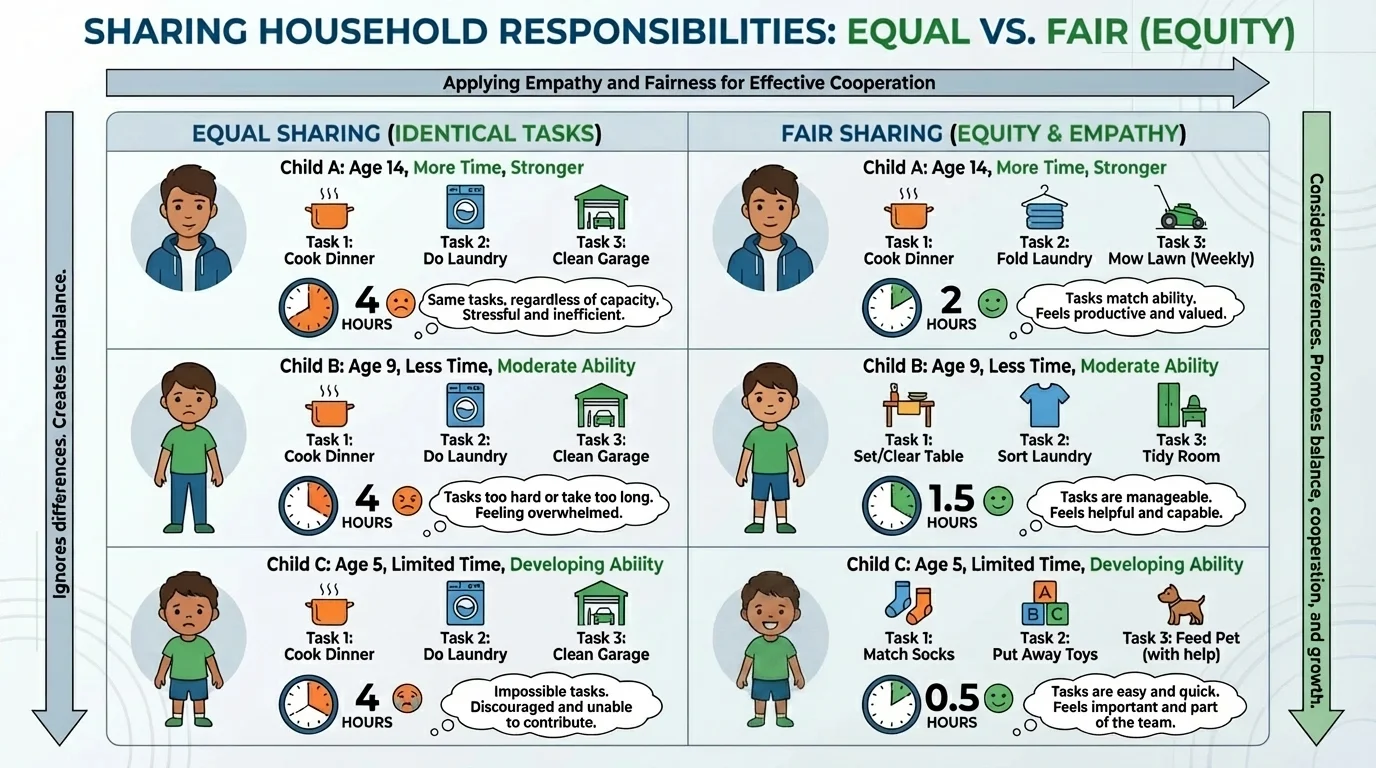
You can use a simple check to divide tasks fairly. First, list all the jobs. Next, estimate how much effort each job takes. Then match jobs to people based on time, skill, and what is happening that day. Finally, check if one person still has too much. If so, rebalance.
Here is a simple comparison:
| Way to share | What it looks like | Possible problem | Better use |
|---|---|---|---|
| Equal sharing | Everyone gets the same number of tasks | Tasks may not take the same time or effort | Works when tasks are very similar |
| Fair sharing | Tasks are matched to time, ability, and needs | Takes more discussion | Works best in most real-life situations |
Table 1. Comparison of equal sharing and fair sharing in group responsibilities.
As you saw earlier in [Figure 2], fair sharing often means different people do different jobs for good reasons. That is not unfair if the group understands the reasons and agrees the balance makes sense.
[Figure 3] Words can either calm a problem or make it explode. Respectful language helps people stay open and listen in a group conversation. You do not need fancy words. You need honest, clear, kind words.
Try sentence starters like these: "I think…," "I feel…," "I heard you say…," "Can you explain that more?," "What would feel fair to everyone?," and "Maybe we can take turns." These phrases show that you are trying to solve the problem instead of attack a person.
Avoid blame words such as "You always…" or "You never…" These often make people defensive. Instead of saying, "You never help," try, "I feel stressed when I have too much to do. Can we split this in a better way?" The second sentence is more likely to lead to a real solution.
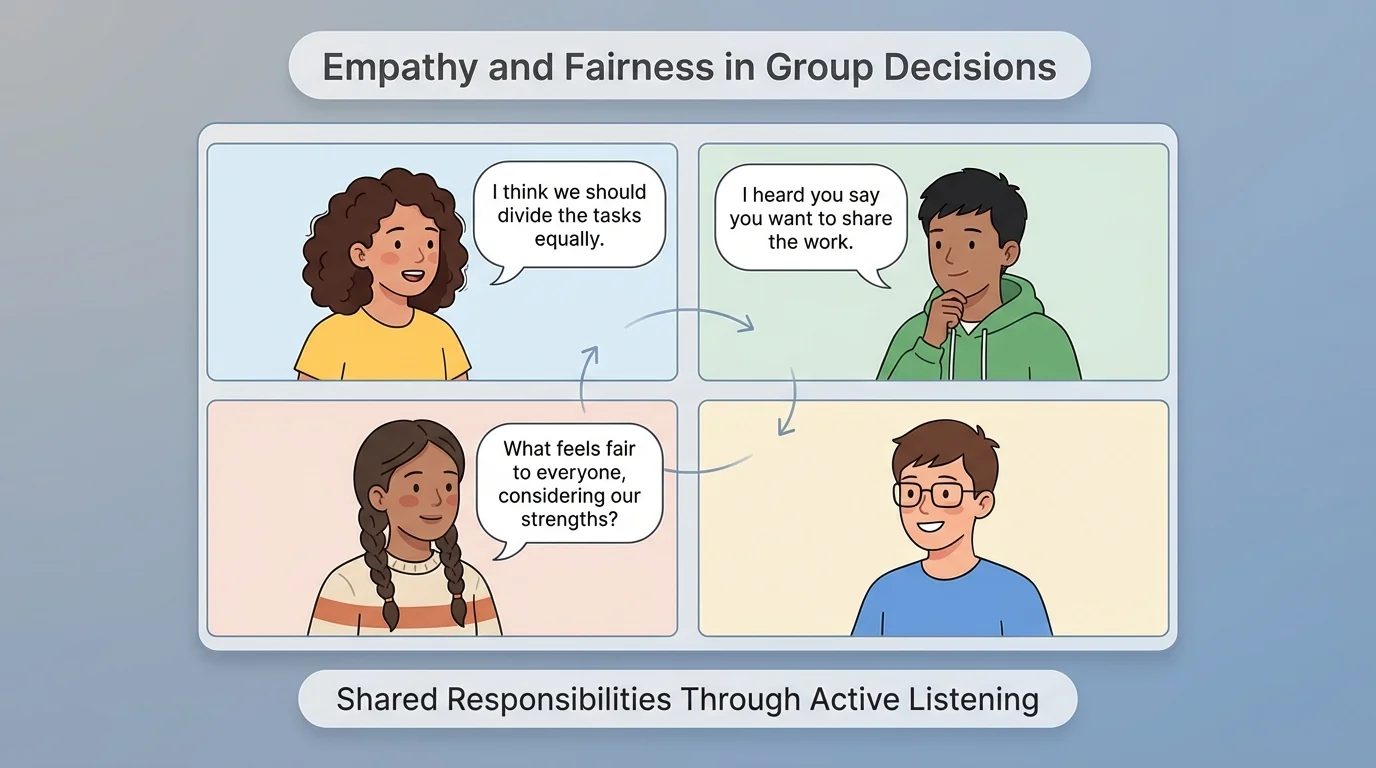
If someone disagrees with you, show respect. Respect means treating others in a thoughtful and polite way, even when you do not agree. You can disagree without being mean. For example: "I see it differently," or "I understand your idea, but I'm worried about the time."
"Fair does not mean everyone gets the same. Fair means everyone gets what they need to do well."
Sometimes the best move is to ask one more question before responding. Questions can slow down conflict and uncover important information. A person who seems rude may actually be confused, worried, or feeling unheard.
Here are some everyday places where empathy and fairness matter. In an online game, one player may want to lead every time. A fair group might rotate leaders so everyone gets a chance. In a family chore plan, one person may be busy one day and free the next, so responsibilities can shift. In a neighborhood activity, some kids may be strong at organizing while others are strong at creating posters or greeting people.
Empathy also matters when someone is struggling quietly. Maybe a friend in your club is late with their part of a task. You could jump to "They don't care," or you could ask, "Are you okay? Do you need help?" That small change can turn conflict into teamwork.
Example: Sharing a community project
A group of kids is collecting books for a local sharing shelf. One child can make digital flyers, one can sort books, one can talk to neighbors, and one can help carry boxes for only a short time.
Step 1: They list the jobs: collect, sort, advertise, and deliver.
Step 2: They match jobs to strengths and limits. The child who likes art makes flyers. The child who is comfortable speaking talks to neighbors.
Step 3: They check fairness. The heavy jobs are split so one person is not overloaded.
Step 4: They agree to help each other if someone falls behind.
This group uses empathy by noticing what each person can handle and fairness by dividing the work in a balanced way.
When groups do this well, people often feel proud, included, and more willing to help again in the future.
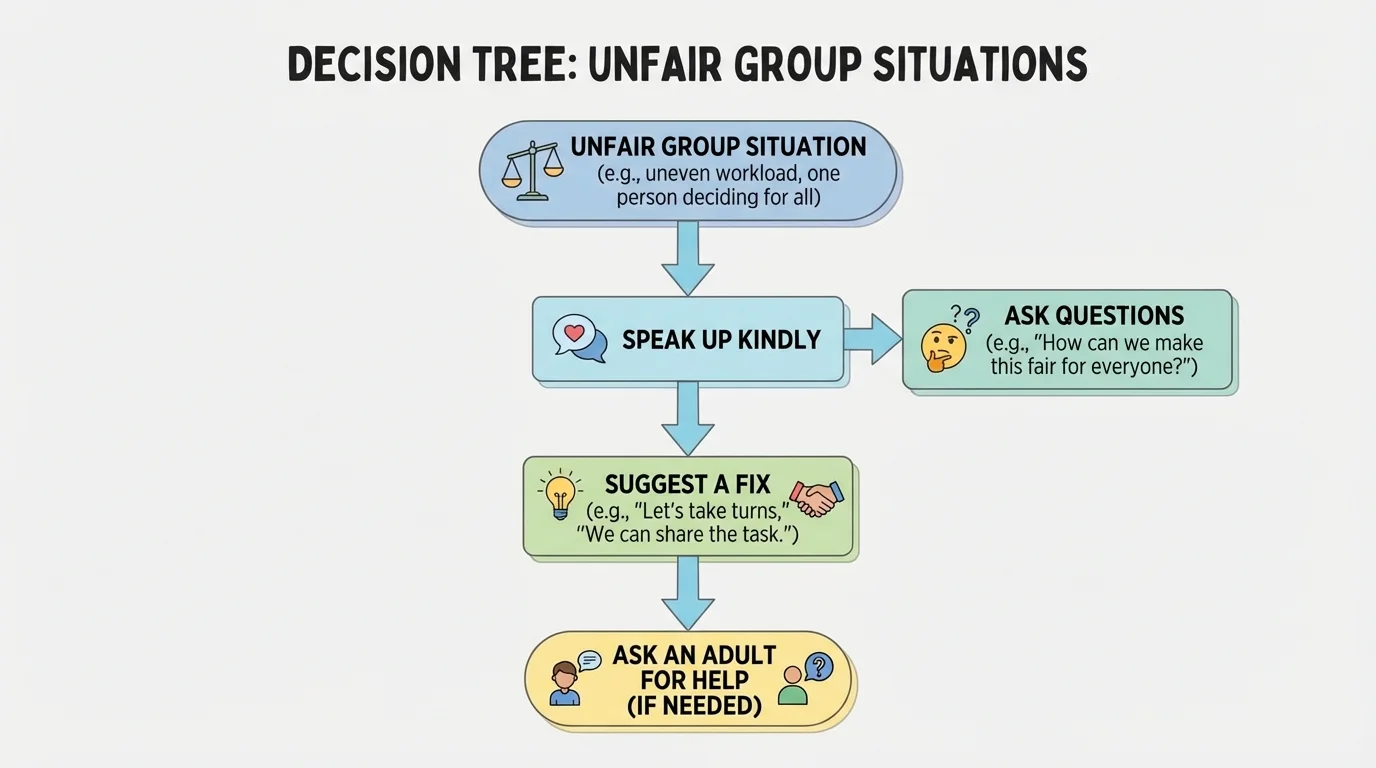
[Figure 4] Sometimes you will still end up in a situation that feels wrong. Maybe your idea was ignored, maybe someone gave you too much work, or maybe one person kept choosing for everyone. In moments like this, it helps to have a calm plan.
First, pause before reacting. If you respond while very upset, you may say something you regret. Second, ask a question: "Can we talk about how we divided this?" or "Can you help me understand this choice?" Third, explain the problem clearly and kindly. Fourth, suggest a fix, such as rotating turns, re-dividing jobs, or checking in again later.
If the problem continues, ask a trusted adult for help. Getting help is not tattling when the goal is solving a problem fairly. Adults can help when a group is stuck, when someone is being excluded, or when the situation feels too big to handle alone.
It is also okay to admit when you were the unfair one. Maybe you interrupted, ignored a quieter person, or chose the easiest job for yourself. Taking responsibility is part of fairness too. You can say, "I realize I did not listen well. Let's start again." That kind of honesty builds trust.
Good problem-solving is not about winning every time. It is about understanding the situation, making a reasonable plan, and treating people well while you work through it.
A calm response gives you more choices than an angry reaction. You can speak up, ask questions, propose a better plan, and reach out for support if needed.
Empathy and fairness get stronger with practice. You do not need to wait for a big conflict. You can build these skills in small ways every day. Notice who has not had a turn speaking. Ask someone what they think. Offer help before being asked. If you had first choice today, let someone else go first next time.
Try This: Before your next group decision, ask two questions: "How might others feel about this?" and "What would make this feel fair?" Those two questions can completely change the tone of a conversation.
Try This: If you are sharing responsibilities at home, make a short list of the jobs and talk about which tasks take more time or energy. Then help create a fair plan instead of assuming equal means better.
Try This: During your next disagreement, use one respectful sentence starter before sharing your opinion. For example, "I heard your idea, and here is my thought…" That small habit can help everyone stay calmer.
You will not do this perfectly every time, and that is okay. Real group work is messy sometimes. What matters is that you keep practicing how to listen, how to care about other people's needs, and how to make balanced choices. Those are life skills you can use in friendships, families, teams, and communities for many years.
