Have you ever heard someone share a great idea, but nobody understood it because they rushed, mumbled, or jumped around? That happens a lot. A strong idea is only powerful when people can follow it. When you speak clearly and confidently, others are more likely to listen, understand, and remember what you say.
Speaking to a group is not just for adults giving speeches. You might explain game rules to a club, share your opinion in an online class meeting, tell a team your plan during practice, speak in a youth group, or present a project on video. In all of these moments, your job is the same: help other people understand your message.
When your speaking is clear, people know what you mean. When your speaking is confident, people trust that you are prepared. This does not mean you have to sound perfect. It means you speak in a way that is organized, calm, and easy to follow.
Clear speaking means expressing your ideas so other people can understand them easily. Confidence in speaking means acting prepared, steady, and willing to continue even if you feel nervous. Pacing means how fast or slow you speak.
Think about the difference between these two speakers. One says, "Um, so, like, I have three things, but maybe I'll start with the second one, and... wait..." The other says, "I want to share three reasons this plan will help. First, it saves time. Second, it keeps everyone organized. Third, it is simple to use." The second speaker is easier to follow because the ideas are in order.
A good presentation has a few key parts. First, it has a clear message. Second, the speaker uses eye contact to connect with listeners. Third, the speaker uses an appropriate voice, meaning the volume, tone, and expression fit the situation. Fourth, the speaker uses steady pacing so people have time to understand each point.
You do not need fancy words to sound strong. In fact, simple words often work best. If your listeners understand you the first time, you are doing well. Speaking clearly is not about sounding impressive. It is about helping people follow your thinking.
Your listeners often decide in the first few seconds whether you seem prepared. That is why a calm start, a clear first sentence, and steady eye contact matter so much.
Another important part of speaking well is knowing your purpose. Ask yourself, "What do I want this group to know, do, or remember?" If you know your purpose, it becomes much easier to choose what to say and what to leave out.
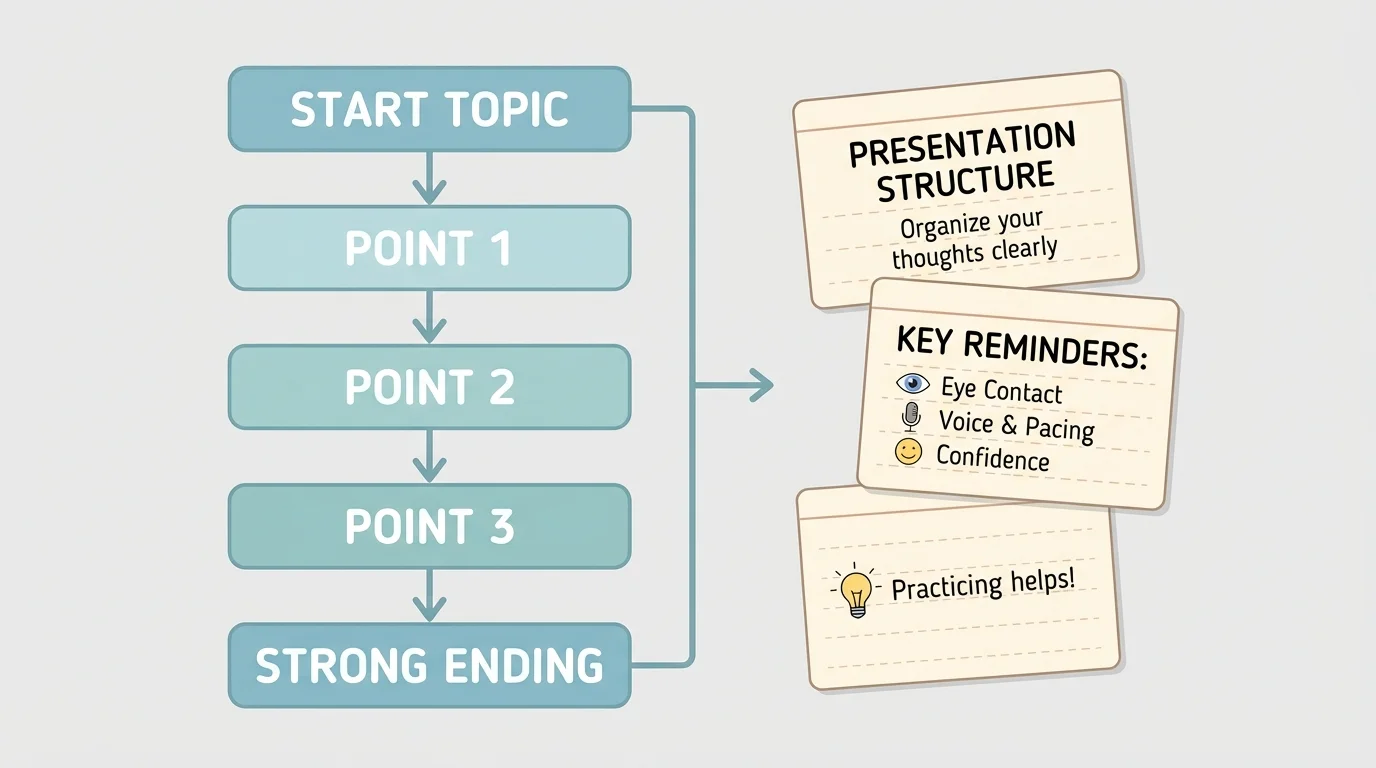
A short talk works best when it follows a clear path, as [Figure 1] shows. If your thoughts are in order, your listeners do not have to guess what comes next. One of the easiest ways to organize your ideas is to use three parts: beginning, middle, and end.
In the beginning, tell the group what your topic is. In the middle, share your main points. In the end, wrap it up with one strong final thought. This simple structure helps you stay on track, even if you feel nervous.
Here is a practical way to plan:
Step 1: Pick your main idea. Try to say it in one sentence. For example: "Recycling at our community center would make the space cleaner and reduce waste."
Step 2: Choose two or three important points. Do not try to say everything you know. A group usually remembers a few strong points better than many scattered ones.
Step 3: Put your points in order. Ask yourself, "What should come first? What should come next? What should come last?"
Step 4: Plan your opening and ending. Your opening gets attention. Your ending leaves people with the main message.
You can also use very short notes instead of writing every word. Notes might say: "Topic," "Reason 1," "Reason 2," "Example," "Ending." That helps you speak more naturally. If you read every sentence from a paper or screen, your voice may sound flat and your eyes may stay down too much.
Example: Turning a messy idea into an organized talk
A student wants to tell a community gardening group why kids should help plant vegetables.
Step 1: Start with the main message.
"Kids should help in the garden because they learn useful skills and help the community."
Step 2: Pick three points.
Point 1: Gardening teaches responsibility. Point 2: It helps kids learn where food comes from. Point 3: It gives fresh food to others.
Step 3: Add an opening and ending.
Opening: "Have you ever eaten a tomato that you grew yourself?" Ending: "When kids help in a garden, everyone grows something valuable."
The speech now has a clear order and is easier to present.
Later, when you are speaking in a real group, the same structure still helps, just like the flow in [Figure 1]. If you lose your place, you can return to your next main point instead of feeling completely stuck.
Eye contact helps listeners feel that you are speaking to them, not just saying words into the air. In online settings and small community groups, eye contact works a little differently, and [Figure 2] illustrates both situations.
If you are speaking on a video call, looking at the camera for short moments makes it seem like you are looking at your audience. You do not have to stare at the camera the whole time. You can glance at your notes or the screen, then return your eyes to the camera.
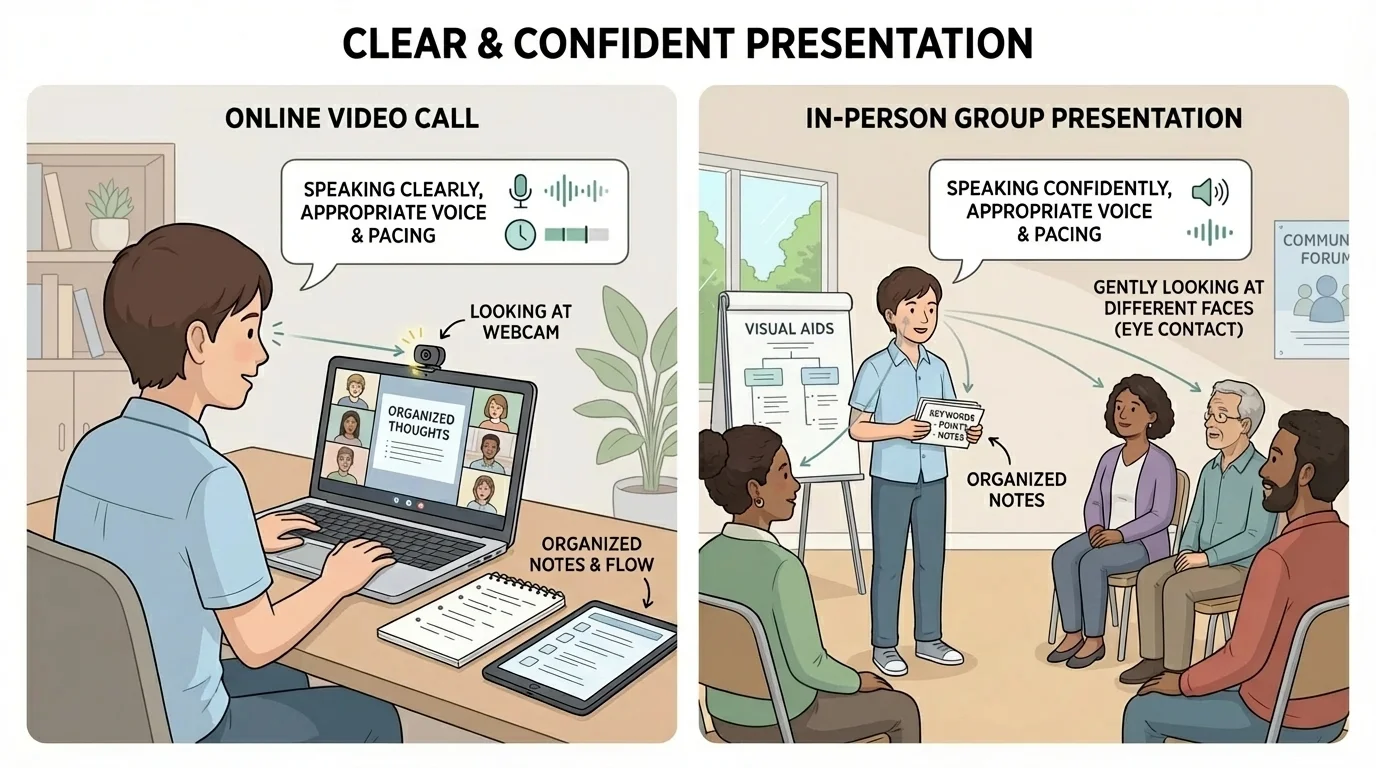
If you are speaking to a small group in person, such as a club, faith group, or team meeting, look at different people around the group for a few seconds at a time. Do not stare at one person for too long. Think of it as gently sharing your attention.
Some students look away because they feel nervous. That is common. A helpful trick is to look at people's foreheads or between their eyes if direct eye contact feels too hard at first. It still helps you look engaged.
Eye contact also helps your audience stay focused. When people feel seen, they are more likely to listen. This is one reason speakers who use eye contact often seem more confident, even if they are nervous inside.
Eye contact is about connection, not staring. Good eye contact means you regularly look toward your listeners so they feel included. It should feel natural and calm. If you stare too hard, people may feel uncomfortable. If you never look up, people may feel ignored.
When you combine eye contact with organized ideas, your message feels stronger. That is why both parts matter together, as you can see by comparing the speaking situations in [Figure 2].
Your voice carries your message. Even strong ideas can get lost if you speak too softly, too fast, or in a flat way. Pacing changes how easy your message is to understand.
Volume means how loud or soft your voice is. Speak loudly enough for everyone to hear, but not so loudly that you sound like you are shouting. If you are online, test your microphone before you start. If people keep saying "What?" your volume may be too low or your words may not be clear. As [Figure 3] shows, differences in speed can make speech hard or easy to follow.
Tone is the feeling in your voice. If your tone sounds interested and friendly, people are more likely to stay engaged. If your voice sounds bored, your listeners may stop paying attention, even if your topic is good.
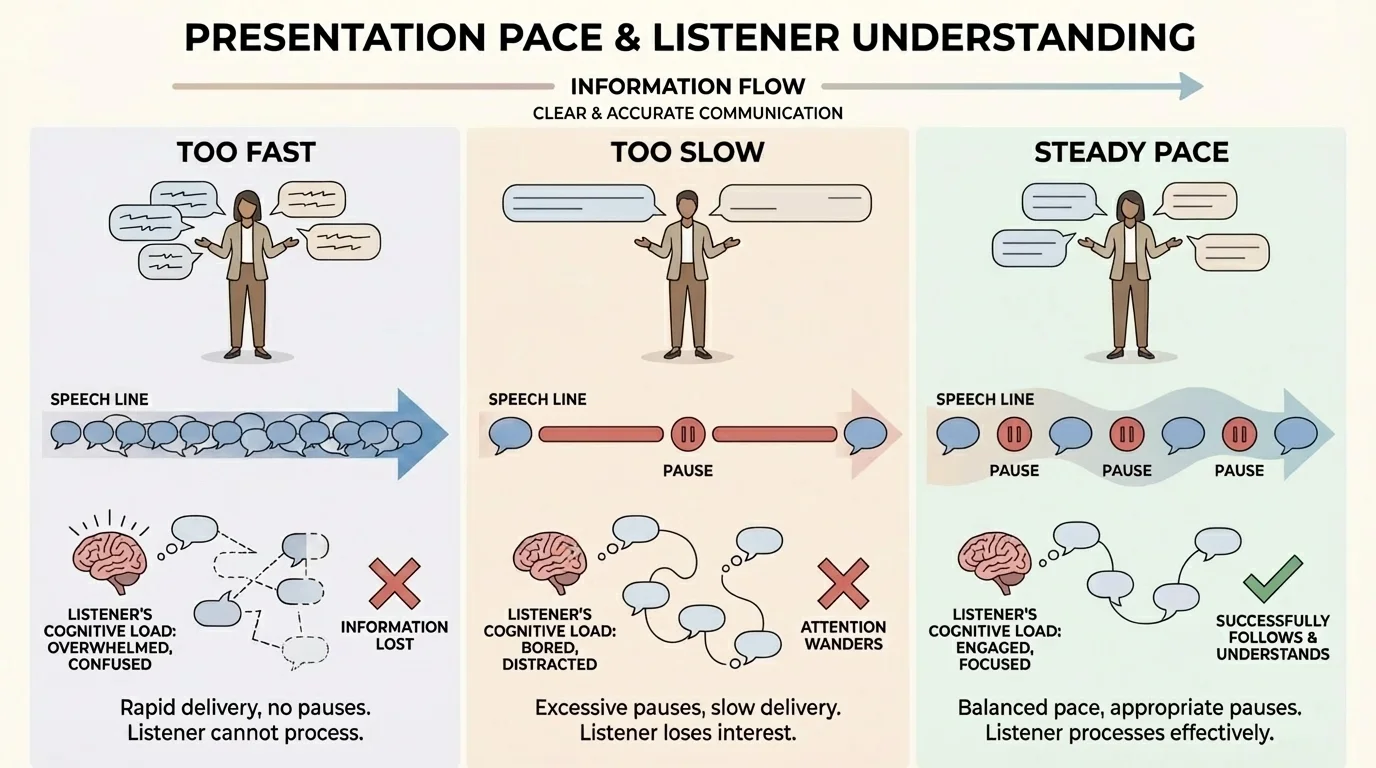
Pacing is especially important. If you rush, your ideas can run together. If you go too slowly, listeners may lose focus. A steady pace gives people time to understand each point. One easy trick is to pause after an important sentence. A short pause is powerful. It gives your words room to land.
Try this when speaking: say one complete thought, pause, then move to the next thought. That keeps your speech from becoming one long stream of words. This matters even more when you are explaining directions, sharing an opinion, or asking a group to agree with your plan.
You can also use your voice to emphasize key words. For example, instead of saying every word the same way, stress the important part: "The main reason this works is that it saves time." That helps listeners notice what matters most.
Example: Fixing rushed speaking
A student says: "IthinkweshouldstartthecleanupgrouponSaturdaybecausepeoplearefreeandwecanfinishfast."
Step 1: Break the idea into parts.
"I think we should start the cleanup group on Saturday."
Step 2: Pause, then give the reason.
"Most people are free then."
Step 3: Pause again, then end clearly.
"That means we can finish the work faster."
The same idea becomes much easier to understand when the speaker slows down and pauses between points.
Later, if you notice listeners looking confused, think back to the pacing patterns in [Figure 3]. Slowing down just a little and adding pauses often fixes the problem quickly.
Almost everyone feels nervous before speaking to a group. Confidence does not mean you never feel shaky. It means you know what to do anyway. A prepared speaker often looks confident because they have a plan, not because they feel completely calm.
One helpful tool is breathing slowly before you begin. Take a slow breath in, then let it out. Relax your shoulders. Stand or sit tall. These small actions help your body send a calmer message to your brain.
"Being brave does not mean you are never scared. It means you keep going even when you are scared."
Another good strategy is to start with a sentence you have practiced. The first sentence is often the hardest. If you know exactly how you will begin, it is easier to get moving. Once you are speaking, your nerves often shrink.
If you make a mistake, keep going. You do not need to say, "Oops," or "I ruined it." Most small mistakes are noticed much less by the audience than by the speaker. You can simply correct yourself and continue. For example: "Our event is on Friday—sorry, I mean Saturday." Then move on calmly.
Confidence also grows with practice. Each time you speak clearly in a group, your brain learns, "I can do this." You are building a skill, not waiting for magic.
These speaking skills matter in many parts of life. If you are sharing an idea in an online class video discussion, organized points help your teacher and classmates follow your thinking. If you are in a robotics club, sports team, music group, or volunteer project, clear speaking helps people know the plan. If you are talking in a community meeting, your voice and eye contact help others take your idea seriously.
Here are a few examples:
| Situation | What helps most | What can go wrong |
|---|---|---|
| Video call presentation | Look at the camera often, speak clearly, keep notes short | Reading every word and never looking up |
| Club or team meeting | Use a beginning, middle, and end | Jumping from idea to idea |
| Community event announcement | Use strong volume and slower pacing | Mumbling or rushing |
| Sharing an opinion | Give one clear reason and an example | Talking too long without a point |
Table 1. Common group-speaking situations and the habits that help most.
Good speaking is also respectful. When you speak in a way people can follow, you show that you care about their time and attention. You are making it easier for everyone to work together.
Many people think confidence starts inside and then shows on the outside. Often the reverse happens too: when you stand tall, speak a little slower, and look up, you begin to feel more confident.
That means you do not have to wait until you feel fearless. You can use confident actions first, and your feelings may catch up. [Figure 4] outlines a simple routine that helps you do this.
A repeatable routine makes speaking feel more manageable and lays out a simple plan you can use before, during, and after a short talk. When you know the steps, your brain has something steady to follow.
Before speaking: know your main message, choose two or three points, practice your opening, and check your notes. If you are online, test your microphone and camera.
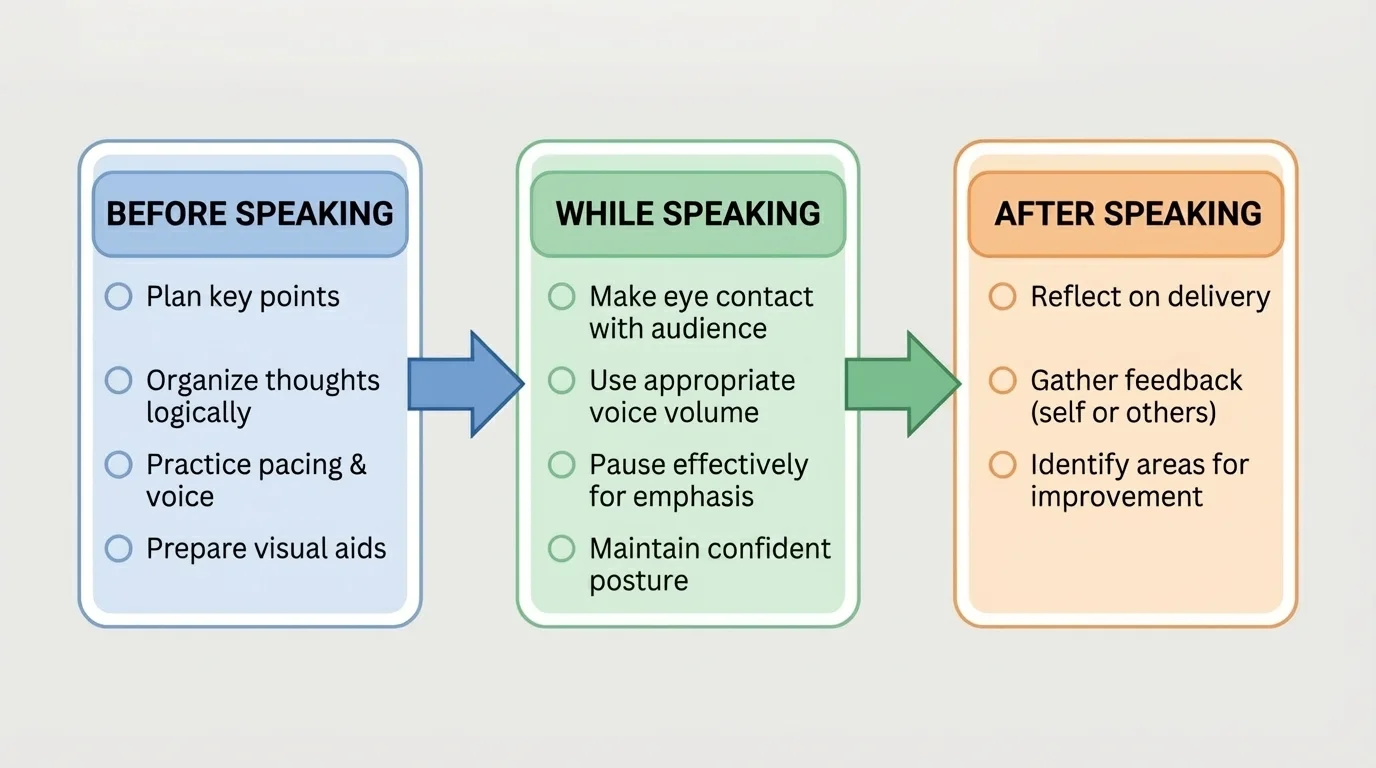
While speaking: start clearly, look up often, speak at a steady pace, and pause after important ideas. If you forget something, move to your next point instead of panicking.
After speaking: think about one thing you did well and one thing to improve next time. This keeps practice useful without being harsh on yourself.
This routine works for a short announcement, a group idea, a video response, or a community presentation. You do not need a different method every time. A simple structure repeated often becomes a habit.
Try This: A quick speaking routine
Step 1: Write your topic in one sentence.
Example: "I want our team to practice passing for ten extra minutes."
Step 2: Add two reasons.
"It will improve teamwork." "It will help us keep the ball longer."
Step 3: Practice saying it while looking up between points.
Use short notes, not full paragraphs.
Step 4: Slow down and pause after each reason.
This makes your idea easier to understand.
As you keep using the routine in [Figure 4], speaking starts to feel less like a big mystery and more like a skill you can control.
Sometimes a speaking problem has a simple fix. If you mumble, open your mouth a bit more and slow down. If you speak too quietly, sit or stand tall and aim your voice forward. If you read every word, shorten your notes. If you talk too fast, pause at the end of each main point. If you forget what comes next, return to your structure: beginning, middle, end.
Another common problem is saying too much before getting to the point. A group should not have to wait a long time to know what you mean. Try saying your main idea early. Then support it with reasons or examples.
You may also notice filler words like "um," "uh," and "like." Using a few sometimes is normal, but too many can make your speech sound unprepared. The best way to reduce filler words is not to rush. A quiet pause sounds stronger than filling the space with extra sounds.
You already use many of these skills in everyday life when you explain a game, tell a story, or ask for help. Group speaking builds on those same communication habits: clear ideas, calm delivery, and attention to the listener.
Speaking clearly and confidently is not about being the loudest person in the group. It is about helping others understand your thoughts. When your ideas are organized, your eye contact is steady, and your voice has the right pacing, your message becomes much stronger.
