Every day, people and screens ask you to believe something: a video says a trick works, an ad says a snack is the "best," a game pop-up says you "must buy now," or a friend online says a rumor is true. Some of these messages are helpful. Some are mistaken. Some are made to push you into a fast choice. Critical thinking helps you slow down and decide wisely instead of reacting.
That matters because your choices have real results. If you believe every message right away, you might waste money, share false information, click something unsafe, or choose something that is not healthy or helpful. When you think carefully, you protect your time, your feelings, your safety, and your trust.
You already make many decisions each day. You choose what to watch, what to eat, whether to believe a message, whether to join an online challenge, whether to spend your allowance, and whether to repeat something you heard. Some choices seem small, but small choices add up.
Suppose a video says, "This simple trick will help you finish your homework faster." That sounds exciting. But if the video is really trying to get clicks, it may not be honest. Or maybe a website says, "Only 2 left. Buy now." That message is trying to create pressure. Critical thinking helps you notice what is happening before you act.
Critical thinking means thinking carefully to understand a message, ask questions, look for evidence, and make a smart choice. A claim is something a person says is true. Evidence is information that helps show whether a claim is true.
Being a critical thinker does not mean being rude, negative, or suspicious of everything. It means being careful. You can listen with an open mind and still ask, "How do I know?" That question is powerful.
When you use critical thinking, you do four important things. First, you notice the message. Second, you question it. Third, you check it. Fourth, you decide what to do. This works for messages from ads, videos, websites, adults, kids, apps, and even your own first thoughts.
A smart thinker knows feelings matter too. Sometimes a message tries to make you feel excited, scared, left out, or rushed. Strong feelings can push fast decisions. Critical thinking helps you pause and think even when a message feels urgent.
"Think first. Not fast."
— A strong rule for everyday decisions
You do not need to be perfect. You just need a plan you can use again and again.
A good decision tool works like a map, and [Figure 1] shows a simple path you can follow when a message grabs your attention. The four steps are Stop, Ask, Check, Choose. You can use them before you click a link, share a post, believe a rumor, buy something, or copy a trend.
Step 1: Stop. Pause for a moment. Do not react right away. Fast choices are often weaker choices.
Step 2: Ask. Ask simple questions: Who made this message? What do they want me to believe or to do? How does this message make me feel? Is it trying to rush me?
Step 3: Check. Look for proof. Can you find the same information somewhere else? Is there a trusted adult, a trusted website, or clear reasons to support it?
Step 4: Choose. Decide what to do next. You may believe it, ignore it, ask an adult, wait, or look for more information.
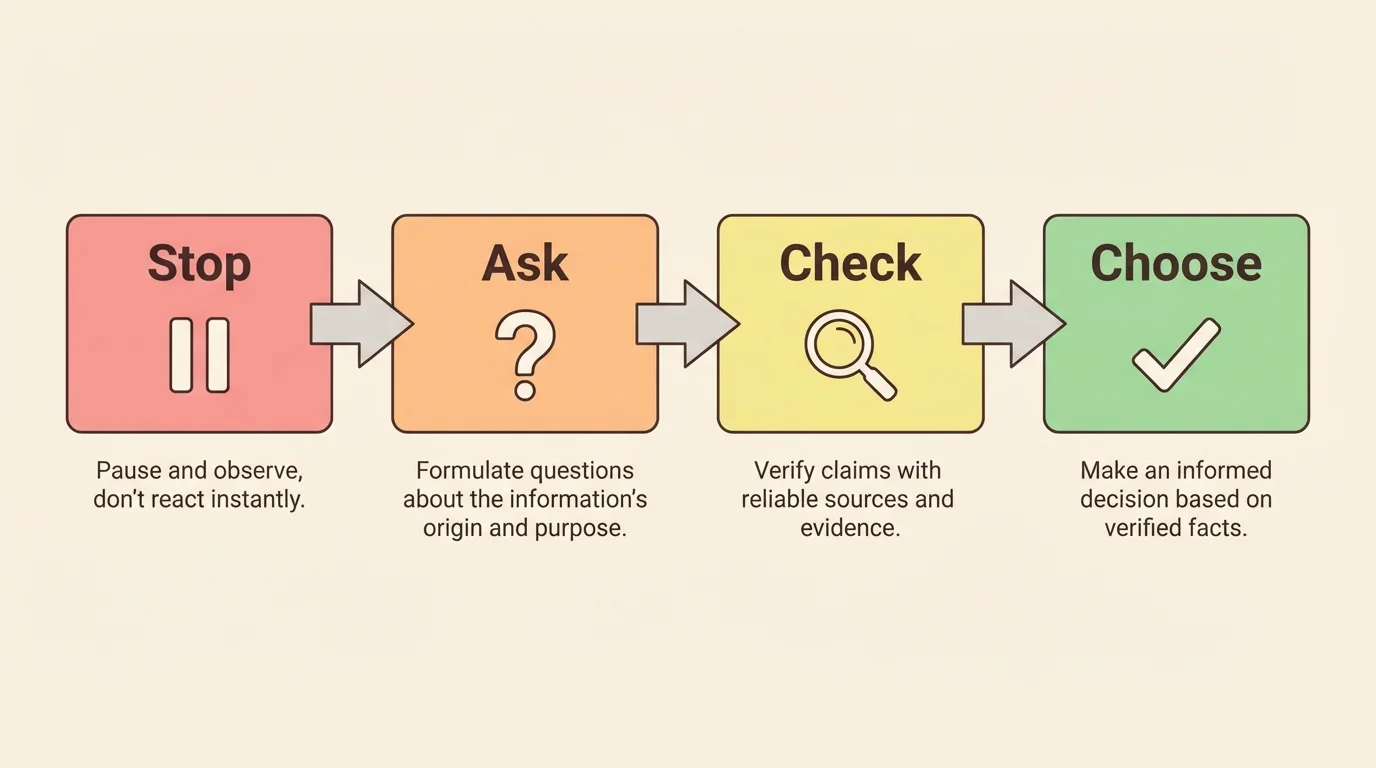
This tool is useful because it turns a big skill into a simple habit. If you practice these four steps often, they become easier. Later, when you face a tricky decision, your brain already knows what to do.
Real-life example: A pop-up in a game
A game pop-up says, "Get the ultra pack now for $4.99. Offer ends in 5 minutes."
Step 1: Stop
Take a breath. A timer is trying to rush you.
Step 2: Ask
Do I really want this? Is this worth my money? Is the game using pressure words?
Step 3: Check
Look at what the pack actually gives. Read reviews if possible. Ask the adult in charge of purchases.
Step 4: Choose
You might decide to wait a day. If it still seems important later, you can think again.
Notice something important: waiting is also a choice. You do not always have to decide immediately.
Messages are built in certain ways to grab your attention, and [Figure 2] illustrates how colors, words, pictures, and missing details can shape what you think before you even notice it. A message might be an ad, a video, a comment, a headline, a text, or even a product label.
Some messages are mostly trying to inform you. Others are trying to persuade you. A persuasive message wants you to think, feel, buy, click, join, or share. That does not always make it bad, but it does mean you should look carefully.
Watch for exciting words like "best ever," "guaranteed," "everyone loves this," or "you need this now." Those phrases sound strong, but they may not include proof. Strong words are not the same as true words.
Pictures matter too. A product may look bigger, cooler, or more useful in a video than it really is. Music, happy faces, glowing colors, and exciting sounds can make something seem better than it is.
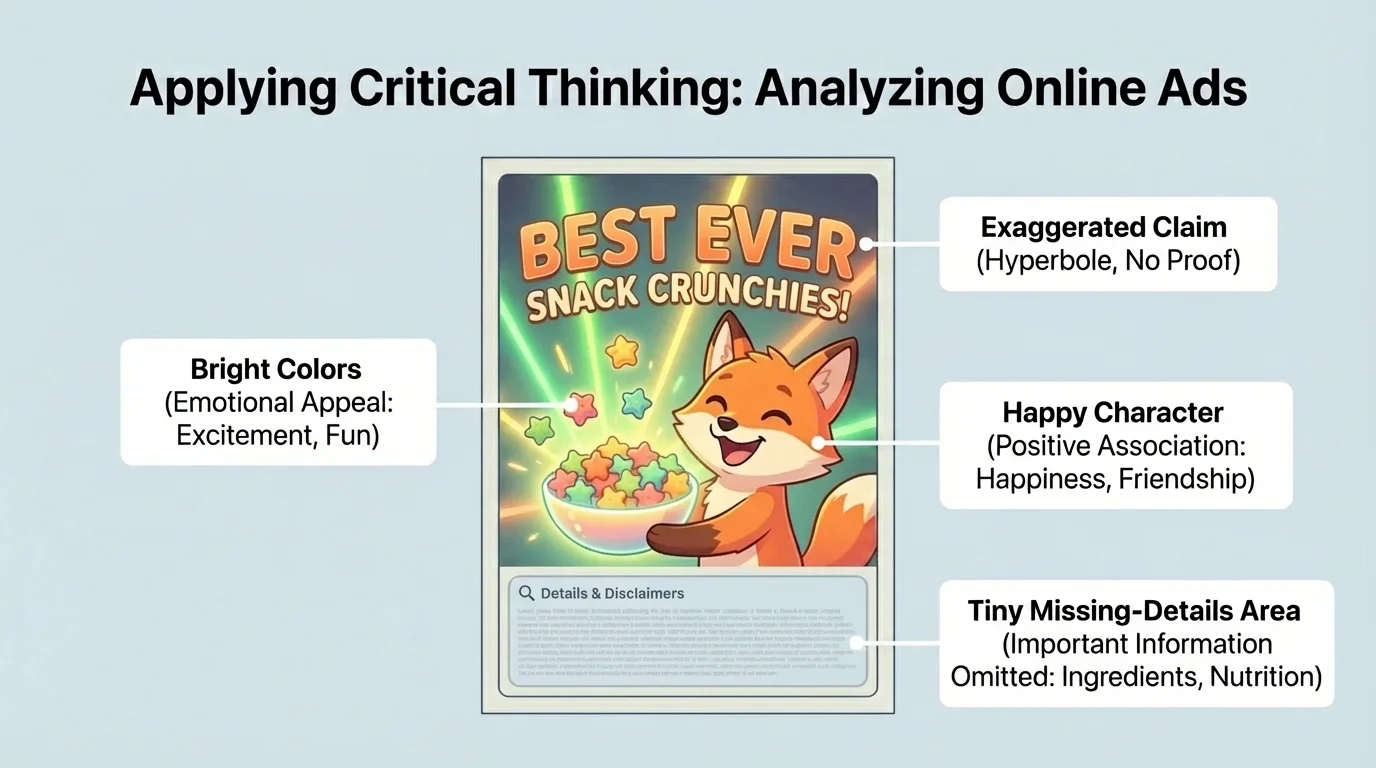
Another clue is what the message leaves out. Maybe an ad tells you the fun part but hides the cost. Maybe a rumor gives the dramatic part but not the source. Maybe a post says a challenge is safe but ignores the risks. Good thinkers ask not only, "What is here?" but also, "What is missing?"
As you saw earlier in [Figure 1], the "Check" step matters here. When a message is loud, flashy, or urgent, that is often the exact time to slow down the most.
Your brain notices bright colors, surprising words, and strong feelings very quickly. Advertisers and content creators know this, which is why pausing before you choose is such a smart habit.
You should also think about the source. A source is where the information comes from. Is it a trusted group, a grown-up you know, a safe website, or just an unknown account trying to get attention?
Some claims are stronger than others. A strong claim has clear evidence. A weak claim may use pressure, big promises, or missing facts. Here are clues to watch for.
Clue 1: It asks you to act fast. "Buy now." "Share now." "Click now." Rushing gives you less time to think.
Clue 2: It uses extreme words. Words like "always," "never," "perfect," or "everyone" are often too broad.
Clue 3: It gives no proof. If someone says, "This works every time," ask, "How do you know?"
Clue 4: It copies what others said. If a rumor keeps repeating but nobody knows where it started, be careful.
Clue 5: It only shows one side. Good information often includes limits, details, or possible problems.
| Message clue | What it may mean | Smart response |
|---|---|---|
| "Hurry, last chance!" | Pressure to decide fast | Pause and wait |
| "Everyone says this is true" | No clear source | Ask who "everyone" is |
| "Best product ever" | Opinion or exaggeration | Look for evidence |
| No details given | Important facts may be missing | Search for more information |
| Only one video says it | The claim may not be reliable | Check another trusted source |
Table 1. Warning signs that a message may need closer checking.
Sometimes people share weak claims because they are confused, not because they are trying to trick anyone. That is why checking matters. Critical thinking is not about attacking people. It is about checking ideas.
You can use this skill in many parts of life, not just when reading news or watching ads.
Online safety: If a message says, "Send your password to win," stop immediately. Real prizes should not ask for private information in unsafe ways. Ask an adult before responding.
Money choices: If you want to spend $10 on a toy accessory, think about how long the fun will last. Compare choices. Would you enjoy a craft kit, book, or game time more? A smart choice matches what matters to you, not just what looks exciting for one minute.
Food choices: If a package says "super energy snack," that sounds impressive, but what does it really mean? Is it actually a balanced choice, or just clever wording?
Time choices: If a video says "one more clip," critical thinking can help you decide whether that fits your plan for the day.
Friendship choices: If someone in a group chat says, "If you are a real friend, send this rumor," critical thinking helps you notice pressure. Real friendship should not depend on spreading something unkind or unverified.
Smart choices match your values
Critical thinking is not only about finding mistakes. It also helps you choose what fits your goals, safety, kindness, and responsibility. A choice can be popular and still be wrong for you.
This is where your own goals matter. Ask yourself: Is this safe? Is this honest? Is this kind? Is this worth my time or money? Those questions help turn thinking into action.
One powerful way to think clearly is to sort statements into three groups. A fact is something that can be checked. An opinion is what someone thinks or feels. Evidence is the information that supports a claim.
For example, "This backpack is blue" can be checked, so it is a fact. "This backpack is awesome" is an opinion because different people may feel differently. "The backpack held five books without tearing" is evidence that might support a claim that it is strong.
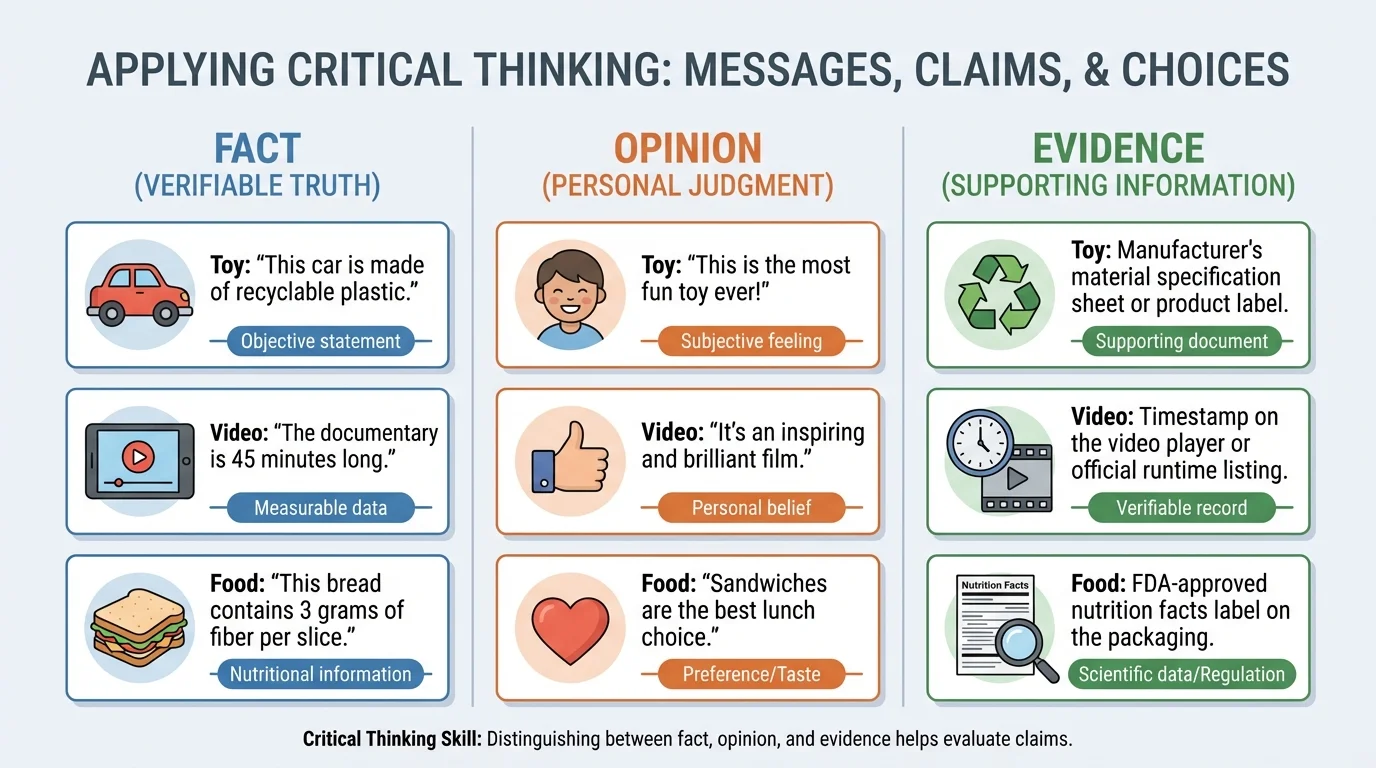
Sometimes people mix these together. A video creator may start with a fact, add a big opinion, and then hope you treat the opinion like proof. That is why sorting statements helps.
Case study: Should you believe a toy review?
A reviewer says, "This is the best toy ever. It never breaks. You need it."
Step 1: Find the opinions.
"Best toy ever" and "You need it" are opinions or persuasion.
Step 2: Find the claim.
"It never breaks" is a claim that can be checked.
Step 3: Look for evidence.
Did the reviewer test it? Are there other reviews? Is there proof, or only excited language?
Step 4: Decide.
You might wait and read more before choosing.
Later, when you compare another review, the sorting idea from [Figure 3] still helps. You are training your mind to ask, "What part is checkable, what part is a feeling, and what part is proof?"
Sometimes you will believe something that turns out to be wrong. That happens to everyone. Critical thinking includes being willing to change your mind when new, better information appears.
This is a strength, not a weakness. If you once thought a rumor was true but later learn it was false, the smart move is to stop sharing it and correct it if needed. Flexible thinkers keep learning.
Good thinking is not about winning an argument. It is about getting closer to what is true and making wiser choices.
It also helps to notice your own bias. Bias means a leaning or preference that can affect how you think. For example, if you already love a certain brand or creator, you may trust them too quickly. Knowing your own bias helps you be fairer and more careful.
Here are small ways to build this skill right away.
Try This 1: Before sharing any surprising post, ask one question: "Where did this come from?"
Try This 2: When you want to buy something, wait at least one day if you can. See if it still feels important later.
Try This 3: When you hear "everyone knows," ask for a real example or source.
Try This 4: Practice saying, "I'm not sure yet. I want to check first." That sentence protects you from rushed choices.
Try This 5: If a message makes you feel very excited or worried, pause longer. Big feelings can make checking harder.
Critical thinking is like a toolbelt for everyday life. You use it with messages, rumors, products, videos, online chats, and your own decisions. The more you practice, the easier it becomes to spot weak claims and make strong choices.
