People often notice your habits before they notice your talent. If two students are both good at drawing, coding, cleaning up a park, or helping with a group project, the one who shows up ready, listens carefully, and finishes the job well is usually the one people want to work with again. That is a big part of growing up: learning how to be someone others can count on.
Work-readiness habits are the actions and attitudes that help you do a task well with other people. You do not need a paid job yet to practice them. You can use them while helping at home, joining a club, taking part in a neighborhood event, volunteering, or working with others online. These habits matter because they build trust. When people trust you, they know you will try, communicate, and follow through.
If you use strong work habits, good things happen. Projects get done on time. Group members feel respected. Adults see that you are dependable. If you do not use these habits, the opposite can happen. Directions get missed, tasks stay unfinished, other people feel frustrated, and your team may not want to rely on you next time.
Dependable means people can count on you to do what you said you would do. Responsible means you take care of your job and your choices. Teamwork means working with others to reach a shared goal. Initiative means getting started and helping without always waiting to be told every small step.
These habits are not about being perfect. Everyone forgets something sometimes. Work-readiness is really about what you do next: Do you fix your mistake? Do you ask for help? Do you stay calm and keep trying? That is what shows maturity.
One important habit is reliability. Reliability means people can trust you to do your part. If you say, "I will make the title slide," then you do it. If you promise to bring supplies for a service project, you remember them. Reliability is built through small actions again and again.
Another habit is initiative. This means you get started in a helpful way. You might read directions before asking for help, open the shared document early, or notice that your team needs someone to organize ideas and offer to do it. Initiative does not mean taking over. It means helping the work move forward.
A third habit is communication. Good communication means speaking and writing clearly, listening carefully, and answering kindly. In online school or group work, this might mean replying to a message, joining a video call on time, or asking, "Can you explain that part again?" instead of staying confused.
You also need effort, honesty, and self-control. Effort means you try your best even when a task feels boring or hard. Honesty means you tell the truth about your work. Self-control helps you stay focused, wait your turn, and use respectful words, even if you feel annoyed.
Good habits make you easier to work with
When adults talk about someone being "ready for work," they usually mean more than skill. They mean the person shows up prepared, stays on task, solves small problems, and treats others well. You can practice all of that right now in everyday life.
You do not need a fancy project to show these habits. Helping your family organize a room, joining an online club challenge, working with a sibling on a chore, or serving in your community all give you chances to practice.
Strong work habits begin before the work starts. A simple starting routine helps you avoid confusion later. As shown in [Figure 1], first, understand the task. What are you supposed to do? When is it due? Are you working alone or with others? What does "done" look like?
Next, gather what you need. That may be paper, a tablet, gloves for cleanup, art supplies, a list of phone numbers, or login information for an online meeting. Starting without what you need often leads to delays and frustration.
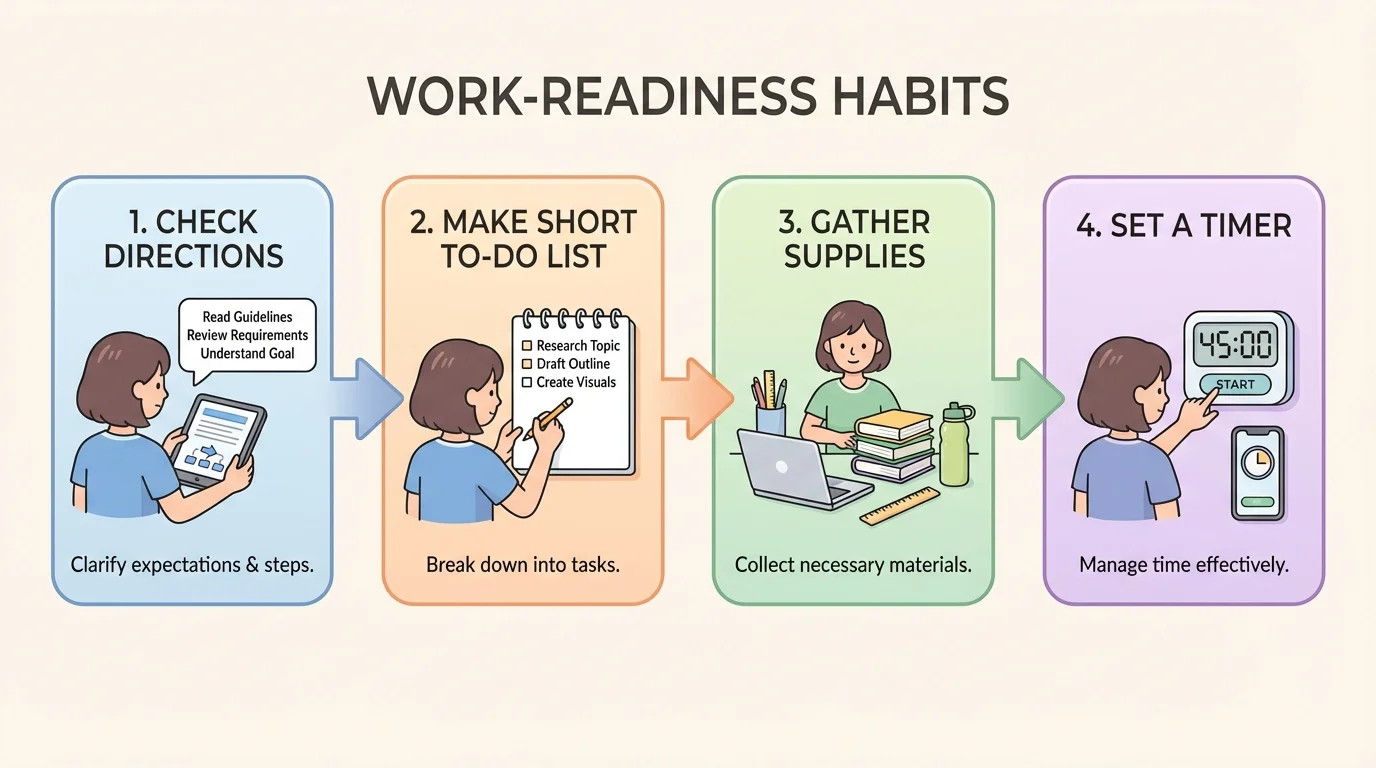
Then make a simple plan. You do not need a giant schedule. A short list is enough: step one, read directions; step two, do your part; step three, check it; step four, turn it in or share it. If a task is bigger, break it into smaller pieces. That makes it feel manageable.
It also helps to think about time. If something will take about 20 minutes, do not begin when you only have 5 minutes left before another activity. Good planning means matching the task to the time you actually have.
Ask questions early, not at the last minute. If instructions are confusing, it is responsible to ask. For example, you might message an adult or group leader: "I want to make sure I understand. Should I write two paragraphs or make a short video?" That shows care, not weakness.
Starting a neighborhood service task
You agreed to help sort canned food for a local pantry on Saturday morning.
Step 1: Read the details.
You check the message to see the time, place, and what to wear.
Step 2: Get ready the night before.
You set out comfortable clothes and a water bottle.
Step 3: Arrive prepared.
You arrive with what you need and are ready to help.
Step 4: Listen to directions first.
You wait to hear how the food should be sorted before starting.
Because you prepared early, you can focus on helping instead of scrambling.
A prepared person looks calm because many problems have already been anticipated and prevented. That is one reason planning is so powerful.
Once the task begins, stay focused on the goal. This can be hard when there are distractions at home, messages popping up, or other fun things to do. A good strategy is to work for a short amount of time with full attention, then take a quick break. You can even set a timer for something small, like 15 minutes, and tell yourself, "For these 15 minutes, I will give my best effort."
Do your share. In group work, it is unfair when one person does almost everything while another person barely helps. If you are responsible for one part, complete that part carefully. If you finish early, ask if the team needs help instead of disappearing.
Try to solve small problems first. If a file will not open, you might refresh, check the link, or ask a polite question. If supplies are mixed up, sort them. If directions are unclear, reread them. Problem-solving is an important part of a strong work ethic because it shows you do not quit right away.
Keep a positive attitude. Positive does not mean pretending everything is easy. It means staying helpful. You can say, "This part is tricky, but let's try one step at a time." That kind of attitude helps the whole team keep going.
Many adults say they would rather work with someone who is dependable and respectful than with someone who is talented but hard to work with. Skills can grow, but poor habits can slow down the whole team.
Be honest about your progress. If you are behind, say so early. If you made a mistake, admit it and fix it. Hiding a problem usually makes it bigger.
[Figure 2] shows how clear and respectful teamwork depends on good communication. This is especially important when you work online, because people cannot always read your face or hear your tone perfectly through a screen. Short, kind, clear messages work best.
When someone else is talking, listen all the way through. Do not interrupt. On a video call, you can mute when not speaking, watch for your turn, and take notes. In a chat, read the whole message before answering. Good listening is part of being respectful.
If you disagree, stay calm and talk about the idea, not the person. Instead of saying, "That's dumb," you can say, "I think another idea might work better because we have less time." The second response protects the relationship and keeps the group focused on the task.
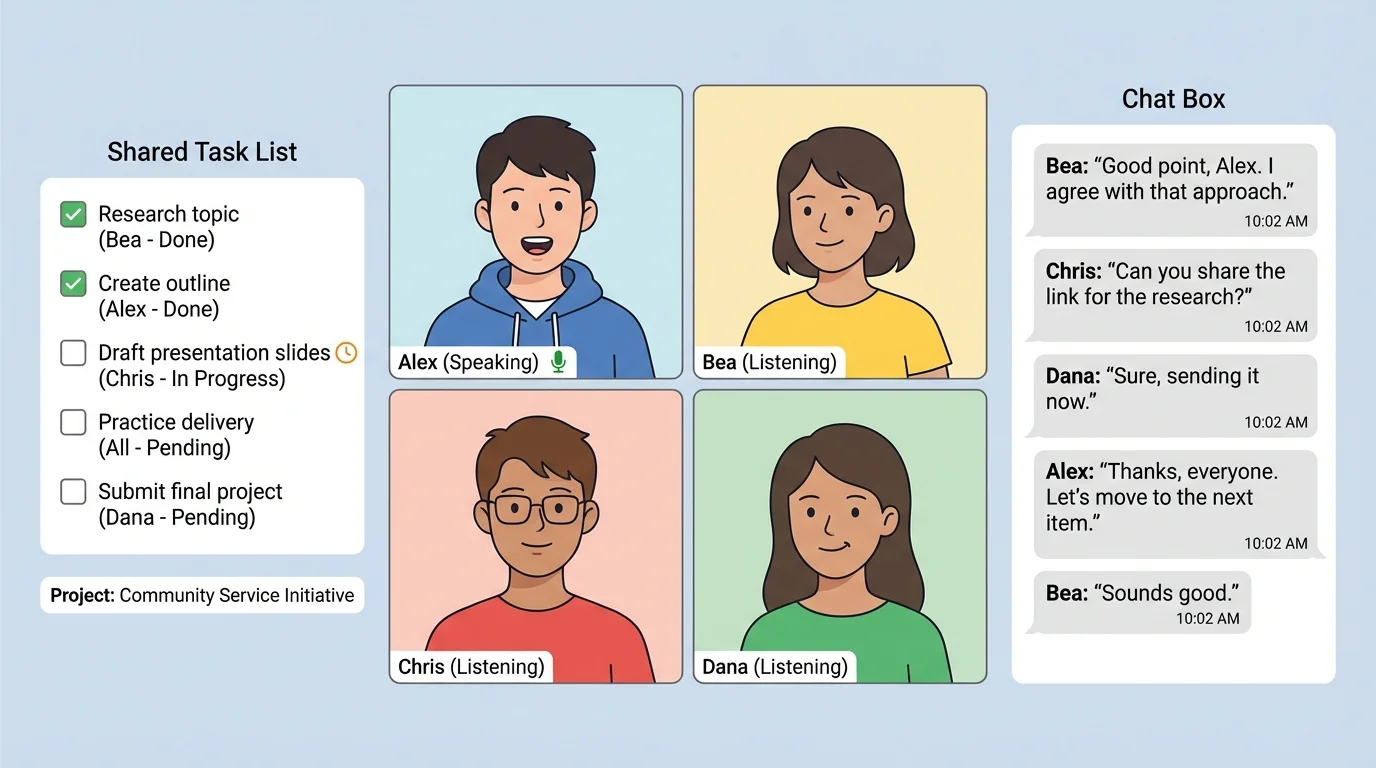
Polite words matter. Try phrases like "I can help with that," "Thank you," "Can you explain that again?" and "I finished my part." These simple sentences make group work smoother.
If someone is left out, include them. You might say, "What do you think?" or "Do you want to take this part?" Being welcoming is a strong team habit because it helps everyone feel safe to contribute.
Later, when you work with more people in clubs, service groups, or jobs, these same habits still matter. The respectful turn-taking and clear messages in [Figure 2] are the same skills older students and adults use in meetings and team projects.
Handling a group problem online
Your team is making a short presentation, but one member has not uploaded their slide.
Step 1: Stay respectful.
You do not send a rude message.
Step 2: Check in kindly.
You write, "Hi, just checking in. Are you still able to do slide 3, or would you like help?"
Step 3: Make a backup plan.
If needed, the team divides the missing part so the project can still be finished.
Step 4: Keep the goal in mind.
You focus on completing the task, not on blaming.
This shows responsibility, patience, and teamwork.
Good communication does not mean talking all the time. It means saying what matters, listening well, and choosing words that help.
As shown in [Figure 3], the end of a task matters just as much as the beginning. A strong final check helps you catch mistakes and leave a good impression. Before you say you are done, compare your work to the directions. Did you complete every part? Did you forget a name, date, file, or supply?
Review your work for quality. Read your writing again. Make sure links open. Check that materials are sorted correctly. If you helped with service work, return tools, clean your space, and leave things better than you found them.
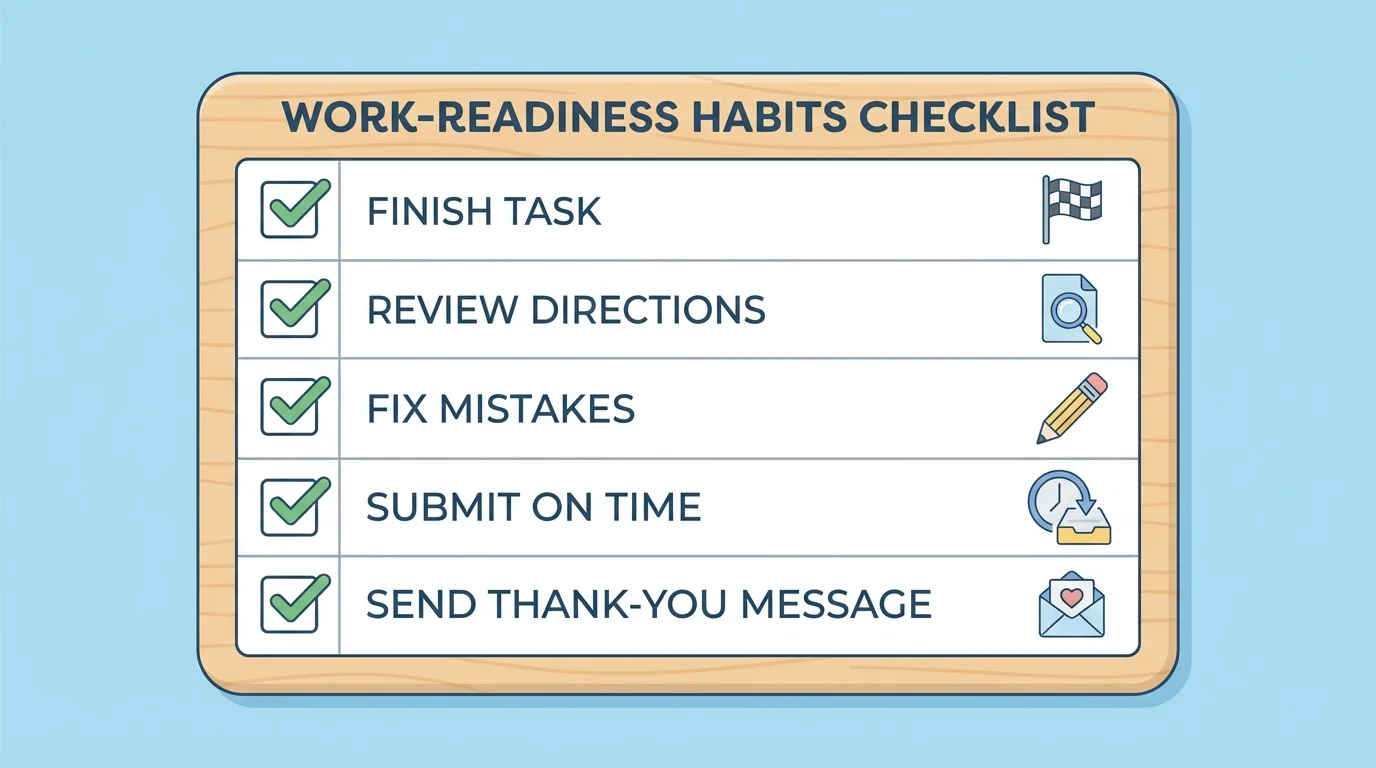
Meet deadlines when you can. Turning something in late can affect the whole team. If there is a real problem, tell someone early. Saying, "I need 10 more minutes because my internet went out, but I already finished most of it," is much better than saying nothing.
Thank people and show appreciation. You can say, "Thanks for explaining the directions," or "I liked working with you." Showing gratitude is a professional habit. It helps people feel respected and makes future teamwork easier.
As you get older, people often remember the ending: whether you followed through, whether your part was complete, and whether you handled the last details well. That is why the checklist in [Figure 3] is so useful.
"Being trusted is better than being impressive for one minute."
— A strong rule for teamwork
Finishing strong means your work is not just started well. It is completed well.
Here are some places where work-readiness habits show up in everyday life. At home, you might help plan a family meal. Showing work-readiness means checking what ingredients are needed, doing your job safely, and cleaning up afterward. In a community cleanup, it means listening to safety directions, staying with the group, and helping until the job is complete.
In an online club, it might mean joining on time, keeping your microphone muted when needed, and sharing ideas kindly. In a team art project, it might mean making your section carefully so the final piece looks complete. In pet care, it might mean remembering feeding times and telling an adult if something seems wrong.
| Situation | Work-ready habit | What it looks like |
|---|---|---|
| Online group project | Reliability | You finish your assigned slide and upload it on time. |
| Community service | Responsibility | You follow directions and use supplies correctly. |
| Helping at home | Initiative | You start your chore without being reminded many times. |
| Video meeting | Communication | You listen, take turns, and use respectful words. |
| Any task | Quality check | You review your work before saying it is finished. |
Table 1. Examples of how work-readiness habits appear in everyday situations.
Notice that these habits work in many places. That is why they are so valuable. You are not learning them for one assignment only. You are building habits that can help for years.
Work-readiness grows through repetition. You do not become dependable in one day. You become dependable by practicing small actions over and over. Put materials away in the same place. Read directions fully. Answer messages politely. Finish one task before jumping to another. These are simple moves, but they build a strong reputation.
Here are some easy ways to practice right now. Try This: before any task, ask yourself three questions: "What is my job?" "What do I need?" and "When should it be finished?" Try This: after any task, ask, "Did I complete all parts?" and "Would someone else say I was helpful?" Try This: when working with others, use one respectful phrase on purpose, such as "How can I help?"
You may already know that habits are actions you repeat often. Repeated actions become patterns, and patterns shape how other people experience working with you.
It can also help to notice your own progress. Maybe last month you often forgot supplies, but now you pack them the night before. Maybe you used to get upset when plans changed, but now you take a breath and adapt. Those changes matter.
No one gets every task exactly right. The goal is not perfection. The goal is becoming the kind of person who prepares, tries, communicates, and follows through. That is what work-readiness looks like.
