One dropped wrapper, one rude comment online, one light left on all day, one library book ruined by carelessness—small actions may seem tiny, but they can affect many people. The opposite is also true. One helpful act, one respectful message, or one careful choice can make life better for others. That is part of being a good member of your community.
Even though you learn from home, you are still part of many groups: your family, your neighborhood, online learning spaces, clubs, teams, libraries, parks, and the larger community around you. In each of these places, people share space, materials, time, and trust. When you do your part, you help those groups work better.
Civic responsibility means doing your part to help your community stay safe, fair, and caring. A community can be very small, like your home or apartment building, or much larger, like your town, city, or online group. Civic responsibility is not just for adults. Kids can practice it every day.
Think about a playground, a public library, or a neighborhood garden. These places work well only when people treat them with care. If someone breaks things, wastes supplies, or ignores rules, everyone else has a harder time. But if people clean up, follow rules, and respect others, shared places stay useful and welcoming.
Civic responsibility is doing your part to help a group or community.
Service is helping others through useful actions.
Stewardship is taking care of things that matter so they stay safe and useful.
Shared resources are things many people use, such as parks, library books, water, community spaces, and shared online tools.
These ideas matter because your choices do not stop with you. If you waste water, there is less available for others. If you damage a shared object, someone else cannot use it. If you speak kindly and help solve problems, your community becomes stronger. Civic responsibility is really about understanding that your actions connect to other people.
You do not need a big job or special title to be responsible. You show civic responsibility when you return borrowed items on time, clean up after yourself, recycle correctly, use kind words in shared online spaces, or tell a trusted adult about something unsafe. These actions may seem simple, but they build trust.
A helpful way to think about it is this: ask, "If everyone did what I am about to do, would things get better or worse?" If everyone littered, shared spaces would become dirty fast. If everyone picked up after themselves, shared spaces would stay clean. This simple question can guide many good choices.
"Leave things better than you found them."
— A strong rule for service and stewardship
This rule works in many places: your kitchen table, a park, a library, a chat group, a sports field, or a community event. It means you do not just avoid making problems. You also try to help make things better.
Service means helping others in ways that are useful, respectful, and appropriate for your age. As [Figure 1] shows, service can happen in person in your community or through safe, adult-guided online efforts. Service is not about showing off. It is about noticing what is needed and doing what you can.
You might help carry groceries for a family member, sort clothes to donate, write a thank-you card for a community helper, help clean a shared yard, join a neighborhood cleanup with an adult, or assist with organizing supplies for a local event. You can also serve in digital spaces by sharing helpful information, being patient in group projects, and reporting harmful behavior to a trusted adult instead of joining in.
Good service starts with listening. Sometimes people need help, but not the kind of help you first think of. For example, if a neighbor is older, they might need someone to bring in mail with permission, not someone to rearrange their things. Helpful service respects what other people actually need.
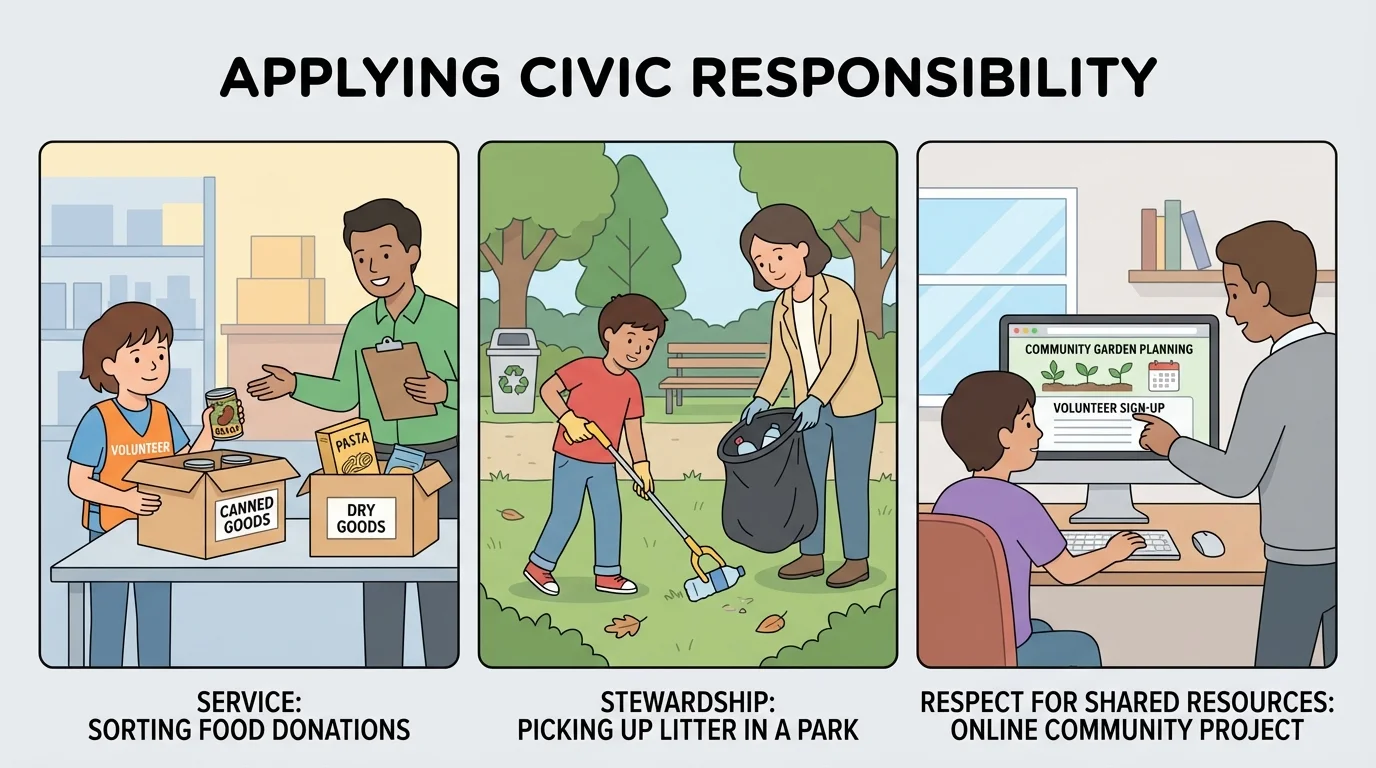
Here are a few strong ways to practice service:
Service works best when it is steady. A single big act is nice, but small helpful habits matter too. If you put away shared materials every day, refill the pet water bowl, or remind your family to bring reusable bags, you are building a pattern of care. That pattern makes you someone others can count on.
Real-life service example
A child notices that books in a little free library box near a park are messy and some are upside down.
Step 1: Ask first.
The child checks with a parent or guardian and makes sure it is okay to help.
Step 2: Do a useful job.
The child neatly arranges the books, removes visible trash nearby, and closes the door properly.
Step 3: Protect the shared resource.
The child handles the books carefully so others can enjoy them too.
Step 4: Leave it better.
The space is cleaner, more organized, and easier for others to use.
Later, when you think about your own community, remember these examples. Service does not have to be huge. It just needs to be real, respectful, and helpful.
Stewardship means caring for things so they last and stay useful for other people too. As [Figure 2] illustrates, stewardship includes everyday choices like turning things off, putting them away safely, and avoiding waste. A steward thinks, "This matters, and I will take care of it."
Shared resources can be objects, places, or even systems. A park bench is a shared resource. So is clean water. So is a public trail. So are library books, craft supplies at a club, and shared online documents in a supervised learning group. If people misuse these things, they wear out faster or become less helpful.
Stewardship often means preventing damage before it happens. You close a marker cap so it does not dry out. You shut a door gently so it does not break. You turn off a faucet tightly so water is not wasted. You plug in a device only when needed and put it away carefully after use.
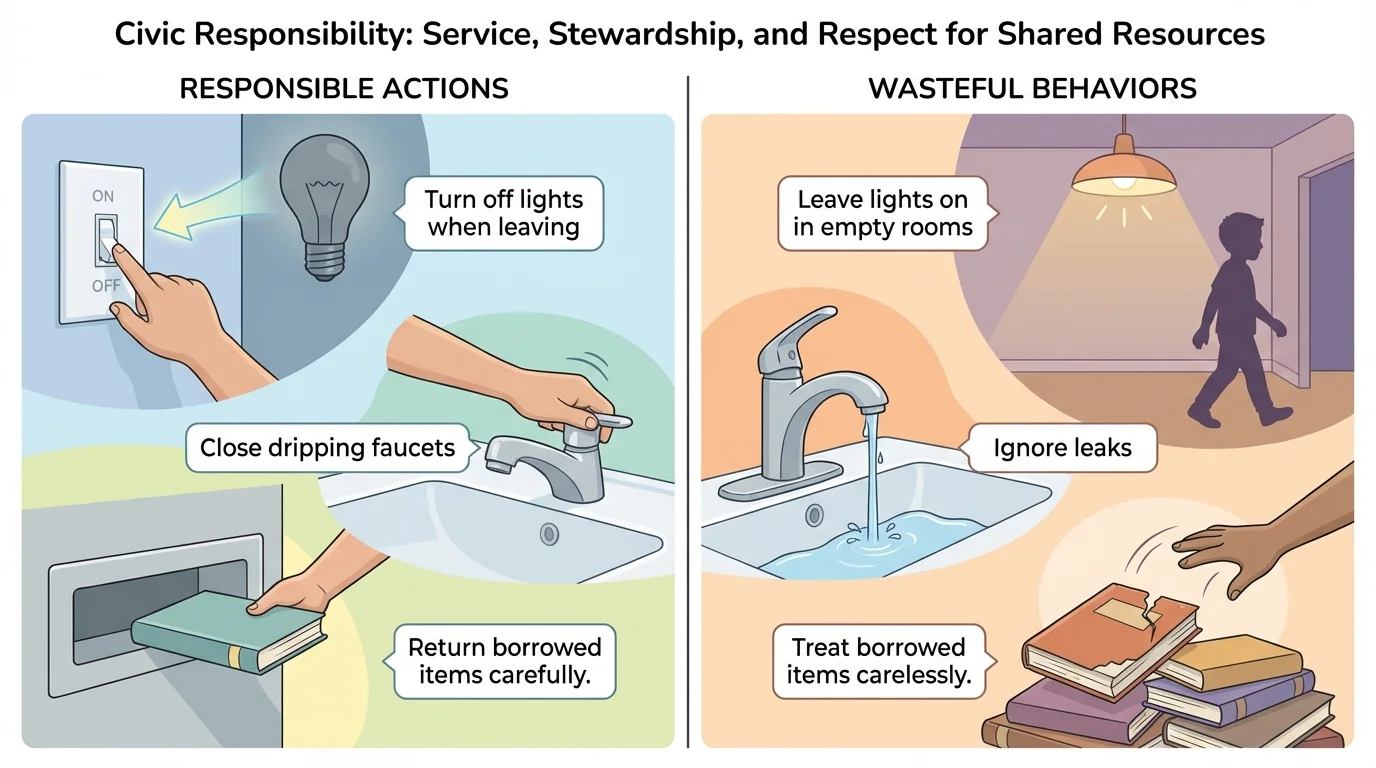
Stewardship also includes natural resources. Water and electricity may feel endless because they are easy to use, but they should not be wasted. If you leave a light on in an empty room for hours, that wastes energy. If a faucet drips, water is being lost little by little. Small waste repeated many times becomes a bigger problem.
Here is a simple comparison of responsible and irresponsible choices.
| Shared resource | Responsible action | Irresponsible action |
|---|---|---|
| Library book | Keep it clean and return it on time | Bend pages, spill on it, or lose it |
| Park | Use trash cans and stay on paths | Litter or damage plants |
| Water | Turn off faucet when done | Let water run without using it |
| Electricity | Turn off lights and devices when not needed | Leave lights and screens on all day |
| Online shared space | Post respectfully and stay on topic | Spam, insult others, or share harmful content |
Table 1. Examples of how to respect or misuse different shared resources.
A dripping faucet may not seem important, but a small drip over time can waste a surprising amount of water. Tiny actions matter when they happen again and again.
You can practice stewardship every day by checking your surroundings before you leave a space. Is the light off? Is the chair pushed in? Is the game put away? Is the shared tablet charged and stored safely? These habits show care for both people and property.
When you revisit your own habits, this contrast helps you notice an important idea: stewardship is not only about stopping damage. It is also about keeping shared things ready for the next person.
Shared resources are all around you. At home, they might include the couch, dishes, games, chargers, internet access, or art supplies. In public, they include sidewalks, parks, recreation spaces, books, public seating, and community centers. Respecting shared resources means using them fairly, safely, and with care.
Fair use matters. If one person keeps a shared device all day, others cannot use it. If someone takes more than their share of snacks at an event, there may not be enough left. Respect often means noticing what other people need too.
Here are practical ways to show respect for shared resources:
Suppose your family shares one charging cable. If you unplug it carelessly, knot it tightly, or leave it on the floor, it may break. Then everyone loses access. Respecting a shared item means thinking beyond the moment.
Fairness and shared use are closely connected. When something belongs to a group, each person should use it in a way that gives others a chance to benefit too. Fairness is not only about taking turns. It is also about preventing waste and damage.
This is also true in community places. If you visit a park, stay where you are allowed, throw away trash, and treat equipment carefully. If you use a public library, speak quietly when needed and return materials on time. Shared spaces feel safer and more welcoming when people show care.
Real responsibility shows up when nobody reminds you. It is easy to act carefully when an adult is standing next to you. It is harder, and more important, to make a good choice on your own. A simple decision tool helps you slow down and choose wisely.
When you are unsure what to do, ask yourself four questions. As [Figure 3] shows, a simple decision flow can help: Is it safe? Is it fair? Does it help or harm others? What should I do next? These questions can stop a poor choice before it becomes a bigger problem.
For example, maybe you see trash on the ground at a park. It might not be yours, but you can still help by picking it up safely with an adult or by telling an adult if the item is dangerous. Or maybe you notice someone left a shared online document messy. Instead of deleting their work, you can politely ask how to organize it or tell the group leader.
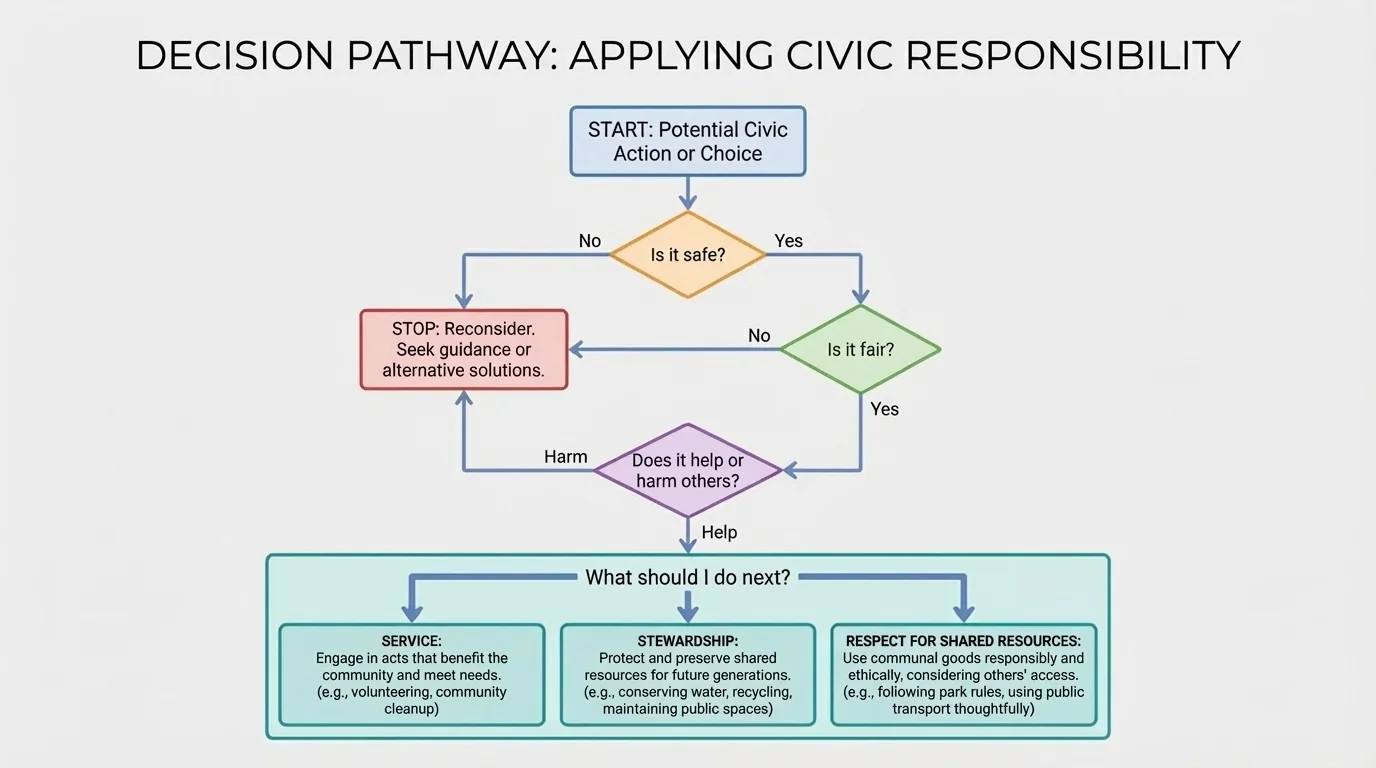
Here is a step-by-step way to decide:
Step 1: Pause before acting.
Step 2: Look at who could be affected.
Step 3: Think about safety, fairness, and care.
Step 4: Choose the action that protects people and resources.
Step 5: If you are unsure, ask a trusted adult.
These steps help with many situations: using shared headphones, deciding whether to leave a mess for someone else, seeing unkind behavior online, or noticing waste at home. Good choices are often made one question at a time.
Decision example
You finish using art supplies at a community program. You are tired and want to leave quickly.
Step 1: Pause.
You notice brushes in water cups, paper scraps on the table, and markers without caps.
Step 2: Ask the questions.
Is it fair to leave the mess? No. Could the supplies be damaged? Yes.
Step 3: Take responsible action.
You cap the markers, throw away scraps, and clean your space.
Step 4: Think ahead.
The next person can use the supplies, and they stay in better condition longer.
Responsible choices build trust. Over time, people learn that you are careful, honest, and dependable. That is a powerful way to contribute to your community.
Rules are not always enjoyable, but many rules exist to protect shared resources and keep people safe. A sign that says "Stay on the path" may protect plants. A rule about quiet voices in a library helps others read and learn. A rule about not sharing private information online helps keep people safe.
Following rules is one part of civic responsibility. Another part is speaking up when something is wrong. Speaking up does not mean arguing or trying to solve dangerous problems by yourself. It means telling a trusted adult when you notice harm, damage, danger, or unfair behavior.
For example, if you see vandalism, bullying in an online group, unsafe behavior in a public place, or damage to community property, tell a parent, guardian, program leader, librarian, or another trusted adult. Reporting a problem can protect people and resources.
Being responsible does not mean handling every problem alone. Safe civic action often means getting the right adult involved.
Respect for rules and laws helps communities function. Laws are official rules for everyone in a town, state, or country. Children are still learning about laws, but you can practice the habits behind them now: honesty, safety, fairness, respect, and care for what belongs to everyone.
Communities are not only physical places. Online spaces are communities too. If you learn in digital groups, play games with chat features, or use shared online documents, your behavior there matters. A digital citizen is someone who uses technology in safe, respectful, and responsible ways.
Being a good digital citizen includes using kind words, staying on topic, not flooding chats with repeated messages, protecting passwords, and respecting shared work. If you use a shared online file, do not erase other people's work. If you disagree, respond politely. If something seems unsafe or mean, tell a trusted adult.
Shared digital spaces can be damaged too. Hurtful comments can make a group feel unsafe. False information can confuse people. Careless clicking can delete important work. Respect online means thinking before you type, post, share, or delete.
Online actions can spread very fast. A single unkind message or harmful post may be seen by many people, which is why digital responsibility matters so much.
Before posting or sending something, ask yourself: Is it true? Is it kind? Is it helpful? Is it safe to share? These questions protect both people and shared online spaces.
You do not need to do everything at once. Start with a few clear habits and repeat them until they become normal. Civic responsibility grows through practice.
Try this in your daily life:
You can also make your own quick reminder: Help. Care. Share fairly. Speak up safely. Those four ideas cover a lot of civic responsibility.
When communities work well, it is usually because many people are doing small, responsible things over and over. You are one of those people. Your choices matter at home, online, and in every shared space you use.
