Here is something surprising: many adults use the same kinds of skills every day that you are practicing right now. Reading directions, solving problems, explaining ideas, staying organized, using technology, and working with others are not just "school things." They are life skills. The way you learn, practice, and act today can help shape what kinds of jobs you may enjoy later and how you can make a difference in your community.
You do not need to wait until you are grown up to start building your future. Every time you finish an assignment on time, speak kindly during an online discussion, fix a mistake, or learn a new tool, you are building useful skills. These skills can lead to future work, hobbies, leadership, and service.
Think about adults you know or know about. A nurse reads carefully, listens well, and stays calm. A game designer uses creativity and technology. A mechanic solves problems step by step. A community volunteer notices what people need and takes action. These adults did not suddenly wake up one day with all those abilities. They grew them over time.
Career means a kind of work a person chooses and grows in over time.
Community role means a way a person helps, leads, or contributes to the people around them, such as being a helper, organizer, coach, volunteer, or good neighbor.
Pathway means the route or steps that lead from where you are now to where you want to go.
Your future does not have to be fully planned right now. At this stage, the goal is not to choose one perfect job forever. The goal is to notice what you are good at, what you enjoy, what matters to you, and how your actions today can open doors later.
A skill is something you can learn to do. Some skills are easy to see, like typing, drawing, measuring, coding, or writing a clear paragraph. Other skills are just as important but harder to spot, like listening, staying patient, solving conflicts, managing time, or speaking respectfully.
People sometimes talk about hard skills and soft skills. Hard skills are skills you can practice in a direct way, such as reading charts, using a spreadsheet, editing a video, or measuring ingredients in a recipe. Soft skills are the ways you work and interact, such as cooperation, responsibility, and self-control.
Your strengths are the things you do especially well or learn quickly. Your interests are the things that grab your attention and make you want to keep learning. Both matter. You might be strong at organizing ideas and interested in animals. That could connect to careers like veterinarian, wildlife educator, or animal shelter organizer. You might be strong at explaining things and interested in sports. That could connect to coaching, sports journalism, or physical therapy one day.
Skills grow when you use them. You are not simply "born good" or "born bad" at most things. Practice, feedback, patience, and good habits make a huge difference. A student who struggles with speaking on camera today can become confident later by practicing short presentations and learning from mistakes.
This is important because it means your future is not locked. If you are not great at something yet, the word yet matters. You can improve.
One of the best things to understand is that one skill can connect to many possible futures, as [Figure 1] shows with school subjects branching into jobs and community roles. That means your reading, math, writing, creativity, and teamwork are more powerful than they may seem.
Reading helps people understand directions, contracts, stories, safety rules, and research. Adults use reading in jobs like law, medicine, construction, customer service, and journalism. In community roles, reading helps when you follow instructions for an event, understand local information, or help younger children with books.
Writing helps people send clear messages, make plans, explain ideas, and keep records. Writers are not only authors. Nurses write notes. Business owners send emails. Designers explain project ideas. Volunteers write sign-up messages and thank-you notes.
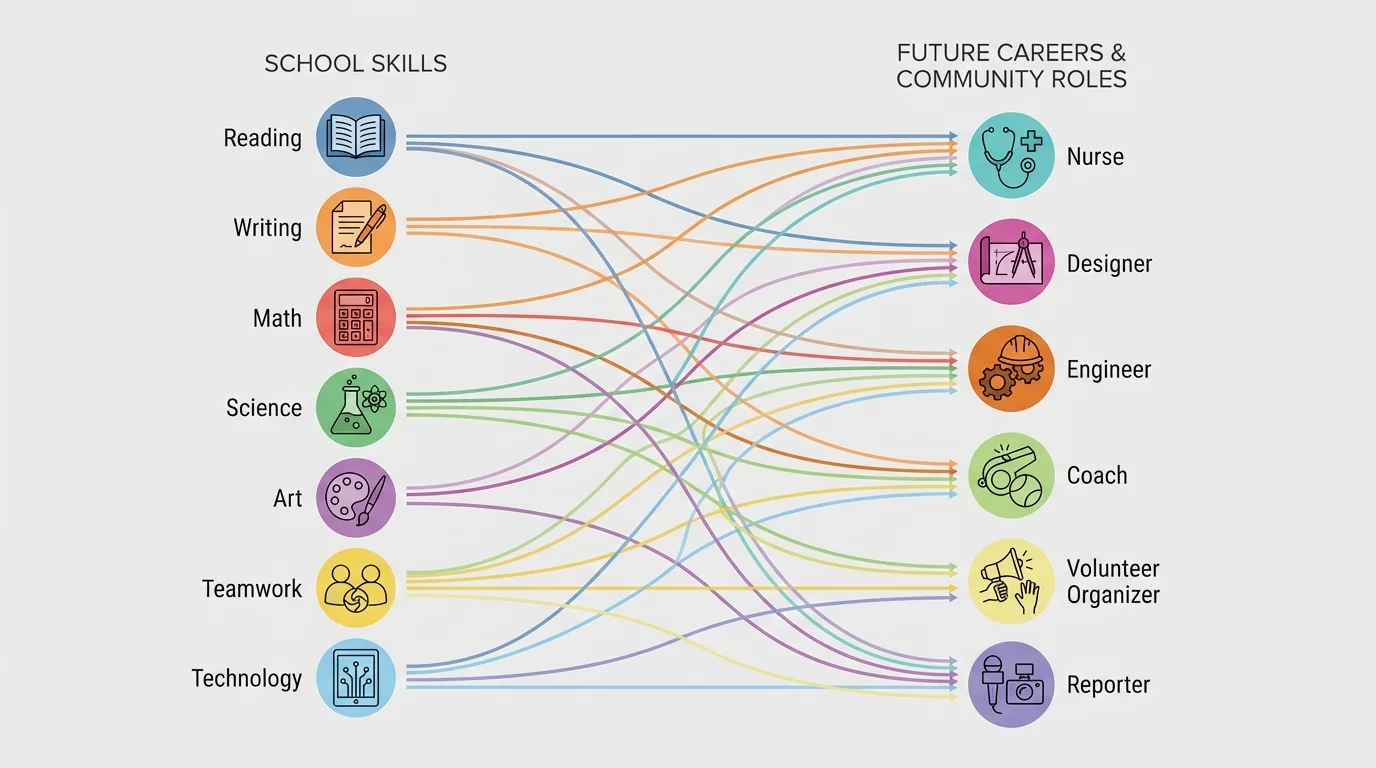
Math helps with money, measuring, timing, building, estimating, and comparing choices. A baker uses fractions. A contractor measures space. A store manager tracks prices. A delivery worker plans time. Even simple decisions use math, such as checking whether you have enough money for two items if one costs $8 and the other costs $5, so the total is \(8 + 5 = 13\).
Science teaches observation, testing, and cause-and-effect thinking. Those skills are useful in healthcare, farming, environmental work, engineering, cooking, and even pet care. If something goes wrong, science habits help you ask, "What changed? What can I test?"
Technology skills matter in almost every field now. Knowing how to type, upload files, join video calls, organize digital folders, and stay safe online can help in business, education, design, customer support, and many other jobs.
Art and creativity are not extra. They are useful for making things that people enjoy, understand, and remember. Creativity helps with design, music, animation, advertising, teaching, product invention, and problem-solving.
Teamwork and communication matter almost everywhere. A person may know a lot, but if they interrupt others, ignore instructions, or refuse to cooperate, that can cause problems. As shown earlier in [Figure 1], teamwork connects to careers like coaching, healthcare, event planning, and community leadership.
| School skill | How it helps in real life | Possible future connection |
|---|---|---|
| Reading carefully | Understanding directions and details | Nurse, mechanic, volunteer helper |
| Writing clearly | Sending messages and explaining ideas | Reporter, business owner, community organizer |
| Math | Budgeting, measuring, planning | Engineer, baker, store manager |
| Science thinking | Testing and solving problems | Doctor, veterinarian, gardener |
| Creativity | Designing and inventing | Artist, game designer, advertiser |
| Teamwork | Working with people respectfully | Coach, teacher, project leader |
Table 1. Examples of how common school skills connect to everyday adult tasks and future roles.
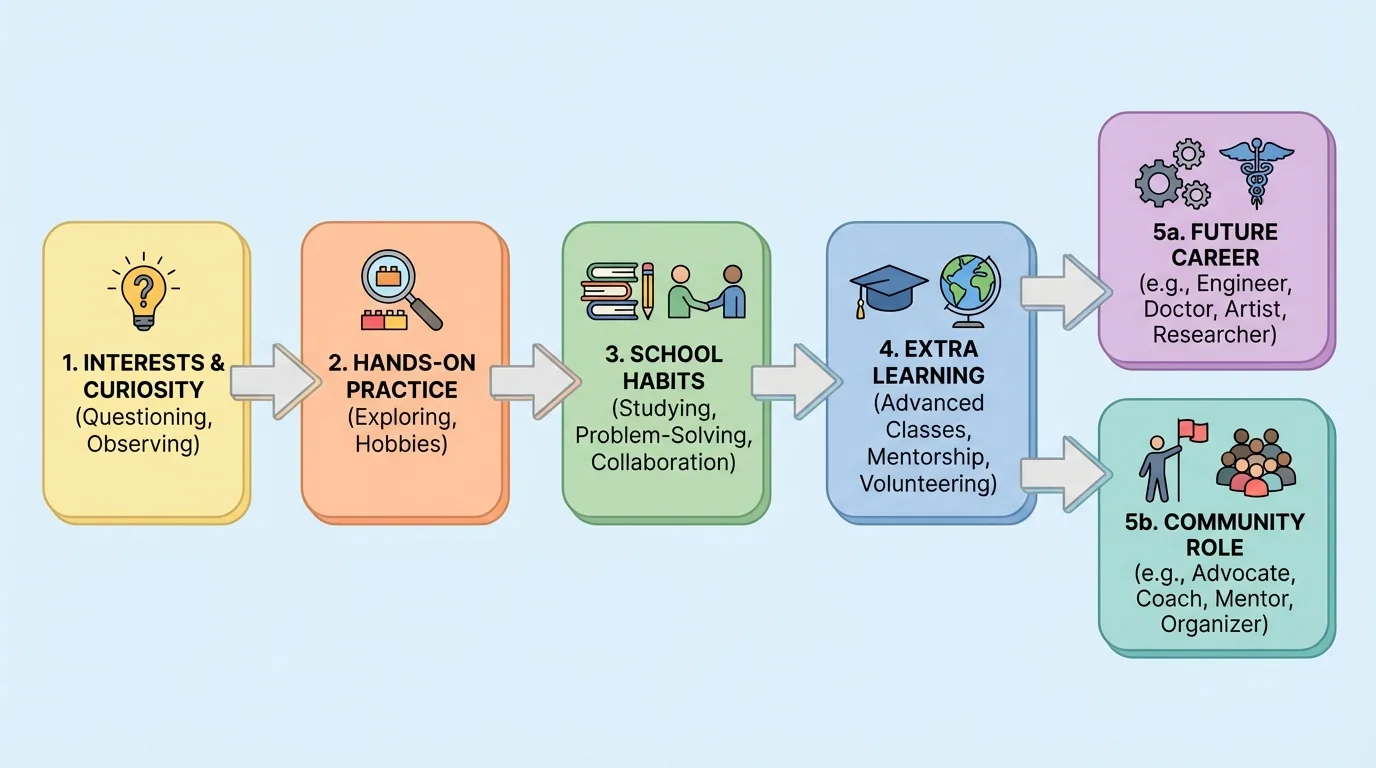
A pathway is like a trail made of many steps, not one giant leap, and [Figure 2] lays out how interest, practice, habits, and learning can connect over time. Most people do not move in a perfectly straight line. They try things, learn more, change direction, and keep growing.
For example, a student who likes animals may start by reading about pets, helping care for a family animal, asking good questions, and learning responsibility. Later, that student might volunteer at an animal shelter when older, study animal science, or work in pet care. Another student who loves creating videos may begin by practicing short edits, learning clear storytelling, and managing deadlines. That could lead toward media, marketing, teaching, or digital design.
The key idea is that your pathway starts with small, repeated actions. Showing up on time for online meetings, checking your work, learning to ask for help, and sticking with hard tasks are all part of the path.
You also do not have to choose between a job and helping others. Some pathways include both. A person might become a chef and also help at a food drive. A programmer might create useful tools and mentor younger students online. A photographer might run a business and also help community groups share events.
Many adults work in jobs that did not even exist when they were children. That is one reason flexible skills like communication, problem-solving, and learning new technology are so valuable.
If the world changes, people with strong skills can adapt. That is a big advantage.
Success is not only about earning money. It is also about being useful, trustworthy, and kind. Community roles are the ways people help others and make places better. You can practice these roles now.
At home, you can be reliable by finishing chores, helping younger siblings, caring for pets, or preparing part of a meal. In your neighborhood or local groups, you can help clean up a park, join a library activity, support a food collection, or assist at a community event when an adult is with you. Online, you can use respectful words, avoid spreading rumors, and share helpful information instead of unkind comments.
These actions build a responsibility record. People notice when someone can be counted on. That matters in friendships, volunteering, leadership, and future jobs.
Real-world consequence example
Two students both want to help with a community pet supply drive.
Step 1: One student answers messages politely, finishes small tasks, and checks details before posting information.
Step 2: The other student forgets deadlines, posts unclear information, and does not respond when adults ask questions.
Step 3: Adults are more likely to trust the first student with a bigger role next time.
When you are dependable, people are more willing to give you opportunities.
That is why community roles matter. They help other people, and they help you build a strong reputation.
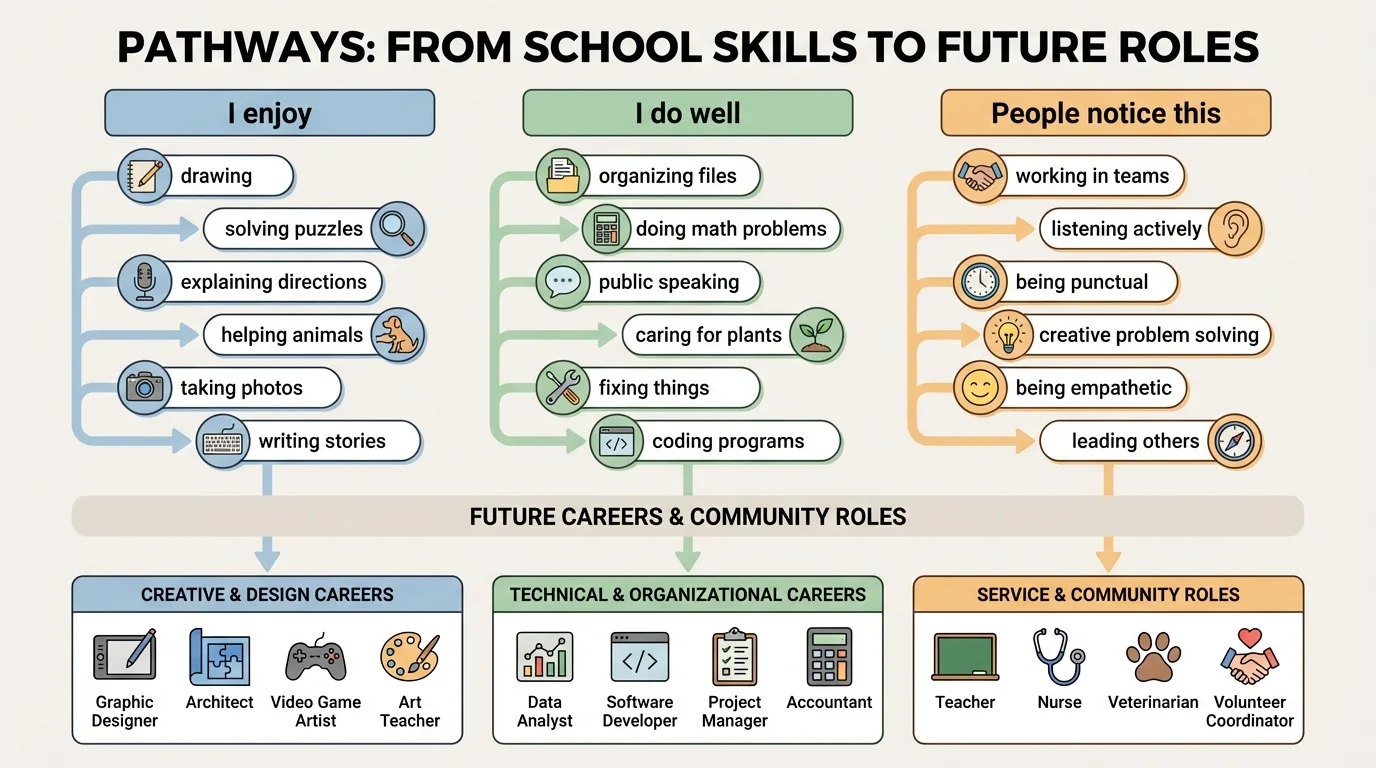
You do not have to guess wildly about what you might be good at. You can collect clues about yourself in a simple chart, as [Figure 3] demonstrates by sorting what you enjoy, what you do well, and what other people notice. This works better than waiting for a sudden big answer.
Start by paying attention to moments when you feel focused, useful, or proud. Ask yourself: What tasks make time go quickly? What kind of problems do I enjoy solving? When do people thank me for helping? What do I choose to learn about even when I do not have to?
You can also notice what kind of effort feels satisfying. Some students like creating. Others like organizing. Others like fixing, leading, explaining, caring, building, or performing.
Another smart move is to ask trusted adults for feedback. You could ask a parent, guardian, coach, club leader, or mentor, "What strengths do you notice in me?" Sometimes other people see patterns before you do.
Keep your answers in a note, journal, or digital document. After a few weeks, look for patterns. Maybe "I like making things neat," "I remember details," and "People trust me with instructions" all point toward strong organization skills. Maybe "I enjoy comforting others," "I notice when someone feels left out," and "People come to me with problems" point toward caring and communication skills.
You have probably already practiced reflection before: noticing what went well, what was hard, and what you can improve. The same habit helps you discover future pathways.
As seen in [Figure 3], one clue by itself does not tell the whole story. But several clues together can point you toward possible roles to explore.
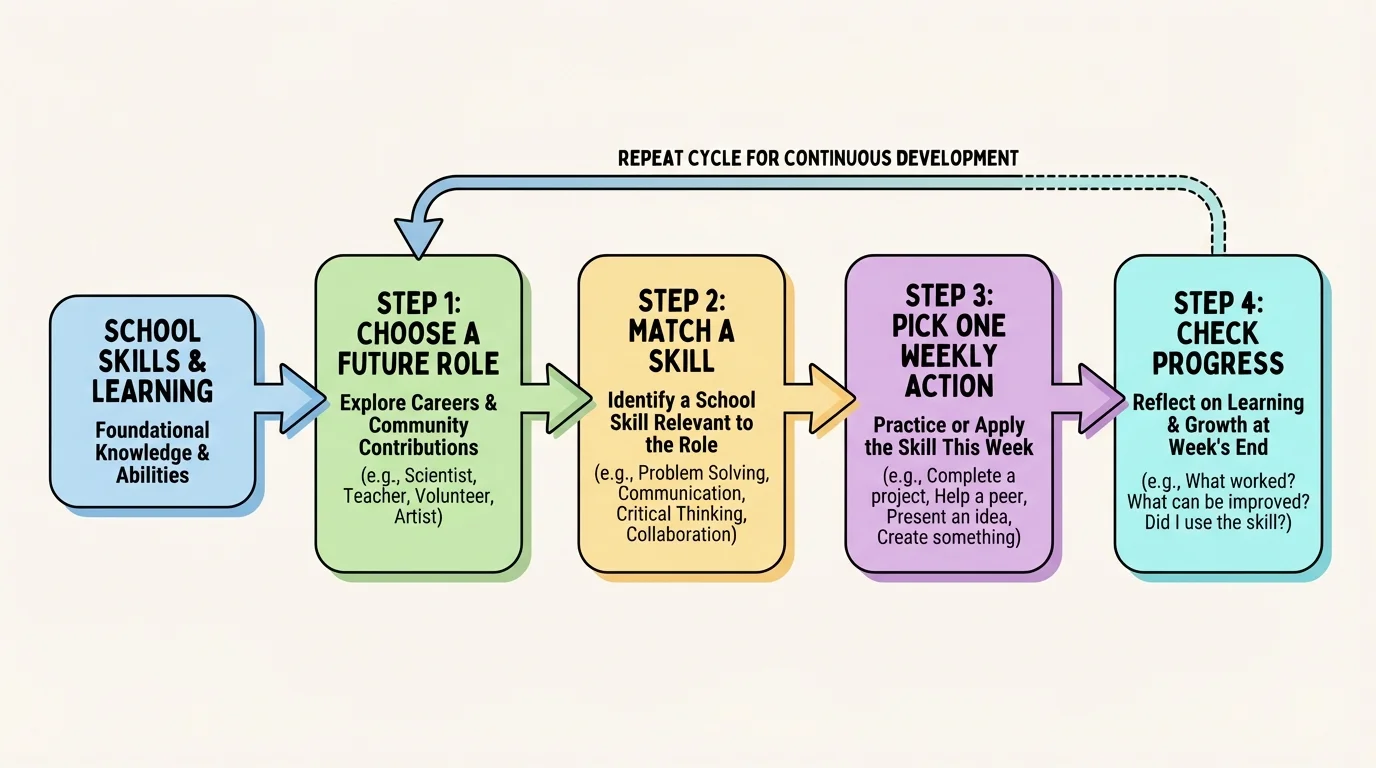
You do not need a giant life plan. You need a small, clear plan you can actually follow. A good plan connects one future possibility to one skill you can practice now.
Here is a simple way to do it.
[Figure 4] Step 1: Choose one role that interests you. It could be a job, like designer, chef, teacher, or engineer. It could also be a community role, like helper, coach, organizer, or mentor.
Step 2: Pick one skill that role uses. A chef uses measurement and time management. A teacher uses communication and patience. An engineer uses problem-solving and math. A community organizer uses planning and teamwork.
Step 3: Choose one small weekly action. Read one article. Practice one useful tool. Help with one real task. Improve one habit.
Step 4: Check your progress. Ask: Did I do it? What went well? What should I change next week?
Simple planning example
A student is interested in being a veterinarian someday.
Step 1: Choose the role: veterinarian.
Step 2: Match current skills: science observation, careful reading, responsibility, and kindness with animals.
Step 3: Pick one weekly action: help feed a pet every day, read one article about animal care, and record observations.
Step 4: Review after one week: Which part was easy? Which part needs improvement?
This plan is small, but it is real. Real plans are better than vague wishes.
Choose one future role and write one sentence that starts with "This week I will practice..." Keep it specific enough that you can actually do it.
Some choices may seem small now, but they can affect future opportunities. For example, your online behavior matters. If you are rude in chats, copy other people's work, or ignore digital safety, that can harm trust. If you communicate respectfully, protect private information, and act honestly, that builds trust.
Time management matters too. When you procrastinate all the time, tasks pile up and stress grows. When you break work into smaller parts, it becomes easier. If a project takes about one hour, you can split it into four parts of about \(60 \div 4 = 15\) minutes each. That feels much more manageable.
Problem-solving also matters. If something goes wrong, pause before reacting. Ask: What is the problem? What are my choices? What happens if I choose each one? Who can help? This kind of thinking is useful in jobs, friendships, and community work.
"Small disciplines repeated with consistency every day lead to great achievements gained slowly over time."
— John C. Maxwell
Good habits do not make you perfect. They make you more prepared.
Here are some realistic examples of how today's skills can connect to tomorrow's roles.
Example 1: A student enjoys drawing, editing short videos, and choosing colors carefully. That student may be building skills for graphic design, animation, advertising, or social media management. In the community, those same skills could help make posters for an event or share clear information online.
Example 2: A student likes organizing supplies, making checklists, and noticing when something is missing. That may connect to project management, event planning, office work, logistics, or running a business. In a community role, it could help with organizing a donation drive or planning a local activity.
Example 3: A student enjoys explaining game rules, helping younger children, and staying patient when others are confused. That may connect to teaching, coaching, counseling, training, or customer support. In the community, it could help with tutoring or mentoring.
Example 4: A student likes measuring ingredients, testing recipes, and cleaning up carefully. That may connect to cooking, nutrition, food science, or hospitality. At home and in the community, it can help with meal planning or preparing food for others.
Example 5: A student enjoys fixing broken things, building models, and figuring out why something works. That may connect to engineering, mechanics, construction, robotics, or technical repair. In the community, it may help with practical problem-solving and useful projects.
Notice what these examples have in common: one interest does not lead to only one answer. A strength can open several doors.
Your interests may change, and that is normal. A student who loves animals at age \(10\) may still love animals later, or may discover a new interest in science, art, or technology. Changing your mind is not failure. It is part of learning about yourself.
What matters most is building strong habits and staying curious. If you learn how to read carefully, solve problems, communicate respectfully, use technology wisely, and keep trying after mistakes, those abilities can travel with you into many different futures.
The future is not only something that happens to you. Little by little, choice by choice, you help build it.
