Some people think reaching a goal is all about being talented or lucky. But most goals are shaped by something much more ordinary: what you do over and over, what gets in your way, and who or what helps you keep going. If you want to finish a book series, save money for something special, get stronger at a sport, or remember your weekly chores, your progress usually depends on small patterns, not one giant moment.
A goal is something you want to achieve. It can be big, like learning to play several songs on an instrument, or small, like keeping your room tidy for one week. Goals matter because they help you make choices on purpose instead of just reacting to whatever happens during the day.
When you make progress, it often feels good and builds confidence. When you keep getting stuck, you may feel frustrated and want to quit. That is why it is important to analyze your goal progress. Analyze means to look closely and figure out what is helping, what is hurting, and what needs to change.
Goal progress is how far you have moved toward what you want to achieve. Habits are actions you do regularly, often without thinking much about them. Obstacles are things that make progress harder. Supports are people, tools, routines, or resources that help you succeed.
If you do not stop to notice these things, you might blame yourself in a way that is not fair or helpful. For example, if you are not finishing your reading goal, the problem may not be that you are lazy. It might be that your reading habit is weak, your evenings are noisy, and you do not have a good place to keep your book nearby.
These three ideas work together all the time. A helpful habit can make an obstacle feel smaller. A strong support can help you build a good habit. But an unhelpful habit can make even a simple goal feel hard.
Think of goal progress like moving along a path. Helpful habits are like steady steps forward. Obstacles are like puddles, rocks, or wrong turns. Supports are like a flashlight, a map, or a friend cheering you on. The path is still yours to walk, but the conditions around you matter.
For a student learning from home, this is especially important. You manage more of your own time and space. You may need to notice whether your devices distract you, whether your schedule helps you, and whether adults or family members know what support you need.
Habits matter because repeated actions add up. A tiny action done every day can move you forward, and a tiny unhelpful action repeated often can slow you down, as [Figure 1] shows. You do not need a perfect day to make progress. You need patterns that usually point you in the right direction.
A helpful habit is something you do regularly that supports your goal. If your goal is to improve your handwriting, a helpful habit might be practicing for 10 minutes after breakfast. If your goal is to save money, a helpful habit might be putting part of your allowance into a jar each week before spending the rest. If your goal is to be ready for online lessons, a helpful habit might be charging your device each night.
An unhelpful habit does the opposite. If you always leave your supplies in different places, you waste time looking for them. If you stay up too late watching videos, you may feel too tired to focus the next day. If you tell yourself, "I'll do it later," every time a task appears, you build a pattern of delay.
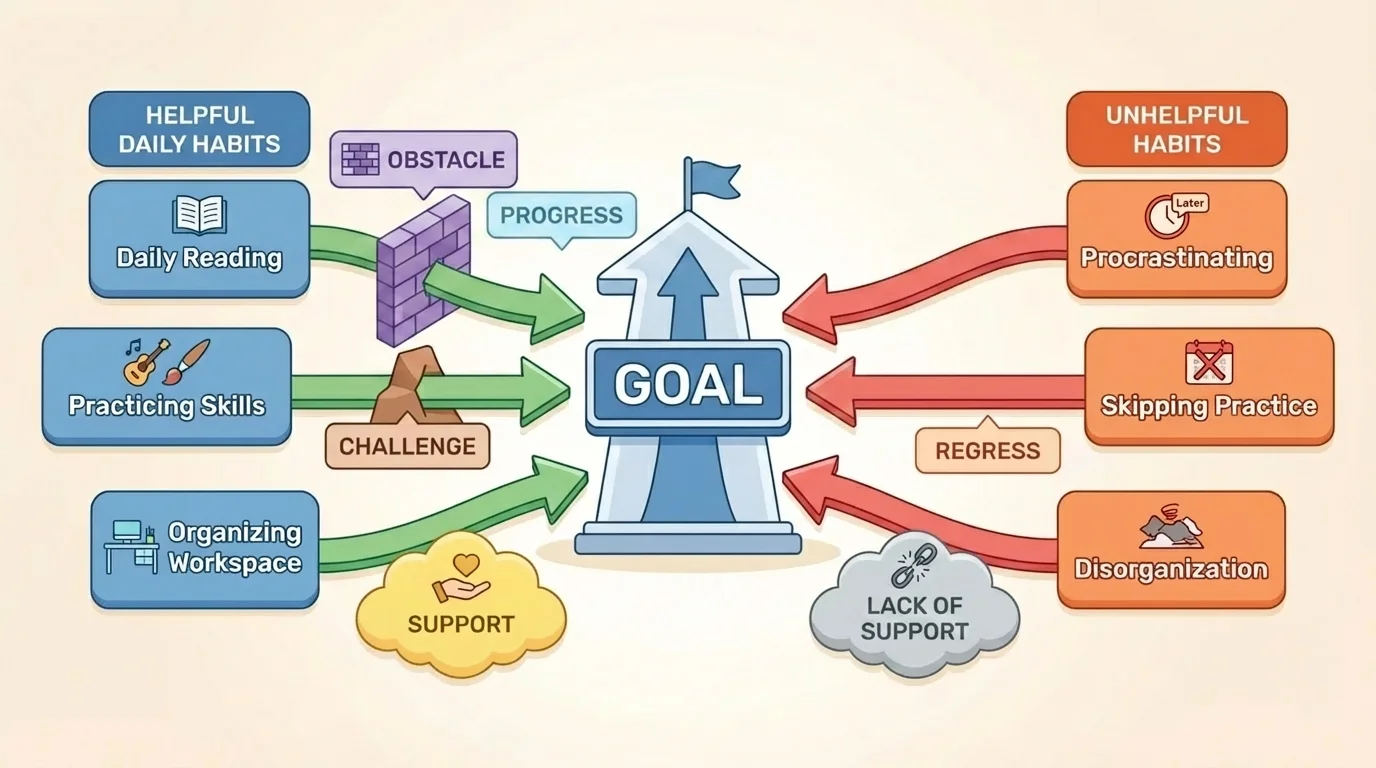
Helpful habits are often simple. They are not always exciting, but they are powerful. Brushing your teeth is a habit. Packing what you need before an activity can become a habit. Checking a list before logging off for the day can become a habit too.
One reason habits are strong is that they reduce decision-making. If you already know, "Every evening at 7:00 I read for 15 minutes," you do not have to argue with yourself each day. Even if you use simple time estimates, they still show how small steps add up. Reading for 15 minutes over 4 days adds up to \(15 + 15 + 15 + 15 = 60\) minutes. That is one whole hour of practice built from a small routine.
Bad habits can build just as quietly. Ten minutes of distraction may not seem important once, but repeated distractions can break your focus over and over. This is why it helps to ask, "What do I do again and again?" instead of only asking, "What happened today?"
Brains often like routines because routines save effort. When a helpful action becomes more automatic, it can feel easier to keep doing it.
You can build better habits by starting small. Many people fail because they choose a plan that is too big. Saying, "I will practice piano for 45 minutes every day forever," may sound impressive, but it can be hard to keep. Saying, "I will practice for 10 minutes after lunch on weekdays," is clearer and easier to repeat.
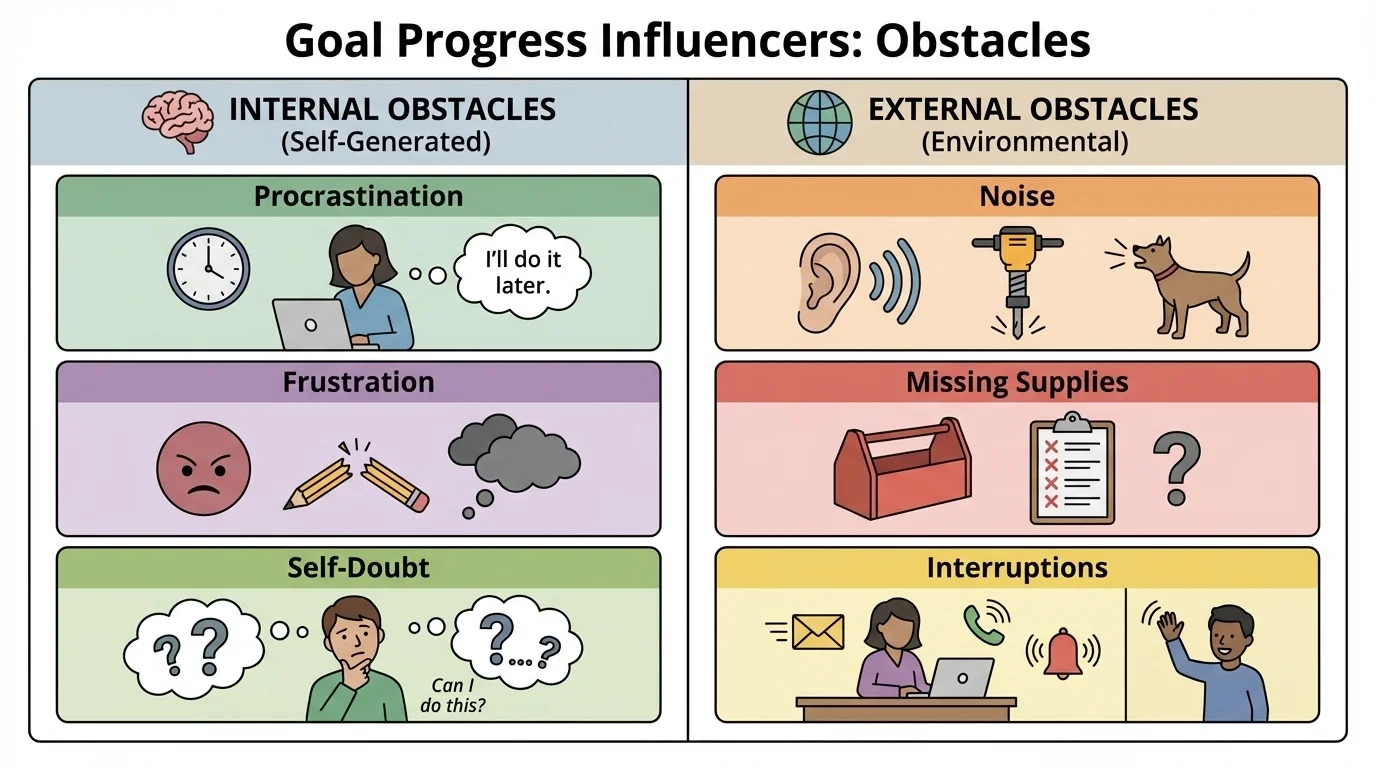
Obstacles are normal. Every goal has them. Some obstacles come from inside you, and some come from around you, as [Figure 2] explains. Noticing obstacles does not mean making excuses. It means being honest about what is making the goal harder.
Internal obstacles are things happening in your thoughts, feelings, or choices. These can include forgetting, procrastinating, getting discouraged quickly, feeling nervous, or giving up after one mistake. For example, if your goal is to improve at drawing, an internal obstacle might be thinking, "If it is not perfect, I should stop."
External obstacles are things outside you. These can include a noisy room, a broken charger, interruptions at home, limited supplies, a schedule change, or not enough sleep because the household was busy. If your goal is to finish your weekly tasks, an external obstacle might be that you do not have a regular time to do them.
Some obstacles are short-term, like feeling sick for a day. Some are ongoing, like sharing a workspace with siblings or having internet problems sometimes. When you know the kind of obstacle you are dealing with, you can choose a better response.
Obstacles often create patterns. For example, maybe every time you plan to practice a skill in the evening, you are already tired. The obstacle may not be the skill itself. The obstacle may be the time you chose. Moving the practice to earlier in the day could help more than "trying harder."
Another important point is that one obstacle can lead to another. If you forget your plan, you fall behind. When you fall behind, you feel stressed. When you feel stressed, you avoid the task. This chain reaction is common. Spotting the first problem early can stop the rest of the chain.
Obstacles are clues, not stop signs. When something keeps slowing your progress, it gives you information. Instead of thinking, "I can't do this," try thinking, "Something in my plan needs to change." This mindset helps you solve problems instead of feeling stuck.
Later, when you compare your own obstacles to the kinds shown in [Figure 2], you may notice that many problems are easier to fix when you name them clearly. "I'm bad at this" is vague. "I keep forgetting because I don't have a reminder" is specific and useful.
Supports are the helpers around your goal. Some supports are people. Some are objects. Some are systems you create for yourself. Strong supports do not do the work for you, but they make it easier for you to do the work.
Support from people might include a parent, guardian, older sibling, coach, club leader, neighbor, or friend who checks in with you online.
Tool supports might include a timer, checklist, calendar, quiet headphones, labeled folder, water bottle, practice chart, or a jar for saving money. Environment supports matter too. A clean desk, a set reading corner, or keeping supplies in one basket can save time and energy.
Emotional supports are important as well. If someone reminds you that mistakes are part of learning, that support can keep you from quitting too soon. Sometimes the most powerful support is hearing, "You are improving because you kept trying."
Supports are especially useful when motivation is low. You will not always feel excited about your goal. On hard days, a routine, reminder, or check-in can carry you forward. This is one reason responsibility and community fit together. You are responsible for your choices, but you often do better when you let others help you wisely.
"You do not have to do everything alone to be responsible."
A good support matches the problem. If the obstacle is forgetting, the support might be an alarm or sticky note. If the obstacle is discouragement, the support might be encouraging feedback. If the obstacle is noise, the support might be moving to a quieter spot. The best support is not always the biggest one. It is the one that fits.
When a goal feels easy or difficult, it helps to check it in a clear order. The process in [Figure 3] breaks the work into five simple parts so you can see what to keep and what to change.
Step 1: Name your goal clearly. Instead of saying, "I want to do better," say, "I want to read 20 pages four times a week," or "I want to save $5 each week for a new game." Clear goals are easier to track.
Step 2: Look at your current habits. Ask, "What do I do regularly that helps this goal? What do I do regularly that hurts it?" Be honest. This is not about blame. It is about noticing patterns.
Step 3: Identify your obstacles. Ask, "What keeps getting in the way?" Try to separate internal obstacles from external ones. This makes your problem-solving stronger.
Step 4: List your supports. Ask, "Who or what helps me?" Think about people, tools, routines, reminders, and spaces.
Step 5: Choose one change. Do not try to fix everything at once. Pick one habit to build, one obstacle to reduce, or one support to add.
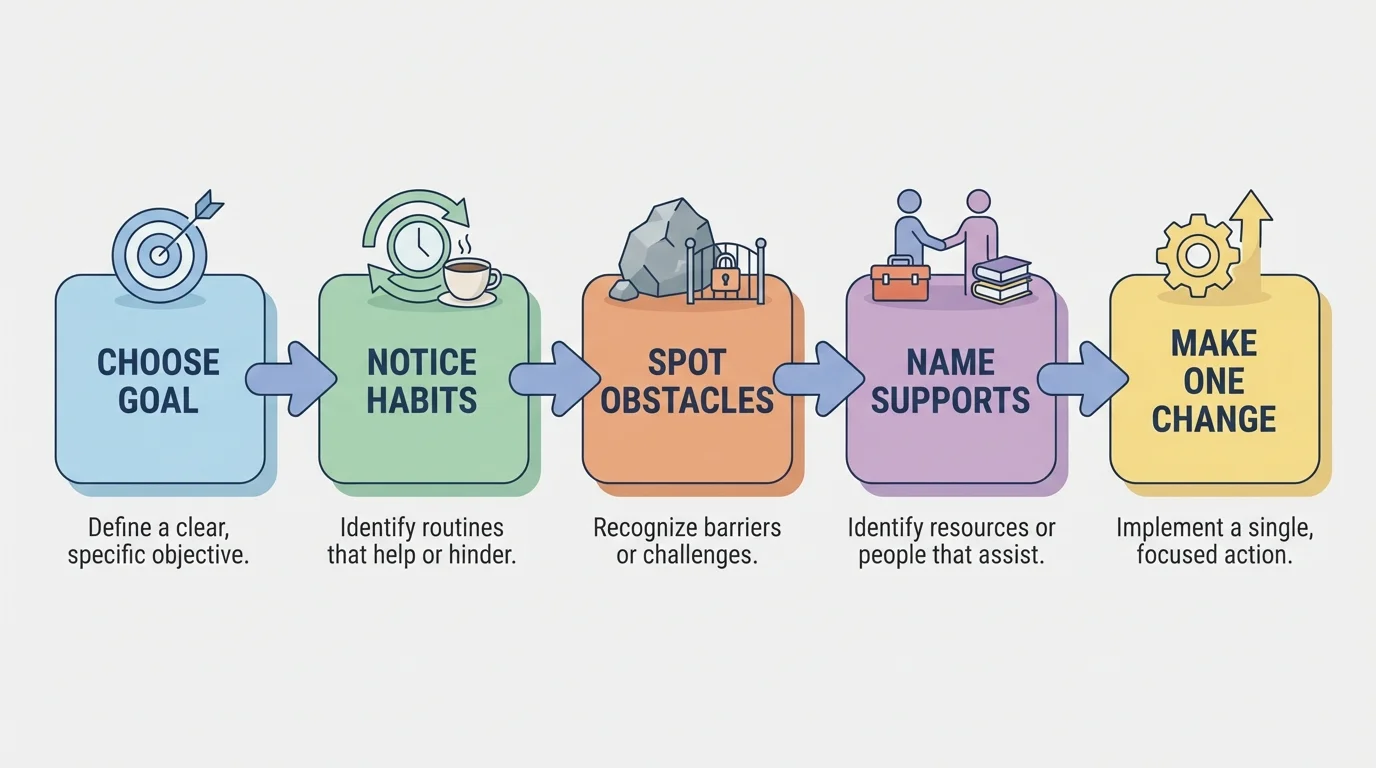
This process helps because it turns a confusing problem into smaller pieces. It also shows that being stuck does not always mean the goal is wrong. Sometimes the plan around the goal needs improvement.
Example: analyzing a reading goal
A student wants to finish more library books each month but keeps stopping halfway through.
Step 1: Name the goal clearly.
The student changes the goal to: "Read for 15 minutes after lunch on Monday, Tuesday, Thursday, and Friday."
Step 2: Check habits.
Helpful habit: sometimes reading after lunch already happens. Unhelpful habit: leaving the book in different rooms.
Step 3: Spot obstacles.
Internal obstacle: forgetting. External obstacle: younger siblings being noisy in the afternoon.
Step 4: Add supports.
The student keeps the book and a bookmark in one basket, uses headphones, and asks a parent to give a reminder on reading days.
Step 5: Make one change first.
The first change is placing the book basket next to the usual reading chair.
The goal now has a better chance of success because the student changed the system, not just the wish.
When you use this same process, the path in [Figure 3] helps you stay calm and organized. It reminds you that progress is something you can study and improve.
Here are a few ways habits, obstacles, and supports can affect everyday goals.
Saving money goal: You want to save $20 for art supplies. A helpful habit is putting aside $5 each week before buying snacks. An obstacle might be spending quickly when you feel excited. A support could be using an envelope labeled with your goal and asking an adult to help you track how much is inside. After 4 weeks, if you save $5 each week, your total is \(5 + 5 + 5 + 5 = 20\). The small habit reaches the goal.
Exercise or practice goal: You want to do 15 minutes of soccer footwork three days a week. A helpful habit is practicing right after changing clothes. An obstacle might be forgetting which drills to do. A support could be a simple list of 3 drills taped near where you practice.
Chore goal: You want to remember to feed a pet every morning. A helpful habit is doing it before breakfast. An obstacle might be sleeping late on weekends. A support might be a reminder on a family calendar and keeping the pet food in a clear, easy-to-reach spot.
Creative goal: You want to finish a comic story. A helpful habit is sketching one panel each afternoon. An obstacle might be getting upset if one drawing does not look right. A support could be keeping an "ideas page" so you can move forward even if one panel needs fixing later.
Good goals usually work better when they are specific, realistic, and connected to a regular time or routine. Vague goals are harder to follow than clear ones.
Notice that none of these examples depends only on willpower. They depend on patterns, barriers, and helpers. That is why two people can want the same thing but have very different progress. Their habits, obstacles, and supports may not be the same.
Sometimes a goal needs a reset. Resetting is not the same as quitting. Resetting means making a smarter plan.
If a goal is not going well, ask yourself a few questions. Is the goal clear enough? Is it too big right now? Is there an obstacle I have ignored? Do I need more support? Is the habit attached to the wrong time of day? These questions lead to action.
For example, suppose your plan was to practice keyboard for 30 minutes every evening, but you have only practiced once in a week. A reset might be changing the plan to 10 minutes right after breakfast on four days. That is a smaller habit and may fit your real life better.
It also helps to look for progress, not perfection. If you missed two days but kept going on the third day, that still matters. One missed day is information. It does not have to become a stopped goal.
Quick reset checklist
Step 1: Shrink the task if it feels too big.
Make the next action simple enough to start.
Step 2: Remove one obstacle.
Put supplies where you can reach them, change the time, or reduce distractions.
Step 3: Add one support.
Use a reminder, checklist, or trusted person to help you stay on track.
Step 4: Try again soon.
Do not wait for a "perfect" Monday or the start of a new month.
When you do this, you are acting responsibly. Responsibility does not mean never struggling. It means noticing what is happening and responding in a thoughtful way.
The way you handle goals now can help you later in life. As you grow, you will set goals about learning new skills, helping your family, joining community activities, earning money, managing time, and taking care of your health. The same three questions will still matter: What habits help me? What obstacles slow me down? What supports can I use?
Community matters because goals are often connected to other people. If you keep your promises, show up prepared, and ask for help respectfully, people learn that they can trust you. Trust opens doors. It can lead to stronger friendships, more opportunities, and better teamwork in clubs, sports, volunteer work, and future jobs.
Support systems are built on communication. You may need to tell a parent, "I want to remember my chores. Can we make a checklist together?" Or you may tell a coach, "I want to improve, but I'm not sure how to practice at home." Asking for help is a skill, not a weakness.
The more you understand yourself, the better your future planning becomes. Maybe you learn that you focus best in the morning. Maybe you learn that visual reminders work better for you than memory alone. Maybe you learn that encouragement helps you bounce back after mistakes. These discoveries make your plans stronger over time.
As you continue setting goals, think like a detective. Notice the clues. Keep the habits that move you forward. Change the ones that do not. Reduce obstacles where you can. Accept support with maturity. That is how steady progress is built.
