Have you ever been one click away from slamming your laptop shut, sending an angry message, or giving up on something because the pressure felt too big? That moment matters. What you do in the next few seconds can make the situation worse or better. The good news is that you do not have to wait until you "feel calm" to make a good choice. You can use skills to help your body and brain settle down first.
Grounding and coping strategies are tools you can use when stress, frustration, or pressure starts to build. These skills help you slow down, think more clearly, and respond instead of reacting. They are useful during online classes, sports practice, family disagreements, performances, games, tests, group chats, and any moment when your emotions start getting louder than your thinking.
Stress is a normal part of life. You might feel it before a big quiz, while trying to finish work on time, when a friend leaves you on read, or when adults expect a lot from you. A little stress can help you focus. Too much stress can make your body feel jumpy and your mind feel stuck.
When you use calming skills well, you are more likely to finish the task, speak respectfully, and solve the problem. When you do not, you might snap at someone, shut down, avoid the situation, or make choices you regret. This is not about being "perfect." It is about learning how to steady yourself so you can handle hard moments better.
Grounding means using your senses, breathing, body, or surroundings to bring your attention back to the present moment.
Coping strategies are healthy actions that help you deal with stress, frustration, or pressure.
Trigger means something that starts a strong emotional reaction.
One important thing to remember is that different tools work for different people and different situations. A strategy that helps during homework might not help during an argument. That is why it is smart to learn several options.
Stress does not just live in your thoughts. It can show up in your body, your feelings, and your actions, as [Figure 1] illustrates. You might notice a racing heart, sweaty hands, tight shoulders, a hot face, a stomachache, or fast breathing. In your mind, you may hear thoughts like "I cannot do this," "This is not fair," or "I have to get this right."
You may also notice behavior signs. Maybe you talk louder, cry faster, stare at the screen without thinking, rush carelessly, or want to quit. Some people get extra quiet. Others get angry. Some start avoiding the task. These signs are clues. If you can notice them early, you have a much better chance of using a skill before the stress takes over.
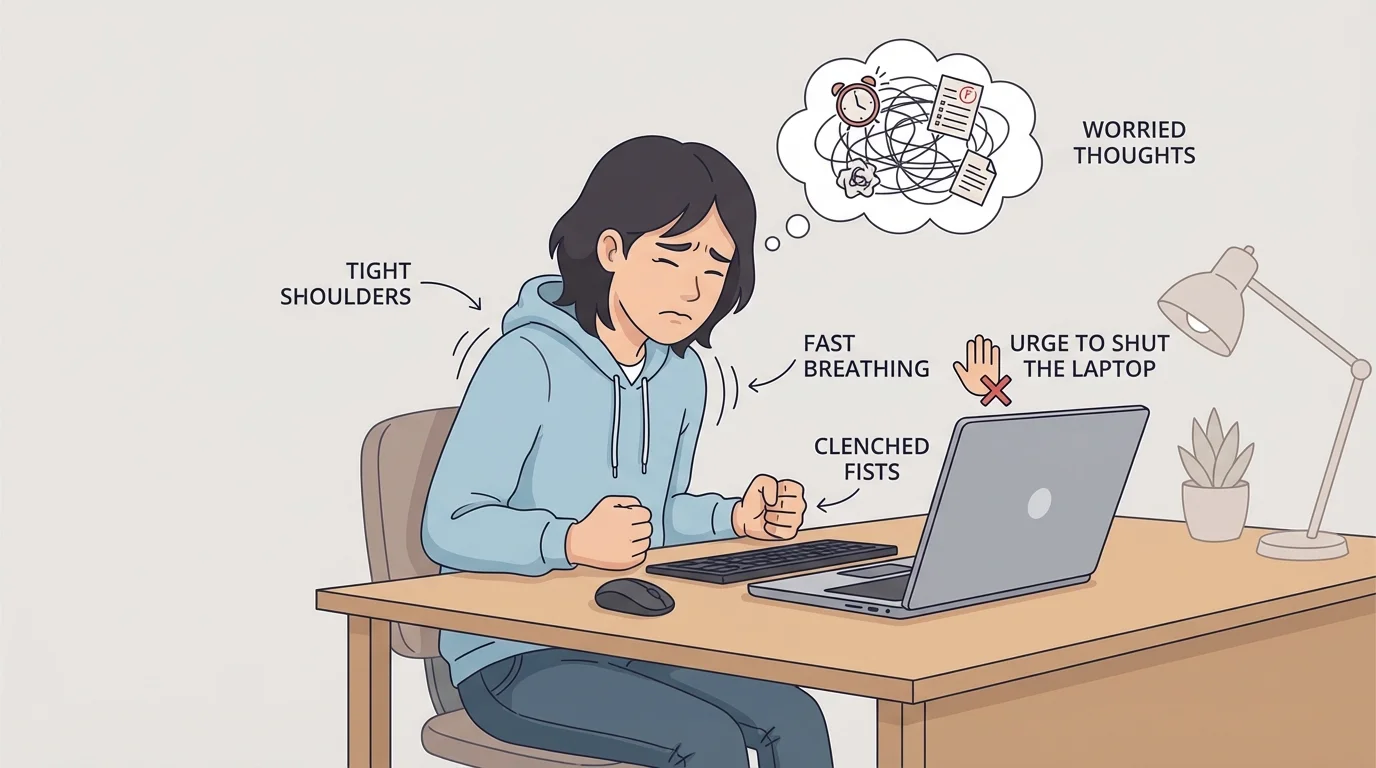
A trigger can be big or small. It might be a countdown timer, criticism, an argument, losing a game, a confusing assignment, too many notifications, or being tired and hungry. The trigger is not always the real problem by itself. Sometimes stress builds because several small things pile up at once.
Your body can react to emotional stress almost as if it is reacting to danger. That is why strong feelings can make your heart beat faster or your muscles tighten even when you are just sitting at home.
Notice the difference between having a feeling and being controlled by it. Feelings are real and important. But they do not have to be the boss of your next choice.
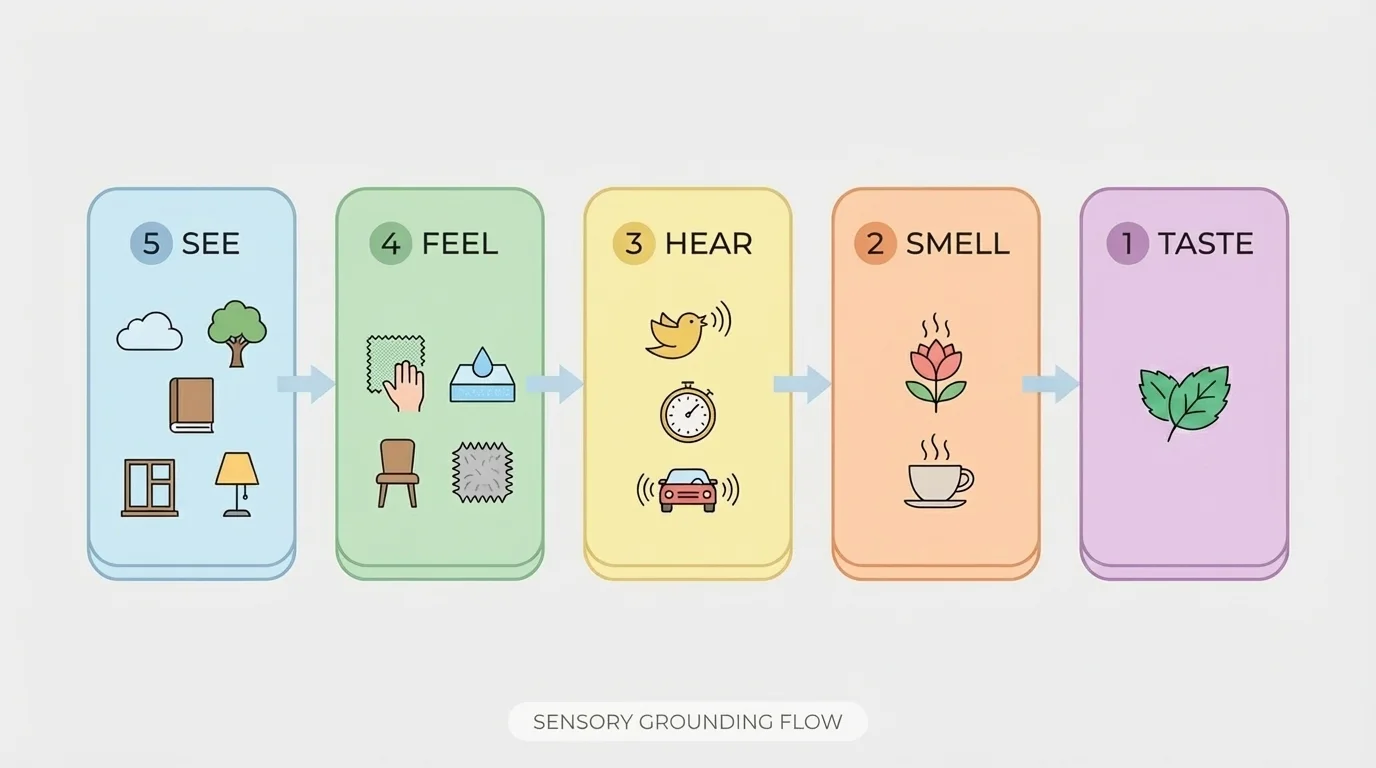
When your thoughts start racing, grounding helps you reconnect to what is happening right now instead of getting pulled into panic, anger, or worry. One of the easiest grounding tools is the sensory method shown in [Figure 2]. It gives your brain something clear and simple to focus on.
Try the 5-4-3-2-1 method. Look for 5 things you can see, 4 things you can feel, 3 things you can hear, 2 things you can smell, and 1 thing you can taste. You do not have to do it perfectly. The point is to slow down and return your attention to your surroundings.
Another grounding tool is box breathing. Breathe in through your nose for a count of 4, hold for 4, breathe out for 4, and hold again for 4. Repeat a few times. Slow breathing sends your body a message that you are safe enough to calm down.
You can also use your body to ground yourself. Press your feet into the floor. Sit up tall. Unclench your jaw. Relax your shoulders. Hold something cold, like a water bottle. Stretch your hands open and closed. These actions sound small, but they help interrupt the stress cycle.
Why grounding works
When you are overwhelmed, your brain focuses on the threat or problem. Grounding shifts attention to something concrete and present, like breathing, touch, sound, or posture. This helps you feel more in control and makes it easier to think clearly about your next step.
If the sensory method does not help much, that does not mean grounding "failed." It may mean you need a different tool. Some students calm down by naming objects in the room. Others calm down by washing their hands, stepping outside for fresh air, or repeating a phrase like, I can handle one step at a time.
Later, when you are building your own toolkit, remember the sensory flow in [Figure 2]. It is useful because it gives you a ready-made structure when your mind feels messy.
Grounding helps you settle. Coping strategies help you deal with the situation in a healthy way after you settle, or while you are trying to stay steady. A good coping strategy lowers stress without creating a new problem.
Healthy coping can include taking a short movement break, drinking water, asking for help, writing down what is bothering you, listening to calm music, breaking a big task into small steps, using positive self-talk, or taking a short screen break if notifications are making things worse.
Some coping strategies are for before a stressful event. For example, getting materials ready before an online class, charging your device, having water nearby, and checking the schedule can lower pressure. Some strategies are for during the event, like breathing slowly or muting notifications. Others are for after the event, like going for a walk, talking to someone you trust, or reflecting on what worked.
| Situation | Helpful coping strategy | Why it helps |
|---|---|---|
| Feeling overwhelmed by assignments | Write the first 3 small tasks | Makes the work feel manageable |
| Angry after a text message | Wait before replying | Prevents saying something hurtful |
| Nervous before speaking | Slow breathing and positive self-talk | Calms your body and boosts confidence |
| Frustrated during practice | Take a water break and reset your goal | Helps you refocus |
Examples of healthy coping strategies for common stressful situations.
A useful question is: "Will this help me feel better and do better?" Some choices may feel good for one minute but make things worse later. Healthy coping does both: it helps in the moment and supports your future self too.
"You do not have to control every feeling. You do need a plan for what to do next."
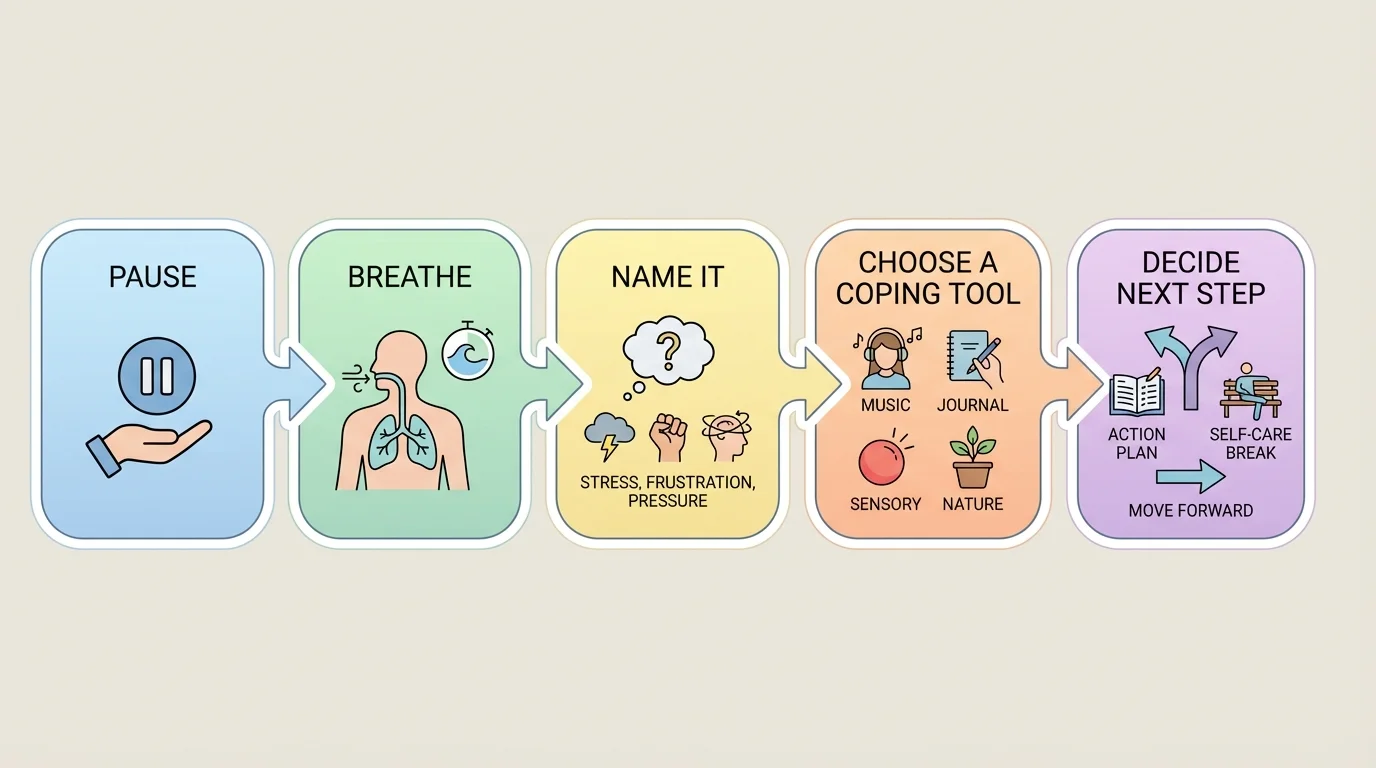
When pressure hits fast, it helps to follow the same routine each time. This routine keeps things simple: pause, breathe, name the feeling, choose a tool, and decide your next step. You do not need a long speech in your head. Short and clear works best.
Here is a practical plan you can use, shown in [Figure 3]:
Step 1: Pause. Stop what you are about to do for a few seconds. Do not send the message yet. Do not yell yet. Do not quit yet.
Step 2: Breathe. Take slow breaths. Even two or three can help.
Step 3: Name it. Say to yourself, "I am feeling frustrated," or "I am under pressure right now." Naming the feeling can lower its intensity.
Step 4: Choose one tool. Grounding, water, movement, writing, asking for help, or stepping away for a minute.
Step 5: Decide your next move. Return to the task, ask a question, take a short break, or respond calmly.
Real-life example: upset during online class
You are in a live class video call. The teacher asks a question, your internet lags, and you miss part of the directions. You feel your face get hot and think, "I am so behind."
Step 1: Pause instead of panicking.
You keep yourself from clicking out of the class.
Step 2: Breathe and ground.
You press both feet to the floor and take three slow breaths.
Step 3: Name the feeling.
You think, "I feel stressed and embarrassed."
Step 4: Choose a coping tool.
You type a respectful message asking for the directions to be repeated.
Step 5: Take the next helpful action.
You write down the task and start with the first part.
The stressful moment does not disappear, but it becomes manageable.
This same flow works in lots of situations. That is why the routine is worth practicing before you really need it.
When you are under school pressure at home: Break work into smaller steps. Set a timer for a short work period. Clear away extra tabs or distractions. If your thoughts start spinning, ground first, then return to one task only.
When you are frustrated with a family member: If your voice is rising, step away briefly if it is safe to do so. Breathe. Think about what you want the other person to understand. Then use calm words like, "I need a minute," or "I feel frustrated because I thought something different was happening."
When you feel left out online: Do not assume the worst right away. Ground yourself before replying or posting. Ask yourself if you know the full story. Reach out to a trusted person if the feeling grows bigger.
When you are nervous before sports, music, or another activity: Use routines. Stretch. Breathe. Repeat a short phrase such as, Do the next thing well. Pressure often shrinks when you focus on one action instead of the whole event.
Real-life example: angry text message
A friend sends a message that sounds rude. You want to answer immediately with something even harsher.
Step 1: Pause.
Put the device down for a minute.
Step 2: Ground.
Name five things you can see to stop your thoughts from racing.
Step 3: Check the facts.
Could the message have sounded harsher than it was meant to?
Step 4: Respond with self-control.
You might write, "I am not sure how you meant that. Can you explain?"
You protect the friendship and avoid turning one message into a bigger fight.
When you make a mistake: This is a major pressure point for many students. Instead of thinking, "I ruined everything," try, "I do not like this mistake, but I can still fix part of it." That shift helps you move from panic to problem-solving.
Not every way of coping is helpful. Some responses may feel powerful in the moment but cause more stress later. Examples include yelling, throwing things, insulting someone online, skipping important responsibilities, doom-scrolling for hours, or pretending nothing is wrong while your stress keeps growing.
Another unhelpful pattern is saying, "This is just how I am," as if you cannot improve. Skills get stronger with use. You may not control the trigger, but you can build better reactions.
Strong emotions are not bad. The goal is not to erase them. The goal is to notice them, steady yourself, and choose a response that matches your values and the situation.
If a strategy harms you, harms someone else, or makes the problem bigger, it is not healthy coping. A good test is to ask: Will I be glad I did this later today?
A calm toolkit is a small set of grounding and coping tools that work for you in different settings, as [Figure 4] shows. You can keep it simple and realistic. The best toolkit is not a giant list. It is a few tools you actually remember and use.
Your toolkit might include a water bottle, a sticky note with a calming phrase, headphones for quiet music, a notebook, a stress ball, a stretching routine, and the name of a trusted adult you can contact. You can also include helpful scripts, such as "Please repeat that," "I need a minute," or "Can you help me break this into steps?"
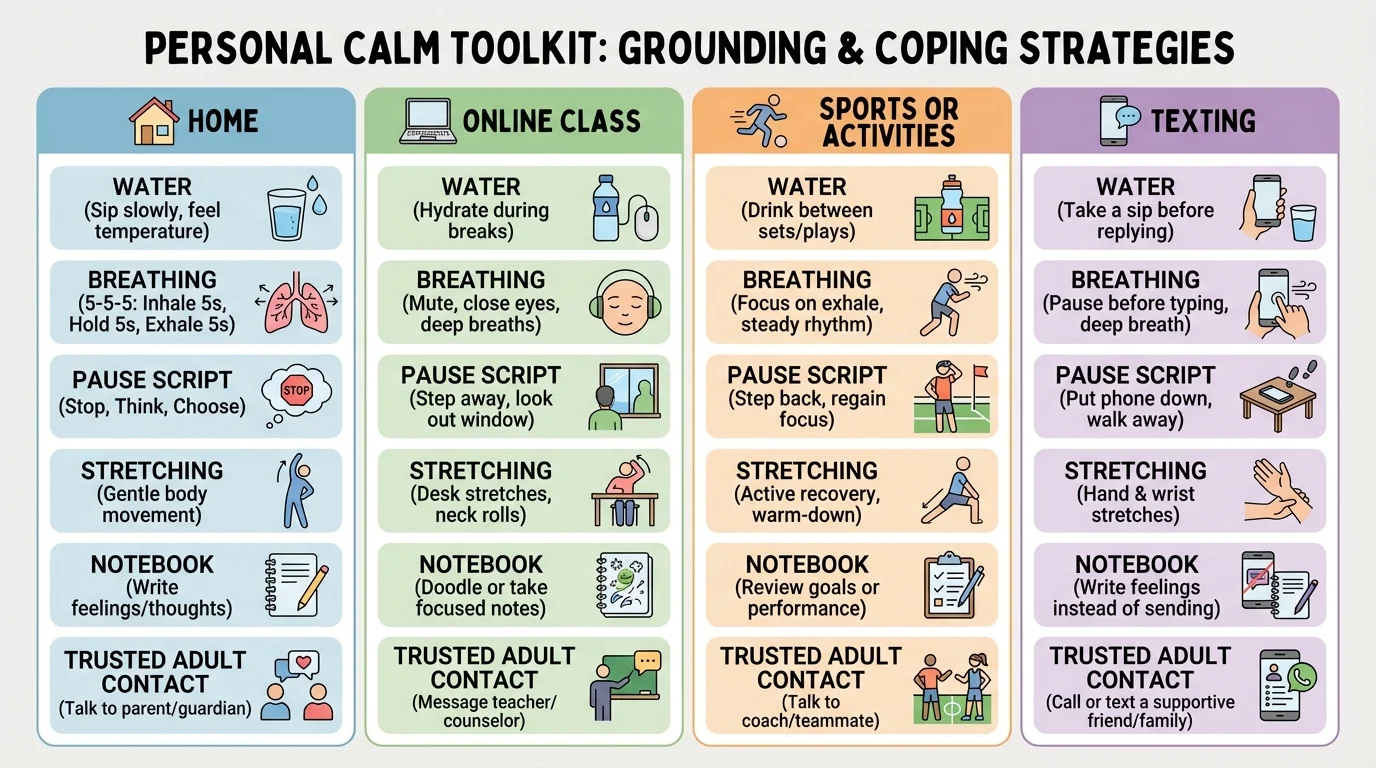
Think about where stress shows up most often for you. Is it during homework? While texting? Before a performance? During conflict at home? Put tools where you need them. If online class is stressful, keep a written reset plan near your workspace. If texting causes stress, decide ahead of time that you will wait before responding when upset. You can organize these ideas by situation, as shown in [Figure 4].
Later, when you feel pressure building, the categories help you quickly match the situation to a tool instead of trying to invent a plan while upset.
When to ask for help right away
Some stress is too big to handle alone. If you feel unsafe, cannot calm down for a long time, have repeated panic, or think about hurting yourself or someone else, tell a trusted adult immediately. Reaching out is a strong coping strategy, not a weakness.
Practice these skills when the stakes are lower. Use grounding during a minor frustrating moment, not only during your worst one. The more you practice, the easier it becomes to remember what to do when pressure is high.
You are not trying to become someone who never feels stressed. You are becoming someone who knows how to handle stress with more control, respect, and resilience.
