One short message can change everything. A text like "Fine. Whatever." can turn a small disagreement into a big argument, while a message like "I'm upset and want to talk this through" can calm things down. The words you choose, the timing of your response, and the way you listen all matter. Learning how to communicate well does not mean you will never have conflict. It means you will know how to handle conflict in a way that protects relationships and shows respect.
You use communication every day: texting a friend, talking with a sibling, joining a video call, posting online, asking for help, or explaining your side of a problem. Good communication helps people understand you. Poor communication creates confusion, hurt feelings, and sometimes long-lasting interpersonal conflict.
Conflict is a normal part of life. People disagree. People make mistakes. People misunderstand each other, especially online, where you cannot always hear the tone of voice or see facial expressions. What matters most is not whether conflict happens. What matters is how you respond when it does.
Conflict is a disagreement, argument, or struggle between people. Mutual respect means both people treat each other as important, even when they disagree. Communication strategies are tools you can use to speak, listen, and respond in ways that make understanding more likely.
When you communicate with respect, you are more likely to solve the real problem. When communication becomes rude, sarcastic, or blaming, the focus often shifts away from the problem and onto hurt feelings.
Most conflicts do not explode out of nowhere. They usually start with warning signs. If you learn to notice them early, you can stop things from getting worse.
Common warning signs include feeling triggered, such as becoming angry, embarrassed, jealous, or frustrated. Your body might get tense. Your face might feel hot. You might want to type fast, interrupt, defend yourself right away, or say something sharp. Online, warning signs also include reading a message in the meanest possible tone, jumping to conclusions, or replying before you fully understand what the other person meant.
Another warning sign is making assumptions. For example, if a friend does not reply for a while, you might think, "They are ignoring me on purpose." But there could be many other reasons: they are busy, their device died, or they did not know how to answer yet. Assumptions often add conflict before you even have the facts.
Text messages are one of the easiest ways for misunderstandings to happen because you cannot hear tone, volume, or pauses. A short reply can seem rude even when the person did not mean it that way.
A helpful habit is to ask yourself, What else could be true? That one question can slow down angry thinking and make room for understanding.
Strong emotions can push you to react fast, but fast reactions are often the ones you regret. A simple pause plan, as shown in [Figure 1], helps you create space between your feelings and your actions. That space is where better choices happen.
When you feel upset, do not answer immediately. Stop for a moment. Put the phone down, lean back from the keyboard, or mute your microphone for a few seconds if you are on a call. Take a few slow breaths. Count to five. Read the message again. Ask yourself what outcome you want. Do you want to win the moment, or solve the problem?
Step 1: Notice your emotion. Name it clearly: "I feel annoyed," "I feel left out," or "I feel embarrassed." Naming a feeling can make it easier to manage.
Step 2: Slow your body down. Breathe in slowly and breathe out slowly. Relax your shoulders and jaw.
Step 3: Check the facts. What exactly happened? What do you know for sure? What are you guessing?
Step 4: Choose your next move. You might respond calmly, ask a question, wait until later, or decide this is not a conversation to have by text.
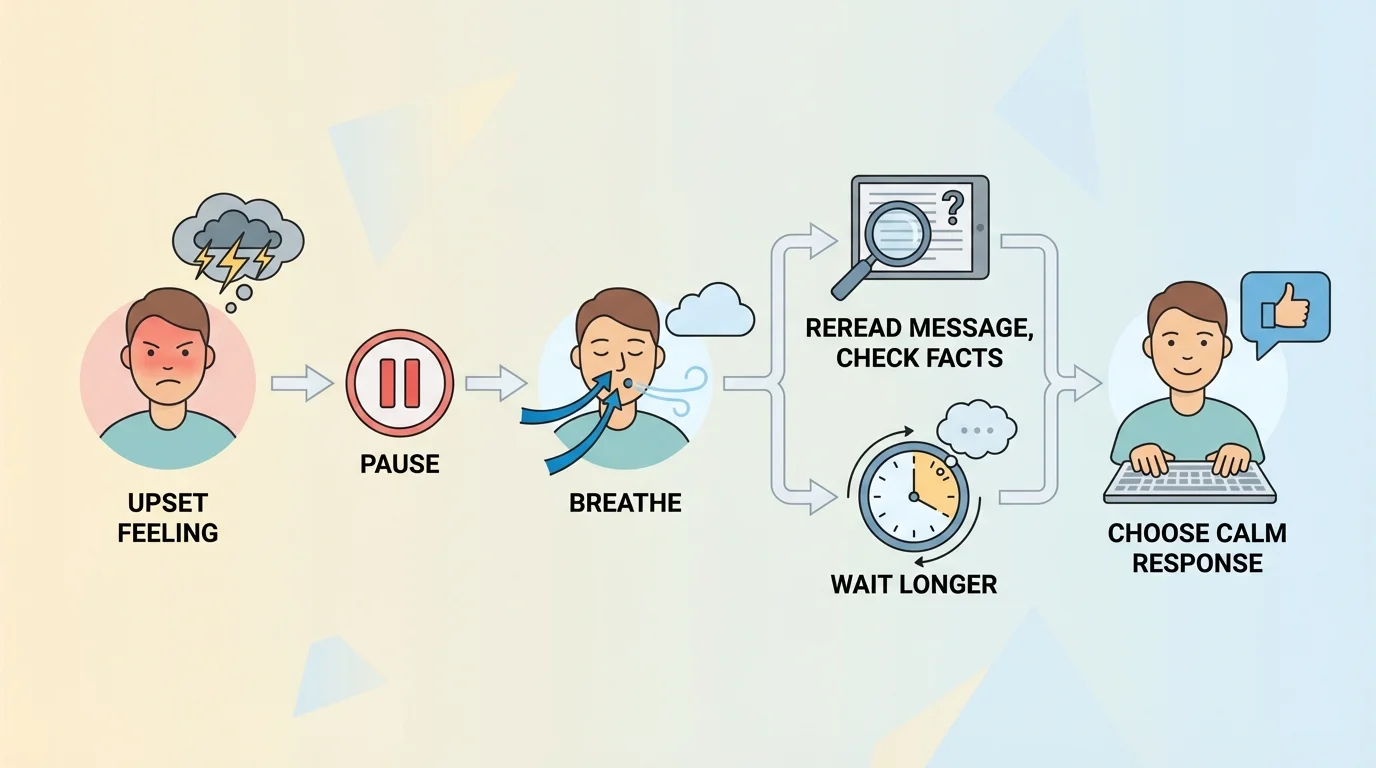
Pausing is not weakness. It is self-control. People often think being the fastest person to reply makes them strong, but real strength is being able to stay calm when you are upset.
Real-life example
You see a group chat making plans, and no one invited you. You feel angry and want to type, "Wow, thanks for leaving me out."
Step 1: Pause
You put your device down for two minutes and take slow breaths.
Step 2: Check the facts
You realize you do not know whether it was an accident, a private event, or something planned at the last minute.
Step 3: Respond calmly
You send: "Hey, I saw the plans in the chat. I felt left out when I read that. Was it meant to be a small group, or was I missed by accident?"
This message gives the other person a chance to explain instead of forcing them to become defensive.
Sometimes the best move is to wait until you are calm enough to speak respectfully. If you are still shaking with anger, you are probably not ready to solve the problem yet.
[Figure 2] Some words act like fuel on a fire. Other words act like water. The comparison shows how small changes in wording can lower tension and keep respect in the conversation. One of the best tools is the I-statement, which helps you talk about your own feelings and needs instead of attacking the other person.
An I-statement often follows this pattern: I feel... when ... because .... I would like .... For example: "I feel frustrated when plans change at the last minute because I need time to get ready. I would like a message earlier if possible."
This works better than saying, "You are so inconsiderate," because blaming words usually make people defend themselves instead of listening.
Here are some communication choices that lower conflict:
Here are choices that often increase conflict:
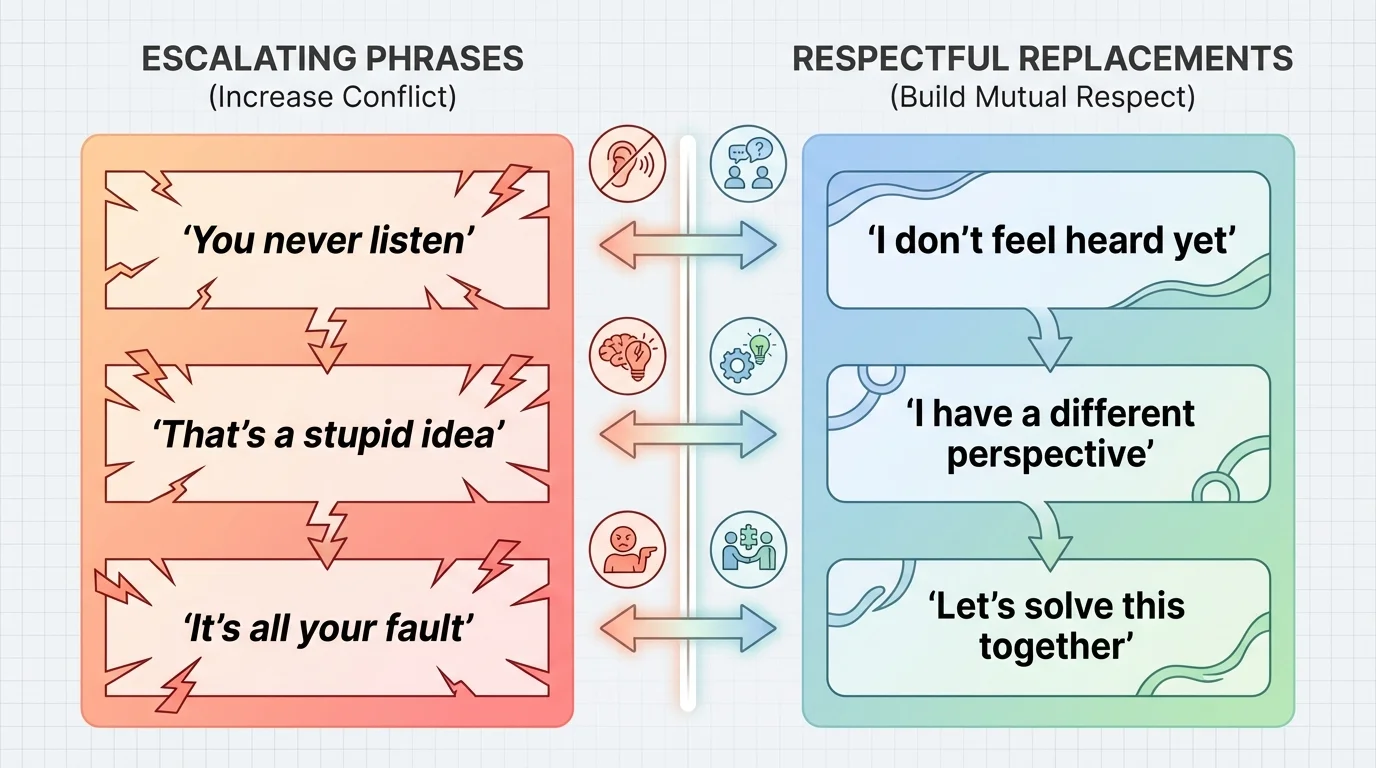
If you need a simple script, try this: "I want to talk about something that bothered me. I'm not trying to fight. I want us to understand each other." That opening can change the whole direction of the conversation.
Respectful communication does not mean pretending everything is fine. It means you can be honest without being cruel. You can disagree, set limits, and speak up for yourself while still treating the other person like a human being.
You can also be specific. "You were rude" is vague. "When you interrupted me three times on the call, I felt dismissed" is clearer. Specific language helps solve the real problem because it tells the other person exactly what needs to change.
Communication is not just about what you say. It is also about how well you listen. Respect grows when people feel heard. A powerful skill here is active listening, which means listening carefully and showing that you are trying to understand.
Active listening does not mean you automatically agree. It means you are giving the other person a fair chance to explain their thoughts and feelings.
You can practice active listening by doing these things:
For example, you might say, "So you thought I was joking, but I was actually serious. Is that right?" This gives the other person a chance to correct misunderstandings before things get bigger.
Listening example
Your cousin says, "You ignored me all weekend." Instead of arguing immediately, you respond, "It sounds like you felt pushed away. I was busy, but I can see why it felt that way."
This response does not admit to something untrue. It shows you understand their feeling, which often lowers anger enough to have a real conversation.
When people feel unheard, they often repeat themselves more loudly or more harshly. Listening well can reduce that pressure and help both sides become calmer.
Once both people feel heard, you can move toward compromise or another fair solution. Conflict can be handled like a step-by-step process, as [Figure 3] illustrates, instead of a battle where one person has to lose.
Start by naming the problem in a neutral way. Instead of "You ruined everything," try "We had different expectations about the plan." Neutral wording makes it easier for both people to work on the issue together.
Then look for a shared goal. Maybe both of you want the friendship to feel fair. Maybe both of you want smoother teamwork in a club, better planning for family chores, or fewer arguments in a gaming group. Shared goals help you feel like teammates against the problem, not enemies against each other.
A practical problem-solving process looks like this:
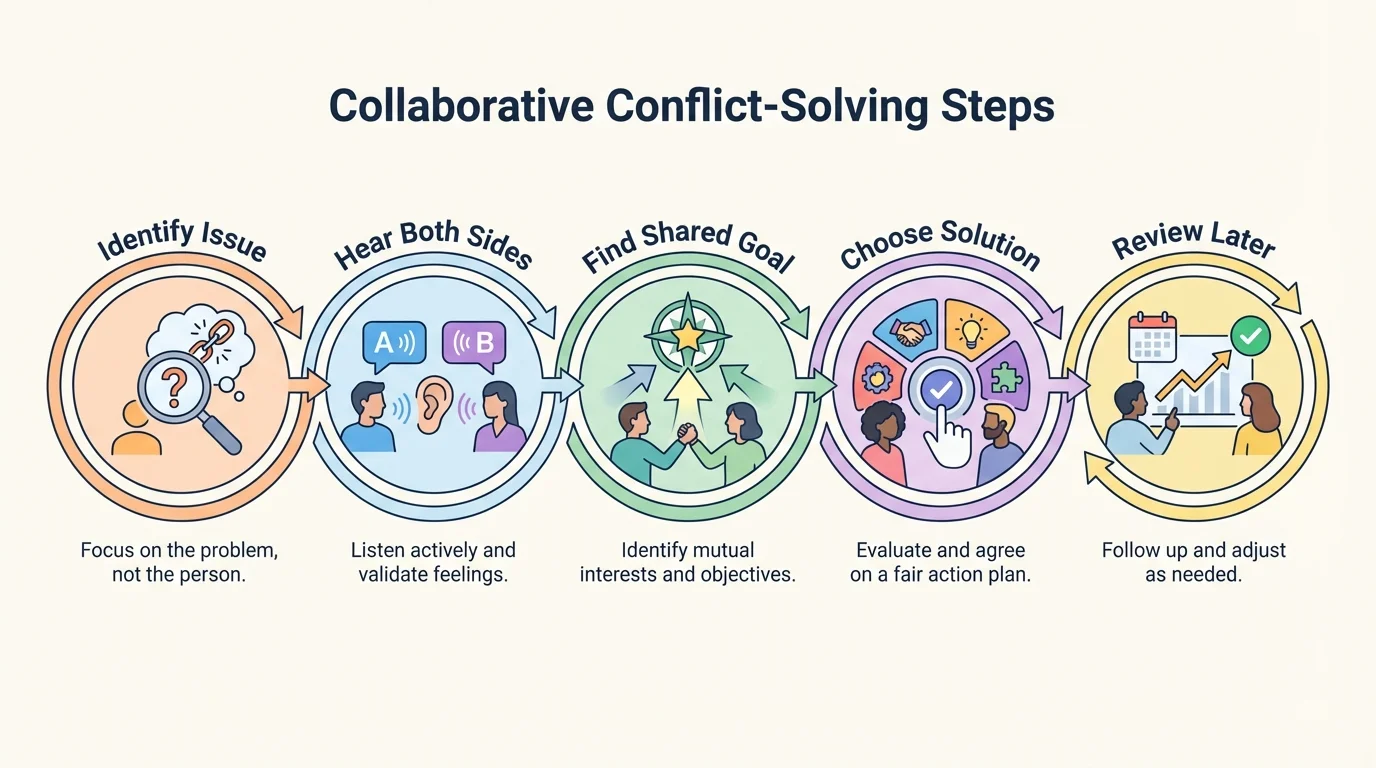
For example, maybe you and your sibling both want to use the same shared device. Fighting over whose turn it is will not fix much. A better plan might be agreeing on a schedule, setting a timer, and deciding what happens if someone needs extra time for a good reason.
You do not always need a perfect solution. You need a workable one. Sometimes that means both people adjust a little.
Later, when you think about fair solutions again, this process remains useful because it reminds you to review the plan after trying it. A solution is only successful if it actually improves the situation.
Respect is not only about being nice. It is also about having healthy boundaries. A boundary is a clear limit that protects your well-being, time, space, or feelings.
You can set a boundary respectfully. For example: "I want to talk, but not if we are yelling." Or, "Please do not post pictures of me without asking." Or, "I'm willing to discuss this later when we're both calmer."
Boundaries are not punishments. They are clear statements of what you will and will not accept. Good boundaries can actually reduce conflict because they make expectations clear.
"Be clear, not cruel."
— A strong rule for hard conversations
It is also important to respect other people's boundaries. If someone says they need a break from arguing, that does not always mean they are avoiding the problem. It may mean they are trying not to make it worse.
Some situations are more difficult than ordinary disagreements. You may face teasing, gossip, pressure in a group chat, unfair blaming, or repeated disrespect. In those cases, calm communication still matters, but you may also need support.
If someone is teasing you, you might respond briefly and firmly: "I don't think that's funny. Stop." If the behavior continues, stop arguing and reach out to a trusted adult. If someone spreads gossip, avoid adding more gossip back. Correct false information calmly if needed, save evidence if it is online, and get help.
If a disagreement keeps repeating, ask yourself whether the problem is a misunderstanding or a pattern. A misunderstanding can often be fixed with one good conversation. A pattern of disrespect may require stronger boundaries or adult support.
Remember that respect goes both ways. You are responsible for your choices, but you are not responsible for making harmful behavior okay. If someone is threatening, harassing, or repeatedly crossing boundaries, getting help is the right move.
Seek trusted adult help right away if there are threats, bullying, pressure to share private images or information, hate speech, stalking behavior, or anything that makes you feel unsafe. Reducing conflict does not mean staying silent about serious problems.
Communication skills get stronger with practice. You do not need to wait for a big argument. You can use them in everyday life.
Try This: Before sending a message when you are annoyed, reread it and remove one blaming phrase.
Try This: Use one I-statement this week with a family member, friend, teammate, or club partner.
Try This: When someone is upset, say, "I want to understand. Can you tell me more?"
Try This: If a text feels rude, ask a clarifying question before assuming the worst.
Try This: Practice one boundary sentence out loud so it feels natural when you need it.
The pause plan from [Figure 1] and the word choices from [Figure 2] work best when you practice them before a major conflict happens. Skills used often become easier to remember under stress.
No one communicates perfectly all the time. You will sometimes say the wrong thing, misunderstand someone, or react too quickly. What matters is being willing to repair the situation: apologize honestly, listen again, and choose a better response next time. That is how trust grows.
