A post says a famous athlete eats only one food to get stronger. A video claims a weather event was "fake." A creator promises free virtual currency if you click fast. Online, information can spread in seconds, but truth usually takes longer to check. That is why media literacy is such a useful life skill. It helps you protect your time, your feelings, your privacy, and your decisions.
When you use good media-literacy habits, you are less likely to fall for tricks, rumors, or dangerous advice. You also become a more responsible digital citizen. That matters when you text friends, scroll short videos, watch streams, read comments, or search for answers at home.
Not every incorrect post is trying to fool you on purpose. Some people share things because they are excited, scared, or confused. Other people post false information to get attention, money, followers, or clicks. Either way, the result can be the same: people believe something that is not true.
That can lead to real problems. A fake health tip might be unsafe. A false rumor about a person can hurt their reputation. A scam giveaway can steal account information. A made-up story about a current event can cause panic. Media literacy helps you slow down and make smarter choices before you react.
Media literacy means using smart habits to understand, question, and evaluate messages you see online or in other media. A claim is something a post says is true. A creator is the person, group, or account that made the content. A source is where the information comes from, such as a website, article, video channel, expert, or organization.
Misinformation is false or misleading information shared without meaning to harm. Disinformation is false information shared on purpose to mislead people. Bias is a leaning or preference that can shape how information is presented.
Those words matter because checking a post is easier when you separate the parts. First, ask what the post is saying. Next, ask who made it. Then ask where the information came from. That simple split turns a confusing post into a problem you can solve.
If you see a dramatic post online, do not treat all parts of it as equal. The claim might be false even if the video looks real. The creator might sound confident but still lack facts. The source might copy information from somewhere else and leave out important context.
Strong media literacy is not about distrusting everything. It is about asking good questions. You can stay curious without being gullible. You can stay open-minded without believing every post you see.
As [Figure 1] shows, when something grabs your attention, a short routine helps you stay in control. Instead of reacting right away, pause and move through a few questions in order. This takes less time than fixing a mistake after you share something false.
Step 1: Pause. If a post makes you feel shocked, angry, scared, or super excited, that is a sign to slow down. Strong emotion can push people to share before thinking.
Step 2: Identify the main point. What exactly is the post saying? Try to say the claim in one clear sentence.
Step 3: Check who made it. Look at the account name, bio, past posts, and whether the person or group seems real, informed, and honest.
Step 4: Check where the information came from. Does the post link to an original article, expert, official statement, or trustworthy report?
Step 5: Look for evidence. Are there facts, names, dates, quotes, photos with context, or data? Or is it just a bold opinion?
Step 6: Cross-check. See whether other reliable places report the same thing.
Step 7: Decide. Share, save, ignore, or ask an adult for help. Waiting a moment is often the smartest choice.
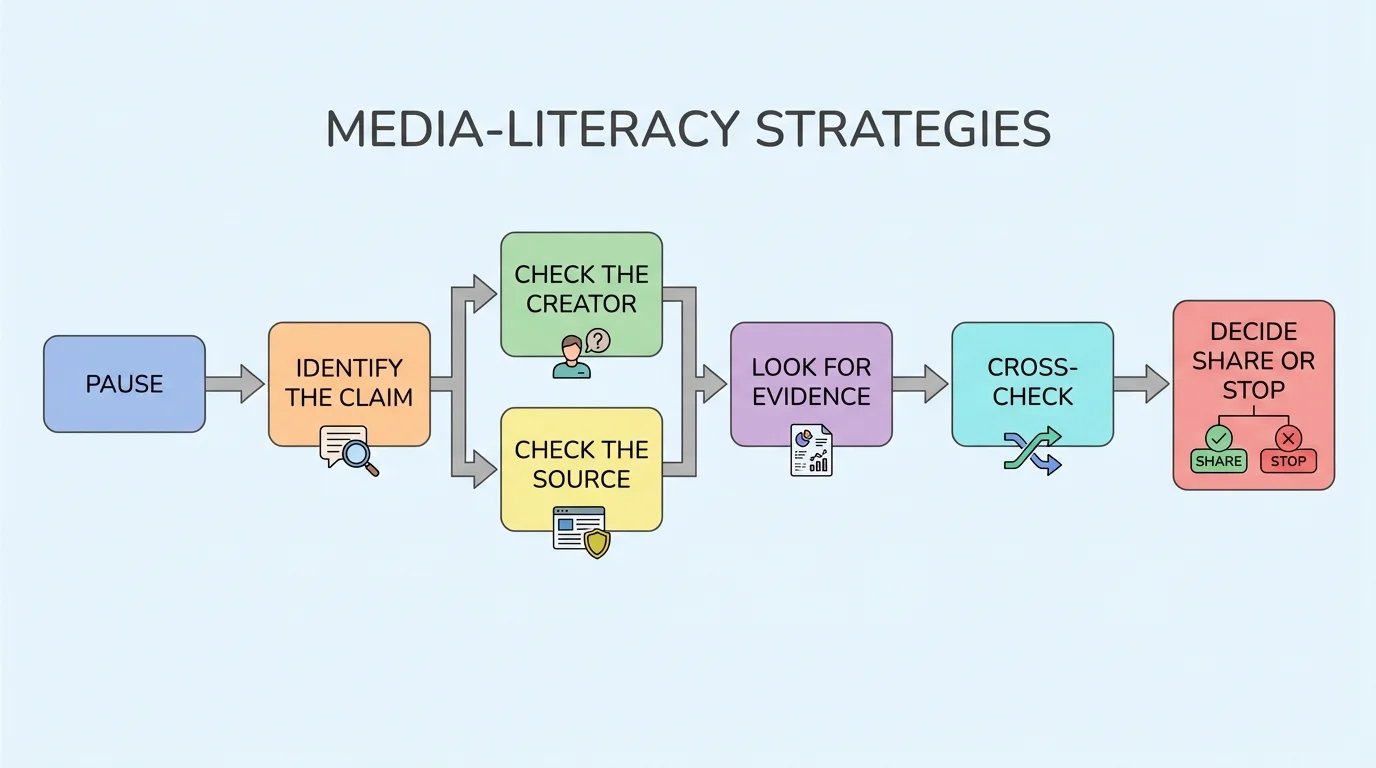
This routine is useful because false posts often rely on speed. They want you to react before you think. When you pause, you interrupt that trick.
You already know that not everything online is private or permanent. Media literacy adds another protection: before something becomes part of your digital footprint, you check whether it is accurate and safe to share.
You do not need to become an expert in every topic. You just need a habit of checking before trusting. That habit gets stronger each time you use it.
A good first question is, "What is this post actually trying to make me believe?" The claim may be obvious, or it may be hidden under jokes, dramatic music, or a flashy headline. Pull out the main message and look at it clearly.
Then check the wording. Be careful with phrases like everyone knows, they do not want you to know this, guaranteed, miracle, or proof without real support. These phrases can sound powerful, but they often try to replace evidence with emotion.
Watch for missing details. A strong claim should answer basic questions: who, what, when, where, and how. If a post says, "Scientists proved this snack doubles your memory," ask: Which scientists? When? What study? Where was it published? What exactly was tested?
Also check the date. Old information can be shared as if it is new. A weather photo from years ago might be reposted during a new storm. An old rumor about a game update might keep spreading long after it became false.
Evidence beats confidence
People often sound believable when they speak with certainty, but confidence is not proof. Good evidence can include direct quotes from experts, original documents, reliable reports, clear data, or video and image context that can be checked. If a post has a huge claim and almost no evidence, treat it carefully.
Another smart question is whether the claim even makes sense. If a creator says a free app will pay every user $1,000 every day forever, basic logic should make you pause. Big promises need big proof.
The person or group behind a message matters, and several clues can help you judge whether a creator seems trustworthy. You do not need to know everything about them, but you should look for signs of honesty, expertise, and clear purpose.
As [Figure 2] suggests, start with identity. Is this a real person, organization, or parody account? Does the bio explain who they are? Do they post consistently about the same topic, or do they jump from random dramatic claims to random dramatic claims?
Next, think about bias and motive. Why might this creator want your attention? Some creators want likes and followers. Some want ad money. Some want to sell products. Some want to push a certain opinion. Having a motive does not automatically mean they are wrong, but it does mean you should check carefully.
Expertise matters too. If the topic is medical, does the creator have medical training or quote trusted medical groups? If the topic is a local emergency, are they sharing official updates from emergency services or just repeating rumors?
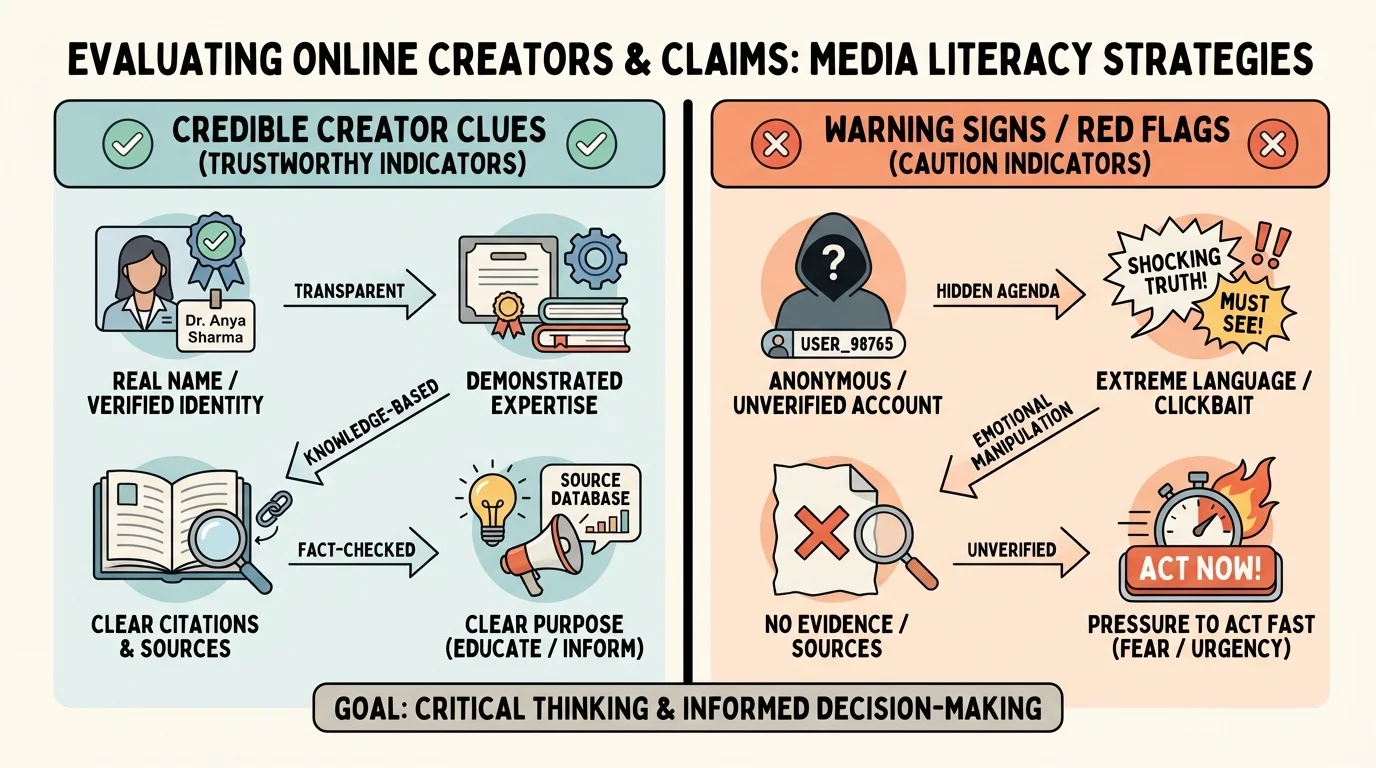
Look at patterns across several posts. A trustworthy creator is more likely to correct mistakes, link sources, explain context, and avoid constant exaggeration. A suspicious creator may use extreme titles, all-caps warnings, insults, or pressure like "Share now before they delete this."
Warning signs do not always prove a creator is dishonest, but several warning signs together should make you slow down. Trust is built from many clues, not just one.
Real-world example: checking a creator
You find a short video that says a common food is "secretly poisonous."
Step 1: Check the account.
The account name is dramatic, the bio says almost nothing, and most videos use fear-based titles.
Step 2: Check for expertise.
The creator does not name any training, and the video gives no links to reliable health information.
Step 3: Check purpose.
The video ends by telling viewers to buy the creator's own "detox" product.
That does not automatically prove the claim is false, but it gives you strong reasons to be cautious and look for better sources.
Sometimes the safest choice is not to argue in comments. If the content seems misleading, it is usually better to avoid boosting it and look for trustworthy information elsewhere.
A source is not just the app where you saw the post. It is the origin of the information. If a video says, "Experts say," the real source should be the experts or their published work, not the video itself.
Try to trace information back to the original source. For example, if a post quotes a news story, open the story. If that story mentions a study, look for the study or a trusted summary of it. If a post says an official agency announced something, check the agency's own website or verified account.
Reliable sources usually make it easier to find author names, dates, contact information, and supporting evidence. Less reliable sources may hide who wrote the content, use many pop-up ads, copy material from elsewhere, or have web addresses designed to look similar to real sites.
Be extra careful with screenshots. A screenshot can remove context, cut off dates, or hide where information originally came from. Screenshots are easy to edit and easy to misunderstand.
| Question | Stronger sign | Warning sign |
|---|---|---|
| Who made it? | Author or group is clearly named | No clear author |
| When was it made? | Date is easy to find | No date or very old date |
| Where did it come from? | Links to original evidence | Repeats claims with no source |
| Why was it posted? | To inform or explain clearly | To shock, sell, or stir people up |
Table 1. Questions you can use to judge whether an online source seems stronger or weaker.
Reliable does not mean perfect. Even good sources can make mistakes. The difference is that stronger sources are more likely to show where information came from and correct errors when needed.
One of the smartest habits online is cross-checking. That means comparing the same claim in more than one reliable place. If only one random account is saying something huge, be cautious. If several trustworthy sources report the same verified information, confidence grows.
Cross-checking works best when the sources are not all copying one another. Look for independent confirmation. For example, if a claim is about a storm, you might compare an official weather service, a local news organization, and a trusted science source.
Fact-checking websites can also help, especially for viral rumors. They often explain what the claim says, what evidence was checked, and what conclusion was reached. But even then, it is smart to notice dates and context because situations can change.
False information often spreads faster than accurate information because it is more surprising or emotional. That is one reason slowing down is a powerful digital-safety skill.
If you cannot confirm a claim, that does not mean it is true or false yet. It means you do not have enough information. "I'm not sure" is a strong, responsible answer.
As [Figure 3] illustrates, visuals can feel convincing, but they can also mislead. A real photo can be cropped to hide important context. A video can be edited. An old image can be reposted with a new caption. An AI-made image can look realistic even when the event never happened.
When checking an image or video, ask where it first appeared, when it was made, and whether the caption matches the real context. Listen for missing background details. Look for odd shadows, strange hands, blurry text, repeated patterns, or audio that does not match the scene. These signs do not prove fakery, but they tell you to investigate more.
You can also search for the same image in other places. Reverse image search tools can help you find older versions of a picture or show that it came from a different event. This is especially helpful when a viral post uses an old disaster photo and claims it is new.
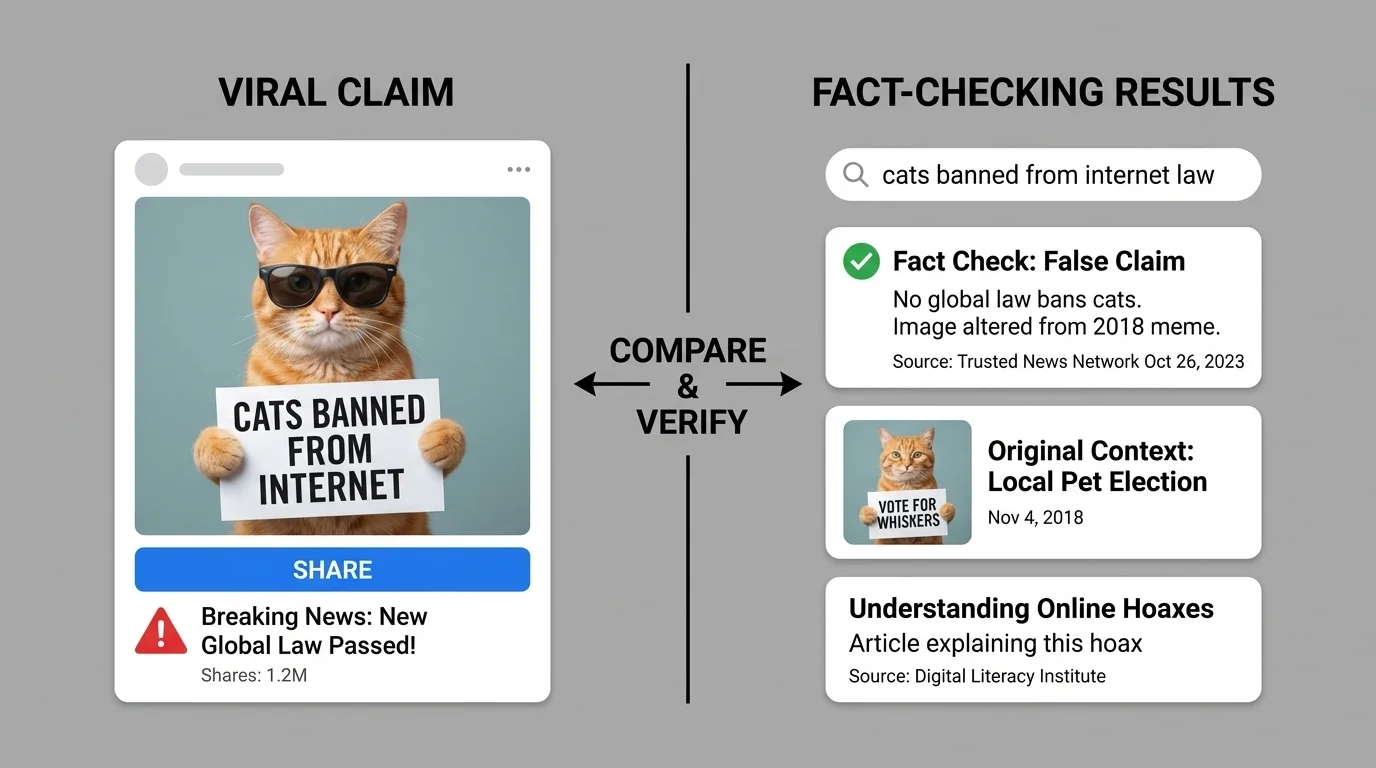
Captions matter just as much as visuals. A true image with a false caption can still mislead people. Checking context is often the key step, not just staring at the picture itself.
Audio clips can be tricky too. A short sound clip might leave out what happened before or after. A person's words can sound very different when a clip is edited to remove the rest of the conversation.
If something seems suspicious, you have several smart options. You can wait. You can search for better information. You can ask a trusted adult. You can check an official website. You can choose not to like, repost, or comment, because engagement can help misleading content spread.
If a post involves safety, health, threats, or emergencies, check official sources first. If a message asks for passwords, personal details, or payment information, treat it as a possible scam. If a rumor targets a real person, do not pass it along.
If you discover that you shared something false, correct it. You can delete the post, send a correction, or say that new information shows the claim was inaccurate. Fixing a mistake is responsible, not embarrassing.
"Pause before you pass it on."
— A strong rule for digital citizenship
That short rule works because sharing is a choice. Each time you pause, you protect both yourself and other people.
Here are a few situations you might actually run into.
Scenario 1: The miracle study. A post says drinking a certain smoothie raises test scores by a huge amount. The claim sounds exciting, but there is no study title, no scientist name, and no link. The creator also sells smoothie powder. A smart move is to search for trusted education or health sources instead of trusting the post.
Scenario 2: The free giveaway. A gaming account says the first 500 people who comment will get rare items for free. The account was created recently, has copied images, and asks users to log in on another site. That is a major warning sign. Do not click or enter account information.
Scenario 3: The dramatic weather image. A viral image claims to show today's storm in your area. But when you check the date and search the image, you find it was posted years earlier from another country. The image is real, but the claim attached to it is false.
Quick decision example
A friend sends you a video that says, "This trick instantly charges your phone battery."
Step 1: Pause instead of trying it right away.
Step 2: Identify the claim: the video says a simple trick instantly adds battery power.
Step 3: Check the creator and source: there is no expert explanation and no reliable source linked.
Step 4: Cross-check with trusted tech sources.
You would likely find that the claim is misleading or fake. Because you paused, you avoided wasting time and spreading bad information.
These examples show an important truth: your first reaction is not your final answer. With a few checks, you can move from "Whoa!" to "What is the evidence?"
The best media-literacy strategy is one you can actually remember. Keep it simple: Pause. Check the claim. Check the creator. Check the source. Cross-check. If anything still feels off, do not share.
You can even make a personal rule: if a post makes you feel a huge emotion, you must do at least two checks before reacting. That turns emotion from a trap into a signal.
Over time, you will get faster at spotting patterns. You will notice when headlines try to push your buttons. You will see when creators use confidence instead of evidence. You will learn that trustworthy information usually leaves a trail you can follow.
That is what digital citizenship looks like in real life. It is not just about being online. It is about being thoughtful online.
